• About
  • BeyondOverton Travel
    • Silk Road (1): If Turkey is in crisis, it’s not obvious visiting it
    • Silk Road (2): Could beautiful nature and ancient history create a false sense of entitlement?
    • Silk Road (3): Fast Car
    • Silk Road (4):We took a bus ride to Iran
    • Silk Road (5): Border bothers
    • Silk Road (6): Chevrolet Land
    • Silk Road (7): Free-roaming camels and wild horses
    • Silk Road (8): China West to East
    • Silk Road (9): I have not told half of what I saw
  • BLOG
  • g88kboy Travel
    • On the Silk Road
    • Bulgaria : The Chicken crossed the Road
    • Turkey : The Country, not the Bird
    • Georgia on my Mind
    • Armenian Ayran
    • Iran – The Curious Land
    • An American in Azerbaijan
    • Uzbekistan: Golden Teeth and Neon Signs
    • Kazakhstan: Thirty Sweating Seniors
    • China Part One – Pandas Are Extinct
    • China Part Two: My TED Talk (Deep Analysis)
    • Phillipines – They Relax, I (pretend to😉) Study
    • Singapore: flashing trees and a torrent of tears
    • Malaysia: That ain’t no croc, it’s a log
    • Brunei: The Instinctive Fight for Superior Domination
    • Phillipines: Hello Friend Again
  • Outside the window
    • Bulgaria
    • Turkey
    • Georgia
    • Armenia
    • Iran
    • Azerbaijan
    • Uzbekistan
    • Kazakhstan

BeyondOverton

~ let's move this window

BeyondOverton

Category Archives: Asset Allocation

Corona Virus market implications

29 Saturday Feb 2020

Posted by beyondoverton in Asset Allocation, China, EM, Equity, Monetary Policy, Politics, UBI

≈ 1 Comment

Tags

corona virus

Following up on the ‘easy’ question of what to expect the effect of the Corona Virus will be in the long term, here is trying to answer the more difficult question what will happen to the markets in the short-to-medium term.

Coming up from the fact that this was the steepest 6-day stock market decline of this magnitude ever (and notwithstanding that this was preceded by a quite unprecedented market rise), there are two options for what is likely to happen next week:

  1. During the weekend, the number of Corona Virus (CV) cases in the West shoots up (situation starts to deteriorate rapidly) which causes central banks (CB) to react (as per ECB, Fed comments on Friday) -> markets bounce.
  2. CV news over the weekend is calm, which further reinforces the narrative of ‘this too shall pass’: It took China a month or so, but now it is recovering -> markets rally. 

While it is probably obvious that one should sell into the bounce under Option 1, I would argue that one should sell also under Option 2 because the policy response, we have seen so far from authorities in the West, and especially in the US, is largely inferior to that in China in terms of testing, quarantining and treating CV patients. So, either the situation in the US will take much longer than China to improve with obviously bigger economic and, probably more importantly, political consequences, or to get out of hand with devastating consequences. 

It will take longer for investors to see how hollow the narrative under Option 2 is than how desperately inadequate the CB action under Option 1 is. Therefore, markets will stay bid for longer under Option 2.

The first caveat is that if under Option 1 CBs do nothing, markets may continue to sell off next week but I don’t think the price action will be anything that bad as this week as the narrative under Option 2 is developing independently. 

The second caveat is that I will start to believe the Option 2 narrative as well but only if the US starts testing, quarantining, treating people in earnest. However, the window of opportunity for that is narrowing rapidly.

What’s the medium-term game plan?

I am coming from the point of view that economically we are about to experience primarily a ‘permanent-ish’ supply shock, and, only secondary, a temporary demand shock. From a market point of view, I believe this is largely an equity worry first, and, perhaps, a credit worry second.

Even if we Option 2 above plays out and the whole world recovers from CV within the next month, this virus scare would only reinforce the ongoing trend of deglobalization which started probably with Brexit and then Trump. The US-China trade war already got the ball rolling on companies starting to rethink their China operations. The shifting of global supply chains now will accelerate. But that takes time, there isn’t simply an ON/OFF switch which can be simply flicked. What this means is that global supply chains will stay clogged for a lot longer while that shift is being executed. 

It’s been quite some since the global economy experienced a supply shock of such magnitude. Perhaps the 1970s oil crises, but they were temporary: the 1973 oil embargo also lasted about 6 months but the world was much less global back then. If it wasn’t for the reckless Fed response to the second oil crisis in 1979 on the back of the Iranian revolution (Volcker’s disastrous monetary experiment), there would have been perhaps less damage to economic growth.  Indeed, while CBs can claim to know how to unclog monetary transmission lines, they do not have the tools to deal with supply shocks: all the Fed did in the early 1980s, when it allowed rates to rise to almost 20%, was kill demand.

CBs have learnt those lessons and are unlikely to repeat them. In fact, as discussed above, their reaction function is now the polar opposite. This is good news as it assures that demand does not crater, however, it sadly does not mean that it allows it to grow. That is why I think we could get the temporary demand pullback. But that holds mostly for the US, and perhaps UK, where more orthodox economic thinking and rigid political structures still prevail. 

In Asia, and to a certain extent in Europe, I suspect the CV crisis to finally usher in some unorthodox fiscal policy in supporting directly households’ purchasing power in the form of government monetary handouts. We have already seen that in Hong Kong and Singapore. Though temporary at the moment, not really qualifying as helicopter money, I would not be surprised if they become more permanent if the situation requires (and to eventually morph into UBI). I fully expect China to follow that same path.

In Europe, such direct fiscal policy action is less likely but I would not be surprised if the ECB comes up with an equivalent plan under its own monetary policy rules using tiered negative rates and the banking system as the transmission mechanism – a kind of stealth fiscal transfer to EU households similar in spirit to Target2 which is the equivalent for EU governments (Eric Lonergan has done some excellent work on this idea).

That is where my belief that, at worst, we experience only a temporary demand drop globally, comes from, although a much more ‘permanent’ in US than anywhere else. If that indeed plays out like that, one is supposed to stay underweight US equities against RoW equities – but especially against China – basically a reversal of the decades long trend we have had until now.  Also, a general equity underweight vs commodities. Within the commodities sector, I would focus on longs in WTI (shale and Middle East disruptions) and softs (food essentials, looming crop failures across Central Asia, Middle East and Africa on the back of the looming locust invasion). 

Finally, on the FX side, stay underweight the USD against the EUR on narrowing rate differentials and against commodity currencies as per above.

The more medium outlook really has to do with whether the specialness of US equities will persist and whether the passive investing trend will continue. Despite, in fact, perhaps because of the selloff last week, market commentators have continued to reinforce the idea of the futility of trying to time market gyrations and the superiority of staying always invested (there are too many examples, but see here, here, and here). This all makes sense and we have the data historically, on a long enough time frame, to prove it. However, this holds mostly for US stocks which have outperformed all other major stocks markets around the world. And that is despite lower (and negative) rates in Europe and Japan where, in addition, CBs have also been buying corporate assets direct (bonds by ECB, bonds and equities by BOJ).

Which begs the question what makes US stocks so special? Is it the preeminent position the US holds in the world as a whole? The largest economy in the world? The most innovative companies? The shareholders’ primacy doctrine and the share buybacks which it enshrines? One of the lowest corporate tax rates for the largest market cap companies, net of tax havens?… 

I don’t know what is the exact reason for this occurrence but in the spirit of ‘past performance is not guarantee for future success’s it is prudent when we invest to keep in mind that there are a lot of shifting sands at the moment which may invalidate any of the reasons cited above: from China’s advance in both economic size, geopolitical (and military) importance, and technological prowess (5G, digitalization) to potential regulatory changes (started with banking – Basel, possibly moving to technology – monopoly, data ownership, privacy, market access – share buybacks, and taxation – larger US government budgets bring corporate tax havens into the focus).

The same holds true for the passive investing trend. History (again, in the US mostly) is on its side in terms of superiority of returns. Low volatility and low rates, have been an essential part of reinforcing this trend. Will the CV and US probably inadequate response to it change that? For the moment, the market still believes in V-shaped recoveries because even the dotcom bust and the 2008 financial crisis, to a certain extent, have been such. But markets don’t always go up. In the past it had taken decades for even the US stock market to better its previous peaks. In other countries, like Japan, for example, the stock market is still below its previous set in 1990.

While the Fed has indeed said it stands ready to lower rates if the situation with the CV deteriorates, it is not certain how central bankers will respond if an unexpected burst of inflation comes about on the back of the supply shock (and if the 1980s is any sign, not too well indeed). Even without a spike in US interest rates, a 20-30 VIX investing environment, instead of the prevailing 10-20 for most of the post 2009 period, brought about by pulling some of the foundational reasons for the specialness of US equities out, may cause a rethink of the passive trend.  
Brace your horses, this carriage is broken

11 Saturday Jan 2020

Posted by beyondoverton in Asset Allocation, Equity

≈ Leave a comment

Tags

ETFs, share buybacks

ETFs are not like subprime CDOs but they come close. Direct access to the Fed’s balance sheet will become essential for fund managers’ survival during the next financial crisis.

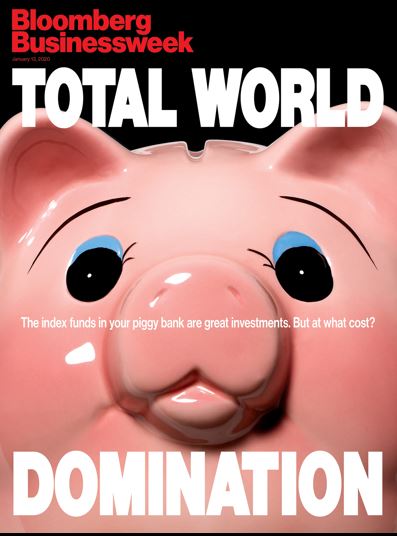
According to Bloomberg Magazine, the largest asset managers in the world, BlackRock, Vanguard and State Street, hold about 80% of all indexed money.

“Some 22% of the shares of the typical S&P 500 company sits in their portfolios, up from 13.5% in 2008…BlackRock, Vanguard, and State Street combined own 18% of Apple Inc.’s shares, up from 7% at the end of 2009… The phenomenon can be even more pronounced for smaller companies.”

This high concentration is the most serious danger to stock market bulls. Though, it is not obvious what the trigger for a market decline could be, when it happens, the present market structure could make it a much worse experience than the 2008 stock market decline.

Unlike 2008, however, the risks are on the buyside and the market doesn’t seem leveraged. But like 2008, the Fed is probably in the dark to the actual risks in the system, because the buyside is like shadow banking: no one knows what is going on/off fund managers’ balance sheets. Like the broker-dealers of pre-2008, the buyside today does not have access to the Fed’s balance sheet. The Prime Dealers Credit Facility (PDCF), which allowed access to borrowing from the Fed, was only created after Bear Stearns ‘failed’. Still, PDCF did not help Lehman Brothers, even though the latter did have good collateral at hand.
The buyside now may not be leveraged that much indeed but the extreme concentration of positions leads to the same effect on liquidity under stress as in 2008. This concentration is worsened by the fact that ETF sizes are many times larger than the underlying assets/markets in many cases. And though in 2008 broker-dealers ‘could’ possibly get some liquidity if they had good collateral, now the interbank market is much trickier as banks are in a regulatory straitjacket and it is not obvious (barring de-regulation) how they can provide much more liquidity even under normal conditions.

Does this make ETFs as dangerous as subprime CDOs of the 2000s indeed? I don’t know, but it makes them not that different at the same time. For example, we know that at least 40% of S&P 500 companies are money losing and we know that there is very high concentration of risk in them as per the Bloomberg Magazine article above (for comparisons, the percentage of subprime mortgages in 2000s CDOs varied between 50% in 2003 to 75% in 2007).

There are also similarities in the way the two markets emerged. In the late 1990s the Clinton administration decided not only to close the budget deficit but to also run a surplus. Bad things happen in financial markets when the US runs a budget surplus and reduces the flow of safe assets (thankfully, it does not happen often). The market responded by creating fake safe assets, like (subprime) CDOs.
In a similar fashion to the US Treasury actions of the late 1990s, US corporates have been buying back their shares, significantly reducing US public share count in the process. As the financial sector kept growing, it was starved of options where to put its money. How did the market respond? Fund managers (mostly, but also some banks) started creating ETFs. Just like CDOs, with the ETFs you buy the pure-bred stallions and the broken carriage as a package – you don’t have a choice. And as the passive/indexing trend spread, concentration soared further.

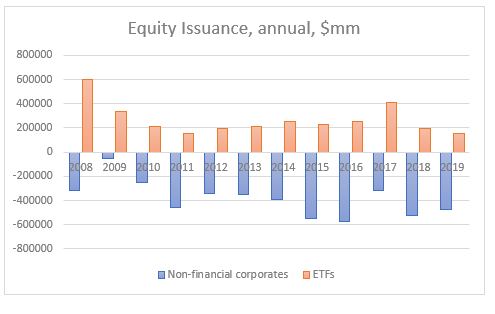
Non-financial corporate issuance has indeed been negative (corporates bought back shares) since 2008 at $4.6Tn, cumulative, but ETFs issuance is a positive $3.2tn. So, net there is still a reduction in public equity flow but nothing as dramatic as some sell side analysts claim (excluding US equity issuance abroad – see below).

Source: Federal Reserve Z1 Flow of Funds, beyondoverton

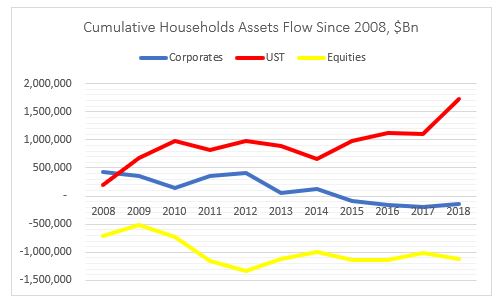
And the flip side of that is retail, which has indeed been selling equities direct but also buying indirect through ETFs – so, similarly, households have sold equity risk down but not as much as claimed – in a sense, retail buying is ‘masked’ in the flows (it is simply an incomplete ‘wash’ from owning equities direct in an active form to owning equities indirect in passive ETFs).

Actually, in 2019 households bought the most equities direct since the crisis. Foreigners and mutual funds, on the other hand, sold the most equities since the crisis. And equity issuance was the most negative (in the chart below, it is shown as a positive number to signify equity share buybacks).

Source: Federal Reserve Z1 Flow of Funds, beyondoverton

Equity issuance above is comprised of non-financial corporate, ETF and new issues abroad. When most sell side analysts report share buybacks, they only take into consideration net domestic non-financial corporate issuance. But ETFs and new issues abroad also matter from a flow perspective. The big change in 2019 was, in fact, the new issuance abroad which was negative – the last time it was negative was in 2008 (the data for 2019 is as of Q3, but it is annualized for comparison purposes).

Unlike 2008, however, it is not obvious to me where the trigger for the unwind of the ETF flow would come from. With the CDOs it was ‘easy’ – all it took was for rates to rise to ‘cripple’ both the mortgage payer and the leveraged CDOs owner. The debt overhang today is actually even bigger than in 2007, but the Fed’s failed experiment between 2016-2018 pretty much assures rates will stay low for the foreseeable future. Still, even though there is not much leverage in the system now, the high concentration of risk could produce the same effect on liquidity as if there were. But you still need a ‘seller’ to start the carriage rolling down the hill, don’t you?

This seller could be retail as an unwind of the 2019 inflow. Or the ‘selling’ could come from US corporates themselves (in the form of less buying back of their own shares – or no buying at all as a response to a regulatory change – but the latter is a 2021 event, post US presidential election, most likely). Or it could be a natural decline in share buybacks as a response to a drop in corporate Free Cash Flows (FCF) on the back of top-line revenues having peaked already (for the 17 out of 20 largest share buyback companies that is indeed the case).

The need for liquidity from fund managers is unlikely to be provided by the banking system, which is even now, without any stress, constrained by Basel III regulations to expand sufficiently its balance sheet. The Fed could be either forced to start buying equities to stem the slide and allow fund managers to meet redemptions, or it could extend a direct line of liquidity to them in a similar fashion to the creation of PDCF in 2008 for the primary dealers. My bet is on the latter as a politically more acceptable solution.

No financial crises are alike but a precondition for all of them is an extreme build-up of either economic or structural market imbalance. The next crisis is more likely to be a function of the latter one, namely high concentration of risk in institutions without direct access to liquidity from the Fed.

As for the trigger for the crisis, we can only speculate. Anyway, there isn’t usually one trigger per se but rather a combination. And we are only meant to figure that out in retrospect. But it is important to do away with two wrong narratives. First, that retail accounts have been large sellers of equities, and second, that the supply of equities has been hugely negative.

This note showed that neither of them holds water. ETF flow is at the core of the matter here. On one hand, it has facilitated the issuance of plenty equity-like instruments to make up for some of the lack of direct equity issuance, and, on the other, it has allowed retail to partially switch from active and direct equity management to passive and indirect one. In doing so, it has created the said market imbalance.  

ETF, WTF.

Do stock markets always go up?

08 Friday Nov 2019

Posted by beyondoverton in Asset Allocation, Equity, Questions

≈ 1 Comment

Tags

returns

In the long run – yes (assuming no failed states).

Do you, guys, remember the Betteridge’s law of headlines?

How do we define a long run?

How about the whole history of the S&P 500 Index.

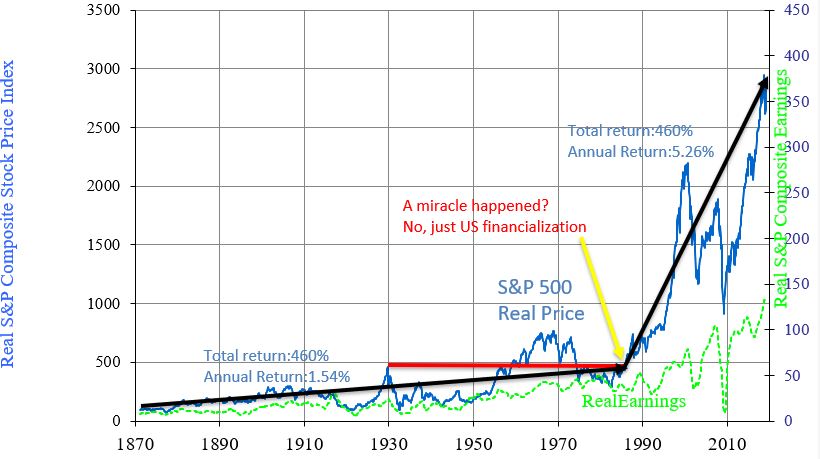
Since 1871 S&P 500 index has gone up 3,049% (2.4% annual return) or 1,855,212% (6.9% annual return) in real terms*.

However, it took 57 years for the S&P 500 to break firmly above its 1929 high in real terms! That’s more or less, one generation of flat returns.

And let’s look at those 148 years of returns. How were they distributed?

For 115 of those, between 1871 and 1986, the S&P 500 had a total return of about 460% (without dividends – just price change). That’s 1.5% return per year.

Then for the next 33 years, the S&P 500 returned the same 460% in total but this time, the annual return was more than 3x higher at 5.3%.

115 years of return happened in just 33 years!

What exactly happened in the early 1980s?

Let’s just say, there was no miracle.

However, the power of shareholders’ primacy lead to an explosion of US share buybacks; the economy’s financialization lead to massive M&A activity and the reform of executive compensation incentives. All this contributed to the strong returns for US stocks.  

There was, of course a positive correlation to US GDP growth and US productivity growth and US population growth, but a negative correlation to the changes in them (meaning, the lower growth rates of the US economy, productivity and population in the latter period coincided with higher stock market returns).

Were the strong returns post 1986 a payback of the decent returns prior or a pay-forward from the future earnings ahead?

My bet is on the latter given the possibility of simple mean reversion of returns probability coupled with lower real GDP growth rates and declining productivity growth rates. If negative returns on sovereign debt are any guidance, I would not be surprised if what follows is several decades of flat returns overall.

*Source for all data is Robert J. Shiller website: http://www.econ.yale.edu/~shiller/data.htm

Who has done what in the major asset classes: real money flows since 2008*

06 Wednesday Nov 2019

Posted by beyondoverton in Asset Allocation, Debt, Energy

≈ 1 Comment

Tags

corporate bonds, households, mutual funds, pension funds

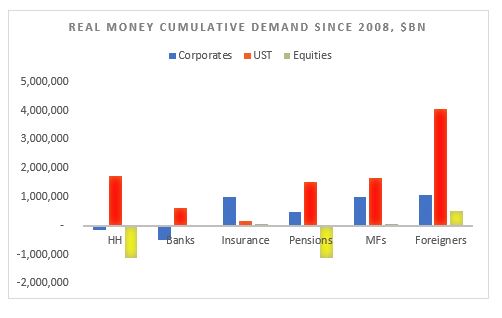
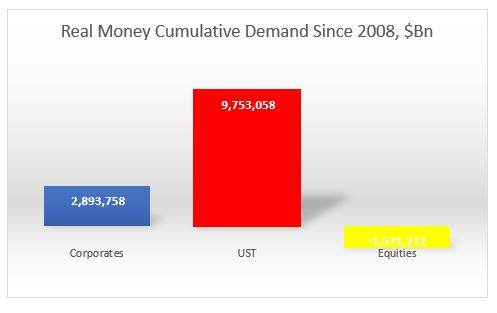
Households have massively deleveraged: sold about $1Tn of US equities and bought about $2Tn of USTs. The have also marginally divested from corporate bonds.

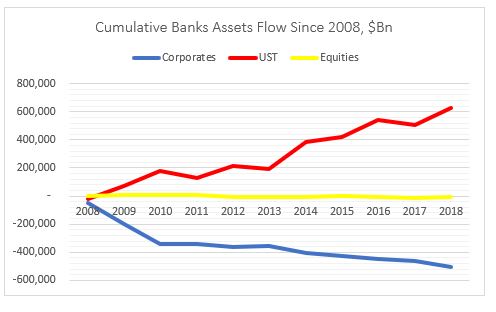
Banks have deleveraged as well: bought about $0.5Tn of UST while selling about the same amount of equities. The have also marginally divested from corporate bonds.

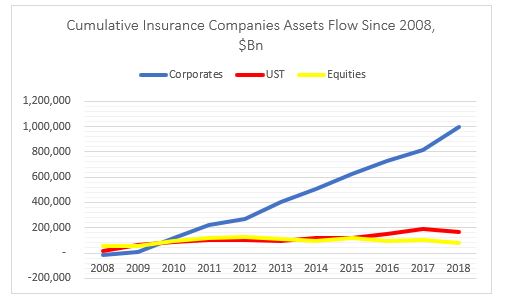
Insurance companies have put on risk: bought about $1Tn of corporate bonds and small amounts of both equities and USTs.

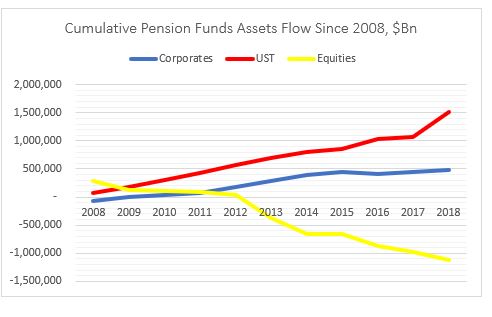
Mix bag for pension funds with a slight deleveraging: bought $0.5Tn of corporate bonds but sold about $1Tn of equities. But also bought $1.5Tn of USTs.

Mutual funds have put on risk: bought about $1Tn of corporate bonds and small amount of equities. Also bought more than $1.5Tn USTs.

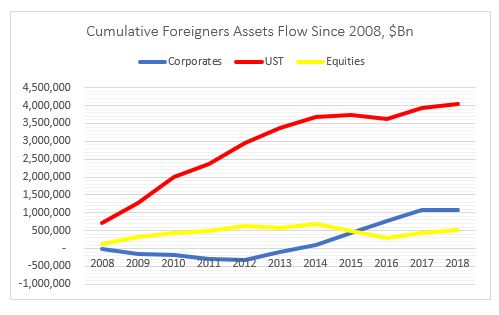
Finally, foreigners have also put on risk: bought $1Tn of corporate bonds, $0.5Tn of equities and $4Tn of USTs.  

Overall, the most (disproportionate) flows went into USTs, followed by US corporates. Demand for equities was actually negative from real money.

What about supply?

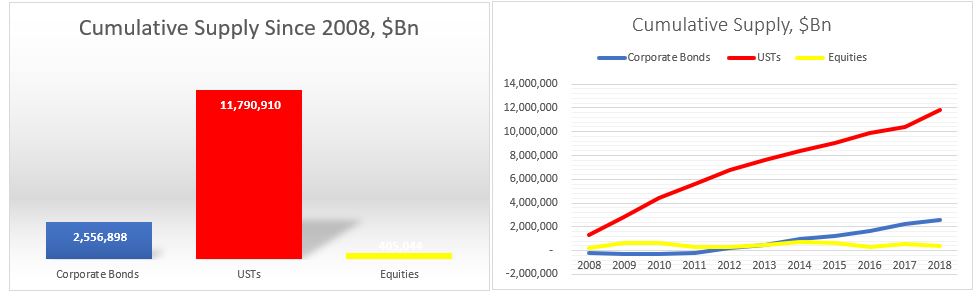
Issuance of USTs was naturally the dominant flow followed by US corporates and US equities.

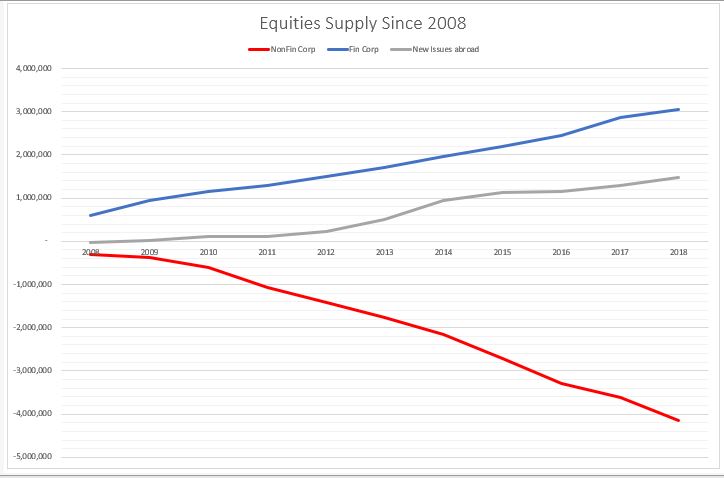
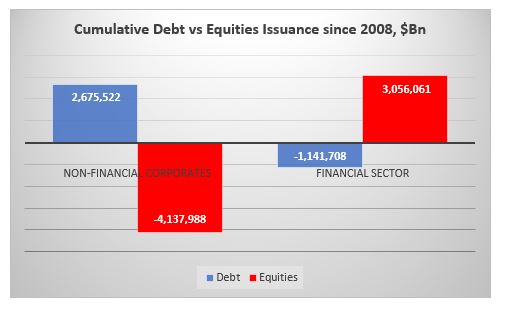
On the US equities side, however, there is a very clear distinction between US non-financial corporate issuance, which is net negative (i.e. corporates bought back shares) and US financial and US corporate issuance abroad, which is net positive. In other words, the non-corporate buybacks (more than $4Tn) were offset by the financial sector (ETF) and ‘ADRs’ issuance.

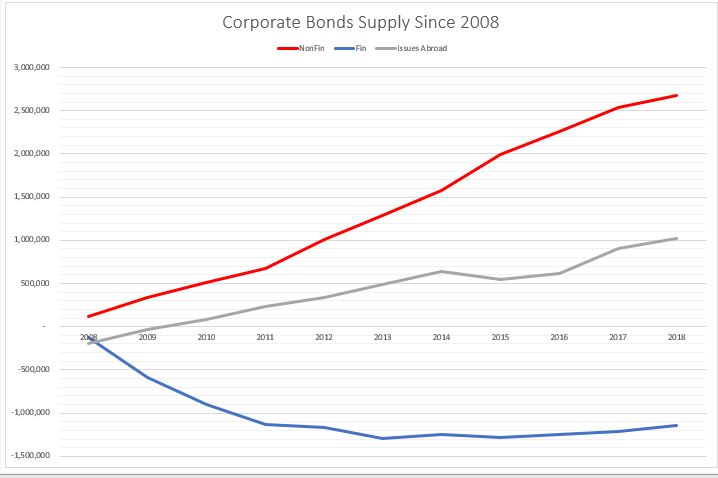
The opposite is happening on the corporate supply side. Non-financial corporates have done the majority of the issuance while the financial sector has deleveraged (reduced debt liabilities).

In other words, non-financial corporates have bought back their shares at the expense of issuing debt, while the financial sector (ETFs) has issued equities and reduced their overall indebtedness.

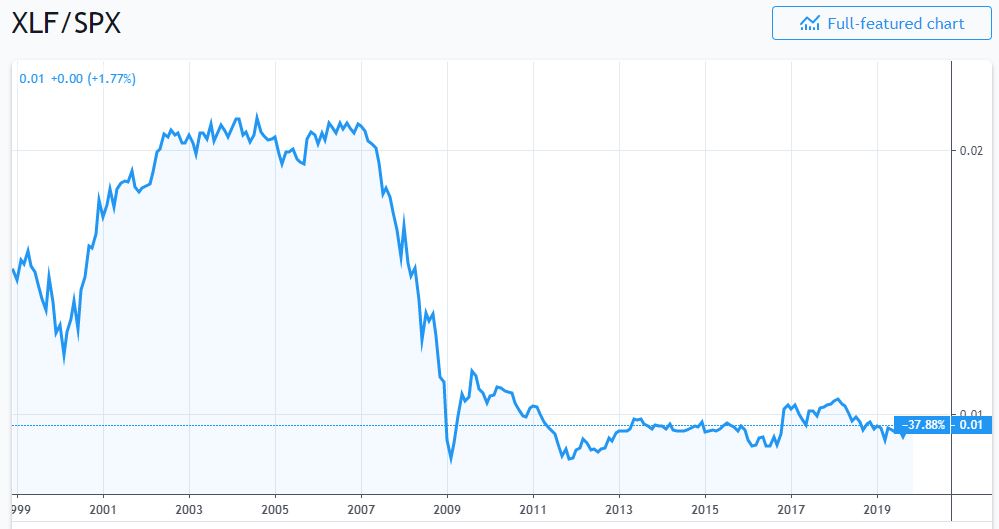
No wonder, then that financial sector shares have underperformed the overall market since 2009.

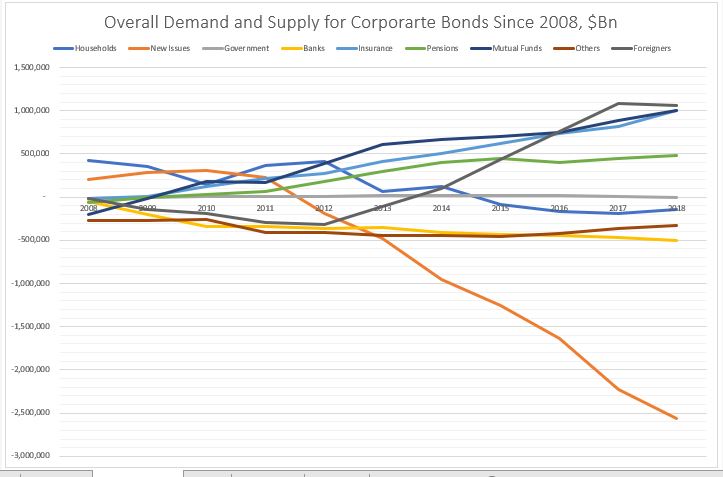
Putting the demand and supply side together this is how the charts look.

On the equities side, the buying comes mostly from ETFs (in ‘Others’ – that is basically a ‘wash’ from the issuance) and foreigners. The biggest sellers of equities are households and pension funds. The rest of the players, more or less cancel each other out.

 So, households and pension funds, ‘sold’ to ETFs and foreigners.

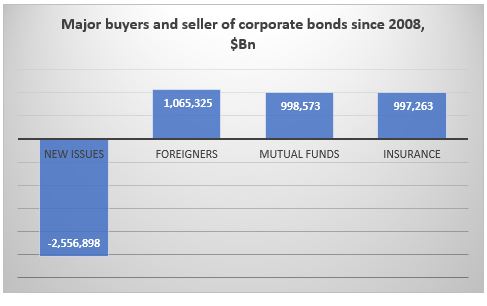
On the corporate bonds side, the main buyers were foreigners, mutual funds and insurance companies. Pension funds also bought. The main seller were the banks. ‘Others’ (close end funds etc.) and households also sold a small amount.

So, here it looks like foreigners, mutual funds and insurance companies ‘bought’ mostly at new issue or from the banks.

Finally, on the USTs side, everybody was a buyer. But the biggest buyer by large were foreigners. Mutual funds, pension funds, the Fed and households came, more or less, in equal amount, second. And then banks, ‘Others’ and insurance companies.

Kind of in a similar way, everyone here ‘bought’ at new issue.

Conclusion

It’s all about demand and supply.

In equities, real money has been a net seller in general, while the biggest buyer has been non-financial corporates themselves in the process of share buybacks. The financial sector has been a net issuer of equity thus its under-performance to the non-financial corporate sector. Equity real money flow is skewed mostly on the sell side.

Real money flow in corporate bonds is more balanced, but with a net buying bias.

USTs real money flow is skewed completely on the buy side.

Overall, since 2008 real money has sold equities, bought a bit of corporate bonds and bought a lot of UST: it does not seem at all that real money embraced the bullish stance which has prevailed in the markets since March 2009.

*Data is from end of Q4’08 till Q4’18, Source for all data is Fed Z1 Flow of Funds

China issues in hard currency!?

05 Tuesday Nov 2019

Posted by beyondoverton in Asset Allocation, China, Debt

≈ Leave a comment

Why do smart people do obviously ‘irrational’ things? It must be the incentive structure, so for them they do not seem irrational. So, I am wrecking my brain over China’s decision to issue EUR-denominated bonds (and a few weeks ago USD-denominated ones), in light of its goal of CNY and CGBs internationalization, 40-50bps over the CGB curve (swapped in EUR).

The rationale China is putting forward is that enables it to diversify its investor base on the back of the trade tensions! Seriously? Do they really mean that or are they getting a really bad advice? Wasn’t the intention to actually go the other way as a result of the trade war? Didn’t China want to be become more self-reliant? In any case, China does not need foreign currency funding given its large, positive NIIP. China has the opposite problem. It has too much idle domestic savings and not enough domestic financial assets. This, among other things, creates a huge incentive for capital flight which, despite its closed capital account, China is desperately trying to prevent.

In that sense, China does need foreign investor but to invest in CGBs (and other local, CNY-denominated bonds) to act as a buffer to the potential domestic capital outflow as the capital accounts gates slowly open up. It is for this reason that BBGAI and JPM have started including CGBs into their indices this year.

It is for this reason SAFE decided to scrap the quota restrictions on both QFII and RQFII in September. It is for this reason that Euroclear signed a memorandum of understanding with the China Central Depository & Clearing to provide cross-border services to further support the evolution of CIBM. That opens up the path for Chinese bonds to be used as collateral in international markets (eventually to become euro-clearable), even as part of banks’ HQLA.

All these efforts are done to make access to the local fixed income market easier for foreign investors. And now, what does China do after? Ahh, you don’t need to go through all this, here is a China government bond in EUR, 50bps cheaper (than if you go through the hassle of opening a Bond Connect account and hedging your CNY back in EUR).

This not only goes against China’s own goals regarding financial market liberalization but also against the recent trend of other (EM) markets preferring to issue in domestic currency than in hard currency. And while other EMs may not have had the choice to issue in hard currency from time to time, China does. And while the investor base for other EMs between the domestic and the hard currency market is indeed different, and the markets are very distinctive, China does not have much of an international investor base. Issuing in the hard currency market may indeed ‘crowd out’ the domestic market. Especially when you come offering gifts of 50bps in a negative interest rate environment.

The best portfolio diversifier (cont.)

01 Friday Nov 2019

Posted by beyondoverton in Asset Allocation, China, Debt, EM

≈ Leave a comment

…is (actually) Chinese bonds

When speaking to investors, the two most common questions I get asked, given rather extreme levels and valuations of (most) asset classes, are:

1.Should my asset allocation change dramatically going forward? and

2.What is the best risk diversifier for my portfolio?

I have previously opined on this here. Very broadly speaking, on the equity portion, one should reduce exposure to US equities and increase allocation to EM equities (unhedged). On the fixed income side, one should move completely out of the long end of UST and put everything into T-Bills to 2yr UST; exposure to EU-denominated sovereigns should also be reduced to zero at the expense of EM local (unhedged) and hard currency bonds. In the normally ‘Others’ section of the portfolio, one should include soft commodities (or alternatively, scale everything down to make space for them). Finally, in terms of FX exposure, apart from EM currencies through the unhedged portions of the bonds and equities allocations, one should hedge the USD exposure with EUR.

Here I am adding some more general thoughts on what I consider to be the best portfolio diversifier for the next 5 years, possibly even longer. To my knowledge, ‘noone’ is invested in any meaningful way in Chinese bonds (I am excluding the special situations credit funds, some of which I know to be very active in the Chinese credit space – but even they are not looking at Chinese government or bank policy bonds).

The big fixed income funds, the pension/mutual funds, the insurance companies have zero allocation to Chinese bonds. Some of the index followers started dipping their foot in the space but most of them are either ignoring China’s weight or are massively underweight the respective index. Finally, a sign of how unloved this market is, on the passive/ETF side, the biggest fund is just a bit more than $100mm.

Let me just say here that we are talking about the third (possibly even the second, by the end of this year) largest fixed income market in the world. And no one is in it?

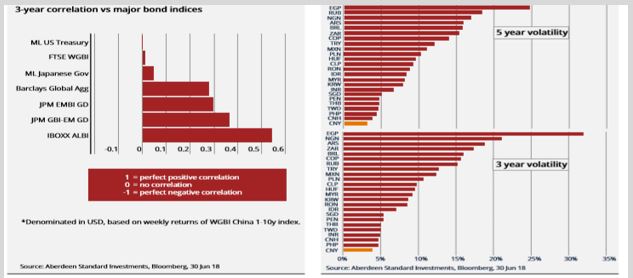
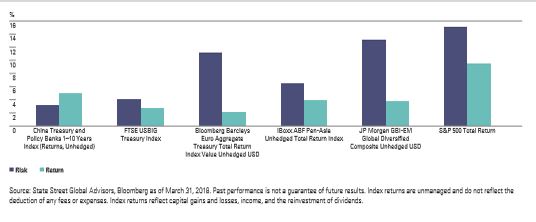
Chinese bonds merit a rather significant place in investors’ portfolios. They offer diversification thanks to their low correlation and superior volatility-adjusted return relative to other developed and emerging markets. In addition, Chinese bonds are likely to benefit significantly from both the passive and active flows going forward: I expect up $3 trillion of foreign inflows over the next decade on the back of indexation.

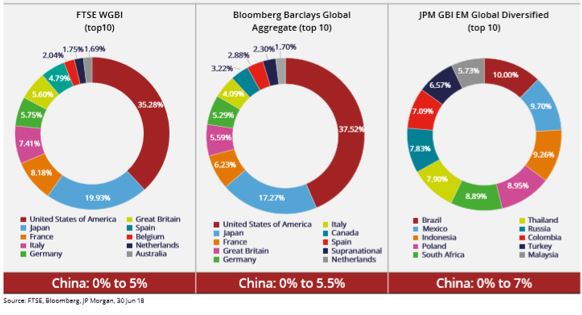
Bloomberg Barclays Global Aggregate Index (BBGAI) and JP Morgan Global Diversified have already confirmed Chinese bonds inclusion in their respective indices. FTSE Russell WGBI is likely to do that next March. This inclusion is a big deal! It will have huge repercussions on the global bond industry. It is a much more important and far-reaching development than a similar inclusion of Chinese equities in global indices last year. And the market is not only not ready for this, but it is also underestimating its impact overall.

China is a highly rated sovereign with a much better risk/return profile than other high-quality alternatives.  Chinese bonds offer a significant scope for portfolio diversification because they have very low correlation to global interest rates which means lower return volatility.

Therefore, China sovereign bonds offer a much better volatility-adjusted return than Global Bonds, EM Hard Currency and Corporate Bonds, US HY and Equities, Global Equities and Real Estate.

Among the plethora of negatively yielding sovereign bonds, China sovereigns offer a good pick-up over other DM bonds while yielding not too much lower than EM bonds. In addition, they offer much more opportunity for alpha generation than both DM or EM sovereign bonds. This alpha partially comes from the fact that Chinese fixed income market is still not so well developed and partially from the fact that there are not many sophisticated foreign players in it, as access to it is still not that straightforward.

However, things are rapidly improving on the access side. Bond Connect has already started to revolutionize the onshore market. Before the setting-up of CIBM, and especially Bond Connect in 2017, access to the China bond market was extremely cumbersome through a lengthy process requiring approvals from high authority (QFII and RQFII). Bond Connect, on the other hand, does not require domestic account and custody while following international trading practices. In addition, not long ago, it started real-time settlement and block trading. As a result, Bond Connect volumes doubled.

Moreover, in September this year, SAFE decided to scrap the quota restrictions on both QFII and RQFII, while Euroclear signed a memorandum of understanding with the China Central Depository & Clearing to provide cross-border services to further support the evolution of CIBM. That opens up the path for Chinese bonds to be used as collateral in international markets (eventually to become euro-clearable), even as part of banks’ HQLA. Such developments are bound to make access to the Chinese bond market much easier for overseas investors.

September proved to be a very important month for the China bond market also because the authorities finally delivered on the interest rate reform agenda. The central bank eliminated the benchmark policy loan and deposit rates in favor of a more flexible reference rate. This should be positive for yield curve formation and the continued expansion of interbank liquidity.

China does not have some of the weaknesses typical of emerging markets. On the opposite, it has very little sovereign FX debt, has large FX reserves, and it is a net creditor to the world. Moreover, some of the foreign debt is most likely offset by foreign assets.

Corporate-sector leverage, however, is still high, though default rates, despite lots of recent media focus, are still relatively low. On the other hand, the recovery rates are high, while the official, banking and household sectors are in relatively strong position which, reflects degrees of freedom to deal with these challenges. China has large amounts of debt with implicit state backing and a culture averse to defaults. In effect, the government controls both the asset and the liability side of the domestic debt issue thus a debt crisis is much less likely than in a fully free-market economy. The fact that China has the ‘fiscal’ space to deal with the private debt issue is one big advantage it has over DM countries with similarly high private debt burdens but which have also already used the option of shifting that debt to the government balance sheet.

The high debt issue and the authorities’ attitude to it, the structure of the economy (export-driven) as well as the potential transition from an extremely high growth rate to a more ‘normal’ one, makes China’s situation very similar to Japan’s in the late 1980s. Yet, there are also major differences. China’s urbanization rate is much below Japan’s before the 1990 crisis, the real estate bubble is only in the top tier cities as opposed to country-wide as in Japan, the Renminbi is more likely to depreciate going forward than massively appreciate which is what happened to the Yen after the Plaza accord.  

The high debt issue is a problem China shares not only with Japan but also with most advanced countries in the world. Similar to them, China is fully sovereign (the government has full control of the overall economy balance sheet; the currency peg is a “question mark”, not a real issue given China’s large positive NIIP). Of all these advanced economies with similarly high non-financial debt to GDP, only China has not reached the zero-bound*. It is, therefore, likely for the Chinese policy rate to continue to move lower until it eventually hits 0%.

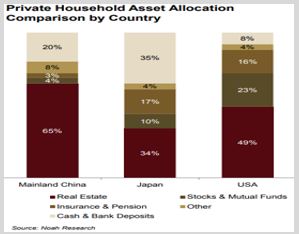
Similar to Japan, it has a high household savings rate and a rapidly ageing population. Yet, Chinese households have relatively low exposure to financial assets and especially to bonds. Given the policy agenda of financial market reform and the life-cycle savings behavior (i.e. risk-aversion increases with age), Chinese households’ allocation to bonds is bound to increase manifold. Moreover, with the looming of the property tax law (sometime next year), I expect the flow into bonds to start fairly soon.

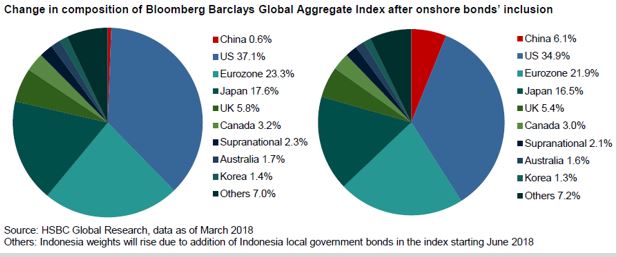
This flow aspect makes the case for investing into China bonds much stronger. Given the size of the Chinese fixed income market, its rapid growth rate and the reforms undertaken most recently, global bond indices had ignored Chinese bonds for too long. However, last year BBGAI announced that it would include China in its index as of April 1, 2019. Purely as a result of this, China bond inflow is expected to reach $500Bn by 2021 as the weights gradually increase from 0.6% to 6%. By then China will be the 4th largest component in the index (after US, Japan and France – and bigger than Germany!)

Before BBGAI’s inclusion, there had never been a bond market that large, that was not included in an index, as the Chinese bond market. In fact, China already represents the third largest bond market in the world, growing from $1.6 trillion in 2008 to over $11 trillion now.

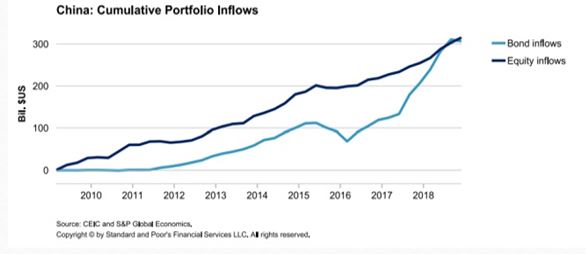
And there is much more money flowing into Chinese bonds, for example, than into Chinese equities for the first time in history.

Despite the setback of FTSE Russell postponing its decision to include Chinese bonds into its index to March next year, JP Morgan did follow through with the inclusion. The FTSE Russell decision to wait for the inclusion happened literally a day before Trump announced that he is considering banning all investments into China on the back of the escalating trade war. Tensions since then have been substantially reduced and I do not expect Trump’s warning to materialize regardless. I expect foreign flows into Chinese bonds, therefore, to continue to grow substantially (probably by another $150Bn combined on the back of the FTSE/JP Morgan inclusions).

And that’s just from index accounts. I expect substantial inflows also from accounts outside of the passive investment universe. In addition, CBs and SWFs (which so far have been the largest investors in Chinese bonds) are also likely to keep increasing allocations. Bottom line is, as the liquidity and transparency improve, unconstrained bond managers and sovereigns are also likely to start allocating money in this space.

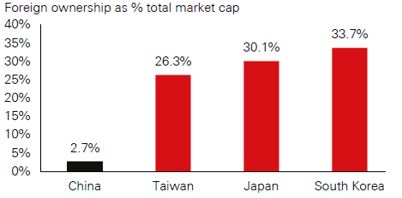
And even after these inflows, China bonds are still likely to remain relatively under-owned by foreigners as they would represent just 5% of China’s total bond market (currently foreign ownership of the overall bond market is around 3%, PBOC expects it to reach 15%). Foreign ownership of China sovereign bonds (CGBs) is slightly higher, but even at around 6%, it is materially lower than in other major sovereign bond markets. This under-ownership is even more pronounced relative to the emerging market (EM) universe (the ranges there are between 10% and 50%).

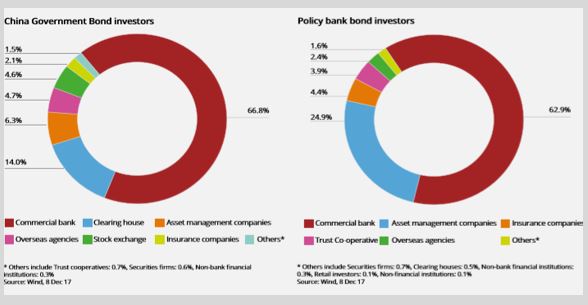
Compare this potential foreign involvement in Chinese bonds with those in Japanese bonds (the second largest market currently in the world, one which, actually, China is likely to surpass very soon): 40% of the traded volumes there are by foreign entities. Foreigners own about 13% of the market there – this may indeed seem small but it is still larger than local banks ownership, plus one has to take into consideration that Bank of Japan owns majority of the issues. The Chinese bond market, on the other hand, is completely dominated by domestic institutions (more than two-thirds is owned by commercial banks).

Domestic commercial banks have very much a ‘buy-and-hold’ mentality but liquidity in Chinese bonds is expected to increase substantially as local insurance companies and asset managers start becoming more active. In the sovereign bond market, for example, there are 45 primary dealers. Auctions are regular with single issue sizes varying between $3bn and $17Bn and maturity up to 50 years. On-the-run bonds (there isn’t a well-defined yield curve which actually provides opportunity for surplus alpha – see above) have bid-offer spreads normally around 1-3bps. In terms of liquidity, bonds stay ‘on-the-run’ for at least a year, in some cases longer.

Finally, foreign investors are expected to continue to get very favorable treatment from the Chinese authorities. The government has an incentive to make things easier as they need the foreign inflows to balance the potential domestic outflows once the current account is liberalized. For example, the tax changes implemented last year allowed foreigners to waive the withholding tax and VAT on bond interest income for a period of three years.

I am still frankly shocked how little time investors have to discuss these developments above but, at the same time, how eager they are to discuss the Chinese economy and the trade tensions. From one hand, they acknowledge the importance of China for their investment portfolio, but on the other, they continue to ignore the elephant in the room being the Chinese bond market. I understand that this choice is perhaps driven by investors’ inherent negative bias towards any Chinese asset, but the situation between asset and asset is much more nuanced.

In the fixed income space, one can be bearish select corporate credit and bullish CGBs or bank policy bonds (in fact, the more bearish one is on corporate credit, the more bullish sovereign bonds one should be). Finally, I do acknowledge that the big unknown here is the currency. But even there, the market has become much more sophisticated: one can now use a much longer CNY/CNH forward curve to hedge.

Bottom line is that if you are still looking for a fixed income alternative to diversify your portfolio and you are not looking at Chinese sovereign bonds as an alternative, you are not being fiduciary responsible.

*For more details, see JP Morgan’s economics research note, “China’s debt: How will it evolve?”

The best portfolio diversifier

24 Thursday Oct 2019

Posted by beyondoverton in Asset Allocation, EM

≈ 2 Comments

Given low, and in some countries negative sovereign rates, are sovereign bonds still the best portfolio diversifier in the long run? 

Yes

Because the portfolio optimization function has also changed. We are moving away from a world of profit maximization to a world of loss minimization.

Given persistent and large output gaps and surplus capital in the developed world, the expected return on future capital investment should be negative.

If Japan, Switzerland, Sweden and Denmark are any guide, their respective stock markets are down or flat since rates hit 0%. US is still a massive outlier (buybacks) but that is also fading (SPX buyback index is down YTD).

From a long-term point of view, I would still own sovereign debt as it has superior risk-adjusted returns even at these low yields. For example, in the last bear market for bonds, 10yr UST went from 1.95% in 1941 to 14.6% in 1982. Annual real total return for the period was 0.4% (annual nominal return was 5% with Sharpe ratio of 0.54). There were 10 years of negative returns (24% of the time) with the largest drawdown of 5% in 1969. In the bull market that followed, annual real returns were much higher but that was only because of disinflation (nominal returns were only marginally higher – around 6%). We still had 6 years of negative returns, but the largest drawdown was 11%.

‘Bond bubble’ is an oxymoron. The best value on the curve now: T-Bills. If you could be bothered to roll them, they would have a similar return to the long end but much lower volatility. The Fed just announced it is in the market buying T-Bills (as it ‘should’: the Fed is massively underweight T-Bills vs both history and the market). Despite heavy Treasury issuance net supply of T-Bills is expected to be negative next year.

US retail is massively underweight USTs: about 3-5% of all financial assets and about 2% of their overall assets.

Is gold a better portfolio diversifier when sovereigns yields are negative? Perhaps, in the short term and only for retail. Long-term, expected return on gold should also be negative (as long as sovereign yields are negative). For institutional investor gold is an inferior option from a liquidity and regulations point of view.

Is there a better portfolio diversifier at the moment, short-term? Perhaps soft commodities which trade below production costs (for some, like cotton, wheat – substantially below) – compare to precious metals which trade 50% above marginal cost of production. 

Soft commodities might be the exception among the major asset classes, whereby expected return is actually positive in a negative sovereign yield world, given that they already experienced negative returns in the past 10 years and their zero (negative?) weights in institutional or retail portfolios (mean reversion).

One can go even fancier here, up the risk curve, and allocate to hard currency emerging market debt, which has had even better risk-adjusted returns than USTs over the last 3 years. And, depending on currency views, go even further into local currency (unhedged) emerging market debt. USTs do not need to be negative, just to hover around 0%, for emerging market debt to really outperform, assuming no major market dislocation.

Finally, on the equity side, some allocation to emerging markets equity is also probably warranted given their massive under-performance specifically to US equities and my projected negative returns of the latter going forward. Unlike their developed market counterparts, emerging markets are not running negative output gaps and therefore, capital is still expected to earn a premium there.

Bottom line: if we are indeed in a loss-minimization type of world when it comes to investment returns (note, this does not assume any kind of market crash) one is still better off staying in sovereign debt, even when it yields negative as every other liquid asset is bound to return even more negative on any reasonable time scenario.

The 60/40 portfolio is a myth

24 Thursday Oct 2019

Posted by beyondoverton in Asset Allocation

≈ Leave a comment

Tags

Debt, Equity

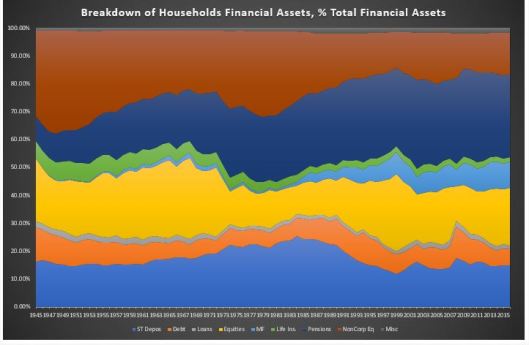
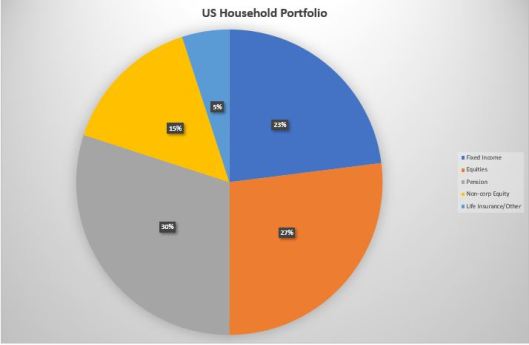
-US households balance sheet is comprised roughly of 70% financial assets and 30% real assets. That mixture has actually been relatively stable throughout the post WW2 period.

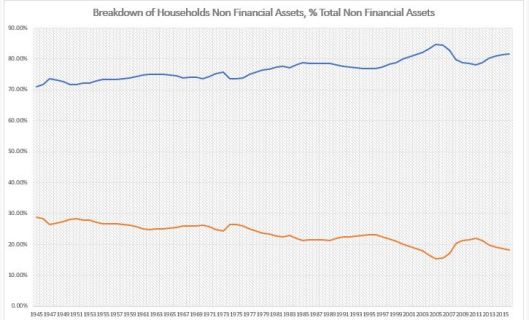
-The non financial side of the balance sheet is comprised of 80% real estate and 20% ‘goods’ (car, furniture, etc.). Since WW2 there has been a gradual increase in the real estate portion from 70% of total to about 85% in 2007.

-The biggest item on the financial side of the portfolio is the pension fund (PF) allocation at around 30% of total. This was not always the case. In fact, it has gradually grown from 9% in 1945.

-The second biggest allocation is to equities (EQ) direct at around 18%, which turns out to be the average for the whole period post WW2. The highest allocation was in 1999 and 1965 at 28%, the lowest in 1984 at 10%.  Households own equities also indirect through their pension and mutual funds.

-The third biggest allocation is cash at 15%, 17% being the average in the post WW2 period, 25% the highest in 1984, and 12% the smallest in 1999.

-The fourth largest allocation is to mutual funds (MF) at 9%. Just like with PF, this allocation has increased gradually from pretty much 0% before the financial liberalization of the early 1980s.

-Fixed Income (FI) direct only comes fifth here at 6%, average 7%, highest 11% in 2008, smallest 5% in 1972. Households also own fixed income indirectly through their pension funds.

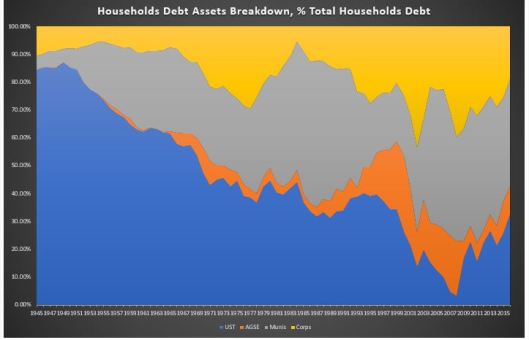
-The FI portfolio is comprised of USTs, agencies, munis and corporate debt. Munis have the largest allocation at around 39% followed by USTs at 33% corporates at 19% and agencies.

-the FI portfolio looked very different in the early days with the bulk of the exposure in USTs (84%), corporates (11%) and munis (5%). Agencies exposure kicked in only in the late 1960s.

-US households also own their own businesses (non-corporate equity – NCEQ) which used to be their largest exposure immediately in the early days post WW2 at 31% but has gradually halved by now.

-If we add cash and loans (very small exposure) to FI, the FI allocation overall goes to 23%. If we add the MF exposure to the Equities exposure, the latter goes to 27%. Life insurance (LI) and ‘Other’ comprise the remaining 5%.

-If we extract the PF exposure to its respective allocation to the different asset classes, the overall ‘concise’ US household portfolio has these weights at the moment: FI-30%, EQ-40%, NCEQ – 15%, LI/Other – 15%.

Newer posts →

Subscribe

  • Entries (RSS)
  • Comments (RSS)

Archives

  • January 2023
  • December 2022
  • November 2022
  • August 2022
  • February 2022
  • April 2021
  • November 2020
  • October 2020
  • September 2020
  • August 2020
  • July 2020
  • June 2020
  • May 2020
  • April 2020
  • March 2020
  • February 2020
  • January 2020
  • December 2019
  • November 2019
  • October 2019
  • May 2019
  • March 2019
  • February 2019
  • January 2019
  • December 2018
  • November 2018
  • October 2018
  • September 2018
  • August 2018
  • June 2018
  • May 2018
  • March 2018
  • February 2018
  • January 2018
  • November 2017
  • October 2017
  • September 2017
  • August 2017
  • July 2017
  • June 2017

Categories

  • AI
  • Asset Allocation
  • blockchain
  • China
  • De-urbanization
  • Debt
  • Decentralization
  • EM
  • Energy
  • Equity
  • FX
  • g88kboy
  • Monetary Policy
  • Politics
  • Questions
  • Quotes
  • The last man standing will laugh
  • Travel
  • UBI
  • Uncategorized
  • VR

Meta

  • Create account
  • Log in

Blog at WordPress.com.

  • Subscribe Subscribed
    • BeyondOverton
    • Join 74 other subscribers
    • Already have a WordPress.com account? Log in now.
    • BeyondOverton
    • Subscribe Subscribed
    • Sign up
    • Log in
    • Report this content
    • View site in Reader
    • Manage subscriptions
    • Collapse this bar
 

Loading Comments...