• About
  • BeyondOverton Travel
    • Silk Road (1): If Turkey is in crisis, it’s not obvious visiting it
    • Silk Road (2): Could beautiful nature and ancient history create a false sense of entitlement?
    • Silk Road (3): Fast Car
    • Silk Road (4):We took a bus ride to Iran
    • Silk Road (5): Border bothers
    • Silk Road (6): Chevrolet Land
    • Silk Road (7): Free-roaming camels and wild horses
    • Silk Road (8): China West to East
    • Silk Road (9): I have not told half of what I saw
  • BLOG
  • g88kboy Travel
    • On the Silk Road
    • Bulgaria : The Chicken crossed the Road
    • Turkey : The Country, not the Bird
    • Georgia on my Mind
    • Armenian Ayran
    • Iran – The Curious Land
    • An American in Azerbaijan
    • Uzbekistan: Golden Teeth and Neon Signs
    • Kazakhstan: Thirty Sweating Seniors
    • China Part One – Pandas Are Extinct
    • China Part Two: My TED Talk (Deep Analysis)
    • Phillipines – They Relax, I (pretend to😉) Study
    • Singapore: flashing trees and a torrent of tears
    • Malaysia: That ain’t no croc, it’s a log
    • Brunei: The Instinctive Fight for Superior Domination
    • Phillipines: Hello Friend Again
  • Outside the window
    • Bulgaria
    • Turkey
    • Georgia
    • Armenia
    • Iran
    • Azerbaijan
    • Uzbekistan
    • Kazakhstan

BeyondOverton

~ let's move this window

BeyondOverton

Monthly Archives: September 2017

Missing liquidity, good intentions and unintended consequences

14 Thursday Sep 2017

Posted by beyondoverton in Monetary Policy

≈ 5 Comments

Source: Z1 Flow of Funds*

The queen asked the wrong question

In November 2008, the Queen of England asked why no one saw the credit crunch coming. That was kind of unfair. The thing is quite a lot of people saw it coming. Some of them even publicly warned about it (even though that went on for many years in advance, so people ignored them). However, very few people did something about it (those that did are now ‘legendary’ and there are books written and movies made about them, to say nothing that they are also very rich as a result).

The right question to have asked is why nobody in authority did anything about it. I suspect that is the case because very few people actually understood what was going on and why it was happening. The data was not there. It goes back to the fact that it is pointless to guess what people think because that would not help you ascertain what they will do. Our mind freezes when we are facing options and we do not have the data or the ability to analyze the data in order to help us make a decision. In most situations that matter, therefore, people act only when they do not have a choice.

Smart ideas implemented too early could be a job killer

Most people in my circle of risk takers in 2006 and 2007 knew very well that something was afoot with all this subprime mortgage origination going around. Even if you were not a mortgage specialist, there was plenty of anecdotical evidence of how extreme the situation had gotten. The thing is most of us had been through the emerging market crises of the previous decade and, having survived that, had the temerity of selling risk way too early ahead of the Dotcom crash. There was no way we would have made make that same mistake so soon again in 2006, or 2007.

However, even in early 2008, when the pressure was mounting with funds and banks going out of business, there was still a general feeling of calm and belief in the status quo. The markets had been easy for the last 5 years before that and very few people were crunching the numbers and doing their homework. Everyone was just riding the trend. In fairness, it was not obvious how and where the macro problem was. Traditional liquidity was plentiful despite the Fed raising rates, traditional bank leverage was also not that high. You either had to go micro and do the really had work (aka Michael Burry) or be lucky (some people were, as always).

The case of missing money 2008 edition (flying blind in an ocean of data)

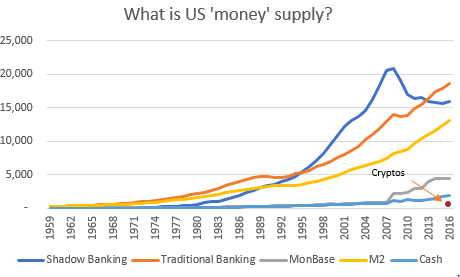
How should we measure monetary liquidity in our modern economy? We know that the physical notes and coins which the Fed and the Office of the Mint in the US, for example, produce is only a small % of the actual money supply (‘Cash’ in the chart at the top of the post). Moreover, we know that this cash is circulated only when the public demands to exchange its digital money for physical ones. The 2008 financial crisis has also finally taught us that majority of the money created is done by the ‘private’ banks in the process of loan origination (‘Traditional Banking’). Some people, however, are still confused with the base money creation by the central banks (‘MonBase’), calling it ‘printing money’. These excess reserves at the Fed, for example, are nothing but a monetary ‘cemetery’. They are stuck there, unable to enter the real economy unless new debt is created.

However, there is also the shadow bank money. The Fed defines shadow banks as “financial intermediaries that conduct maturity, credit, and liquidity transformation without explicit access to central bank liquidity or public sector credit guarantees.” Shadow banking had existed for many years but in the mid-1990s it took over the dominant position in liquidity transformation ahead of traditional money supply (chart at the top of the post).

The first problem of shadow banking, apart from the two obvious ones in the definition above, namely no access to central bank balance sheet and no public guarantees, is that it is done off the brokers’ balance sheets.

The second one was that the brokers, which were the dominant shadow banks, relied completely on the interbank market. Lacking deposits and access to the central bank, their funding was at risk every single time interest rates in the wholesale market went haywire or the value of the collateral (see below) declined.

And the third problem was that in the period between the Dotcom crash and 2008 the ‘safe’ collateral that forms the base of shadow banking liquidity transformation was mostly repackaged private debt in the form of (sub-prime) mortgage back securities.

It was a combination of all of the above which made the 2008 financial crisis so unique: 1) it was difficult to measure either the total liquidity in the system for macro-economic reasons, or the banks/brokers’ financial health; 2) the monetary system was much more dependent on the level of interest rates: one, it affected them directly in the interbank market, and, two, indirectly, as high interest rates eroded the ability to stay current on the mortgages which were at the core of the system -> mortgage assets plunged and -> the shadow banking funding was cut further.

Because most of the money before the crisis was created outside of the remit of the central bank, cutting rates, as was the traditional way of getting liquidity back in the system, did not work without also supplying enough safe assets at Par.

Be careful what you wish for because it can have unintended consequence

The rise of the shadow banking system coincided with the process of the financialisation of the economy in the 1980s and 1990s. As corporate profits increased at the expense of labor, capital was created but never circulated in the real economy. Instead it was hoarded at the top. The economy needed an alternative source of liquidity and the market provided it in the form of shadow banking. However, the Clinton administration’s plan to eliminate the government budget deficit towards the end of the 1990s also meant a substantial decline in US government bonds issuance.

That was a problem for the shadow banking liquidity as safe assets were essential in the liquidity transformation process. But again, the market responded by creating a plethora of seemingly ‘safe’ private assets by combining risky subprime mortgages with prime (GSE-backed) mortgages. In the beginning this suited everybody: the people who, while their real income had been declining, could now get credit to buy houses (and other durable goods), the government, glad to see the economy booming again, shortly after the shock of the Dotcom crash, the central bankers, quick to raise rates to give themselves  some room for cutting them later on, the rating agencies not turning away the extra commissions and eager not to spoil the party by giving ‘everyone a high grade’, and, finally, the banks, opening another avenue of revenue generation.

But the more the Fed raised rates the more difficult it was for those homeowners to stay current on their mortgage payments. We had three forces working together in that regard. First, as seen above, the whole system incentivized the creation of as many mortgages as possible. So, it was a question of volume. Second, there was little regard in terms of how that volume was generated. So, it was a question of very questionable mortgage origination practices (NINJAs, a lot of ARMs, etc.) And third, the price of real estate was rising rapidly. So, it was a question of even more debt in order to be able to buy that more expensive house (many loan-to-value mortgages above 100%). While at the same time real wages were still declining.

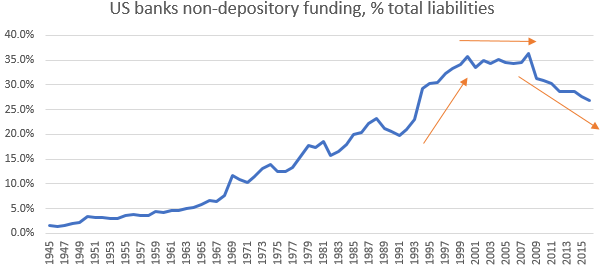
This was not rocket science. But it was the perfect storm that no one wanted to see coming because everyone was enjoying the party. And even though it was not straightforward to see it in the data, there were signs. For example, the chart below shows the non-depository funding (i.e. any other funding but checking and time-deposits which are the most secure ones) of US banks as a % of total assets. In the 1990s there was a spike in banks’ wholesale funding: repos, debt, open market paper, etc. The line flattened thereafter before hitting an all-time high in 2008. After 2008, the banks have continued to move away from wholesale funding in line with the decline of the shadow banking as well as with the new banking regulations.
Source: Z1 Flow of Funds

Bottom line is that despite the rise of math and science PhDs taking over the mortgage structured departments at the banks and broker dealers creating more and more complicated mortgage products, it was simple math that at some point eventually, as long as the Fed kept raising interest rates, the music will stop. No one knew when that would happen though and no one wanted to be the first to leave.

However, when it eventually happened, it was not clear why it happened. Lehman Brothers (one of the main cogs in the shadow banking system) was let go even though just a few months before Bear Stearns was ‘saved’. Letting a broker-dealer go under maybe was to teach a lesson at no such great cost to the system as it was not a depository institution, I do not know, but whatever the reasoning behind it was, it spectacularly backfired as the whole shadow banking system collapsed. The Fed had no choice but to take Morgan Stanley and Goldman Sachs under its wing shortly after Lehman’s bankruptcy (they officially became depository taking institutions).

The case of missing money, current edition

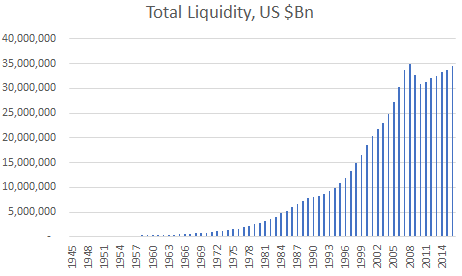
We still have no idea what our money supply is. Shadow banking liquidity continues to decrease and even though traditional money supply has continued to rise, total liquidity now is still just about at the same level as the peak of the 2008 financial crisis (chart below).
Source: Z1 Flow of Funds**

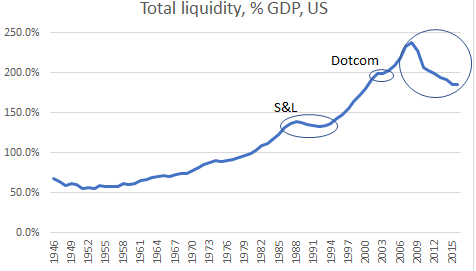
Relative to GDP, the situation looks even worse (chart below). Total liquidity as a % of GDP continues to decrease 8 years after the financial crisis. During the Dotcom crash, it only flattened out, but during the previous debt crisis, the 1990s Savings and Loans Crisis, total liquidity as a % of GDP decreased for about 5 years.
Source: Z1 Flow of Funds

It is no surprise then that we see the emergence of cryptocurrencies. They are the new fake safe private assets in a system starved of money and with real incomes still barely rising. With a total market capitalization of all cryptocurrencies of around $150bn, they are just about 10% of the US physical notes and coins in circulation, and only above 1% of US M2, so not an immediate and systematic danger to the monetary system. But unlike subprime mortgages, their digital and decentralized nature would allow them to spread very fast if the circumstances allow. And just like shadow banking liquidity, they are difficult to follow, let alone measure. Therefore, it is imperative for central banks and regulators not to get too complacent yet again.

*Shadow Banking Liquidity is defined as the sum of all sectors open market paper, holding companies’ debt and loans, GSE total liabilities, Agencies total liabilities, Issuers of asset-backed total liabilities, money market mutual funds total liabilities, broker-dealers repos; Traditional Banking Liquidity is defined as private depository institutions total liabilities; Cryptos is cryptocurrencies which is not to scale; All numbers in $Bn

** Total Liquidity is the sum of Shadow and Traditional banking liquidity
The turn in the equity bull market could possibly only come if Rule 10B-18 is revoked…
13 Wednesday Sep 2017

Posted by beyondoverton in Equity
≈ 2 Comments

…followed by a de-financialization of the US economy.
I am not talking about a correction in this bull market, whether a one-off (1987, for example) or a cyclical one caused by a financial/economic crisis (1998, 2000, 2008). This can happen any time leverage is too high. I am also not talking about a structural bear market either, like the one we had after the Great Depression between 1930 and 1950, for example. For that to happen, if ever (given that it did not happen after the Great Financial Crisis of 2008 thanks to the authorities’ help in restoring the financial plumbing of the economy), we need much more than a regulatory change: we need an economic and financial crisis coupled with a failure of trust in our institutional infrastructure.  What I am talking about is a sustained structural change in the dynamics of the market, something more reminiscent of the more “sideways” market between 1960-1980. The latter can happen without any economic and financial reason; it can happen just if the SEC revokes Rule 10B-18 which allows US corporates ‘safe haven’ to buy their own shares.

The SEC introduced Rule 10B-18 in 1982. The rule greatly simplified the procedures which US corporates must follow in order to buy back their own shares. This resulted in a big spike in US corporate share buybacks. For example, before 1982, there was very little US corporate buyback activity for fear of insider trading prosecution and the likes. Since the rule came into force and especially since the financialization of the US economy in the 1980-90s which spurred M&A and hostile takeovers, and the change in management incentives towards more equity-based remunerative structure, US corporates have become the dominant buyer of US equities. They are a fundamental structural force, and one that is greatly underappreciated, in the equity bull market that followed.

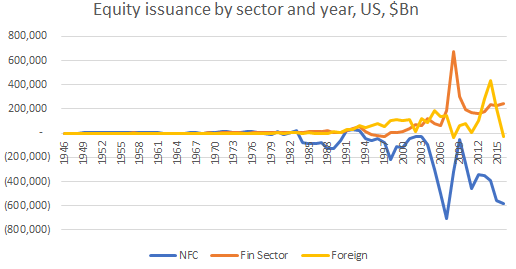
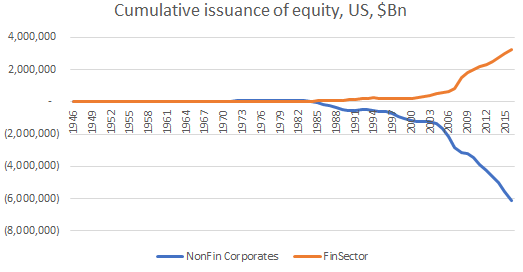
The chart at the top of this post illustrates the financialization of the US economy that took place in the early 1980s and it is ongoing now. Non-financial corporations have been net buying back their own shares (negative equity issuance) while financial corporations have been issuing new shares.

Supply of US equities

Overall US equity issuance can be broken down among three sectors: financial, non-financial and foreign (ADRs, for example). Though the financial and foreign sector have been generally net issuing shares throughout the history of the data, there is a break in the pattern of equity issuance for the non-financial corporate sector (chart below). While between 1945-1982 the latter has been a net supplier of equities, after, it has been a net buyer of equities (negative net equity issuance).

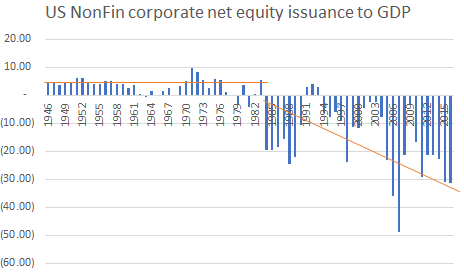
We can see that more clearly if we factor US corporate net equity issuance by GDP (chart below). While before 1982 there were only five years when there was a negative equity corporate issuance, after 1982 the opposite happened: there were only three years when US corporate issued more new shares than they bought outstanding ones.

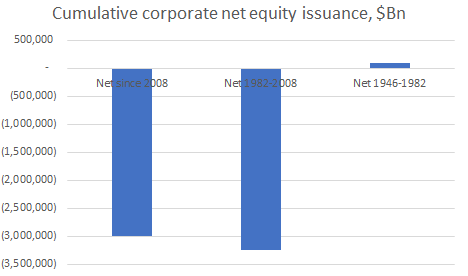
Or another way to look at the changes which occurred in the early 1980s is to break up the periods (chart below). The positive net supply of corporate equities between 1945-1982 dwarfs the negative corporate issuance thereafter. I have broken the 1982-2016 period into two. For the 8 years between 2008 and 2016 US corporates bought (negative net issuance) as much of their own shares as for the 26 years which preceded (1982-2008): this is the power of corporate share buying since the 2008 financial crisis!

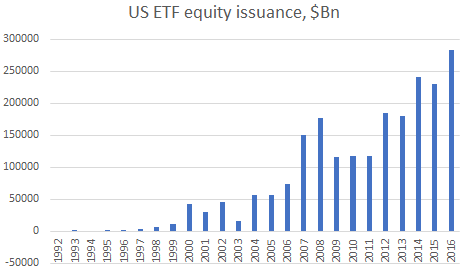
The financial sector, however, has been a net supplier of equities. This is not because banks and other financial institutions have been issuing equities (even though they have as part of their financial restructuring after 2008) but because of ETF shares supply. The two charts below show the breakdown of total US equity supply by the three main categories and the rise of the ETF respectively.

That’s how the supply side of US equity looks. What about the demand side?

Demand for US equities

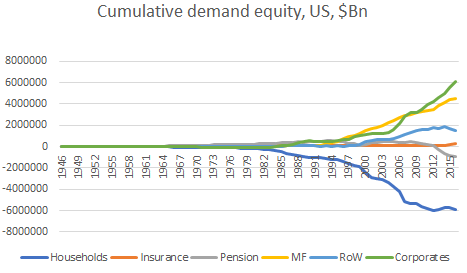
The chart below shows a breakdown of the cumulative demand form the main traditional buyers of equities. Households have been the largest seller of equities. However, what they have done is basically sold their direct holdings of equities but bought equities through mutual funds (and ETFs –  included in that number) and pension funds. Nevertheless, even taking this indirect ownership of equities, US households have net divested of equity shares as pension funds (both public and private) have also net sold equities since 2013. The other big traditional buyer is foreigners but they have also recently started divesting of US equities.

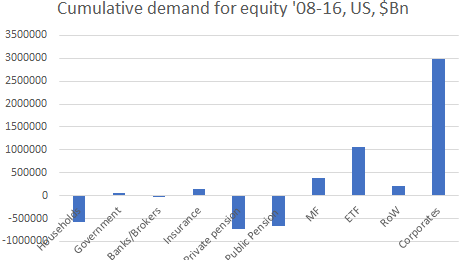
So, how is it possible that the demand for equities from the traditional market players seems to be on a decline relative to history but we have had this amazing bull market in US equities since 2009? It is the supply. I have included in the chart above also US non-financial corporates buying of equities as a positive number (this is the same as negative net supply – the opposite of the line in the chart on top of the post). This is especially so after the 2008 financial crisis, when cumulative US corporate share buybacks overtook buying of US shares by foreigners. In fact, looking only at the 2008-2016 period, US corporate net share buybacks far outstrip any other equity demand (chart below).

Reality is that US corporates sit in both the demand side -through buybacks of outstanding shares – and the supply side – through IPOs – of US equities). They are in a unique position to affect both: the act of buying back your own shares affects positively demand for them but it also affects negatively their supply (the shares are retired and they do not come back to the market). This simultaneous increase in demand and decrease of supply makes US corporates the most important player in the US equity market. That is why, any change in their dominance position would have huge repercussions on the equity market trend.

Margin call

12 Tuesday Sep 2017

Posted by beyondoverton in Debt, Quotes

≈ 3 Comments

“So, you think we might have put a few people out of business today. That it’s all for naught. You’ve been doing that every day for almost forty years Sam. And if this is all for naught then so is everything out there. It’s just money; it’s made up. Pieces of paper with pictures on it so we don’t have to kill each other just to get something to eat. It’s not wrong. And it’s certainly no different today than it’s ever been. 1637, 1797, 1819, 37, 57, 84, 1901, 07, 29, 1937, 1974, 1987-Jesus, didn’t that fuck up me up good-92, 97, 2000 and whatever we want to call this. It’s all just the same thing over and over; we can’t help ourselves. And you and I can’t control it, or stop it, or even slow it. Or even ever-so-slightly alter it. We just react. And we make a lot money if we get it right. And we get left by the side of the side of the road if we get it wrong. And there have always been and there always will be the same percentage of winners and losers. Happy foxes and sad sacks. Fat cats and starving dogs in this world. Yeah, there may be more of us today than there’s ever been. But the percentages-they stay exactly the same.” John Tuld in Margin Call

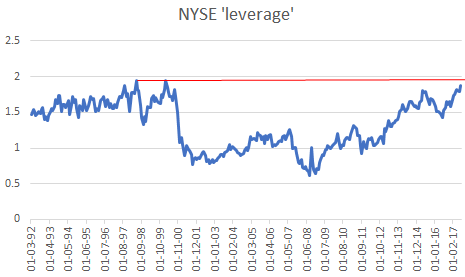
Source: NYSE. Leverage is calculated as the following ratio: NYSE firms debit balances in margin accounts (or margin debt)/ (NYSE free credit balances in cash accounts + credit balances in margin accounts)

Are stocks overvalued? This is the longest stock bull market without a X% drop since XXXX (input your own numbers; they are meaningless, anyway)…  Sure, you must know your history and you must know your valuations. That’s the minimum when it comes to investing money. But none of them provides an edge. History is a pattern recognition puzzle, and, nowadays, as long as you provide the right inputs, even a simple algo would be able to sort it out. Valuation, on the hand, is just simple math. But again, you need the right variables. Knowing what to include and what to omit is tough but it is what would make a difference.

There is one thing, however, which I think beats all other ‘basic’ variables when it comes to figuring out the turning points in investment trends. I think that is leverage. Leverage matters especially in situations like we have today with stocks hitting all time highs and smart people questioning the sustainability of this long bull market. The thing is, we believe history and valuations provide the answers but it is a mind trick – we get the impression they do because that’s what we have been told and because it looks like this… but only in hindsight.

The market, however, can go down on anything that scares people if leverage is high. And it would not be one particular thing: everyone might have a different reason to sell. It could be a geo political event or it could be even something personal. But the underlying reason for selling would be the same – they had to sell!

“Everything needs to change, so that everything can stay the same” (‘Il Gattopardo’, Guiseppe Tomasi di Lampedusa). In other words, what is the context? The same event that happened 50 years ago might provide a totally different outcome now. If it was otherwise and life was linear, investing would have been too easy and life would have been too boring.

For example, history ‘changed’ in 1982 when rule 10B-18 was introduced providing ‘safe haven’ for US companies to buy back their own shares. Corporate buybacks were almost non-existent before. After this rule came into place, US corporates became the biggest buyers of US shares. The result has been negative net-issuance of US shares since at least 2000. Let me repeat that, the net supply of US shares (IPOs, etc. minus buybacks, etc.) has been negative for the last 17 years or so. How many people are taking this into account when they do their valuation analysis?

On the other hand, given how much the composition of stock indices has changed throughout time, how relevant is it to look at a time-series of index-based valuation variables?  Aren’t we comparing apples to oranges? Should US Steel, for example, trade at the same multiples as IBM, Apple, Amazon? I do not have answers to these questions. And even if I did, it would be irrelevant because what matters is what everyone else also thinks, and even if I knew what everyone else thinks, it would be still irrelevant because people do not always do the things they should be doing or thinking. But people always act when they do not have a choice.

When your broker calls you to post some extra margin, which you cannot do, you do not have a choice but to sell. But, don’t worry, this is not going to happen when stocks are hitting all-time highs. So, don’t get too excited about getting the top of the market even if you know what the leverage is. But knowing that the leverage is too high and that, maybe, just maybe, people do not have a choice, will help you sell AFTER the market has gone down 2%, 5%, 10%… Whatever that number is, whenever you think the ‘pain’ becomes unbearable. This is when the trend changes and the buy-on-dip guys get buried and it becomes sell-on-pops.

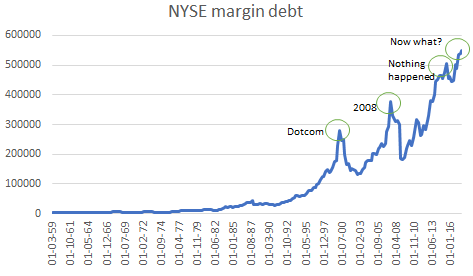
So, the trick is to measure the leverage or to at least to get an idea of how extended it is. One widely cited measure is the NYSE margin debt (the debit balances in margin accounts – chart below). I remember it was a compelling chart to look at in the summer of 2013 when margin debt was approaching the pre-2008 highs. But then it kept going and going, hitting new highs ever since… In the spring of 2015, after it had hit yet another high, it started dropping all the way until the beginning of 2016. And what happened to stocks? Nothing. Margin debt  is sitting on a new high even now but anyone shorting stocks using this measure of leverage has not done that well recently.

Source: NYSE

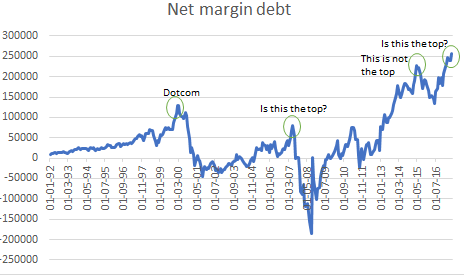
We can also look at the difference between the credit (+ cash) and debit balances of firms’ margin accounts on the NYSE. I call that net margin debt (chart below). That’s even more confusing as we can see the pre-2000 top but for some reason NYSE firms were in net credit (big negative spike) just before the Lehman Brothers bankruptcy. And again, since the summer of 2013 this measure of leverage has been hitting new highs.

Source: NYSE

Alternatively, we can look at the ratio between the two, or what I called, NYSE ‘Leverage’ (chart at the top of the post). This measure is approaching the highs reached at the peak of the Russia crisis and Dotcom crisis. Should we sell? How well would we have done if we followed this signal in 2008? Quite bad actually as this ratio hit the bottom the month before Lehman’s bankruptcy. But of course, 2008 was a ‘debt’ problem, not an ‘equity’ problem like 2000 was. Still US equities had a peak-to-trough decline of more than 50% back then. The bottom line is still that there was not much in the equity valuations and ‘nothing’ in equity accounts leverage that would have helped us predict such an outcome.

These charts above are not especially useful and would not have been much help in our investment decisions. That’s because even leverage has to be taken into context when looking at history. Because even if you have to post extra margin but you can still borrow at a reasonable rate (somewhere else) you might decide to choose the latter instead of selling. So, ceteris paribus, high leverage and high interest rates are the worst possible combination, but high leverage and low rates (the status quo since 2013 at least) means nothing.

Source: NYSE

Indeed, in the context of US interest rates, NYSE leverage actually looks reasonable, not too far from the lows post 2008 financial crisis (chart above). This is purely a function of how low rates have been in that period. Notice, for example, the high leverage throughout the 1990s when we also had a booming stock market. Which opens up another angle of thought. If rates do rise, as the base rate is indeed right now, then high leverage can quickly become a problem.

The turn in the bond market could come only after a negative supply shock

11 Monday Sep 2017

Posted by beyondoverton in Uncategorized

≈ Leave a comment

The bear market in bonds will not arise because of a pick-up in aggregate demand (AD) but because of a possible decline in aggregate supply (AS).

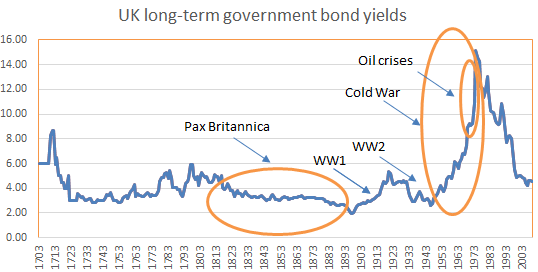
Source: BoE Three Centuries of Data

In times of peace (Pax Britannica see chart above), which allow for capital to accumulate, interest rates trend lower. Wars, conflicts, or even big natural disaster, deplete the capital stock and force interest rates to rise. Sometimes, when these negative supply shocks are one-off occurrences (the 1970s oil crises), we could get just a spike in interest rates; sometimes, if the conflict persists, the increase in interest rates can last much longer (the Cold War).

We are in a period when global capital surpluses have been accumulating at an increasing pace at least since the early 2000s when China entered WTO and most capital barriers were gone. Interest rates have been trending lower since the mid-1980s after the effects of the negative supply shock caused by the oil crises subsided and when eventually, shortly after, the Cold War ended. Some call this the biggest and longest bond bull market in history. It is, probably the biggest because interest rates have gone down from double digits in the 1980s to almost 0% now. But it is certainly not the longest. Interest rates in Britain trended down from 6% to 2% for almost 100 years in the 19th century.

We know that nothing lasts forever in life. Investment trends also end at some point. We spend a disproportionate amount of time and actual and mental capital on predicting these turning points. However, we should probably, instead, heed the words of famous British football coach, Kevin Keagan who is supposed to have said, “I know what is around the corner – I just don’t know where the corner is”. He almost sounds like a portfolio manager when he adds, “But the onus is on us to perform and we must control the bandwagon”.

If we are looking, nevertheless, for the turn in this global bond bull market, we are not going to find it in lower unemployment or even higher wages. In fact, it is unlikely to show up in any economic variables which determine AD. Instead, we should look for signs of any pressure on AS. In an environment of slowing population growth in the developed world and rapid technological expansion, AS can generally accommodate any expansion of AD. However, we should start to get worried if the sustained rise in inequality endangers our institutional infrastructure which leads to a social conflict.

Progress is deflationary. The moment humanity moved from hunter-gathering to agriculture we started creating capital and labor surpluses. Thanks to them we progressed as we could devote extra resources and time to other activities other than survival. At present, when work is equated with a job and income, few people connect that it was because of our leisurely activities that we had a chance to develop the arts and sciences of the past, which defined our culture and laid the foundation of our evolution through history.

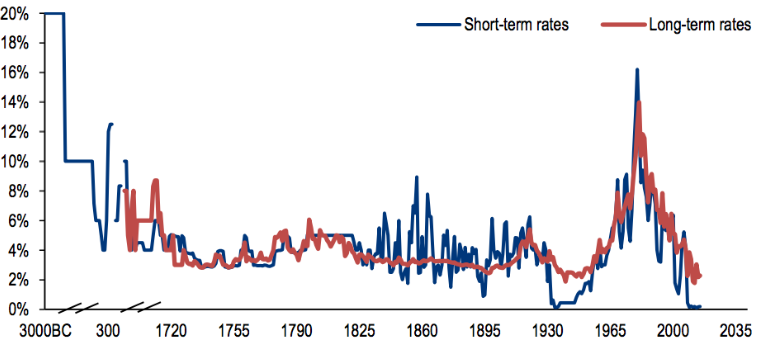
Source: Business Insider; original data from ‘History of Interest Rates’ by Homer and Sylla

Interest rates measure the cost of capital. So, naturally, when capital is abundant, ceteris paribus, interest rates should be low. And even though interest rates have generally moved from the upper left corner of the graph, in Babylonian times, to the lower right corner, now (chart above), history is full of examples when they also go up, and in some cases in a sustained fashion. There could be many reasons for that, but suffice it to say, that any event, natural (earthquakes, floods, etc.) or artificial (wars, epidemic diseases, etc.) which depletes either of the two surpluses would push interest rates higher.

Unfortunately, there have been many more artificial than natural disasters which have delayed our human progress. Nature is unpredictable, but human nature, not so much so. Therefore, some patterns keep repeating in history. Sometimes, it takes years for them to play out but eventually they do. For example, as mentioned above, ever since the Agriculture Revolution, and thanks to the prevalence of capital surpluses, the general norm has been one of AS > AD. The way we have dealt with this s to create an institutional infrastructure to help us distribute the capital surpluses in the most optimal way. Feudalism, capitalism, socialism are some examples of what we have gone through history depending on the level of our economic/technological development.    

The problem arises, when a paradigm shift comes around and changes the mode of both production as well as consumption. The Agriculture and Industrial Revolutions are examples of such positive supply shocks which changed the course of our evolution profoundly. In times like these, because of the inertia of the past and numerous vested interests, the institutional infrastructure takes much longer to adjust to these developments. Therefore, as the capital surpluses keep adding up but their distribution mode remains the same, and thus, outdated, the economy becomes more and more imbalanced (AS>>>AD). The point eventually comes when we ‘force’ a change also in the institutional framework to one more suited to deal with these new surpluses.

In the past these changes in societal structure have generally happened through wars and revolutions, a side effect of which has also been a sometimes substantial reduction of the capital (and labor) surpluses. For example, the period between the end of WW2 and now is considered one of general world peace. And indeed, relative to the horrors of the war which preceded it, it was. But despite the fact that indeed there were no major traditional global wars after 1945, the Cold War was a major global war of ideologies, in which few shots were fired, but one which caused a large capital outlay (military build-up, but also huge government investments in space exploration, and in general, technology).  In addition, there were a lot of proxy wars (Afghanistan, Korea, Vietnam) and conflicts (for example, the 1970s oil crises were a result of such a proxy conflict). As a result of that, interest rates tended to stay high.

By the end of the Cold War, when it was clear that capitalism had gained the upper hand as the main institutional framework of the time, interest rates started to subside. After the 1980s it was clear that USA was to become the global dominant power. In addition, all these government investments started to pay off and eventually ushered the Digital Revolution which is ongoing right now. To a certain extent, one could think of this period since then as Pax Americana, in reference to the global dominance of Britain during most of the 19th century.

Despite the war on terror, which has required also substantial amounts of capital, the fact that most of  the modern world has been in peace, has allowed the proliferation of globalization with trade and commerce booming. Not only the majority of the global surplus capital has found its way back to the US as the default safe haven given its dominance status (and given that the Washington Consensus had made sure most global capital barriers were off), but also it has been US corporates which have hugely benefited from the process of globalization. And finally, US households surplus savings have increased massively. In addition, the Digital revolution could also be ushering a similar paradigm shift to what happened after the Agriculture and Industrial Revolutions in the past.

Source: IMF

Around 60% of these FX reserves are in invested in USD. But is this excess foreign capital trend up now reversing?


Source: US Federal Reserve Z1 Flow of Funds

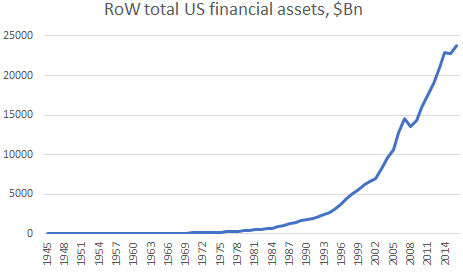
The rest of the world (RoW) total US financial assets (market value) have continued to increase. There was an ‘exponential’ pick-up in the late 1970-early 1980s. As of the end of 2016 there was almost $24Tn of foreign money (private as well as public) invested in US financial assets.

Source: US Federal Reserve Z1 Flow of Funds

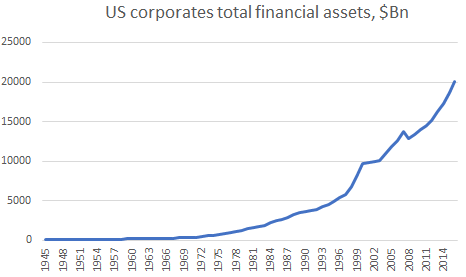
As of the end of 2016, US corporates held about $20Tn of US financial assets (of which about $2tn cash).

Source: US Federal Reserve Z1 Flow of Funds

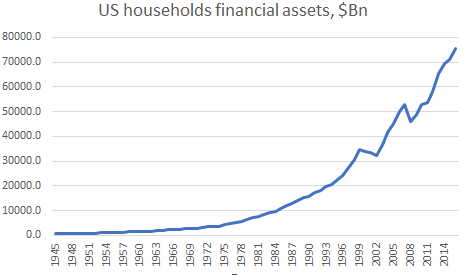
Finally, US households hold about $75tn of US financial assets.

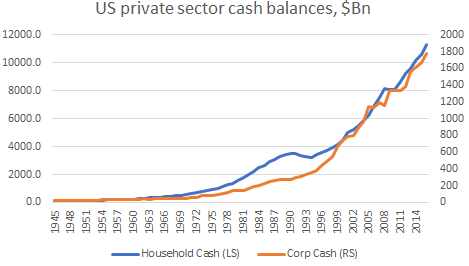
The above numbers are in market value, and market value tends to rise in the long-run as GDP also tends to rise. But even if we strip out the rest and look at nominal cash balances, the US private domestic sector is in huge surplus (chat below).

Source: US Federal Reserve Z1 Flow of Funds

So, it is almost counter-intuitive from what we learn in economics where we are accustomed to believing that a rising GDP is associated with higher interest rates because of the need to suppress potentially inflationary pressures. Reality is that a rising GDP also produces more excess capital which tends to naturally put pressure on interest rates lower. In fact, I wonder whether, if the central banks do not artificially put up base interest rates to supposedly slow down the economy, in an environment of a declining population (slowing AD) growth and an accelerating growth of technological improvements (a large positive supply shock), interest rates would naturally drift lower as GDP rises.

When it comes to debt stock, the data still favors EM, but flow dynamics matter

09 Saturday Sep 2017

Posted by beyondoverton in Debt

≈ Leave a comment

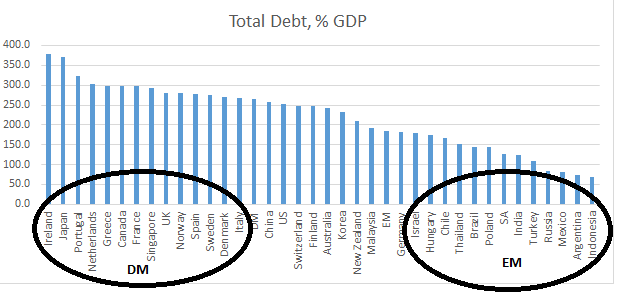
In this post I am looking at debt sustainability, or the horizontal axis of the debt matrix presented here, using data from 36 countries of which 20 are developed markets (DM) and 16 are emerging markets (EM). Source: BIS

Total non-financial debt is composed of Private Debt and Government Debt. Private Debt can be further broken down between Households and Corporates.

Summary

  • In terms of total debt as a % of GDP, the most vulnerable 14 countries are all DM with Ireland (379%), Japan (371%) and Portugal (324%) taking the lead; on the other hand, the least vulnerable 13 are all EM with Indonesia (68%), Argentina (74%), and Mexico (82%) bringing in the rear. However, in terms of debt flow dynamics, EM has generally put on more debt after the 2008 financial crisis than DM.
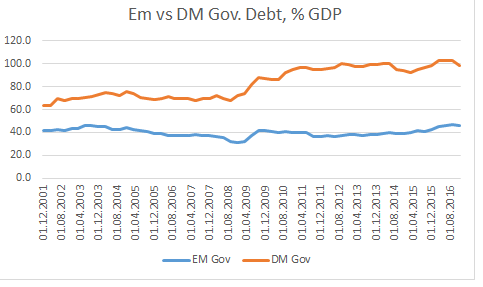
  • We cannot see the latter development in the government debt picture. The 9 countries with the highest government debt to GDP are all DM, while the bottom 5 are all EM. In addition, the gap between DM and EM government debt since the 2008 debt crisis has widened (i.e. DM put on more government debt than EM).
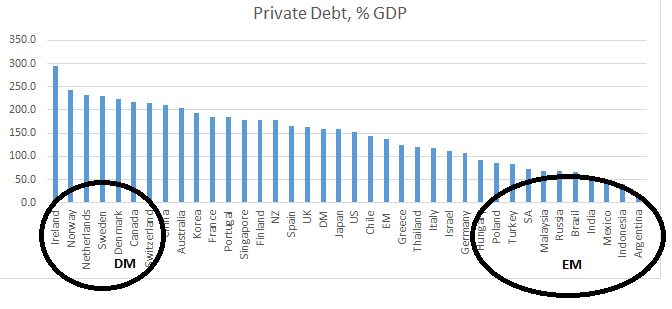
  • But we can see that in the private debt picture. Yes, in terms of debt stock, the worst 7 countries are still all DM and the best 11 countries are all EM, but in terms of flows, the gap between DM and EM since the 2008 financial crisis has substantially narrowed – i.e., EM countries have accumulated substantially more private debt than DM countries.
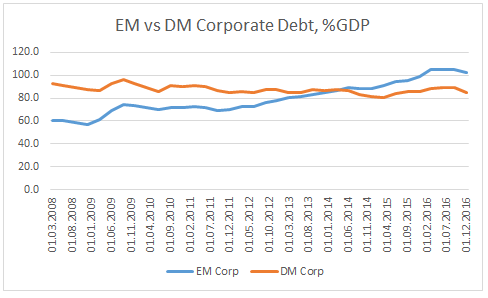
  • The reason for that is EM private corporate debt, which has surpassed that of DM.
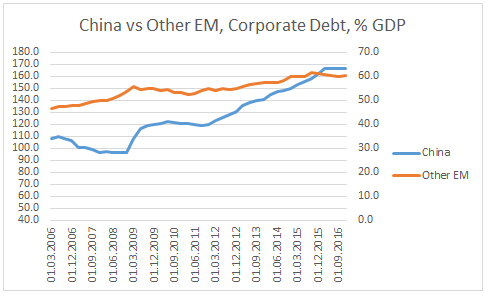
  • Nevertheless, if we strip the effect of China, the increase in EM corporate debt is not that dramatic.
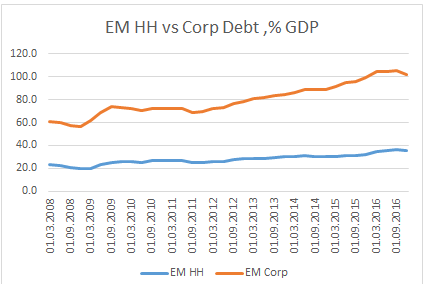
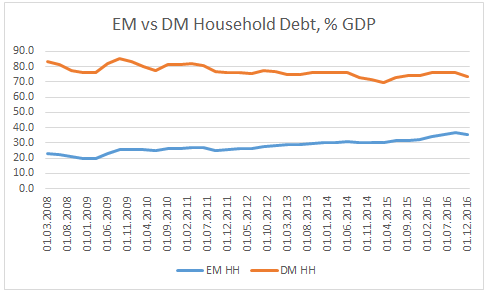
  • There is one area in which EM private debt is still in much better shape than DM. That is household debt, where, in terms of stock, EM’s indebtedness is still half that of DM’s.

(Please click to enlarge for all chats in this post)

Details and charts

Total Debt

The worst indebted country is Ireland with its total debt as a % GDP doubling between 2008 (250%) and 2015 (500%), before settling in at 379%. There was a similar spike in indebtedness with most European countries in the top echelon of the above chart. Japan’s debt, on the other hand has been steadily increasing throughout the period.

The debt stock of the best EM countries is still several magnitudes less than that of the worst DM countries above. However, while DM’s overall debt levels have been more or less unchanged in the years after the crisis, EM has been putting on debt.

EM debt as a % GDP has increased from 140% (2009) to 185% (2016), while DM debt has been relatively stable at 265% of GDP.

Government Debt

Overall, EM debt stock as a % of GDP (46%) is more than half that of DM’s equivalent (98%).

And the gap has widened after the 2008 financial crisis, with DM government debt increasing while EM’s generally stable.

Private Debt

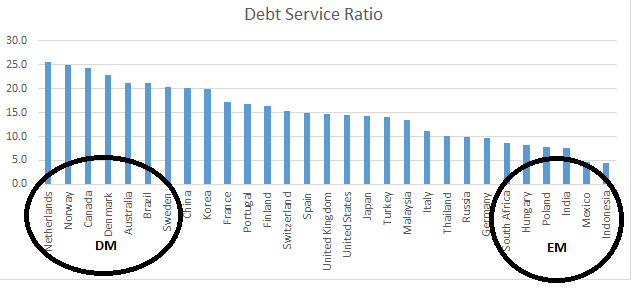
The latest private debt stock figures do not give us any additional information other than what we have already seen in total and government debt above: the most indebted countries being DM and the least EM.  The private non-financial debt service ratios confirm that as well (chart below).

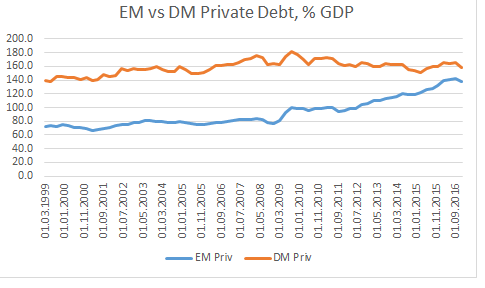
However, the flow picture looks very different.

The gap between DM and EM private debt to GDP has substantially narrowed. If before the crisis, EM debt was less than half of DM debt (84% vs 176%), now they are almost on top of each other (138% vs 158%): EM has leveraged while DM has deleveraged.

(As per BIS, Credit-to-GDP gap is defined as the difference between the credit-to-GDP ratio and its long-term trend.)

After 2008, while DM has generally de-levered private debt at the expense of public debt, EM has levered private debt while public debt has remained the same. As a result, EM has levered while DM has de-levered. But where exactly has EM put on debt?

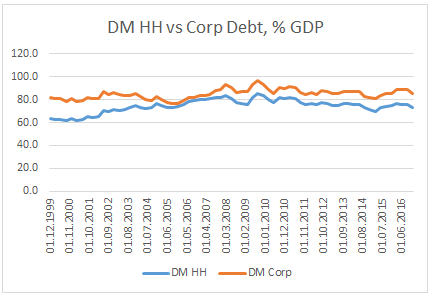
Both EM household and corporate debt have increased since the 2008 crisis but the bigger change is in the latter.

DM, on the other hand, has de-levered both household as well as corporate debt.

EM corporate debt surpassed DM corporate debt in 2014. However, if we strip the effect of China, the rest of EM’s corporate debt does not seem to have risen that much since 2008 (chart below).

In addition, EM households’ balance sheet still seems relatively much cleaner compared to DM’s (chart below).

The bottom line is that while DM’s debt stock is hitting extreme levels, EM’s still has room to grow. In addition, while all public and private debt levels are very high in DM, EM can in theory de-lever its corporate debt at the expense of either household debt or government debt and still keep its total debt level in check.

Conclusion: EM debt picture still looks generally healthier than DM’s equivalent. In fact, EM government debt dynamics have improved relative to DM’s after the 2008 financial crisis. The opposite has, however, happened in private debt dynamics. Nevertheless, despite worries of an increase in EM private debt indebtedness after 2008, this is mostly constrained to China’s corporate debt. EM household debt dynamics are also in much better shape than DM’s.


Flying blind in an ocean of data

08 Friday Sep 2017

Posted by beyondoverton in Uncategorized

≈ 4 Comments

When it comes to the economy we have been flying blind for decades. Economic activity has evolved from manufacturing to services and now to something else completely: we are slowly leaving the physical medium and entering the digital medium where VR/AR, IoT, etc. are the new norms. Yet, we have continued to use the same data, the same measurement techniques, the same assumptions, and the same economic models. No wonder we are not getting anything meaningful form them, while economic growth sputters and inequality continues to increase. The risk here is to our long-established institutional framework. If recent events in the UK and US are examples of the effect of these technological and economic developments, then, barring a change of course, the political system in the developed world could come under even much more pressure.

There is so much to learn from history. Surely this is not the first time we have faced such disruptions. Indeed, after the crash of 1929 and during the following Great Depression, we similarly had no clue what to do. And it was largely because we did not know what had happened to us: thanks to the inventions of the Second Industrial Revolution, the economy had started transforming from being mostly agriculture to manufacturing. Technology had made possible both the production of increasingly larger quantity of goods (anything to do with farming at the time) and the displacement  (from employment) of increasingly more farmers: an uncanny increase of aggregate supply (AS) and a simultaneous decrease of aggregate demand (AD)!

“One reads with dismay of Presidents Hoover and then Roosevelt designing policies to combat the Great Depression of the 1930’s on the basis of such sketchy data as stock price indices, freight car loadings, and incomplete indices of industrial production. The fact was that comprehensive measures of national income and output did not exist at the time.” Richard T. Froyen, History of the NIPA

Part of the problem of not knowing what was going on was not being able to measure economic activity properly. Back then (the 1930s), in the 1980s, when the manufacturing to services transition was largely taking place, now, we seem to prefer to go on autopilot instead of updating our economic knowledge with the developments that have happened in other disciplines, such as technology.

For example, when manufacturing is only 12% of GDP, do we need to continue to put so much importance on manufacturing PMIs, for example? I remember sitting on my desk and looking at the Bloomberg terminal with trepidation every single time the NFP number was about to be released…No wonder it has become almost impossible to make money nowadays if our only gauge of economic activity is these publicized numbers. Correlations are broken, cause and effect has vanished. At best the numbers only give us a snapshot of a small and decreasing part of the ‘economy’, at worst they are totally misleading. Take, indeed, NFP: unemployment is close to its all-time lows and the Fed has hiked rates in anticipation of an inflation pick-up, but there is not even the prospect of inflation.

When the economic status quo changes and we ignore it, the ensuing vacuum creates imbalances which, taken to the extreme, can cause asset price crashes and extreme economic hardships. We got lucky in the 1930s in some countries which had strong leaders not afraid to take drastic actions – DLR’s ‘New Deal’; Takahashi Korekiyo’s ‘helicopter money’. It was fortuitous that some countries also decided to make a clean break from past economic models – the gold standard was abandoned. These measures might have been enough to stop the economic plunge, but not enough to return the economy to its pre-crisis prosperity.

We know in hindsight, sadly, that we had to endure a great war, to finally pull through the economic crisis.From an economic standpoint, WW2 did reduce aggregate supply as capital was depleted and destroyed. The government stepping in with increased spending on the war effort stabilized aggregate demand. It took more than two decades, but eventually both the economy and the stock market managed to recover the lost ground during the Great Depression.

Let’s hope that we do not have to go through the same experience this time around. With all this Big Data sloshing around, with the help of AI and machine learning and the prospect of quantum computing, someone out there surely is designing the next economic model to fit this new reality. Would the next Simon Kuznets, please, step up! According to the BEA, GDP was one of the great inventions of the 20th century and even though it took 8 years after the crisis for the data to be organized and officially put to use, it was worth it.

“Much like a satellite in space can survey the weather across an entire continent so can the GDP give an overall picture of the state of the economy. It enables the President, Congress, and the Federal Reserve to judge whether the economy is contracting or expanding, whether the economy needs a boost or should be reined in a bit, and whether a severe recession or inflation threatens.

Without measures of economic aggregates like GDP, policymakers would be adrift in a sea of unorganized data. The GDP and related data are like beacons that help policymakers steer the economy toward the key economic objectives.” Economics, 15th edition, Paul Samuelson and William Nordhaus

We need our own 2008 Great Recession GDP breakthrough. Yes, the NIPA accounts have been continuously updated since the 1940s, but for all intends and purposes it does feel indeed that we are adrift in a sea of unorganized data. Nowadays, there are billion of devices connected to the Internet with trillion of sensors but less than 1% of that data is utilized! For example, there are human sensors (miniature devices attached to our bodies which monitor our health) which could also be configured to monitor productivity; home device sensors which could give us real-time consumption; factory sensors which could give us real-time production, etc. Most of this data never reaches the operational decision makers.  Yes, there are still some technical challenges as connectivity and storage etc., but as the blockchain becomes even more sophisticated and the data is organized in a proper way, there should be no reason why it cannot be more widely used for macro decision making.

Just as GDP came as a response to the transition from agriculture to manufacturing in the 1920s, we should have looked into completely revamping our NIPA methodology probably already in the 1980s when the shift from manufacturing to services was completed. For example, accounting for services is more difficult as they are not uniform like manufactured goods and are often tailored to the customer.

At least in 1971 we scrapped another vestige of that old world – the Bretton Woods agreement. However, the two consecutive oil crises that followed, had the effect of one of those ‘black swan’ events that probably genuinely took us off course as they substantially curtailed aggregate supply and contributed to the rise of inflation. People do not get it but that supply shock in peaceful times was the anomaly. And because it was a one-off event and did not destroy capital (or labor) as during wars or even natural disasters, the inflationary spike which followed was literally temporary. But, instead, we hiked rates to double digits, and as the economy submerged even more, we got Reagonomics (supply-side economics) and adopted inflationary targeting (which we still practice even now).

When that did not work (in times of technological progress and peace – the period after WW2 – supply is never an issue, but demand is), we decided to financialize the economy and submerge it in debt. With the focus on the supply side and not on the fact that aggregate demand was faltering as manufacturing jobs moved into services but at a lower wage, the only way to replace the lost purchasing power was with debt.

Sadly, the result proved out to be not that much different than the 1929 crash (despite the numerous warnings: the 1980s EM debt crisis, the S&L crisis, the 1990s EM crisis…). In 2008 the great super debt cycle finally stopped for good. True, the aftermath of this most recent crisis was not the disaster the Great Depression had been. Thanks to those lessons from the past, we quickly resorted to a version of the ‘New Deal’ but for banks, and we expanded the monetary base (and again, we created money which were only available to the banks; for everyone else, money came at a price – a still positive interest rate despite base rates being negative in some countries).

In the aftermath of 2008 we managed to stabilize the situation, and even though, unlike the 1930s, the stock market and GDP are well above their pre-crisis highs, inequality continues to worsen. We still have not figured out the real reasons we ended up here. We keep asking questions like, Why is productivity so low? Why aren’t there any wage pressures? Why has labor participation declined? Etc. We need to answer these questions but we need to stop guessing and start thinking how to incorporate the advances of technology into our economic measurement techniques.  We need the data to convince our central bankers the plainly obvious for anyone with ‘real-life’ experience that structurally AD<AS.

And once we do that, we need to develop a plan how to boost AD. As long as there is peace, and because in the developed world we are lucky to have the proper institutional infrastructure which promotes entrepreneurship and protects its achievements, AS will take care of itself. But at the same time, that exact institutional framework which allows AS to grow unhindered, also prevents AD from growing: the same advances in technology which foster growth have also broken the Work=Job=Income model.

Therefore, it is a tricky and delicate situation: how do we change the institutional infrastructure to accommodate these technological changes but also preserve it to foster even more advances? For example, can we institutionalize a rise in wages, like ‘limited wage’? We could, but most likely that would only incentivize companies to speed up automation.

Or we could go the other way, like imposing a ‘Luddite-like’ ban on automation which forces companies to hire more humans. We could also limit the supply of labor by building a real wall on the border with Mexico or an imaginary wall with the EU, or by de-globalization, or, at the extreme, war…Obviously, none of these acts would be welcomed and most likely they would backfire and cause enormous human suffering. Actually, it is not completely out of the question that an overly ambitious and eager ‘benevolent’ government would use an AI algorithm one day to optimize the AD<AS issue with the end result being exactly one of those above.

How about just giving ‘money’ directly to people? And, let’s not use this loaded word, ‘money’. Because, all we would be doing is updating numbers on a spreadsheet. We can’t run out of numbers, can we?

It is difficult to offer a solution to these issues without the proper data. Even in the latter case, how do we know when AD eventually equals AS? How do we know when to stop before inflation does indeed rear its ugly head? Experimenting is what we have done for the last century or so, and thanks to the forces of capitalism we have done this well, certainly much better than any other possible alternative. But even if we want to, it is becoming increasingly clear that we cannot continue with this trial and error method: the ‘errors’ are piling up and are about to crumble our faith in the institutions which govern our modern society. Let’s just hope it is not already too late for a change.

George Carlin (1)

07 Thursday Sep 2017

Posted by beyondoverton in Quotes

≈ Leave a comment

  • “People who see life as anything more than pure entertainment are missing the point.”
  • “Always do whatever is next.”
  • “Most people work just hard enough not to get fired and get paid just enough money not to quit.”
  • “Not only do I not know what’s going on, I wouldn’t know what to do about it if I did.”
  • “I think people should be allowed to do anything they want. We haven’t tried that for a while. Maybe this time it’ll work.”
  • “Never underestimate the power of stupid people in large groups.”
  • “If you try to fail, and succeed, which have you done?” 
  • “I do this real moron thing, and it’s called thinking. And apparently I’m not a very good American because I like to form my own opinions.” 
  • “I went to a bookstore and asked the saleswoman, ‘Where’s the self-help section?’ She said if she told me, it would defeat the purpose.”
  • “Atheism is a non-prophet organization.”
  • “Tell people there’s an invisible man in the sky who created the universe, and the vast majority will believe you. Tell them the paint is wet, and they have to touch it to be sure.”
  • “How is it possible to have a civil war?” 
  • “Isn’t it a bit unnerving that doctors call what they do “practice”?”
  • “In America, anyone can become president. That’s the problem.” 
  • “The caterpillar does all the work, but the butterfly gets all the publicity.” 
  • “Some people have no idea what they’re doing, and a lot of them are really good at it.” 
  • “It’s never just a game when you’re winning.” 
  • “If the black box flight recorder is never damaged during a plane crash, why isn’t the whole airplane made out of that stuff? ” 
  • “Don’t just teach your children to read… Teach them to question what they read. Teach them to question everything.”
  • “I have lots of ideas. Trouble is, most of them suck. ” 
  • “I was thinking about how people seem to read the bible a lot more as they get older, and then it dawned on me—they’re cramming for their final exam.” 
  • And please don’t confuse my point of view with cynicism; the real cynics are the ones who tell you everything’s gonna be all right.” 

Not all debt is created equal

06 Wednesday Sep 2017

Posted by beyondoverton in Debt

≈ 1 Comment

Following up from a previous post which looked at a breakdown of US debt, here are my thoughts on a more general framework of assessing a country’s debt vulnerability.

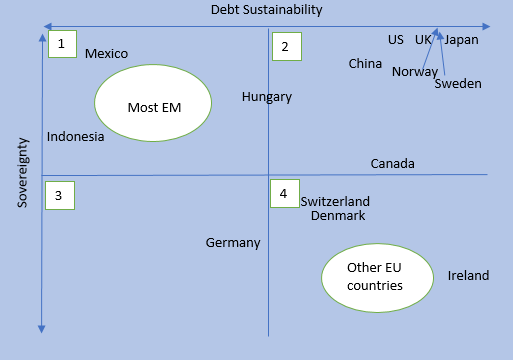
I suggest we look at debt along the lines of debt sustainability (private vs public) and sovereignty (foreign vs domestic). Everything else being the same, in terms of the ability of repayments, public debt is better than private debt, and domestic debt is better than foreign currency denominated debt. This is because it is possible to monetize the debt in the former (public and domestic), while not (directly) possible in the latter (private, foreign).

In the diagram below as one moves from left to right on the horizontal axis the country’s debt sustainability becomes worse; on the other hand, as one moves from top to bottom on the vertical axis, the country is deemed less sovereign (less able to monetize its debt).

(Data source to construct the diagram: BIS on private and public domestic debt, BIS/IMF/OECD/WB on foreign/external debt)

Therefore, one can discern the worst possible combination as being private and foreign debt (Quadrant 4 in the diagram above). An example of that would be Asian corporates/countries in the 1990s: because the countries had a pegged exchange system, i.e. they were not fully sovereign, even the domestic public debt would have been considered ‘foreign’, i.e. no monetization was possible. This, of course, led to the Asian crisis in 1997/98. On the other hand, the best possible combination is a sovereign country with mostly public and domestic debt. Actually, a lot of those same Asian and other emerging market (EM) countries now fall in this category (Quadrant 1). Even though, some of these countries still maintain a ‘dirty’ float, for example Indonesia (therefore not completely sovereign), their debt level is not only much smaller than before but it is also much smaller than a lot of the developed market (DM) countries. In addition, most of the EM countries have very little foreign debt.

Most of EU countries not only have a lot of private debt but they are also not sovereign because they are dependent on the ECB for monetization. In a sense, they all have only ‘foreign’ debt as their central bank is not allowed to create money and monetize. I have put Germany a bit higher than the rest of the EU countries simply because of its deemed influence on the ECB. However, Germany does have much less debt than most of the other EU countries, therefore, it is to the left of them. Actually, because the ECB ‘monetization’ came way too late, we had the EU sovereign crisis of 2011/12. And it was a sovereign (public debt) crisis for some countries directly because they had too much public debt (Greece, Italy) and for some it was indirectly because they also bailed out the private sector first (Ireland).

Japan has a lot of both private and sovereign debt but it is only domestic and the country is fully sovereign. Both US and UK have a lot of private debt but not as much public debt like Japan. However, just like Japan, their overall debt is mostly in their domestic legal tender, so they are fully sovereign.

China is a special case and it requires its own separate blog post. Suffice to say that it has a lot of ‘private’ debt in a foreign currency. However, it also has very little public debt and massive foreign currency reserves. Therefore, in theory, China can deleverage much easier the private debt (which is, actually, ‘quasi-public’ in many cases) by leveraging the sovereign – much easier than the way US, UK or EU had done during their own crises recently, or, in fact, Japan’s in the 1990s. China’s government balance sheet is cleaner in a way.

When it comes to debt vulnerability EM fairs much better than DM in general.

China’s belated move to ban ICOs could actually push token prices higher…

05 Tuesday Sep 2017

Posted by beyondoverton in blockchain, Monetary Policy

≈ Leave a comment

…in the short term as the supply of new tokens becomes restricted, and if demand stays the same. However, further regulations are more likely to take prices lower. Down the line, I would not be surprised if some tokens disappear completely.

To a certain extent, the crypto-mania now reminds me of the dotcom mania in the late 1990s. Both of them have an underlying cause that justifies their rise. In the case of dotcom it was the beginning of the digitalization of society (new ways to connect, work and entertain) and the promise of the commercial internet (new way to shop!). In the current crypto-currencies craze, the underlying cause is the scarcity of money, stemming from the rise of inequality on the back of the breakdown of the Work=Job=Income model, and the following promise of creating the new medium of exchange using a totally different framework (i.e. if we cannot get  the medium of  exchange by having a job, and it the central banks would not print the medium of exchange and  distribute it to the population at large, the population at large will create its own medium of exchange).

I know bitcoin, for example, is down 12% from the announcement of the ban on ICOs. That’s still less than the last time, in March this year, when PBOC also announced it was looking into tightening regulations on bitcoin trading. But that’s beside the point. One could say the most recent news is, actually, more important.

And it is indeed more likely that as the authorities start introducing even more regulations on crypto-currencies, their prices will become … less volatile but also settle down in a lower range. After all, without regulations, and without an underlying businesses per se, crypto-currencies currently do have an advantage over other regulated asset classes. But, strictly speaking, from a flow perspective, restricting the supply of an asset, should make its price go up, if demand is unchanged. The fact that new ICOs are not allowed should make the existing tokens more valuable.

Of course, that is only a short-term view, which does not take into account the possibility of further regulatory actions. It is surprising to me that it has taken such a long time for authorities to start looking into these ICOs and also, in general, into the spread of crypto-currencies, given that the latter are a direct threat to their own legal tender. In fact, there is confusion globally as to what indeed those crypto-currencies are. Are they an asset, a currency, or legal tender? Not only different countries have different definitions but in some countries the definitions vary depending on the regulatory authority even!

For the current crypto-mania to subside we do need to see central banks introducing their own digital legal tender accessible to everyone in society (and not just to banks and other select financial institutions as is the case now with central bank reserves). In other words, authorities need to address the underlying cause of the spread of the crypto-currencies. All other measures would most likely only temporarily slow-down their rise.


It should be abundantly clear by now, but let me state it here, that this blog does not constitute an investment advice. And I have no positions in any crypto-currencies/tokens.

US student loan debt increase: dramatic but not a systematic financial concern

04 Monday Sep 2017

Posted by beyondoverton in Debt

≈ 1 Comment

Summary

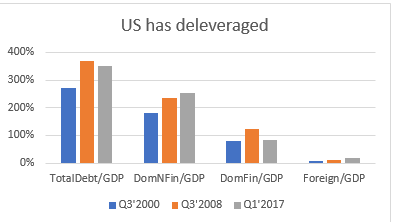
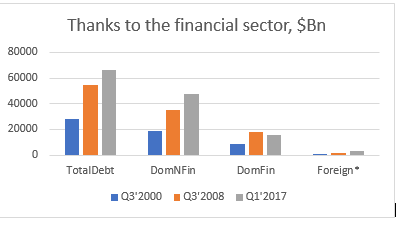
  • Even though total US debt is up in nominal terms since the 2008 financial crisis ($54.7Tn vs $66.5Tn), total debt as a % of US GDP is down (368% vs 353%)
  • It is the financial sector that has deleveraged both in nominal terms and as a % of US GDP ($18.2Tn vs $15.7Tn and 122% vs 83%, respectively)
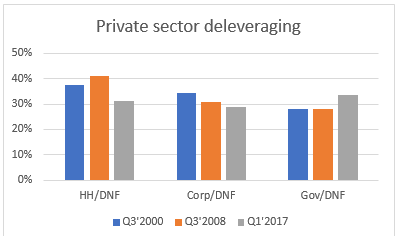
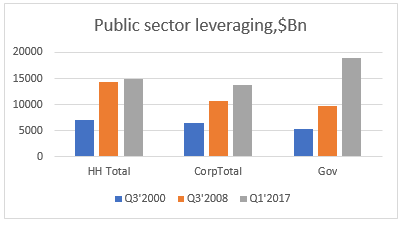
  • Of the nonfinancial sector private debt holders, households have deleveraged relative to GDP (97% vs 79%), while business have leveraged but only from 72% to 73%, even though both of their nominal debt levels have gone up ($14.3Tn vs $14.9Tn and $10.7Tn vs $13.7Tn).
  • The public sector (federal and state government) has leveraged both in nominal terms (the overall debt levels have doubled from $9.8Tn to $18.9Tn) and relative to GDP (66% vs 84%)
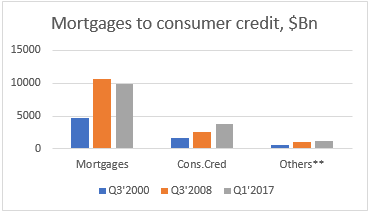
  • Households have reduced their mortgage debt from $10.7Tn to $9.8Tn, while increased their consumer credit debt from $2.6Tn to $3.8Tn
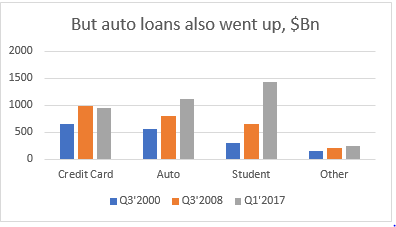
  • Out of consumer credit, households reduced marginally their credit card debt ($983Bn vs $959Bn), increased their auto loans ($802Bn vs $1.1Tn) and more than doubled their student loans ($659Bn vs $1.4Tn)
  • The media and some financial analysts are focusing on these latter increases in auto and student loans as a sign that households are increasingly leveraging again, however, the reality is that a large part of the increase in consumer credit debt is offset by the decrease in mortgage debt
  • In addition, neither student (8% GDP) nor auto (6% GDP) – nor the two combined – have the systematical and strategic significance of mortgage debt which was the cause of the 2008 financial crisis (72% of GDP at the time)

Charts and details

There is a lot of confusion sometimes when it comes to analyzing debt. From a macro point of view there are two main distinctions: private (household and businesses) vs public (sovereign) and domestic (denominated in the sovereign currency) vs foreign (foreign currency). The distinction above is important because for a fully sovereign country it is the private and foreign debt that one should be really concerned about.

The public sovereign debt can always be repaid because the sovereign can print the currency at will, even though in extreme cases that may mean currency devaluation and possibly hyperinflation. The private domestic borrowers have no choice but to find means of acquiring the legal tender to repay the debt. However, in some extreme cases, as in during the 2008 financial crisis, the sovereign can choose to bail the private sector out (the financial sector in this case) by resorting to creating currency ‘ex nihilo’.

Neither public nor private foreign borrowers (i.e. entities which have borrowed foreign currency) can resort to such privilege and, just like the private domestic sector, have to find means to obtain the foreign currency to repay their debt. Again, sometimes in extreme cases, as in during the Greek crisis, international institutions can choose to bail out the sovereign foreign borrower. This normally happens after the sovereign foreign borrower has first bailed out a private foreign borrower in their own country (as it happened for the financial sector in Portugal, Ireland and Greece during the European sovereign crisis).

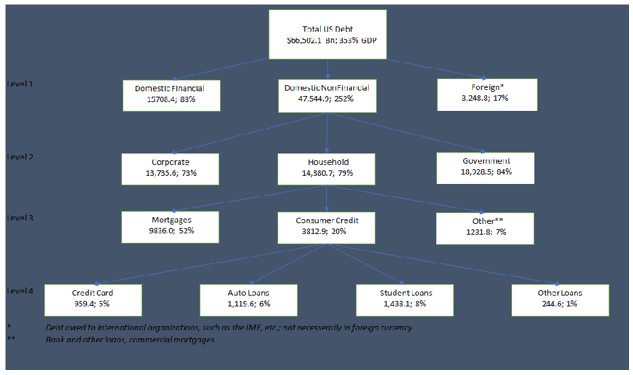
Here I focus on US domestic nonfinancial debt, i.e. both public as well as private but denominated in the sovereign legal tender. Here is a big picture view of that debt:

(Click to enlarge for a better view)

The numbers above are the latest available (Q1, 2017) from the US Fed Z1 Flow of Funds Report. All the data in this note are sourced from the above report. In the analysis below, which uses the above diagram as a basis, I have chosen to look at the relevant debt levels now as well as just before the 2008 and 2000 US crises.

Level 1 Analysis:

Relative to GDP, the US has deleveraged, even though the domestic non-financial sector has continued to leverage.

However, the US financial sector has deleveraged in nominal terms as well, which is quite extraordinary indeed.

Level 2 Analysis:

Here we drill down the US domestic non-financial sector debt. Relative to the overall domestic non-financial sector total debt, both households and the corporate sector have deleveraged.

It is the government (mostly the federal government) which has continued to leverage. Public sector debt has more than doubled since 2008 and almost quadrupled since 2000. But as per the above, even though the increase of public sector debt is an issue (see Japan), it is not a systematic issue (again, see Japan). Our concern is drilling further into the private debt story, more specifically the household sector.

Level 3 Analysis:

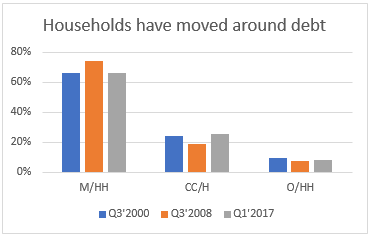
Mortgage debt as a % of overall household debt has decreased at the expense of consumer credit. The polar opposite of what happened between the 2000 and 2008 crises.

But in nominal terms, between 2000 and 2008, both mortgage debt and consumer credit debt increased (and mortgage debt more than doubled from $4.7Tn to $10.7Tn). That is why the 2008 financial crisis was so massive. Still, what is causing the increase of consumer credit debt?

Level 4 Analysis:

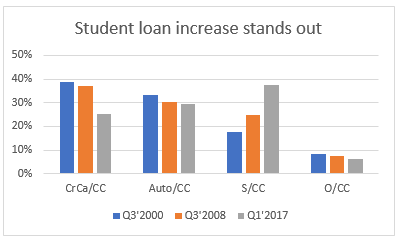
It seems out that the media, etc. does have a reason to focus on the ‘extraordinary’ rise in student loans, especially when they hit, and surpassed, the trillion dollar mark. Relative to overall household consumer credit, student loan is the only item which has increased.

In nominal terms, auto loans also surpassed the trillion dollar mark, but it is nevertheless the sheer increase in student loans which has captured the attention. Perhaps, there is much more to the student loan story than the financial implications. There is also the moral/emotional side of the fact that the cost of education has increased disproportionally to what it can offer in terms of advantages in the job market in the age of the sophisticated machine. While it is still true that a person with a higher education would generally fair better professionally, there must be a heavy discount to the fact that this person would have to also pay down the student debt which he/she acquired in the process. Once we draw the line, who is better off?

There is no doubt though that there is little in the above numbers to be concerned from a systematic point of view. At least relative to previous financial crises. A collapse of the student loan market would certainly affect consumer confidence and economic growth but it is unlikely to have the same catastrophic effect as the mortgage crisis of 2008.

Newer posts →

Subscribe

  • Entries (RSS)
  • Comments (RSS)

Archives

  • January 2023
  • December 2022
  • November 2022
  • August 2022
  • February 2022
  • April 2021
  • November 2020
  • October 2020
  • September 2020
  • August 2020
  • July 2020
  • June 2020
  • May 2020
  • April 2020
  • March 2020
  • February 2020
  • January 2020
  • December 2019
  • November 2019
  • October 2019
  • May 2019
  • March 2019
  • February 2019
  • January 2019
  • December 2018
  • November 2018
  • October 2018
  • September 2018
  • August 2018
  • June 2018
  • May 2018
  • March 2018
  • February 2018
  • January 2018
  • November 2017
  • October 2017
  • September 2017
  • August 2017
  • July 2017
  • June 2017

Categories

  • AI
  • Asset Allocation
  • blockchain
  • China
  • De-urbanization
  • Debt
  • Decentralization
  • EM
  • Energy
  • Equity
  • FX
  • g88kboy
  • Monetary Policy
  • Politics
  • Questions
  • Quotes
  • The last man standing will laugh
  • Travel
  • UBI
  • Uncategorized
  • VR

Meta

  • Create account
  • Log in

Blog at WordPress.com.

  • Subscribe Subscribed
    • BeyondOverton
    • Join 74 other subscribers
    • Already have a WordPress.com account? Log in now.
    • BeyondOverton
    • Subscribe Subscribed
    • Sign up
    • Log in
    • Report this content
    • View site in Reader
    • Manage subscriptions
    • Collapse this bar
 

Loading Comments...