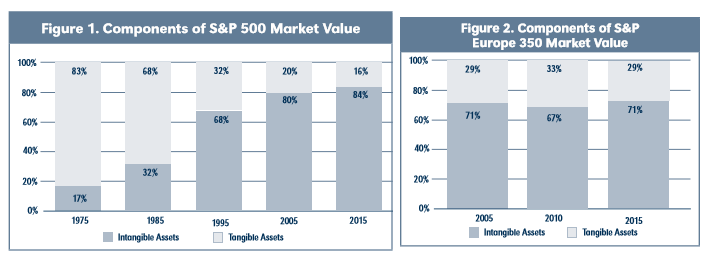
A simplified version of the monetary transmission mechanism


(Click to enlarge)

This is a follow-up on yesterday’s post which showed a simplified version of the hierarchy of money. This one dwells on why exactly the money supply is not reaching the end consumer and how this can be fixed.

The two main parts of the diagram are the financial system and the real economy. The financial system comprises all the main actors depicted in the “Hierarchy of Money”: the central bank, the banking system, shadow banks and cryptocurrencies. The link between the financial system and the real economy is the banking system (with the help, recently, of shadow banks and cryptocurrencies).

At the moment there is no direct way to ‘deliver’ safe assets from the central bank to the public. Everything has to go through the banking system which generates state-backed private money (the banks and the shadow banks) which then get lent to the public. Cryptocurrencies are a new addition to the financial system. Unlike the other actors, they generate private assets not backed by state money and, moreover, they can enter the real economy directly, not in the form of borrowing but in exchange for ‘work’ (the verification process) – which is what really makes them attractive to the other forms of money.

The process of QE is really a closed-loop within the financial system. All it does is swaps financial assets (mostly sovereign paper in the US and UK, some private assets in EU, and now a lot of private assets in Japan) for central bank reserves. The public does not get any benefit from QE directly. However, they do benefit from the lower rates of interest, thanks to QE, which the banks offer on borrowing (the downside being that demand for loans has decreased in the developed world after 2008 in general, and, moreover, banks are not that eager to extend new loans pressed by the recent regulations).

Within the real economy, there are generally two traditional ways to receive income: from corporates and from the government, in both cases in exchange for work. Working for the government had been on the rise before 2008 but with the push for austerity thereafter, this has slowed down. Corporate employment has remained stable but because of outsourcing abroad and especially because of technological automation of work, real wages have been stagnant for decades. Higher paid manufacturing jobs have been replaced by lower paid service jobs; full employment with benefits has been replaced by part-time employment without benefits.

In addition, corporates had been investing less and less in R&D and Capex, which in theory could have led to more employment. In fact, since 1982 when Rule SEC 10B-18 was introduced, corporate have preferred to engage in share buybacks.

So, one way for the public to replace the lost income from traditional employment has been direct borrowing from the banks. This is a phenomenon which started already in the 1980s with the financialization of the real economy. It really took off after the dotcom crisis when shadow banking offered cheap residential mortgages loans. After 2008, which marked the peak of the private debt super-cycle, this has also slowed down massively.

This opened the way for cryptocurrencies to fill in the void offering an alternative source of income – access to a seemingly safe private asset. Cryptocurrencies are a much riskier development than the shadow banking lending and if they are allowed to spread more widely within the real economy, they could lead to a much bigger financial crisis than 2008.

The economy cannot operate if all avenues which increase consumer purchasing power are either closed (Work≠Job≠Income) or they are becoming risky (direct borrowing from banks, shadow bank borrowing, cryptocurrencies). The public needs to be able to receive safe assets directly from the central bank (central bank digital ‘cash’) either in the form of discounted loans or even in the form of UBI.

A simplified hierarchy of money

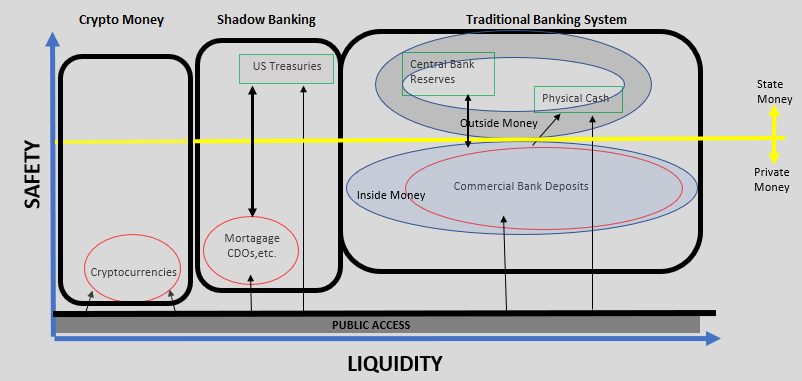
This is a simplified diagram of the modern monetary system from the point of view of liquidity (horizontal axis – liquidity increases as we move to the right) and safety (vertical axis – safety increases as we move upwards). It distinguishes among three types of monetary systems: traditional banking, shadow banking and crypto money. In addition, it defines money as ‘private’, i.e. money created in the private financial system (majority of money) and public or state, i.e. money created by the central bank or the government. Finally, the diagram shows which type of money the general public has access to at the moment.

This is work in progress, any feedback is welcome!

Traditional Banking System

The traditional banking system is centralized with the central bank sitting at the top issuing central bank reserves. To connect to the major payment systems, such as BACS or CHAPs in the UK or Fedwire in the US, financial intermediaries must have a reserve account at the central bank. Generally speaking, because central bank reserves are used only for settlement purposes between the central bank and commercial banks, they are sometimes called ‘outside’ money, i.e. money which sits outside of the real economy: the general public does not have access to them.

‘Outside’ money has gone to also comprise all state-issued money: in the US this is the physical coins issued by the government (the US Mint) and the paper dollars issued by the Federal Reserve (US Bureau of Engraving and Printing). It is only to this state money that the general public has access to. ‘Outside’ money is the safest money instrument out there: a fully sovereign government can never willingly default. The risk, as always, is only inflation.

Below state money lie commercial bank deposits which is private money created out of thin air on the back of public borrowing. This privately issued money comprises the majority of money in the system. Because of that, it is also called ‘inside’ money, i.e. this is the money that circulates within the real economy.

Commercial bank deposits are not as safe as state money because banks can go under (the money created is on the back of loans which are inherently risky). However, through the fractional reserve system which we have in place, part of that money is ‘backed’ by state money, i.e. every single time the commercial bank issues a loan by creating bank deposits it has to make sure it also has (or acquires/borrows) a portion of central bank reserves at the same time. In addition, some portion of the public deposits is insured by the state, so that even if a commercial bank goes bankrupt, some of the deposits will be made whole. Finally, all commercial banks are regulated by the central bank and subject to capital, liquidity and leverage requirements.

The public generally does not dwell much on the riskiness of commercial bank deposits. Except for Northern Rock in the UK in 2008, we have not had many major bank-runs in the developed world since the Great Depression. In fact, to most people who have deposits well below the insurance limit, commercial bank deposits are safe. It is this inherent link to the state which gives this impression of safe commercial bank deposits. In the words of former Bank of England governor, Mervyn King, “[M]any treat loans to banks as if they were riskless.  In isolation, this would be akin to a belief in alchemy – risk-free deposits can never be supported by long-term risky investments in isolation.  To work, financial alchemy requires the implicit support of the tax payer.”

The money created within this traditional banking system is the safest and most liquid form of modern money.

Shadow Banking

Shadow banking has been around for a while. In fact, in the mid-1990s, shadow banking liquidity in the US surpassed traditional banking liquidity. This, plus the fact that it is not part of the traditional monetary transmission mechanism (a lot of the liquidity created until 2008 was off banks’ balance sheets – not easy for regulators, or for that matter even bank analysts to spot it), contributed to the 2008 financial crisis. Since 2008, however, shadow banking liquidity has massively declined and now is again less than traditional banking liquidity.

In a similar fashion to the traditional banking system, the core of the shadow banking system is a state money-like asset: US Treasuries. The actual ‘money’ in the shadow system is also, similarly, a private asset in the form of a repackaged loan: the mortgage CDO/CBOs. US Treasuries are used as collateral for the mortgage packages, or one could say as settlement instruments not unlike the central bank reserves. Unlike in the traditional banking system though, the public has direct access to the US Treasury market.

The safety of the US Treasuries is on par with the safety of the state money in the traditional banking system. In terms of liquidity, it depends on the usage. The mortgage packages, however, are private ‘money’ which are substantially less safe than the private commercial bank deposits of the traditional banking system (even though, in most cases, the former had actually higher ratings, a fact which was at the core of the mortgage crisis of 2008).

The shadow banking system grew out of the inadequacy of the traditional banking system to distribute money efficiently. It was a perfect timing as well, coming on the heels of the dotcom crash when the authorities were more than eager to see the residential real estate market driving the bounce.

Crypto Money

This is the latest development in the transformation of the modern monetary transmission mechanism. In a similar fashion to the rise of the shadow banking system in the early 2000s, crypto currencies have come in to fill in the void of lost income post the 2008 crisis and the inability of modern money supply to reach the end consumer.

Crypto money is even worse (less safe) than shadow money because it lacks state money collateral. In addition, the private asset is created outside of the private financial system in a decentralized/distributed fashion. However, its claims of ‘equality’ when it comes to money creation (a permission-less system) may have been valid in the beginning, but with the complexity of the verification process increasing and the need for extra computer power, it is not the case any longer: a few ‘miners’ are now ‘in control. The hard forks which have happened in Bitcoin are an example of these vested interests.

Finally, on the positive side as this is the whole point, the public does have access to cryptocurrencies, but with their price having risen several times over just this year, reality is that now only the ‘privileged’ can afford to buy the major cryptocurrencies. And because they are considered a store of value, with a lot of buyers claiming they are going to hold them ‘forever’, cryptocurrencies are much less likely to be exchanged and thus their liquidity will continue to suffer.

Access to central bank balance sheet

The sovereign state through the central bank is the only issuer of safe assets. Ironically, in the process of QE with the aim to prop up the deleveraging banking system, the amount of safe assets has been greatly reduced (the central bank buys sovereign bonds, to which the public has access to, and issues reserve balances to which the public does not have access to). The demand for physical cash has actually risen in the developed world, partially on the back of this.

In fact, the central bank or the government does not have direct control over any of the safe assets the public has access to: coins are issued by the government and paper dollar are issued by the Federal Reserve but only on the back of demand for physical cash by the public (the public swaps electronic commercial bank deposits with physical cash – in other words, there is no mechanism by which the central bank/government can give physical cash to the public unless it passes through commercial bank deposits). US Treasuries are issued by the government but again they can generally be purchased only by swapping them with commercial bank deposits.

Because access to its balance sheet is so restricted, the central bank’s efforts to increase monetary liquidity post the 2008 financial crisis have been highly inadequate. In fact, in light of this, the central bank should have focused more on how to directly help the financial system with its deleveraging process, than on affecting the money supply. To that effect, it would have been much more beneficial for the central bank to focus on buying mostly private assets. Both the BOJ and ECB have eventually started doing this but more on the back of declining supply of sovereign paper rather than by design.

In addition, the ability of commercial banks to increase the money supply is severely limited not only because there is less borrowing demand from the public but also because capital and leverage regulations (Basel III) make it prohibitively to do so. So, as the money transmission mechanism stalls, similar to the period post the dotcom crisis in the early 2000s, the market has gone and created alternative private safe assets to supplement the public’s need for money: this time, cryptocurrencies. Because they are even more toxic than the sub-prime mortgage packages, the more widespread they become with the pubic, the higher the risk of an even bigger-than-2008 financial accident.

The answer could be widening out access to the central bank balance sheet for the whole population. This can be done in various ways using the same blockchain technology now prevalent amongst the various cryptocurrencies. Indeed, a previous post listed some of the major central banks and their efforts in this direction.

What is the optimal central bank balance sheet size?

Answer: Depends on the size of the overall financial system balance sheet and whether it is deleveraging/leveraging.

This is a follow up on a previous post addressing the rationale for a continued increase of the major central banks’ balance sheet barring a sudden rise in the ‘private’ banks’ balance sheets.

Summary: We have been used to a small and relatively stable central bank balance sheet because before the 2008 financial crisis, the banking system balance sheet had been steadily growing. However, post the crisis, the banking system started deleveraging across the developed world. To avoid a continuation of the financial crisis, the central banks there had no choice but to leverage, i.e. increase their balance sheet.

Going forward, the size of the central bank balance sheet will be very much determined by what happens with the banking system balance sheet as a whole: if banks continue with the deleveraging, something which is more than likely given the plethora of financial regulations (Dodd-Frank, Basel III, MIFID2, FATCA, AMLD, AIFMD, CRS, etc.), the central bank may have to continue to expand its balance sheet or face another financial crisis.

Background

Since the 2008 financial crisis, to most economic observers, central banks have been increasing their balance sheets in order to facilitate easier economic conditions having exhausted their conventional means to do so. There is a strong debate among economists, investors and market practitioners, in general, about the effectiveness of such policies. I argue that the direct economic issues (growth, inflation) may have been of secondary importance to the reasoning behind the increased central bank balance sheets.

Central bankers’ primary objective may have been financial stability, including maintaining a stable rate of growth of the country’s total financial balance sheet. In that sense, some central banks’ balance sheet may need to grow even larger if the ‘private’ banking sector continues to deleverage.

On one hand, central banks’ balance sheets are unique in the sense that they act as the lender of last resort: they control, and, to a certain extent, regulate the money supply. That’s the conventional view of central banks. On the other hand, they are an integral part of the country’s financial sector, and, therefore, cannot be viewed in isolation.

The ‘private’ and central banks’ balance sheets are indeed linked together. We have been used to the former generally rising, especially so after the great financialization of the economy beginning in the 1980s. Therefore, we have taken it for granted that the central bank needs to just ‘sit back and relax’: there was no need for it to do any heavy lifting, i.e. the central bank’s balance sheet did not need to rise relative to GDP or to the whole financial sector’s balance sheet.

Since 2008, however, we have seen the private banking system heavily deleveraging in the US and EU. In Japan, the deleveraging actually started in the mid-1990s when the ‘private’ banking system’s balance sheet started shrinking relative to GDP. In order to maintain financial stability, the central banks in these respective countries needed to start to increase their balance sheet at a much faster pace than GDP and, more importantly, than the rate of deleveraging of the ‘private’ banking sector.

Japan

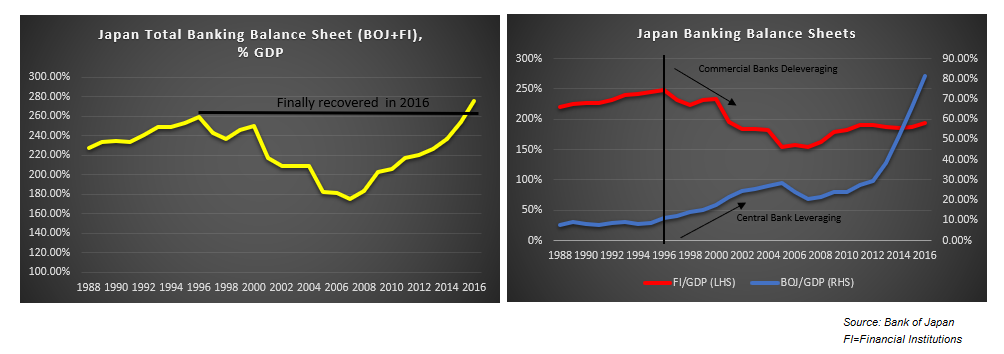
Even though it started properly leveraging (QE) only in the early 2000s, the Bank of Japan (BOJ)’s balance sheet started growing relative to GDP at the same time the domestic commercial banks’ balance sheet started deleveraging in the mid-1990s (see the chart on the right hand-side of the panel below). Nevertheless, the total financial system balance sheet (BOJ + the commercial banks) continued to decline between 1995 and 2007 (see the chart on the left-hand side of the panel below). The BOJ should have expanded its balance sheet much more back then.

Ironically, it was after the 2008 GFC that the domestic commercial banks’ balance sheet in Japan started growing again in line with also the BOJ’s balance sheet. As a result, the total financial system balance sheet also started growing. However, it took until 2016 for it to reach its previous peak from the mid-1990s. That was mostly thanks to the BOJ heavily increasing its balance sheet by starting to buy also private assets – corporate bonds, REITs, equities.

EU

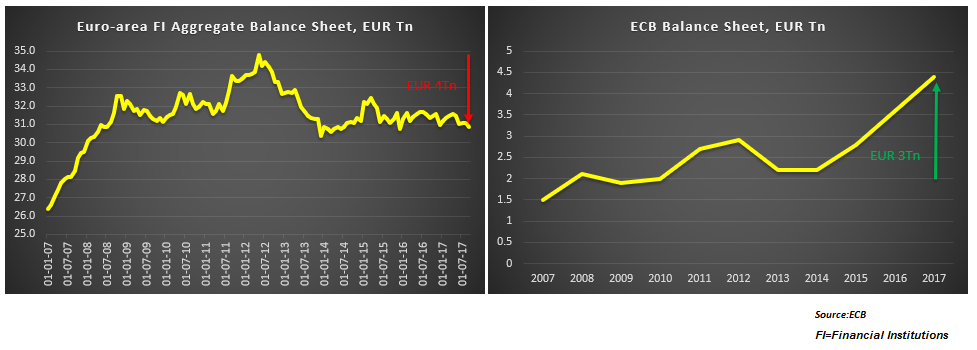
Financial institutions in the Euro-area started deleveraging after the sovereign crisis in 2012 and since then have shed about 4Tn EUR in assets (Left-panel chart below). The European Central Bank’s (ECB) balance sheet, on the other hand, has increased by about 3Tn since the 2008 financial crisis with the majority of the increase happening after 2014 (Right-panel chart below).

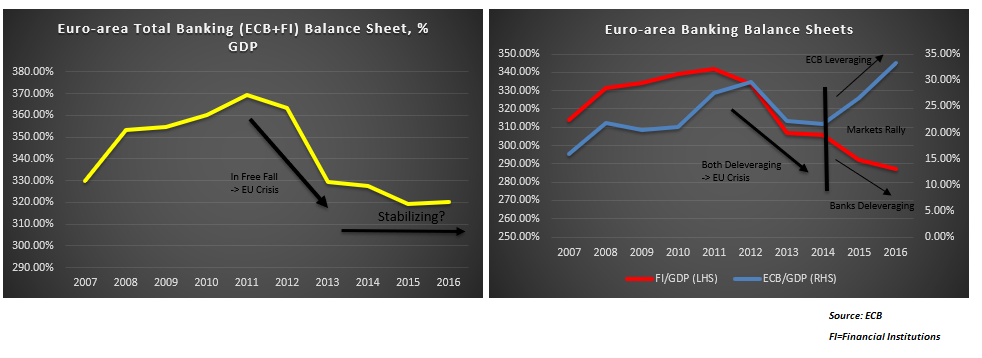
Indeed, between 2011 and 2014, both the banking system’s and ECB’s balance sheets had been decreasing relative to EU-area GDP – a fact which substantially contributed to the prolonged negative effect of the sovereign crisis and kept European assets underperforming (Right-panel chart below). Since 2014, however, while the banking system balance sheets continued to decrease, the ECB balance sheet started to rise relative to GDP.

As a result of that, the total balance sheet (ECB + financial institutions) has started to stabilize at these levels (Left-panel chart above). Nevertheless, it seems that the ECB is indeed repeating the BOJ error of taking its time to raise its balance sheet to support the deleveraging happening in the banking system. If that deleveraging continues, as is more likely than not on the back of continued regulation (Dodd-Frank, Basel III) and the pressure form fintech and now cryptocurrencies, the ECB will most likely also have to massively increase its purchases by adding private assets to the list, just like BOJ.

US

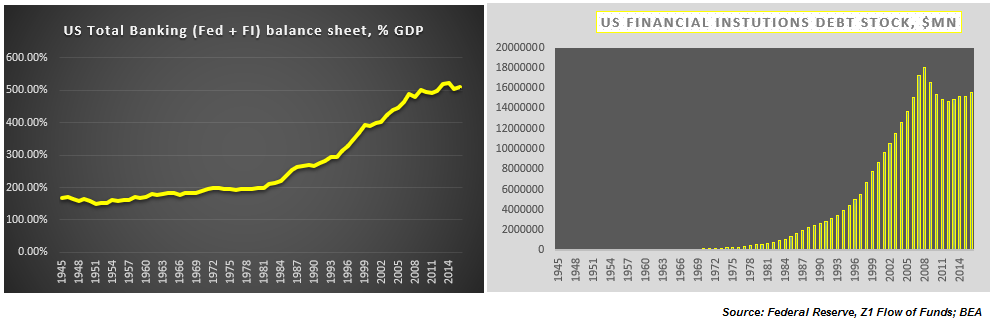
US total banking system assets (Fed + financial institutions) are unchanged since the 2008 financial crisis (Left-panel chart below). Even though, the financial system has indeed deleveraged by the order of $3Tn (Right-panel chart below), the Fed has made up by leveraging its balance sheet by about the same amount. In fact, this is the first time since WW2 when banks in the US have deleveraged.

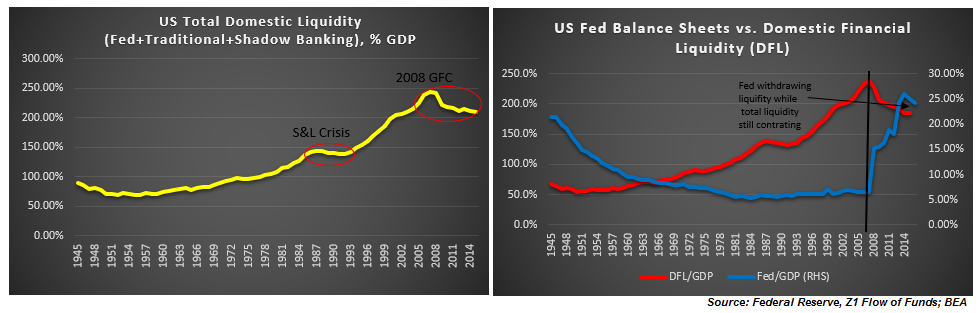
However, most of the liquidity in the system since the mid-1990s has been generated in the shadow banking system (see here, for example). Therefore, for the US, I have compared the central bank’s balance sheet to total domestic liquidity (Charts below).

Total liquidity relative to GDP is still decreasing despite the efforts of the Fed to the contrary (Left-panel chart above). Except for the period between WW2 and 1957, there was only one other period when total domestic liquidity was decreasing – during the Savings and Loan crisis in the late 1980s.

Fed’s liquidity is now starting to slow down as well. This is a big risk if the banking system also continues to deleverage (Right-panel chart above).

Conclusion

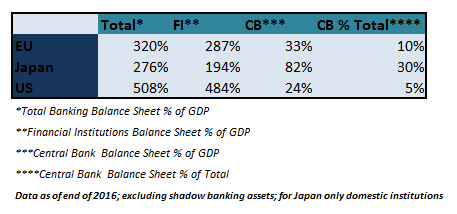
BOJ, ECB, Fed balance sheets are much bigger relative to GDP and relative to where they were before the crisis on absolute levels, but relative to the total balance sheet of the financial system they are still quite small. If the ‘private’ banks continue to deleverage, the central banks’ share of the total balance sheet will continue to naturally rise even if they do not increase their balance sheet. The overall financial system will shrink as a result. However, the risk to the financial system is much bigger if the central banks also deleverage at the same time.

Bitcoin is not the future of money

This is a follow-up on “’Mining’ for money is a ridiculous idea”


Source: https://coinmarketcap.com/ , Author’s calculations

Summary: By creating private alternative money supply and payment systems, cryptocurrencies are threatening the raison d’etre of both the central bank, which governs the current monetary transmission process, and the private money institutions, which create the majority of the money. This is a dangerous precedent which history shows does not end well for the incumbents. Bitcoin, specifically, while it has developed an ingenious way of money creation through the blockchain, has unfortunately, other flaws, namely fixed end supply, high energy costs, limitations of the number of transactions it can process, security and privacy risks.

A ‘bubble’ is a dangerous thing to play with

Below, I am questioning in theory the rise in Bitcoin’s price, specifically, but also the viability of all cryptocurrencies. However, I am absolutely not doing anything about it in practice. Even though the sudden increase in cryptocurrencies’ market capitalization looks absolutely ridiculous to me, I have been around the markets long enough to have been burnt by the Siren call of shorting a bubble before it is ready to pop. I do not have positions in any cryptocurrencies, nor am I advocating positions in any at this point.

Even in real life, I hate the bubbles equivalents: the balloons. They make me nervous because of the uncertainty and suddenness of that popping sound whenever the balloon touches something sharp eventually. When my kids were little and they were invited to a birthday party, I always tried to find an excuse not to go: it was inevitable that balloons would be popping up. The funny thing is that when they brought a balloon home, left it somewhere in a corner and forgot about it, I had no problem: I knew, sooner or later, that the balloon would naturally deflate.

Being right vs. making money

So, I was never a bubble chaser when I was a trader. I preferred to make the money on the way down, after the sudden pop or even when the bubble slowly filtered away. 2008 was my best year, but not because I predicted the crisis. Not at all. I mean, in the years preceding the crisis EVERYBODY knew that credit spreads were ridiculously tight, that the US consumer had too much debt, etc. But nobody, that I know, had the bearish trade on when the bubble eventually burst in 2008. I remember though trying (to put it on) – buying protection in a number of US and UK banks and especially in Eastern European sovereigns – but it was always too early and the negative carry eventually made the trade not worthy.

Going into 2008 I was at least not long the market. By the end of that summer, my P&L was chopping around 0 (but more often on the negative side): the shorts did not work out, and I did not have the stomach to be long. It was basically a waste of time. In fact, I was convinced that they would not let Lehman go. I mean, they had ‘saved’ Bear Stearns…But, moreover, I had done my homework and was aware that Lehman was probably the main character in the shadow banking game. You take Lehman out and the whole show is over: a run on the banks. But not from the retail depositors side – the broker/dealers (Morgan Stanley, Goldman Sachs) did not have retail depositors – rather from the institutional side. I knew that the shadow banking system had produced the majority of the monetary liquidity and that once it was blown apart, the central bank would have to step in big time.

I think if you were in the markets back then, you would always remember exactly what you were doing when you first found out that Lehman Brothers declared bankruptcy. The importance of the event was enormous even by itself: a venerable institution, more than 150-years old, which survived even the Great Depression. (I think the equivalent of that would have been the collapse of Barring Brothers, the second oldest merchant bank in the world, in 1995. Sadly, I started my career on Wall Street in 1996 and have no recollection of that event). However, that Sunday, September 7, 2008, I was waiting to board a flight from Venice to London – we had been there to attend a relative’s wedding. Checking my Blackberry, I was stunned when I read the news! What followed in the weeks after was a relentless buying of Eurodollar futures contracts (short-term rates, not the currency for those that may be confused here by the terminology). And that is why 2008 was my best year managing money…

2008 was year zero in modern banking

While I seemed to be on top of the (trading) world back then, for all intends and purposes, 2008 could be considered the end of traditional banking. The big deal in that sense, however, and in hindsight (always in hindsight – hindsight is the best friend we have ever known) was not Lehman’s bankruptcy, but a white paper by a person or an organization by the name of Satoshi Nakamoto. The paper came in late October of that year. I said in hindsight because I did not know about the paper until much later (and anyway, I was too busy trading Eurodollar futures contracts in 2008). It was the creation of Bitcoin and, more importantly the process associated with it, the Blockchain, which would mark the year 2008 for me: the time before that would be considered BB (Before Blockchain), and the time after – AB (After Blockchain)!

In fact, I do not remember when I first found out what Bitcoin is: 2011, 2012? Yes, I think it was in the midst of the Greek debt crisis when Bitcoin appeared on my trading horizon. You see, I love the idea of technology but I am absolutely rubbish when it comes to its practicality. Bitcoin first became a hot topic of conversation simply because we were in the midst of the European crisis, gold had more than doubled up since the 2008 crisis, interest rates were at 0%, and some smart people started to look for an alternative safe haven for personal use. (Not me…)

However, I never really got involved until late 2015 when I wrote a paper on the Blockchain. I remember when I first mentioned ‘blockchain’ in one of our regular office meetings. Literally no one had a clue what I was talking about. People had kind of heard of bitcoin, but not of blockchain. In banking circles, at least, the idea of the bitcoin was a complete anathema back then. No one of any reputation wanted his or her name associated with ‘Bitcoin’. And rightly so, because it was thought the ‘currency’ was used for nefarious deals on the dark net (and it probably was). Plus, a number of exchanges dealing with it had gone bust in mysterious circumstances.

Anyway, that paper was not on the bitcoin but on the blockchain. We explored how central banks can take the idea of the blockchain from the private sector and use it in a novel way to collect and analyze economic data which would help them conduct monetary policy in a much more efficient way. We advocated a sort of 100% reserve banking experiment.

Since the breakdown of the Bretton Woods System in 1971 and probably by the early 2000s, the private banks had done a fairly good job (with the use of the credit intermediation process) of creating just enough money supply to, more or less, match economic activity (MxV=PxT). However, as our economies gradually moved in the digital era, it became increasingly more difficult to capture that economic activity and match it up with enough mediums of exchange: in a sense, my position was, and still is, that because of its inherent lack of knowledge of economic activity our current monetary system does not produce enough money in order for the economy to work at its full potential.

GDP accounting, created in the ashes of the Great Depression, was more suited to an industrial economy, not so much to a service or, let alone, a digital version. The money created by the private banks, therefore, became increasingly more detached from the real economy. After the burst of the consumer debt bubble in 2008, there was very little demand for loans, so the banks could not create money even when it was most necessary. In addition, the increase in banking capital requirements thereafter, made it more difficult to extend loans and create money even if there was demand for that from the public or corporates.

Basically, it was a mess. Money supply had stopped working properly. So, we thought, what if the primary creation of the money went back to the state. The elegance of the blockchain process allowed for a decentralized, distributed ledger of (economic) data (the new GDP) which the central bank could use to govern the creation of money. This new technology provided for a big diversion from the old days when the state would misuse the creation of money (and which gave ‘helicopter money’ their bad rap).

In a sense, the blockchain offered a sensible alternative to the private-banks-run credit creation of money. In our example, however, the private banks would continue to create money but they would be constrained by a version of ‘100% reserve banking’. The blockchain, therefore, would allow the issuance of central bank digital currency (CBDC) accessible to the public at large (as opposed to a small number of depositor-taking institutions).

Central Bank Digital Currency

That was 2015. At that time, only Ecuador had begun experimenting with CBDC. Eventually, Ecuador became the first country to introduce its own digital cash after it had banned Bitcoin. “Electronic money will work as a payment method beyond the legal tender in circulation, and used with absolute trust by the entire citizenry…”(Source: Electronic Money, Banco Central del Ecuador).

Since then, pretty much all major central banks have embarked on the road of evaluating the feasibility of CBDC. None has, so far, done it.

In its One Bank Research Agenda (OBRA) from February 2015, the Bank of England posed the question of whether central banks should issue digital currencies. “Digital currencies, potentially combined with mobile technology, may reshape the mechanisms for making secure payments, allowing transactions to be made directly between participants. This has potentially profound implications for a financial system whose payments mechanism depends on bank deposits that need to be created through credit.” Since then the BoE has issued several papers on the viability of central bank digital currency. It is also partnering with UCL to practically explore the possibility of creating the so-called RSCoin.

The Riskbank (Sweden) is the oldest central bank in the world, the first to issue paper money in the 17th century, and the first one to move to negative interest rates. It could also be the first to issue CBDC. “The Riksbank is investigating whether it would be possible to issue a digital complement to cash, so-called e-kronas, and whether such a complement could support the Riksbank in the task of promoting a safe and efficient payment system.”

Already in 2014, Danmarks National Bank (Denmark’s Central Bank) said that bitcoin is not money and [Bitcoins] ‘have no actual utility value, bearing closer resemblance to glass beads’. However, blockchain technology, or a variety of that, for example, would be an obvious model to use of virtual currency.

Canada’s Central Bank is running ‘Project Jasper’ which examines the feasibility of using distributed ledger technology (DLT), aka blockchain, to construct a wholesale payment system. This could eventually lead to the central bank issuing a digital currency of its own, called Cad-coin.

The Monetary Authority of Singapore (MAS) is running Project Ubin which uses DLT for inter-bank payments. In a speech (“Economic Possibilities of the Blockchain Technology”) at the Global Blockchain Business Conference this October, Mr. Ravi Menon, Managing Director of MAS asked: “…can we create a more efficient inter-bank payment and settlement system without MAS acting as the trusted party?”

The Central Bank of China could be considering the issuance of CBDC as a way to stabilize its own fiat currency while expressing concern of the inherent dangers of crypto currencies. According to this report, Yao Qian, the Director of the Digital Currency Institute under PBOC said, “it would be a disaster to recognize it [Bitcoin] as a real currency. And the lack of value anchoring inherently determines that bitcoin can never be a real one.”

Heavily burnt by the 2008 financial crisis, Iceland may be taking the most direct drastic measures. In a report commissioned by the Prime Minister, the suggestion is: “[I]n a Sovereign Money system, private banks do not create money. Instead this power is in the hands of the Central Bank, which is tasked with working in the interest of the economy and society as a whole. In the Sovereign Money system, all money, whether physical or electronic, is created by the Central Bank.”

In January 2017, the Reserve Bank of India (RBI) issued a white paper recommending the adoption of the blockchain. In September 2017, IDBRT, a research institute established by the RBI, announced plans for the launch of a blockchain platform.

The Central Bank of Russia (CBR) is moving fast towards the development of a national digital currency. In October 2016, CBR announced it had successfully developed a prototype blockchain called “Masterchain”.

In November 2016, Hong Kong Monetary Authority (HKMA) issued a white paper on the advantages and disadvantages of DLT. In October this year it issued a second white paper in which it stated clearly, “[A]part from the PoC projects, the HKMA has also commenced research on Central Bank Digital Currency (CBDC) with the aim of assessing the potential benefits, challenges and future implications of issuing CBDC. This is another example of the growing potential for the application of DLT.”

The European Central Bank (ECB) has issued several papers on DLT and its potential (the latest) without being explicit about the use of blockchain-based CBDC. Indeed, both the ECB and the Bank of Japan have said recently that they think “DLT like blockchain is not mature enough to power the world’s biggest payment systems, though it has the potential to improve system resilience”. However, Japan’s Financial Service Agency is developing a blockchain-powered platform that will enable Japanese consumers to instantly share their personal information at multiple banks and financial institutions.

Finally, the US Federal Reserve issued a white paper on the possible use of DLT in payments, clearing and settlement. However, recently elected new Fed Chairman Powel said in a speech in March this year, referring to the potential use of DLT or other technologies by central banks to issue a digital currency to the general public, that “[W]hile this is a fascinating idea, there are significant policy issues that need to be analyzed.”

The proliferation of cryptocurrencies

In a sense the developments described above stemmed from the period of central bank uncertainty post 2008. The uncertainty arose not because the central banks were not transparent enough (in fact, one could argue, they were too transparent), but because the policies they were adopting were unprecedented in modern times (post 1971). In addition, it was also a result of the advances in technology which allowed for a potential revamp of the money creation and transmission process. This naturally raised the issue of trust which, coupled with the lack of sufficient money circulation in the real economy, provided for a fertile ground for the development of a decentralized, distributed ledger-based cryptocurrencies that also offered a level of digital security never seen before.

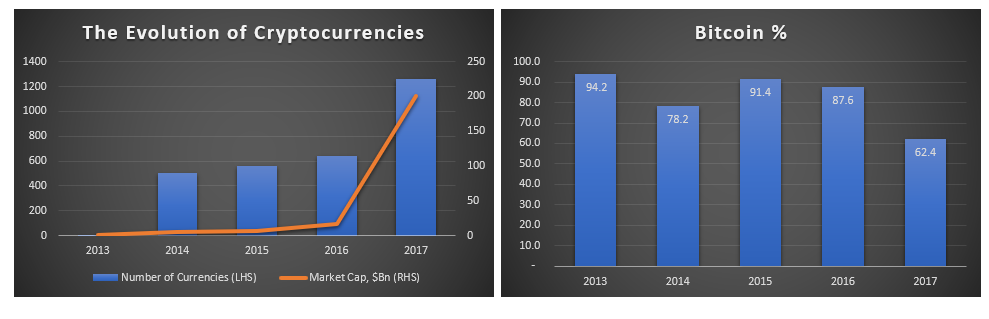
In 2013 there were just 7 alternative digital currencies with a market cap of about $1.5Bn. Bitcoin was the largest amongst them (see Charts at the top).  By October 2017, the number of crypto currencies had risen to 1260 and their market cap to $201Bn. Bitcoin is still the largest but its share has fallen from 94% to 62%. However, the top three cryptocurrencies (Bitcoin, Ethereum and Ripple) still comprise 85% of the total market cap.

The proliferation of these private cryptocurrencies fills a void in the money supply which the central banks have not been able to fill despite the massive increase in their own digital reserves (i.e. the central bank balance sheets). The economy is lacking a medium of exchange (and the subsequent unit of account) in order to operate at its optimum level. The traditional income distribution model, Work=Job=Income, which has characterized the industrial economy so far, stopped working sometimes in the early 1980s with manufacturing finally giving way to services.

In the late 1990s, as the digital economy started gaining speed, consumers started making up for their lost income with debt ‘secured’ by real estate and engineered in the so-called shadow banking system: private ‘AAA-rated’ subprime mortgage pools acted as ‘mediums of exchange’ in a not-so-dissimilar manner to today’s cryptocurrencies. The end of the debt super cycle in 2008 put a stop to that, and with the central banks unable to do anything about it, cryptocurrencies came to the fore.

Despite the massive rise in cryptocurrencies’ market capitalization, they are still less than 1/6 of the subprime total market capitalization at the peak of the crisis in 2007. One could say that they are not, yet, in any way, shape, or form of a systematic significance to the financial system. The problem is that at the growth rate the cryptocurrencies’ market cap is rising, it will reach that critical level ($1.3Tn for subprime) in a couple of years or so. So, perhaps, we may be in 2005 or 2006 equivalent to the 2008 financial crisis?

In addition, however, there is the further danger that crypto currencies are a much more direct competitor to central bank legal tender than shadow banking money because of the ease at which they can be accepted as medium of exchange and unit of accounts in retail outlets. As more economic transactions go through private digital currencies, central bank monetary policy could become less relevant. If there is less need for final settlement in central bank reserves, this threatens the whole existence of the central bank. In addition, if the crypto currencies do not use the private banking system for payments, what is the role of the private banks?

Bitcoin’s major flaws

There is a lot of stake to the current monetary transmission mechanism and it is for this reason why the central banks are starting to react (see above). If history is any guide, they will not hesitate to outlaw any attempt which is aimed at taking over their privilege to govern the money creation process. But Bitcoin also has numerous flaws on its own (the below written from a non-technical, but rather functional, point of view as it pertains specifically to money creation and transmission).

Store of value vs medium of exchange and unit of account. Bitcoin is trying to be both as seen by the various jurisdictions coming with different classifications for it (asset vs currency). But NOTHING can be all these things together at the same time and to the same extent. Bitcoin is a store of value first and a medium of exchange/unit of account second. That is a is problem if it is trying to be a currency. For, if a currency is expected to increase in value it is much more likely to be hoarded than exchanged and thus it is very unlikely to ever become a unit of account. A normal currency’s value is a derivative of its medium of exchange/unit of account function, not the other way around as in the case of Bitcoin.

If Bitcoin, on the other hand, is an asset, then it cannot expect to be a medium of account and unit of exchange in the real economy. However, that puts into question the source of its value in the first place. Compare to gold which, similarly to Bitcoin, has been used as a store of value for centuries due to its pureness (difficult to forge), malleability (ease to transport) and scarcity (limited additional supply). But at least, when all else fails we use gold for decorations. In addition, and more importantly, the authorities gave a big stamp of approval to gold by using it as the core of their money creation process. And when they did not, they did not like us to do it either (confiscation of gold during the Great Depression).

Fixed-end supply. A total of 21m bitcoin can be created. Unless the protocol is changed, the last bitcoin will be “mined” in 2040. Moreover, the rate of bitcoin supply gradually decreases each year (current inflation rate of bitcoin supply is around 4%). By some estimates already 3 out of every 4 bitcoins ever to be created are already ‘mined’. Needless to say, that is why Bitcoin is considered valuable.

But as seen in the preceding paragraphs, if this also destroys the purpose of bitcoin’s use (and assuming there are no other reasons why anybody would want to hold bitcoins), then it also degrades its value. The actual supply of bitcoin can be both much smaller than 21m (miner underplay and other technical peculiarities, loss/destruction of bitcoins) and larger (protocol is changed or the idea of ‘fractional reserve bit-coining’ is practiced).

High energy costs. I already touched on this issue here. More knowledgeable people have written extensively on the technicalities of energy usage in bitcoin ‘mining’ (see, for example, this, “One bitcoin transaction uses as much energy as your house in a week”) so I am not going to spend more time on this.

Transaction processing speed. Bitcoin’s blockchain can process low single digits to low double digits transactions per second. This is much lower compared to traditional payment system providers (Visa, MasterCard, PayPal, etc.) which can process thousands of transactions per second. There is thus a big question to the scalability of the bitcoin as a medium of exchange in the payment mechanism.

Of course, as the technology advances, more progress is expected in this regard (for example, see “Bitcoin Lightening Network: Scalable Off-Chain Instant Payments”, J. Poon, T. Dryja, January 2016). However, the speed of processing, the energy usage and the security (see below) can be increased several-fold if the blockchain process is designed to be ‘permissioned’ (Bitcoin is ‘permission-less’) as in when governed by a central bank, for example, in the case of CBDC.

Security and privacy risk. Without a ‘central authority of last resort’, there is a bigger risk of losing bitcoins than cash deposits, for example. If you lose your private key, or the hard drive gets corrupted, there is no one you can turn to help you retrieve your bitcoins (this is the equivalent of losing your physical cash). The same holds true for the possibility of reversing a bitcoin transaction, if, for example, it is done by mistake – it is not possible (there is a technical solution called ‘multiverse transactions’ but it cannot be done in a decentralized system like the blockchain as it involves a third party).

In addition, it is possible in theory for a major ‘miner’ with enough computational power to ‘fork’ the bitcoin blockchain for his/her own gain. This also opens up the system for potential fraud by altering past records. If the blockchain is permission-less, as in the case of Bitcoin, nothing stops a ‘miner’ to eventually gain this computational power (including collusions amongst miners – how many people trading currently bitcoin, for example, can understand exactly the permutations behind the most recent fork in the Bitcoin blockchain and why really this was done).

Finally, there is also the issue of hacking, whether the bitcoin is stored in an e-wallet on the internet, or with a centralized exchange, it does not matter (understanding the security of a physical bank is one thing; getting your head around cybersecurity is totally another).

Conclusion: Bitcoin and all other cryptocurrencies are a natural development of the money creation process. They are a result of the free market’s response to the breakdown of the traditional income generation model, which had been in existence since the Industrial Revolution, and the authorities’ inability, or rather, refusal, to address it by creating additional mediums of exchange and distributing them among the population.

The cryptocurrencies, however, are an imperfect solution, at best, to our money problem. Taken to the extreme, they could threaten the existence of the central bank and the banking model, in general. However, the technology inherent in them, the blockchain, used in accordance to the regulatory framework of a central bank and without much change to the current banking system, could shape the new money system which fits better our modern digital economy.

‘Mining’ for money is a ridiculous idea

Martin Walker (FT Alphaville) touches upon an important aspect of the modern crypto money creation process: the ridiculous costs and unnecessary side effects of digital ‘mining’.

Bitcoin exemplifies our bizarre relationship with money through the ages stemming from our lack of understanding of what it is. It’s as if we are cursed to never come to terms with money’s functions and how they help us progress. Our problems started with us prioritizing the ‘store of value’ of value function of money over ‘medium of exchange’ and ‘unit of account’. For if money is expected to increase in value, it is much more likely to be hoarded than exchanged and thus it will eventually cease to be a reliable unit of account.  

From the very beginning of humankind, it has indeed been a constant one step forward, two steps back kind of dance with our faithful companion. Money originated as a ‘gift’= a debt of gratitude to our fellow tribal members who shared their luck of finding more food than they needed. When our memory (of ‘how much’ we owe whom) failed and disagreements became common, we created the first money ledger run by the first central authority (the tribe leader): lines in the sand of who ‘owes’ who.

From there on, it all went downhill for different reasons: huge, cumbersome stones; other stupid object; precious metals… There were some interruptions to this craziness: the time of the Roman republic, the first fiat money in China, the Italian city states creating the first modern ledger during the Renaissance. But generally speaking the crazy money mist always came back and deluded us in going to extremes (mining foreign lands, killing indigenous people, etc.) to obtain shiny objects and call them money.

Until it all ended in 1971 when Nixon pulled the US out of the Bretton Woods Agreement and fiat money became the norm globally. And now, in 2017, having reached an extraordinary level of human progress, once again the mist is descending in front of our eyes and we are thinking about going back to ‘mining’ for money?  

VR changes everything


The history of humankind is one of gradually reduced mobility. We generally travel for three reasons: resources, work, entertainment. In the past, as humans captured and started governing more of nature thanks to advances in technology, the need to travel for each of the above decreased. Now, as we move to the digital medium thanks to advances in VR, the need to travel may completely disappear. With VR on the cusp of mass adoption, betting on the autonomous car, whether EV or solar-battery powered, as the next big thing in mobility, may not be the smartest thing to do.

It is no wonder that the means of transportation have actually barely changed even from pre-historic times. For example, in some parts of the world people still use the horse to go places. The cart and the boat are still here, just more powerful because we have improved our energy sources (when it comes the cart-auto, not necessarily even faster in the big cities). The train may look novel but, ultimately, it is just a more efficient version of a mass transportation ‘cart’. The airplane, however, is really a novel way of covering distances. First, because it is air-based while all other means of transportation had so far been land/water-based. Second, because it is much faster than any other means of transportation. 

Perhaps that is why we have been so fascinated with the flying car as the next step in improving our mobility. But the flying car never came. I argue below that this is because there is no need for it as humans have naturally moved less and less through the ages. (It may actually seem less so, as images of the great sea voyages during the Renaissance or as we recently have started to conquer space, come to mind, but these are exceptional cases which actually do not involve that many people relative to the mass human movements in the past.) In addition, as VR continues to improve, we are in the process of ‘moving’ away from the physical to a completely new and different medium of being: the digital.

It is generally believed and accepted that the first human appeared in Africa and from there settled all distant corners of the Earth in search for basic resources for survival. We cut on our nomadic lifestyle of ‘travelling’ for resources first after the Agricultural Revolution when we stopped chasing wild animals for food and settled to a more sedentary lifestyle. That included conquering more arable land and learning wholesale farming, as well as perfecting animal domestication. Mobility actually temporarily increased as people moved to where the arable land is – cities formed and grew. But once settled there, there was barely a need to go anywhere else.

This was also the first time we acquired a surplus over and beyond our needs for survival. Sadly, this did not eliminate scarcity because we lacked the means for its ‘fair’ distribution. The Agricultural Revolution was perhaps the peak of human mobility for resources.

The second time we drastically reduced our mobility was after the Industrial Revolution. Back then we stopped producing our own food and focused on specializing in producing goods for basic needs in much greater quantity than it was ever necessary. This also resulted in a temporary increase in mobility as people had to come to the factories. Cities naturally grew bigger, but once people settled there, mobility went down again. During this period our welfare drastically improved to the point that we soon started to produce goods not just for basic consumption but also for leisure and entertainment. Our ability to distribute this surplus accordingly, unfortunately did not. The Industrial Revolution heralded the beginning of the need to travel for work. That need probably reached a peak sometime after WW2.

The beginnings of the Digital Revolution sometime in the 1980s marked the third time we reduced our mobility as the need to travel to acquire resources and for work became less prevalent. Again, similar to the previous instances, our mobility got a temporary boost because we started travelling for leisure. By then, the fruits of the technological advances of the past had brought an unbelievable welfare surplus which, though never distributed equally, was enough to push not just basic but also discretionary goods prices down. This made leisure and entertainment affordable to the masses. People not only went to restaurants to eat (instead of at home) but to the movies and bowling alleys for fun. Later on, people even started taking vacations in different continents! Mobility for entertainment probably reached a peak in 2007 with the invention of the smartphone (and, unfortunately, with the wider spread of terrorism more globally).

I fear the wide adoption of VR will bring the final nail in the coffin of human mobility. Just until a few years ago, at least we used to go ‘shopping for resources’ to our corner grocery store. Now Amazon and a bunch of other companies bring our food and necessities to our door step. Travelling for work is also decreasing as Internet/network connectivity improves. VR brings the culmination of our mobility for entertainment as well, as the need to go to a concert, the movies, etc. or even travelling across the world on vacation is reduced.

VR will eventually be able to replicate the stimulation to all our senses and once that happens the ‘V’ in VR may become redundant. At the moment vision and sound are the easiest to manipulate. But still, a wide-field vision is mostly lacking in current VR headsets (humans can see at about 220 degrees, the best VR headset is about half that). Resolution is another one which needs to undergo further improvements to get to the 20/20 human vision. Touch is probably the next one after to improve on, and there are already huge strides made in that regard with the haptic glove, for example. Taste and smell are the most difficult ones to replicate but there is progress there too.

Our VR experience does not need to be 100% of what is current ‘reality’. But as that experience improves and as the cost of VR-ing goes down, humans will naturally use more of it relative to the ‘real thing’. Our physical mobility will suffer even more as a result. That is the easier bet simply because there is such a strong trend of this process going back thousands of years. However, eventually, anything associated with the current physical reality may become irrelevant.

And this is likely to happen within our lifetime, or as we used to say on the trading floor, before the long bond matures. It is simply inconceivable that, from one hand, we are working on brain-computer interface and we have even managed for the first time to upload a brain on a computer but then, on the hand, we are still forecasting that our relationship to the physical world will not change much.

I am sure the self-driving EV/Solar ‘car’ is coming but I think the overall number of ‘cars’ on the road will be much, much smaller than what people are currently forecasting. And, yes, most likely people will still be travelling in the physical world, but that will be the exception rather than the rule. And since I mentioned the ‘flying car’, well, it is already here – the drone. But unlike in most science fiction movies, it will continue to be used to transport mostly basic physical goods to the humans in VR ‘capsules’ who need to refuel their energy in the old-fashioned way, i.e. until we decide to upload our brain and be completely cut off from this reality…  

Low productivity is the least of our problems

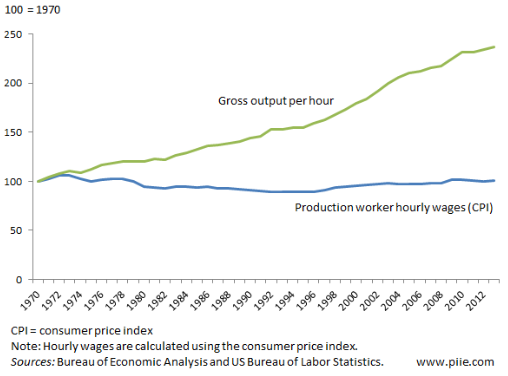
Low productivity is the least of our problems. Why would we want to produce more output, when there is no one able to consume it, is beyond me. If we take care of our stagnating aggregate incomes and put more real purchasing power in the consumers’ wallets, productivity will take care of itself. However, it is a fact that the 200-year old Industrial Revolution-time model of income generation and distribution has broken down due to the spread of globalization and the rise of sophisticated technology which displaces even cognitive and non-routine human jobs. The problem is that we keep wanting to fix it instead of coming up with a new model which fits better our economic realities.

  • Low wages are not a result of low productivity. It is the other way around.
  • If full employment comes at the cost of lower wages, purchasing power may not rise and aggregate demand may not rise->output stagnates.
  • Stagnating numerator (output) and a rising denominator (employment)-> decreasing productivity.
  • Work dynamics have changed dramatically. The 200-yr old distribution model of Work=Job=Income is broken.
  • Machines are cheaper, more efficient and smarter than humans in increasingly more industry sectors.
  • The rate of growth of human cognitive skills (education and training) is unlikely to keep pace with the rate of growth of machine learning.
  • IBM Watson reads 1m books per second (now probably even more): 100k of human evolution is now ‘equal’ to 7 minutes of machine learning.
  • New ‘job’ creation in the digital era will happen but is unlikely to keep pace with the destruction of old jobs.
  • We will always want to work but do we need a job? If we create AGI but insist on people having a job for survival, we would have totally failed.

US corporate profits and the S&P Index

One would think that US corporate profits and the S&P Index should move closely together. And they do… most of the time. But when they diverge, should we be buying/selling US equities?

1990-2017

The chart above shows that since the 1990s there have been three such divergences where the S&P Index ‘outperforms’ US corporate profits by a large margin followed by a subsequent crash in equities: Dotcom Crash, the 2008 GFC, and whatever we have now (WWHN). The Dotcom crash was indeed an equity bubble with US equities starting to diverge already in the mid-1990s.

The 2008 GFC crash did not have much to do (if anything )with equities. However, US corporate profits started declining already in Q3 2006 while the S&P Index continued to rise well until the summer of 2008. Nevertheless, the divergence between the two was not that stark as the in DotCom crash. Still, the declines in the S&P Index during the Dotcom and 2008 GFC were similar.

The bounce back in US corporate profits after 2008 GFC was rapid and extreme, just like the decline was. This was again in stark contrast to the Dotcom crash which was preceded by flat US corporate profits since the mid-1990s. Their rise post the Dotcom crash, thus, was gradual. The 2008 GFC was such an extreme event that caused US corporate profits to ‘outperform’ the S&P Index between 2008 and 2013, a very rare event indeed (see Chart below).  

However, since Q1 2012, US corporate profits are more or less unchanged while the S&P Index continues to power higher. Still the divergence between the two now does not seem that extreme as in the Dotcom crash.

1947-1990

The only other time when US corporates ‘outperformed’ the S&P Index was between the mid-1970s and the mid-1980s. After being flat for almost 10 years priors, the rise in US equities after 1983 to ‘catch up’ with US corporate profits was extreme which might have contributed to the sudden crash in 1987. But one could think of that event as just a sudden stop to regain one’s breath after running a 100m sprint. The S&L crisis that followed, similar to the 2008 GFC, had almost nothing to do with equity valuations which, this time, was reflected in the performance of the S&P Index (no crash).

So where do we go from here?

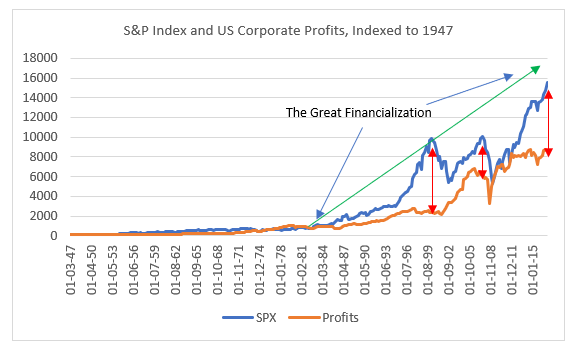
Another way to look at the relative performance of US corporate profits and US equities is to index them to 1947 when data for US corporates started to be available (Chart below). What is obvious here is that ‘something’ happened in the early 1980s: The Great Financialization of the US economy started. Moreover, US equities got an extra ‘artificial’ push when the SEC introduced Rule 10B-18 which gave safe harbor for US companies to buy back their own shares.

The DotCom crash, 2008 GFC and WWHN (TBC) are much more visible and it seems that the divergence between the S&P Index and US corporate profits now is at least comparable to the Dotcom era. So, when is the ‘crash’? All this tells us, is that US equities are running ahead of US corporate profits and that they are on the expensive side when using traditional valuation methods. But there are other things that one should consider before making any conclusions about potential setback in share prices. And even when all things are lined up for that crash that everyone has been waiting for now years, there is still the trigger – leverage.

The elephant in the room is Virtual Reality

The Digital Revolution

The most profound shift happening now is the one from physical to digital. In terms of concept this follows all the other big transitions of the past: agriculture->industry->services. However, in terms of scope and in terms of its effects, this transition is much bigger. All other shifts in the past have been within the physical medium. This is the first time we are transcending mediums. At the same time, we continue to project the future only in terms of the physical medium. For example, when it comes to transportation, the main discussion is what the car of the future will be. One of the boldest predictions that I have seen so far, for example, is an autonomous EV run by a DAO. That still assumes that the physical world will remain the main medium for humanity. But what if that is not the case? How can we reconcile that the brightest human minds are discussing computer brain upload and transhumanism while at the same time entertaining the idea of humans going from point A to B still in a box? The two ideas are incompatible.

A big diversion

Technology has at last developed so that Virtual Reality (VR) has the potential to change humanity profoundly. VR is closely linked to the idea of sub-consciousness and we are already spending 1/3 of our daily life (on average) in such a state while sleeping and dreaming virtual worlds. In fact, the conscious state is just a cover of the subliminal perception which determines to a large extent our actions. It is the guardian of the virtual world and by filtering through only that which we are able to make sense of, it creates the ‘real world’ which we inhabit in our conscious states.

Our human body processes information through the senses (sight, hearing, touch, taste and smell) in various ways we are most of the time not aware of because our consciousness does not have the ability to analyze all this data. To a certain extent, consciousness leaves a lot of stuff on the table when it comes to our understanding of what is going on (no wonder humans have always tried various means to transcend our conscious state). It only gives us just about enough information so that we can ‘survive’. The bottom line is that the process of VR is a natural continuation of what we humans are. The physical reality has been good to us so far but perhaps we are at a stage of development which we can start to ‘make sense’ of the much bigger world which sub-consciousness can reveal to us, a world in which we can not only survive but prosper.      

Back to the ‘car’ of the future

It is not inconceivable that in the future a VR machine would be the main means of human ‘transportation’. Even today we travel less for work and pleasure, we shop on line, we prefer to play video games than participate in outdoor activities, we hang out in virtual chat rooms and engage with our friends on Facebook, etc. And even if there is work in the future, most likely it would not be of a physical nature which would mean that we would be able to do it ‘from distance’. And if VR eventually is able to re-create the same emotional experiences which we now encounter in real life, travelling for pleasure would also be minimal. It does not mean that humans would not move in the physical world, but that would be a ‘luxury’.  

Forecasting auto production numbers, whether EV or ICE or whatever that far in the future (2030-2040), etc. becomes a totally meaningless exercise. It is not just that though. Forecasting anything that has to do with the physical medium becomes a non-linear exercise: energy demand, consumer behavior, health, education, etc.

Policy makers need to take that into account and do not submit to calls to spend blindly on old-fashioned infrastructure. Investors need to think laterally how the VR world will totally change some of the existing industry sectors. We might not know which would be the company of the future to bet on, but we could do well to identify some of the companies which are less likely to make it in the future VR world.

Why US equities keep outperforming?

A lot has been written lately about the outperformance of US stocks over European stocks. Here is a good summary.

I would add two other things to the list of possible reasons for this outperformance.

Corporate share buybacks

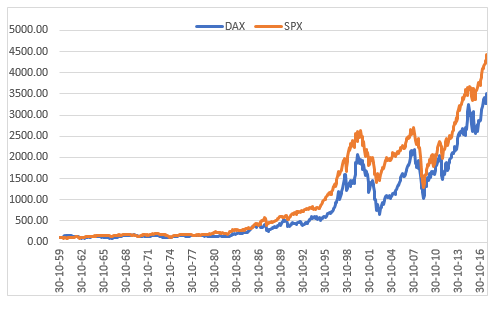
US corporate stock buybacks are a feature in US equities to a much larger extent than European corporate stock buybacks. For example, US corporates were given a “green light” to buy their own shares when Rule 10b-18 was introduced in 1982. The S&P Index started outperforming the DAX in the mid-1980s (Chart below, both of them indexed to 100 in 1959).

Source: Bloomberg, author’s calculations

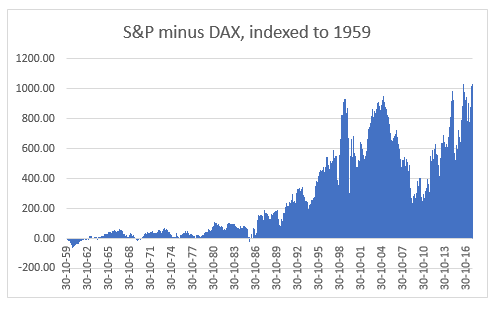
As US buybacks increased, the outperformance became more obvious (Chart below).

Source: Bloomberg, author’s calculations

Intangible assets

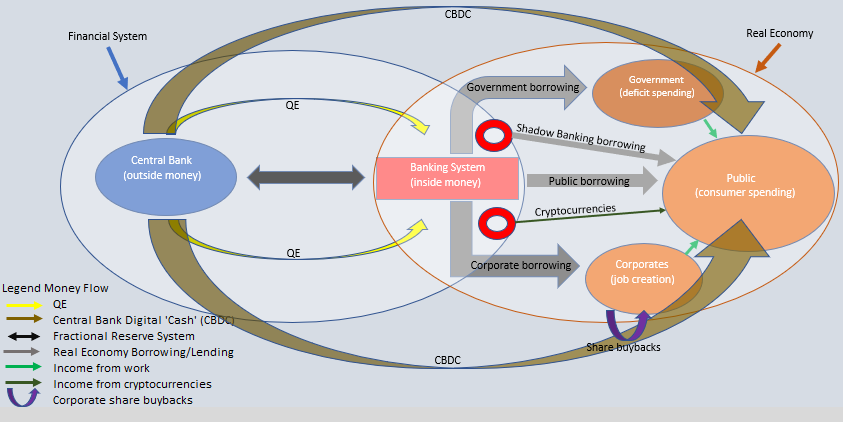
A second reason for the outperformance of US stocks could be the higher % of intangible assets in US indices (Charts below).

Source: “Intangible Asset Market Value Study” by Cate M. Elsen and Nick Hill

Historically, the combined value of a company’s physical assets should equal its market value. But we know that this Tobin’s Q ratio has become a bad predictor of the stock market. Why? Because intangibles have replaced physical assets as the main factor of production. We cannot see the intangibles on companies’ balance sheets but there are ways to guess their worth (look at investments/expenditures on the income statement). According to Simcha Barkai from the University of Chicago, intangibles are worth $48Tn just in the US (that’s more than the physical value of all companies’ assets)!