Plenty of liquidity but scarce money

“All the perplexities, confusion, and distress in America arise…from downright ignorance of the nature of coin, credit and circulation” John Adams in a letter to  Thomas Jefferson

1)We should have never ‘put together’ “store of value” and “medium of exchange”.    

2) If something has intrinsic value which is expected to go up in time, it will be hoarded and exchanged less often.

3)’Money’ is a “unit of account” which we ‘exchange’, in order to efficiently get the things we really need and want in life.

4)Inflation/Deflation are simply measures of whether ‘money’ is abundant or scarce relative to the economic activity we desire.

5)In the economic system we have created, purchasing power is gained either through paid work or through credit.

7)As long as companies earn a profit, they retain more ‘money’ than they distribute in wages and other payments, thus there is insufficient medium of exchange to meet the supply of goods.

7)Even if companies invest the profit in new projects, this only adds to the previous supply-demand imbalance unless new medium of exchange is added endogenously in the form of credit.

8)Advances in technology make the old paradigm of Work=Job=Income obsolete; purchasing power is lost.

9)Credit only makes the scarcity of ‘money’ more acute because new medium of exchange needs to be added just to pay the interest on the debt; a vicious cycle develops.

10)This credit/debt cycle also eventually comes to a natural end (2008); no more purchasing power can be added even endogenously.

11)If we want to keep the current economic system going, we need to find a new way of generating ‘purchasing power’.

12)But if the paradigm has shifted, normalization is meaningless; instead of going back to something that does not work, let’s look forward.

12)’Helicopter money’ has an, unjustifiably, bad reputation historically.

13)UBI is politically unfeasible to implement in a large country with open borders.

14)The problem with them in the past has been our lack of knowledge of existing economic activity, and thus our inability to disburse the right amount of purchasing power needed.

15)M≠PxT, so we invent V, in order to MxV=PxT

16) Both of them, however, are great ideas which need to be put in the context of our existing institutional framework.

17)The central bank opening its balance sheet (CBDC) to the public at large is the next step in monetary/fiscal policy.

18)Blockchain, as in a large, open, decentralized, distributed, real-time database of all economic transactions, is the digital equivalent of ‘GDP’ of the industrial era.

19)The Fisher’s equation above then takes the form of CBDC=Blockchain, ‘money’ matches economic activity.
What if central banks gave the QE money to the people?

I would not be blindfolded by the fact that the US is trying to go back to ‘normal’ with the Fed on a rate-raising spree. ‘Normal’ changed a long time before 2008. You cannot go back to ‘normal’ with a broken monetary transmission mechanism. We can create all the money in the world but if it goes in the hands of the few, if it is subsequently ‘hoarded’ and if it cannot  reach the end consumer because Work≠Job≠Income (whether that is because of technology, globalization or whatever) or because the credit channel is closed (the end of the private debt super-cycle in 2008), the economy is not going to go anywhere. And if there is little demand because there are not enough mediums of exchange, aka money, circulating in the economy, optimizing production is a waste of time and resources.

Instead of focusing on going back to a ‘normal’ interest rate policy, a forward-looking central bank would be looking into the opportunity presented by the rise of the blockchain technology and the subsequent spread of digital cryptocurrencies. The latter are a direct response to the broken down monetary transmission mechanism: if the traditional mediums of exchange do not circulate in the economy, people are devising their own ways of exchanging goods and services.

The interest-rate cycle is something of the past now. If the financial crisis of 2008 did not make it obvious, perhaps, we have to wait for the next one, which would be here like clockwork as policy makers embark on the policy of ‘normalization’. But there is some hope that some central banks are looking into ways to introduce a digital currency of their own and opening their balance sheet to the public at large.

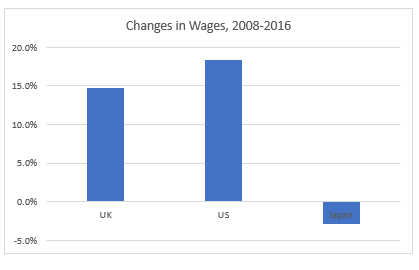
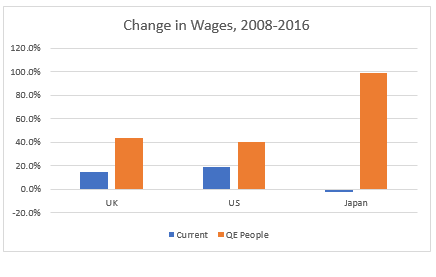
Back of the envelope calculation shows that if the money spent on buying financial  assets by the central banks of UK, US and Japan, was instead disbursed directly to the people, working wages would have risen substantially.

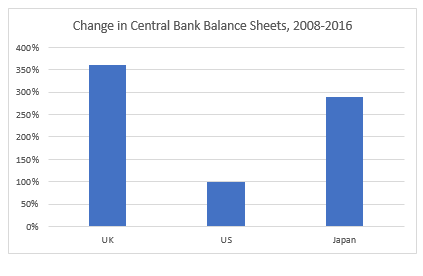
Between 2008 and 2016, central banks’ balance sheets have risen by 360% in the UK, 99% in the US and 280% in Japan.

Source: Bank of England, US Federal Reserve, Bank of Japan

At the same time, over this period, nominal wages have risen by only 14.8% in the UK, 18.4% in the US and actually fallen by 2.9% in Japan! In 2016, the average annual wage in the UK was GBP 34,142, in the US – USD 60,154 and in Japan – Yen 4,425,380.

Source: OECD

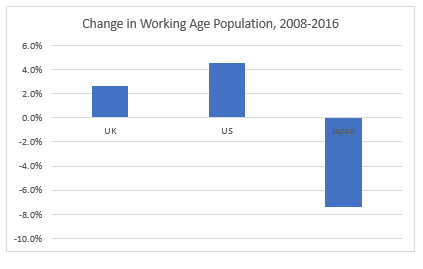
Japan is peculiar also because its working age population declined by 7.4%, while US’ and UK’s rose by 4.5% and 2.7%, respectively, during this period.

Source: OECD

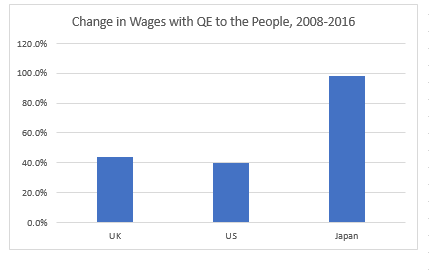
I took the actual change in central bank balance sheets and divided it over the average working age population between 2008 and 2016. If this money could have been disbursed directly to the people, workers would have received a lump sum of GBP8,574, USD10,997, Yen4,430,424 over the period.

Let’s imagine that this lump sum was disbursed to the working age population at the end of 2016. Compared to 2008, their wages in 2016 would then have been higher by 44% (UK), 40% (US), 98% (Japan)!

If wages could indeed ‘miraculously’ rise by almost half in the UK and US and almost double in Japan over this 8 year period, what are the chances that we would still be stuck around 2% inflation in the US and UK and around 0% in Japan? Where would GDP be?

This is a very simple exercise. Undoubtedly real life is much more complicated that this and it is rarely black and white. Moreover, this would have been a lump sum disbursement, a one-off boost to income, and not a permanent rise in wages. Consumer behavior in this case, Ricardian equivalence, etc., would have been very different from a situation with a permanent rise in wages.

However, instead of patting ourselves on the back that things could have been much worse had the central banks not backstopped the financial system by buying financial  assets, can we not also think how they could  have also been much better if we found a better use for the money miraculously created out of thin air? If we could create money out of thin air to boost financial asset prices, is it really not possible to devise a way whereby the consumer also gets a permanent rise in income? Can we have an adult conversation about the effects of such an experiment without resorting to the taboos of the past? Can we include people other than economists in this conversation?

The free market may be the best and most efficient optimization model available so far to us, but what if we are optimizing the wrong variable?

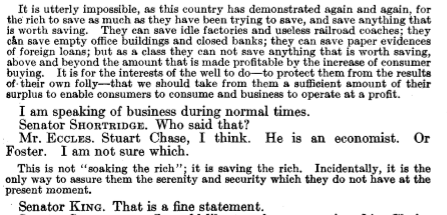
We need a ‘Marriner Eccles’ of our time

Marriner Eccles, Chair of the Federal Reserve, 1934-1948, one of the unsung heroes of the Great Depression in the US.

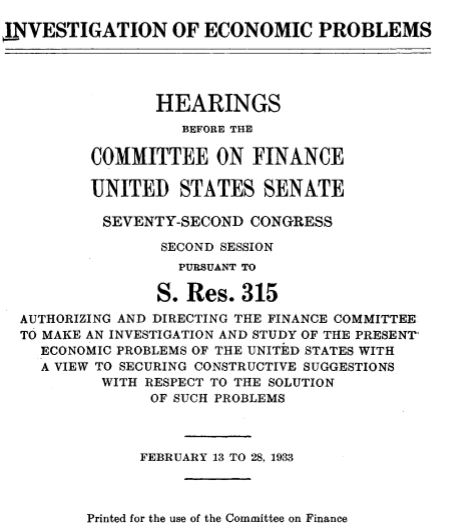
Below is from a Hearing before the Committee on Finance US Senate, February 1933.

  • Before effective action can be taken to stop the devastating effects of the depression, it must be recognized that the breakdown of our present economic system is due to the failure of our political and financial leadership to intelligently deal with the money problem. In the real world there is no cause nor reason for the unemployment with its resultant destitution and suffering of fully one-third of our entire population. We have all and more of the material wealth which we had at the peak of our prosperity in the year 1929. Our people need and want everything which our abundant facilities and resources are able to provide for them.
  • The problem of production has been solved, and we need no further capital accumulation for the present, which could only be utilized in further increasing our productive facilities or extending further foreign credits. We have a complete economic plant able to supply a superabundance of not only all of the necessities of our people, but the comforts and luxuries as well.
  • Our problem, then, becomes one purely of distribution. This can only be brought about by providing purchasing power sufficiently adequate to enable the people to obtain the consumption goods which we, as a nation, are able to produce. The economic system can serve no other purpose and expect to survive.
  • If our problem is then the result of the failure of our money system to properly function, which to-day is generally recognized, we then must turn to the consideration of the necessary corrective measures to be brought about in that field; otherwise, we can only expect to sink deeper in our dilemma and distress, with possible revolution, with social disintegration, with the world in ruins, the network of its financial obligations in shreds, with the very basis of law and order shattered. Under such a condition nothing but a primitive society is possible.
  • The nineteenth century economics will no longer serve our purpose— an economic age 150 years old has come to an end. The orthodox capitalistic system of uncontrolled individualism, with its free competition, will no longer serve our purpose. We must think in terms of the scientific, technological, interdependent machine age, which can only survive and function under a modified capitalistic system controlled and regulated from the top by government.
  • Money has no utility or economic value except to serve as a medium of exchange.
  • The debt structure has obtained its present astronomical proportions due to an unbalanced distribution of wealth production as measured in buying power during our years of prosperity. Too much of the product of labor was diverted into capital goods, and as a result what seemed to be our prosperity was maintained on a basis of abnormal credit both at home and abroad.
  • This naturally reduced the demand for goods of all kinds, bringing about what appeared to be overproduction, but what in reality was underconsumption measured in terms of the real world and not the money world.
  • Why was it that during the war when there was no depression we did not insist upon balancing the Budget by sufficient taxation of our surplus income instead of using Government credit to the extent of $27,000,000,000? Why was it that we heard nothing of the necessity of balancing the Federal Budget in order to maintain the Government credit when we had a deficit of $9,000,000,000 in 1918 and $13,000,000,000 in 1919? Why was it that there was no unemployment at that time and an insufficient amount of money as a medium of exchange?
  • Why resort to inflation of the sort referred to when prices can be increased and business revived on the basis of our present money system? We have nearly one and a half billion currency more in circulation at the present time than we had at the peak of 1929, and under our present money system we are able to increase this by several billion more without resorting to any of the three inflationary measures popularly advocated. There is sufficient money available in our present system to adequately adjust our present price structure. Our price structure depends more upon the velocity of money than it does upon the volume.
  • I repeat there is plenty of money to-day to bring about a restoration of prices, but the chief trouble is that it is in the wrong place; it is concentrated in the larger financial centers of the country, the creditor sections, leaving a great portion of the back country, or the debtor sections, drained dry and making it appear that there is a great shortage of money and that it is, therefore, necessary for the Government to print more. This maldistribution of our money supply is the result of the relationship between debtor and creditor sections— just the same as the relation between this as a creditor nation and another nation as a debtor nation—and the development of our industries into vast systems concentrated in the larger centers.
  • Senator WALSH of Massachusetts. When do you think prosperity will come back? Mr. ECCLES. It depends entirely on what the Government does. It will not come back unless action is taken by the Federal Government, in my judgment.

Note: Italics and bold are mine

There is nothing extraordinary about the rise of central banks balance sheets

There is nothing more deceptive than an obvious fact.

–Arthur Conan Doyle, “The Boscombe Valley Mystery”


  • Major central banks’ balance sheets (Fed, ECB, BoJ) have increased by about $10Tn since the collapse of Lehman Brothers in 2008.
  • There is nothing extraordinary about this fact.
  • This is also how much the IMF estimates the global shadow banking system has lost in about that period.
  • Is this a coincidence?
  • I do not have the data for the shadow banking monetary liquidity globally, but looking at data for the US, shadow banking liquidity has fallen by about $5tn while the Fed’s balance sheet has increased by about $4tn since the 2008 crisis.
  • Still think it is a coincidence?
  • The core of our monetary system is money as credit. If the commercial banks/broker dealers cannot perform the collateral intermediation process as necessary for the monetary liquidity to reach its designated purpose, the central bank has to step in and lend its own balance sheet.
  • The collapse of Lehman Brothers struck directly at the core of the shadow banking system and caused monetary liquidity to collapse as a result. However, in the years that followed, developments on the regulations side (Basel, Dodd-Frank) have further prevented the banks to provide enough monetary liquidity.
  • As long as shadow banking liquidity continues to deteriorate, the central banks will have to plug in the difference just to keep the monetary liquidity from going down.
  • For example, the Fed’s balance sheet stopped growing in 2014 and that’s about when the ECB’s started growing again.
  • Global liquidity is still predominantly in USDs and a lot of that is generated in the offshore dollar market. The ECB, BoE, BoJ have become the de facto dealers of last resort in there. They are providing an extraordinarily formal backstop of this global dollar funding market.
  • This is a good thing. The increase in central banks’ balance sheets is a source of stability, not a reason for concern.
  • We are formalizing the shadow monetary liquidity. As long as this is ongoing, it would be difficult for a sustained rally in the USD.
  • The financial crisis of 2008 has put a lot of economics taboos out for discussion. How money is created in a fiat sovereign monetary system is one of them.
  • Going forward, central banks’ balance sheets may not only not shrink, but they may continue to increase if the central banks allow public (retail) access to them. As the process of digitalization advances and as cryptocurrencies continue to spread, they may not have a choice.

What is the role of surplus capital?

Source: Z1 Flow of Funds, US Federal Reserve/Click to enlarge

“For an individual agent, additional income is necessarily accumulated in financial or real assets. The income not spent (the individual’s “saving”), which is initially received in the form of additional settlement medium, is allocated across asset classes. But for the economy as a whole this is obviously not true. The allocation of savings simply represents a gross transfer of assets across individuals: the increase in deposits of income receivers is matched by the decline in deposits of those that pay that income out. It is only when the additional income is supported by issuance of financial claims (eg credit or shares) that financial assets and liabilities are created. By the same token, the popular and powerful image that additional saving bids up financial asset prices (and hence depresses yields and interest rates) because it “has to be allocated somewhere” is misleading. There is no such thing as a “wall of saving” in the aggregate. Saving is not a wall, but a “hole” in aggregate spending.” BIS Working Paper 346

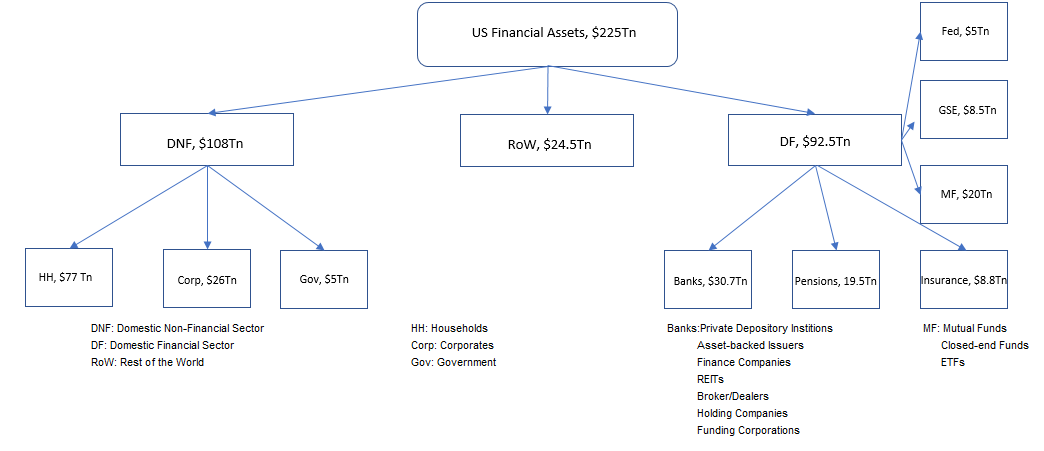
  • There are $225Tn of US financial assets in terms of market value (Chart above).
  • Financial assets growth started to surpass GDP growth in the early 1980s as the financialization of the US economy began. For example, for 40 years between 1945 and 1985, the ratio of financial assets to GDP varied between 5x and 6x. After 1985, the ratio started moving higher and higher and currently stands at record 12x!

Source: Z1 Flow of Funds, US Federal Reserve

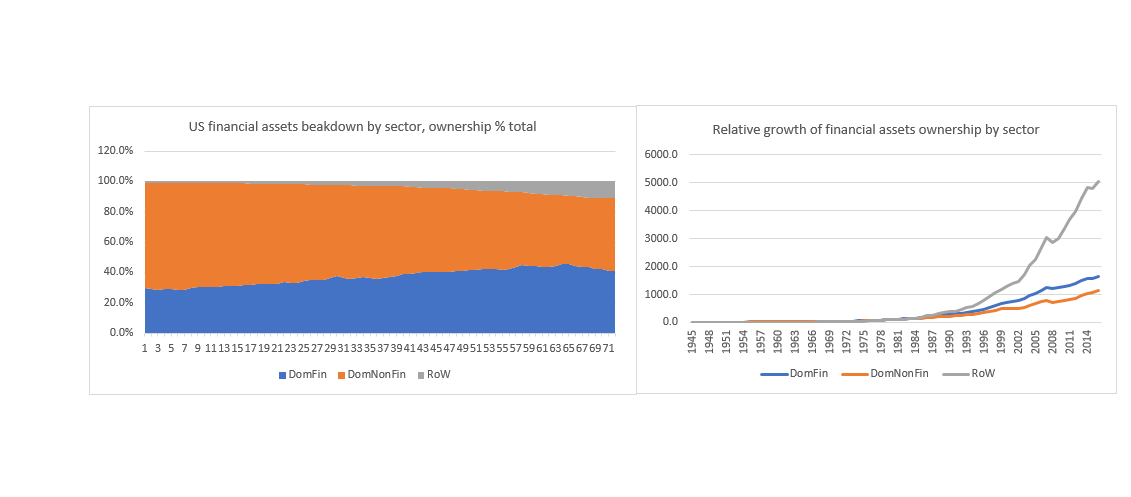
  • In terms of ownership, financial assets are split among three major sectors: Domestic Non-Financial, Domestic Financial and Rest of the World.
  • The Domestic Financial Sector started gathering more and more financial assets relative to the Domestic Non-Financial Sector in the early 1990s. But it is really foreigners who began heavily investing in the US as trade flows picked up in the late 1990s and strong globalization trends emerged.

Source: Z1 Flow of Funds, US Federal Reserve/Click to enlarge

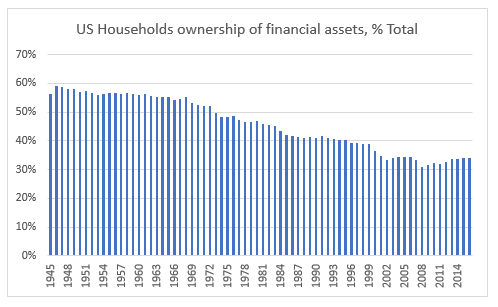
  • US households’ direct ownership of financial assets has gradually decreased since 1945 in line with the financialization of the US economy. As absolute savings increased, the financial industry expanded to meet households demand for new products in which to invest them. After the 1980s, the financial industry not only was creating new products but also started investing on behalf of households.

Source: Z1 Flow of Funds, US Federal Reserve

  • Savings are a dead weight on the real economy as they drain funds away from it. If instead they were invested in real projects, arguably, employment and economic growth could have been higher. At the moment, it is the financial sector, primarily, which benefits from this surplus capital.
  • As this surplus capital gets diverted into savings, new money must be created to serve the real economy. This new money gets created as debt. This has generally been a more efficient method of  money creation than most other ones in the past as it matches closely economic activity.
  • However, as the debt stock increases mathematically due to positive interest rates, this efficiency decreases. In addition, not only new money must be created to serve the real economy but also to pay back the old debt.
  • The financial sector gets a cut on both the asset side of the balance sheet (managing the surplus capital) and on the liability side (creating the debt).
  • Looking at the US economy from this sectoral balance point of view, we should be also asking ourselves questions about the role of this surplus capital.
  • For example, what is the need for government bonds in a fiat monetary regime? Are they ‘created’ to fund US government budget deficits, for example, or to meet the demand for positively yielding (protection from inflation) and safe (protection from default) assets as the surplus capital increases?
  • Given that companies generally prefer to fund themselves using internal capital, what is the role of the stock market especially when there is also surplus corporate capital?
  • How far can we go monetizing the real world to create enough financial assets to meet the demand of the increasing capital surplus globally?
  • In the increasingly digital world where the marginal cost of production is zero and in the old industrial world where the marginal cost of production is dropping fast because of the advances of technology, how much surplus capital in aggregate do we need?
  • Do we have so much surplus capital because our income distribution model is broken?

…

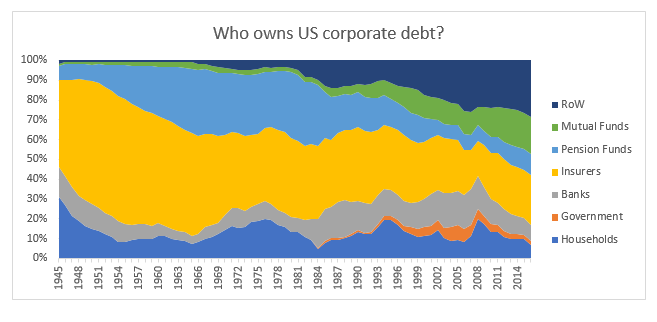
Who owns US corporate debt?

This is Part Four of an exercise looking at how the ownership structure of major US assets has changed over the years. Part One (Equities). Part Two (Debt). Part Three (UST).

Source: Z1 Flow of Funds, US Federal Reserve

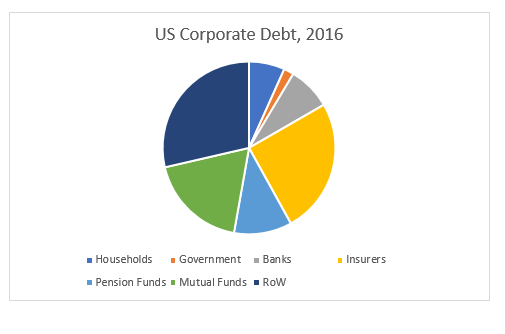
  • The largest holders of US corporate debt are foreign entities at 28.6% of all holdings. That’s up from less than 1% in the late 1940s.
  • The second largest holders are insurance companies at 25%. Even though their holdings have gone down from 44% in the 1940s, when they were also the largest holder by far, insurance companies seem to continue to play a dominant role in the US corporate debt market unlike so in equities or UST.
  • Mutual funds and pension funds come after at 18.6% and 10.8% respectively. Their roles have diverged since the mid-1980s with mutual funds relatively increasing, while pension funds relatively decreasing their holdings of US corporate debt.
  • Households were the second largest holder of US corporate debt in the 1940s at 31%. Today they are one of the smaller holders at 6.7%.

Source: Z1 Flow of Funds, US Federal Reserve

Luck management

Investing is all about luck management. There is plenty of luck to go around but it is not distributed equally all the time.

The say the market is irrational. True. But luck management isn’t.

It’s like a video game. Luck has its own rules and ‘levels of difficulty’. However, unlike a video game, the hardest level is the first one. After that it gets progressively easier and easier simply because there are fewer and fewer players left while the quantity of luck does not change.

There are two things to remember, though.

First is that everyone gets their chance. But the trick is we must wait for our turn. So, patience is paramount.

It’s almost like standing in a ‘queue’. But not the orderly queue you have, for example, in Canary Wharf in London at 5:15pm. It’s more like the ski queues in almost any resort in the Alps at 9:15am. We must make sure we manage our place in the ‘queue’ and, just like in a video game, do not drop out before our turn comes up.

Second, when we are up, we have to go for it. We must take full advantage of our luck so that we can get to the next level where there are fewer people in the queue and the luck-go-round is thus shorter. Just like a ski lift takes you up in the mountain and then there is another lift to go even further higher where there are always fewer people on it.

But to take that second lift, you must first take the time to become better. On the ski slopes you must have the patience to go up and down several times on the same run before you feel you are ready to go higher without breaking your legs on the way down.

I should not be saying this but it happens more often than people think: when you are on that lift, do not drop off by doing silly things.

What else? Oh yes, of course, the most important part. The bonus. No, not the bonus you are thinking of. If you are a good manager of luck eventually you should be able to hire someone else to stand in the queue for you while you go on and finally start to contribute to society.

Share the luck back. Give people a chance to play the game. It’s too late when you die, and it is not heritable. It’s the cycle of life.

Random thoughts

  • In a free-floating fiat currency regime, sovereign bonds are the same as sovereign cash. They do not represent a promise to pay. Rather they are an accounting concept used to measure economic activity over time.
  • There is no bubble in sovereign bonds and the concept of valuation here is meaningless. Bonds are different from any other asset class because they have a terminal value and a maturity structure. They are simple math. No need to put bells and whistles there.
  • If the risk of default of a sovereign bond is 0%, then the only other risk is inflation. If also inflation is 0%? We happily hold risk-free currency in our pockets. Sovereign bonds are just like a savings account with the government instead of a private bank. How much do you get for a 1-year CD with your local bank at the moment? Why should 1-year T-bills yield 100bps more given that it is also better credit?
  • There is no natural rate of interest. Economics is a social science and there are many different equilibria.
  • However, over the very long run, interest rates have fallen from 25% in Babylonian times to almost 0% now in a consistent fashion through the ages. This is a result of the inevitable advances of innovation and the subsequent creation of extra surplus capital accumulation. There is no mean reversion in interest rates.
  • The only time interest rates have deviated from this long-term decline is when there has been a disruption on the supply side which had resulted in the subsequent destruction of capital. Wars and natural disasters or trade barriers and embargoes could be the cause of this. 
  • Negative interest rates are just one state of equilibrium. It may seem that they are central-bank imposed, however, the central bank only follows the market forces in their attempt to manage the debt burden.
  • Every single attempt by the central banks in the developed world to raise interest rates post the 1980s has been unnecessary as the economy has had plenty of surplus capital and labor on the back of years of peaceful technological advancement and no negative supply shocks. It has also backfired and led to recessions because of the increasing debt burdens.
  • Recessions are a balancing act. However, if economic balances are not resolved each following recession becomes more severe than the preceding one.
  • As the economy moves away from manufacturing, which requires heavy upfront investment, to services which require much less investment, and now to digital technologies which require even less investment, interest rates substantially lose their power to affect economic activity.
  • If it were not for externally-driven rising healthcare and education costs, US would have fallen in a deflation already in the mid-1990s.
  • If it was not for the decline in the labor participation rate after the 2008 financial crisis, the US unemployment rate would have been much higher. In addition, the jobs created in the last 8 years are predominantly in the service sector, low-wage, and in many cases, without benefits.
  • Yet interest rates affect the balance sheet of the financial sector. However, the effect is asymmetric. Lower rates push asset prices higher and make debts easier to service, but they do not cause an economic boom. Higher rates, on the other hand, cause asset prices to fall, but do nothing to liabilities which stay unchanged. This creates financial imbalances which eventually also cause economic imbalances.
  • Therefore, central bank interest rate policy may be effective in managing the financial economy but it can become a lose-lose game in servicing the real economy.
  • As a result, on one hand, there is an increasing demand for the medium of exchange from income-poor and debt-laden private citizens and for the unit of safety from savings-rich creditors. And, on the other hand, there is inadequate supply of both from the public sector.
  • This is not a recent phenomenon. We had a similar environment in the early 2000s. The market responded by creating fake-safe private assets (repackaged mortgage CDOs and the likes) which allowed the income-poor to buy real estate while it also provided a seemingly safe-haven for the savings-rich.
  • That did not work out well eventually.
  • The rise of cryptocurrencies in the last few years is just the more modern equivalent of these fake-safe assets. They are a result of the advances in technology but they also are a response to this broken monetary transmission mechanism which eventually led to the current inefficient income generation model.   
  • Cryptocurrencies simply fill in the void left by the central bank in its refusal to extend its balance sheet to the public at large. There is no other way for the public to receive the medium of exchange other than direct from the central bank at no cost: the private debt super-cycle in the developed world reached its peak in 2008, while the Work=Job=Income model broke down already in the 1990s.  
  • In the past, we used to call this kind of money creation by the central bank/government direct, “helicopter money”. It has a lot of negative connotations because of recent historical examples of autocratic rulers printing more money than the economy needed (and often for their own personal use). However, there are plenty of examples in earlier history when “helicopter money” actually worked in restoring and stabilizing economic growth.
  • Examples of that are the Roman Republic and the Song Dynasty in China when there was a solid institutional infrastructure guaranteeing social accountability.
  • The modern equivalent of “helicopter money” is central bank digital cash (CBDC – or some version of that). Given the rapid spread of cryptocurrencies, CBDC is inevitable. I wonder, though, whether CBDC would only be introduced after the next financial crisis forces the authorities’ hand.
  • In the present environment of large capital and labor surpluses, CBDC is unlikely to cause a runaway inflation unless it really is misused. The existence of solid institutional infrastructure in the developed world, however, makes that less likely.
  • However, there are still technical hurdles to the wider use of CBDC. Even with good intentions and with impeccable system of checks and balances, the world is too complex for human central planning.
  • What is the right amount of CBDC to inject in the economy? For how long? Does everyone get the same amount? Etc.  
  • Luckily, harnessing the enormous amount of data we have created using advanced machine learning and with the help of the blockchain to organize and store it, policy makers can draw conclusions about economic activity in real-time and thus supply the medium of exchange on demand.
  • Technological advances causing bigger and bigger capital and labor surpluses, the move from services to the digital economy causing lower and lower demand for investments, the introduction of CBDC making interest rate policy obsolete, what happens to our savings? What use is it to us? Can we live without financial assets?
  • This is not a trick question. Developed world governments have been buying up their own debt back and corporates have been buying back their own shares. Maybe that is a trend reflecting the new economic reality as described above…  

Who owns US Treasuries?

Source: Z1 Flow of Funds, US Federal Reserve

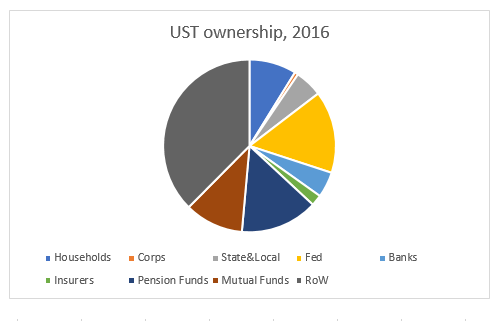
2016

  • The biggest owner of US Treasuries (UST) are foreigners at 37.6% of total. Relative to other holders, their ownership actually peaked in 2008 at 44.2% and they have been net seller in the last two years.
  • The second biggest owner of UST is the Fed at 15.4%. If we add state and local governments to it, the government, as a whole owns, 20.6% of UST.
  • In the domestic sector, pension funds own the most at 14.5%, followed by mutual funds at 11% and households at 8.8%.

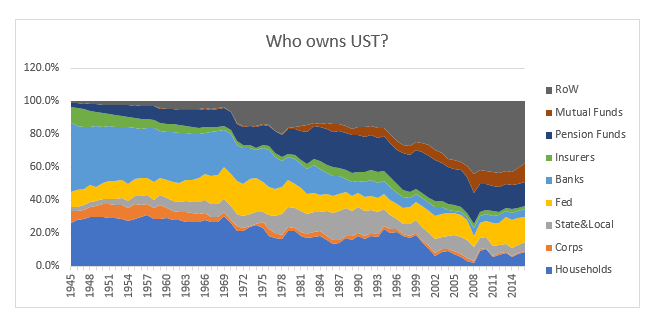
Over the years

Source: Z1 Flow of Funds, US Federal Reserve

  • The ownership of UST has changed significantly over the years. For example, at the start of the data in 1945, the financial sector (banks, broker-dealers, etc.) owned 41.9% of the total; in 2016 that had fallen down to 4.8%.
  • Households, the corporate sector and insurance companies have also substantially reduced their UST holdings over the years.
  • Mutual funds and pension funds, on the other hand, have increased them.
  • The elephant in the room, however, is the foreign sector, which in 1945 was the second smallest owner of UST (after mutual funds) at 1%. There was a big jump in foreign ownership in the 1970s and then starting in the mid-1990s.

T-Bills vs long dated US government securities

Source: Z1 Flow of Funds, US Federal Reserve

  • Majority of US government debt has historically been in long-dated instruments.
  • However, in the mid-1970s, there were about as many T-Bills as long-dated government paper. Nevertheless, over the last couple of years, the issuance of T-bills has declined to all-time low.

Reminiscences of a Stock Operator

by Edwin Lefevre

  • The tape does not concern itself with the why and wherefore. It doesn’t go into explanations… The reason for what a certain stock does today may not be known for two or three days, or weeks, or months. But what the dickens does that matter? Your business with the tape is now–not tomorrow. The reason can wait. But you must act instantly or be left.
  • And right here let me say one thing: After spending many years in Wall Street and after making and losing millions of dollars I want to tell you this: It never was my thinking that made the big money for me. It always was my sitting. Got that? My sitting tight! It is no trick at all to be right on the market. You always find lots of early bulls in bull markets and early bears in bear markets. I’ve known many men who were right at exactly the right time, and began buying or selling stocks when prices were at the very level which should show the greatest profit. And their experience invariably matched mine that is, they made no real money out of it. Men who can both be right and sit tight are uncommon. I found it one of the hardest things to learn.
  • What beat me was not having brains enough to stick to my own game – that is, to play the market only when I was satisfied that precedents favoured my play.  There is the plain fool, who does the wrong thing at all times everywhere, but there is also the Wall Street fool, who thinks he must trade all the time.  No man can have adequate reasons for buying or selling stocks daily – or sufficient knowledge to make his play an intelligent play.
  • If somebody had told me my method would not work I nevertheless would have tried it out to make sure for myself, for when I am wrong only one thing convinces me of it, and that is, to lose money.  And I am only right when I make money.  That is speculating.
  • They say you never go broke taking profits.  No, you don’t.  But neither do you grow rich taking a four-point profit in a bull market.
  • I think it was a long step forward in my trading education when I realised at last that when old Mr Partridge kept on telling other customers, “Well, you know this is a bull market!” he really meant to tell them that the big money was not in the individual fluctuations but in the main movements-that is, not in reading the tape but in sizing up the entire market and its trend. 
  • The market does not beat them.  They beat themselves, because though they have brains they cannot sit tight.  Old Turkey was dead right in doing and saying what he did.  He had not only the courage of his convictions but also the intelligence and patience to sit tight. 
  • Disregarding the big swing and trying to jump in and out was fatal to me.  Nobody can catch all the fluctuations.  In a bull market the game is to buy and hold until you believe the bull market is near its end. 
  • Remember that stocks are never too high for you to begin buying or too low to begin selling.
  • Losing money is the least of my troubles.  A loss never troubles me after I take it.  I forget it overnight.  But being wrong – not taking the loss – that is what does the damage to the pocket book and to the soul. 
  • It sounds very easy to say that all you have to do is to watch the tape, establish your resistance points and be ready to trade along the line of least resistance as soon as you have determined it.  But in actual practice a man has to guard against many things, and most of all against himself – that is, against human nature.
  • Fear keeps you from making as much money as you ought to.
  • The game does not change and neither does human nature.
  • I trade on my own information and follow my own methods.
  • He was utterly fearless but never reckless.  He could, and did, turn on a twinkling if he found he was wrong. 
  • The speculator’s deadly enemies are: Ignorance, greed, fear and hope.  All the statue books in the world and all the rule books on all the Exchanges of the earth cannot eliminate these from the human animal
  • I sometimes think that speculation must be an unnatural sort of business, because I find that the average speculator has arrayed against his own nature.  The weaknesses that all men are prone to are fatal to success in speculation – usually those very weaknesses that make him likable to his fellows or that he himself particularly guards against in those other ventures of his where they are not nearly so dangerous as when he is trading in commodities or stocks. 
  • The public ought always to keep in mind the elementals of stock trading.  When a stock is going up no elaborate explanation is needed as to why it is going up.  It takes continuous buying to make a stock keep going up.  As long as it does so, with only small and natural reactions from time to time, it is a pretty safe proposition to trail with it. 
  • But if after a long steady rise a stock turns and gradually begins to go down, with only occasionally small rallies, it is obvious that the line of least resistance has changed from upward to downward.  Such being the case why should anyone ask for explanations?Â