Silk Road Footnote

Tags

,

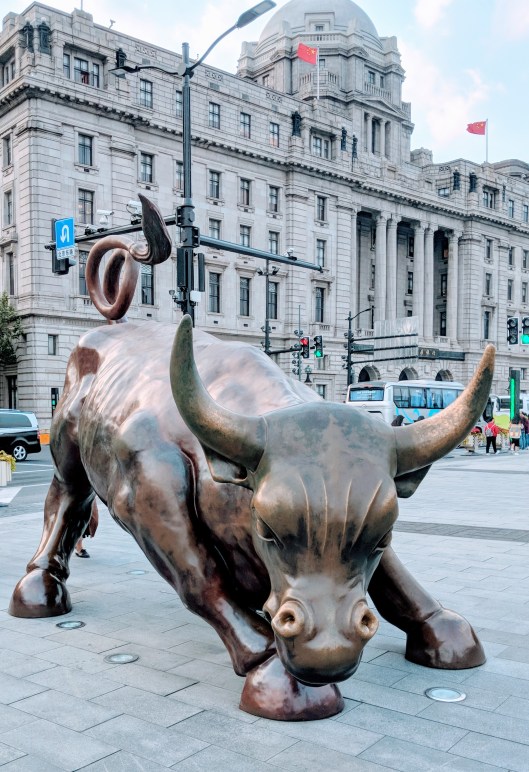
(Bull on the Bund, Shanghai)
We’ve been in China for less than a month as part of our Silk Road journey by land, a time, highly inadequate to make any strong conclusions. Yet, within that time, we’ve crossed the full country west to east, taken only public transport, stayed and dined in ‘everyday’ hotels and restaurants (a lot of street food as well!). All this gave us a chance to engage with locals on a completely different level than by only visiting the financial sector in Shanghai or government officials in Beijing (and staying in 5-star hotels – the way I used to do it as a professional investor). All this is obviously anecdotal ‘evidence’ but what struck me is:

1) the service sector is absolutely booming

2) prices are generally on the same level as in Europe/US

3) the locals can afford them

I consider myself a practical economist (UPenn/Wharton but having acquired 90% of my ‘economics’ from the markets and from tons of reading), so I am not making any claims, but it is actually possible, despite misgivings in the West, that China may indeed be growing at the official rate they have been reporting.

We, ourselves, in the West, are grappling with the accounting of an increasingly digitized service economy. Well, the size of Chinese e-commerce is multiple times that of the US, which means a lot more data. Moreover, because of the structure of society (centralization) they have managed to gather and analyze that data, and perhaps, make better conclusion than we could possibly make.

So, it is possible that we are indeed looking at Chinese growth too pessimistically, which does not negate the fact that all this may indeed be built upon a credit bubble. That would be hardly a surprise given that US growth has been built on a huge private credit bubble since the days of financialization in the early 1980s. Indeed, the locals we spoke to, think there are currently three big bubbles in the world: US stocks, Japanese bonds and Chinese real estate.

My point is that China could be shifting to a consumer-based society much faster than we anticipated and thus is also becoming much less dependent on exports and foreign growth – China does not need to rely on the rest of the world that much anymore. That was more than obvious on our travels in the country: foreign tourists, at best, are tolerated – the local Chinese tourist industry is very well developed and is flourishing. This is a big change from 10 years ago, for example, during which living standards have more than doubled.

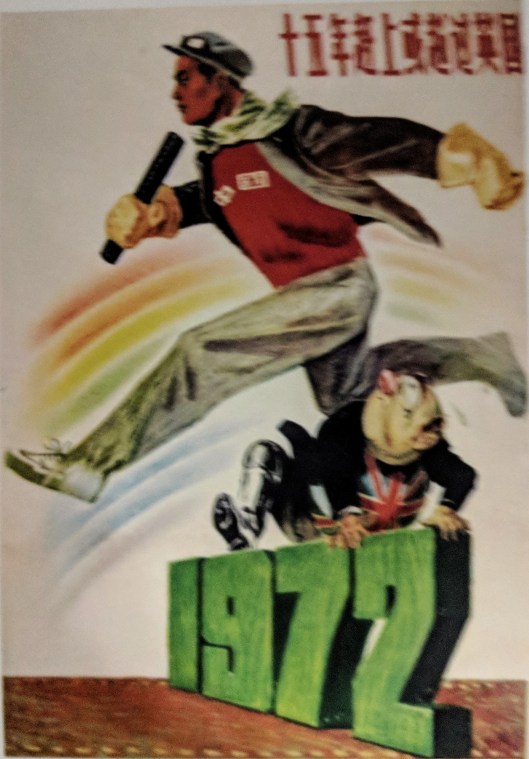
It is amazing, in fact, the magnitude of Chinese middle class growth. When combined with the digitalization of society, totally embraced by the government, and the Great Leap Forward may finally happen.

(*Overtake England in 15 years”, 1958, Shanghai Propaganda Poster Art Centre)

The fact that some of these trends are developing much slower in the West due to a lot of private legacy interests, which stand in the way, and governments which imagine they are running out of money, increases the risk that this latest trade ‘war’ would prove to be a spectacular own goal.

Silk Road (6): Chevrolet Land

I know probably you would not believe me, having also said that every second car in Georgia is a Toyota Prius, but in Uzbekistan, pretty much every new car is a Chevrolet. Ok, I looked it up: thanks to a joint venture between GM and the government, apparently 95% of the new cars in Uzbekistan are Chevrolets.

Because of Uzbekistan’s vast resources of gas (and no oil), majority of those cars are adjusted for methane and propane, which are half the
price of oil. It was strange the first time we took a long-distance taxi and it
had to refill: the driver stopped about 200m away from the gas station and
asked us to get out of the car for safety.

I was really looking forward to visiting Uzbekistan. The country was a major destination along the Silk Road and I had heard so much about the magic of Samarkand already in my school days in Bulgaria. I was also very curious to see a country which was literally locked up for so many years after the breakdown of the Soviet Union: Uzbekistan’s borders were pretty much shut down until 2005 – during and until the end of Islam Karimov’s reign, the first president after gaining independence.

In fact, developing deep and meaningful international relations are still in their early stages. For example, the tourist visa regime was only recently simplified, and only a couple of months before our visit, Uzbekistan finally introduced e-visas. But also, because the country was closed off for the majority of the world for so long, it actually learned to produce a lot of goods locally. Ironically, the joint venture with GM was both an example
of this (locally produced cars) and an exception (foreign joint venture).

One could say that we entered Uzbekistan through the “back door”, from Beyneu, Kazakhstan. In fact, Uzbekistan is one of only two double land-locked countries in the world – these are countries which border land-locked countries themselves – yet another curious feature which made me
eager to visit it..

“Back door” is also in reference to the way tourists travel when they visit the country: they normally fly into Tashkent, go to Samarkand, and then Bukhara. Some of the more adventurous may go to Khiva as well. And
then back. We did it the other way around: Khiva-Bukhara-Samarkand-Tashkent.

We encountered a peculiarity about Uzbek culture already in the
border town there: vodka. When it comes to liquor, restaurants seem to offer a large variety of vodka, and pretty much nothing else (and people do drink their vodka – and it shows!). I seldom saw beer, and when I ordered it, it was not particularly good.

What is surprising, though, is the lack of wine. Uzbekistan has different varieties of amazingly sweet grapes but, as far as I know, not much of a choice when it comes to wine. We did try a bottle of wine in Nukus,
the only one on the menu; it was OK, but it turned out it was sweet (what a
surprise!).

But while we may have gone ‘against the tourist traffic’, so to say, we definitely went with the local traffic. The train left Beyneu,
the last stop before the Uzbek border at 4am. We had ‘camped out’ at the train station for the night which was full of people; in fact, at some point one could barely even stand there. There were traders selling all kinds of stuff outside along the railway line. It was incredibly busy!

The kids by now were used to such an experience and promptly fell asleep on the chairs, their heads resting on their knapsacks. As our trip has progressed, it is actually interesting to see how they finally started to grasp the concept of different kinds of comfort. For example, before
this trip, they were used to staying in 4 and 5 star hotels where their concern would normally be if the facilities include a swimming pool. Now they worry not only about the availability of Wi-Fi but sometimes, as in the case of Beyneu, also of a bed!

Around 2 am, a kind officer in the train station, with whom I struck a conversation about football, informed us that we could actually board the train. What was our surprise when we found out that we did not have any assigned seats, it was ‘first come, first serve’ kind of service, and people had already taken any seats where one could lie down! Eventually we managed to find two bench-seats for the kids.

As usual by now when crossing land borders, majority of travellers were ‘traders’: we were asked several times whether we could take some of their stuff in our bags. Overall, however, people were very nice and we
were simply treated as a curiosity. The border crossing was fast and
straightforward. The customs officer did ask us though whether we were bringing any history books!

We arrived in Nukus after 17 hours, travelling through mostly desert-like terrain. There, at the train station, trying to figure out a way to get to a hotel (we had no booking) I encountered another peculiar feature of Uzbekistan culture: they don’t seem to like to negotiate. Having travelled through all the other countries, but especially Turkey and Iran, where negotiating was part of the process, I found this strange. The taxi drivers in Nukus, for example, had very strict rules, one could say, the equivalent of taxis in the West with meter machines: 5,000 Soum (that’s the local currency) for the first 3km and 500 for each after. They would simply
zero out their odometers on every ride.

Even in the bazaars, Uzbek people did not seem to engage in negotiations. They were a bit more flexible there, but they would almost get offended if it went for too long and eventually refuse to sell you the product at any price if “pushed”. I don’t know if this is a specific Uzbek
characteristic or it is a vestige of the Soviet system but I had to respect that this is the way it is.

Our first planned stop was Khiva, a 3h drive from Nukus. The day we drove to Khiva, the temperature dropped from almost 30C, from the day before, to half that. We did not expect such a big change in weather that
soon, and definitely did not welcome it!

Khiva’s old town is surrounded by a wall, inside which old residential houses stand next to centuries old mosques and madrases. Both Uzbekistan’s history and culture are interlinked with those of Iran (and, later, Turkey), so the structure of the mosques is somewhat similar. Yet, unlike Iran, Uzbekistan is famous for its madrases, Muslim religious schools. Samarkand’s Registan, for example is composed of three madrases (but there is one small mosque in one of them).  

Despite this, Uzbekistan did not strike me as a particularly religious country. We barely saw women wearing hijabs (actually they were predominant only in Tashkent’s old town). We even had pork in a restaurant in Nukus (the proprietor was Korean) and in a cafe in Tashkent.

As we advanced more eastwards, the arid land gave way to some green vegetation, orchards and grapes. Along the roads, there were people
selling fruits and vegetables at almost any time of the day and (probably)
night. What was amazing to see was the melons: apparently Uzbekistan has the biggest varieties of melons of any country in the world (and the ones we tried were exceptionally sweet – it is a shame they do not juice them like in Iran).

Uzbekistan has plenty of cotton fields. As we were in the country right at the time of harvesting it, we could see people picking up the cotton and piling up the bags in massive containers along the road. We were told that students had to help with the harvest as well (i.e. no school for a month!). I remembered with fondness that we had to do the same in Bulgaria when I was a student there in the 1980s.

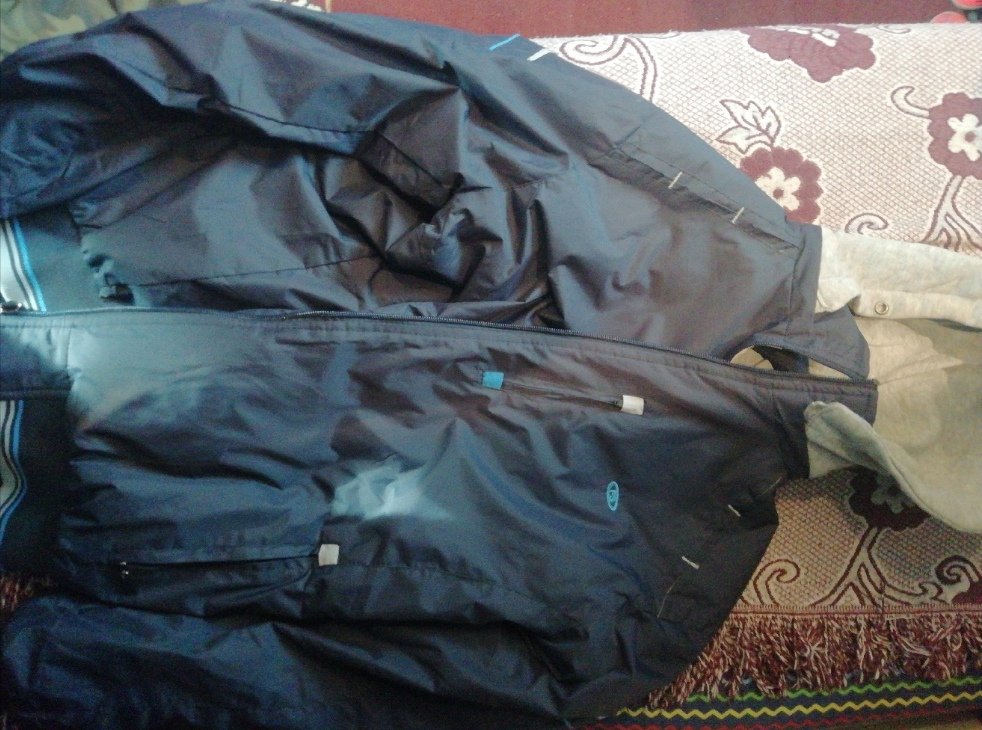
Unfortunately, the weather refused to ‘cooperate’ and it got progressively colder. So much, that we had to buy my son a winter jacket in the local market in Bukhara (he had lost his warm jacket somewhere along the
Silk Road before!). We were also forced to wear pretty much all our layers just to keep warm. Yet, that did not seem to help Georgia who fell ill and had to stay one full day in bed! The next day, while feeling better and able to walk around the streets, she also bought something to keep her warmer: a traditional long Uzbek coat. She looked different in it, and enjoyed the curious (from some, the older ones, obviously approving, from the others, the younger generation, amusing) gazes of the locals as we passed them by.

Another reason I wanted to visit Samarkand was Timur the Great, the legendary local leader I had read about as a kid. He created an empire which spanned a vast area, going deep into Persia and all the way to Delhi. However his reign was a one-off, i.e. there were no successors who could maintain his expansions. Timur was peculiar in a sense that he was illiterate himself, but he believed in the power of knowledge and appreciated the beauty of art. Legend has it that when he first ransacked Samarkand ,he killed the majority of the population but he spared the lives of architects, teachers and generally, people of knowledge. Then, under his guidance, Samarkand was rebuilt with the focus exclusively on madrases and other places of knowledge (Ulug Beg, the famous astronomer lived approximately at the same time).

Our last stop in Uzbekistan was its capital, Tashkent. I did not expect much of Tashkent, especially after visiting all these other places before that. Still, I was looking forward to being there because a friend of mine from both university and Morgan Stanley, whom I had not seen for decades, lives there. Unfortunately, he surprisingly had to go to New York the same week we turned up there. It was a shame, not only because I was looking forward to reconnect with him but also because speaking to a local, who I knew previously,would have enriched massively our view of Uzbekistan. As it was, Uzbekistan, after Iran, was a bit of an anticlimax.

However, we managed to get the best of our visit nevertheless. In fact, I enjoyed Tashkent, if not for anything else, for the blast from my ‘Soviet’ past that it provided, more than any other ex-Soviet capital I had ever been to.

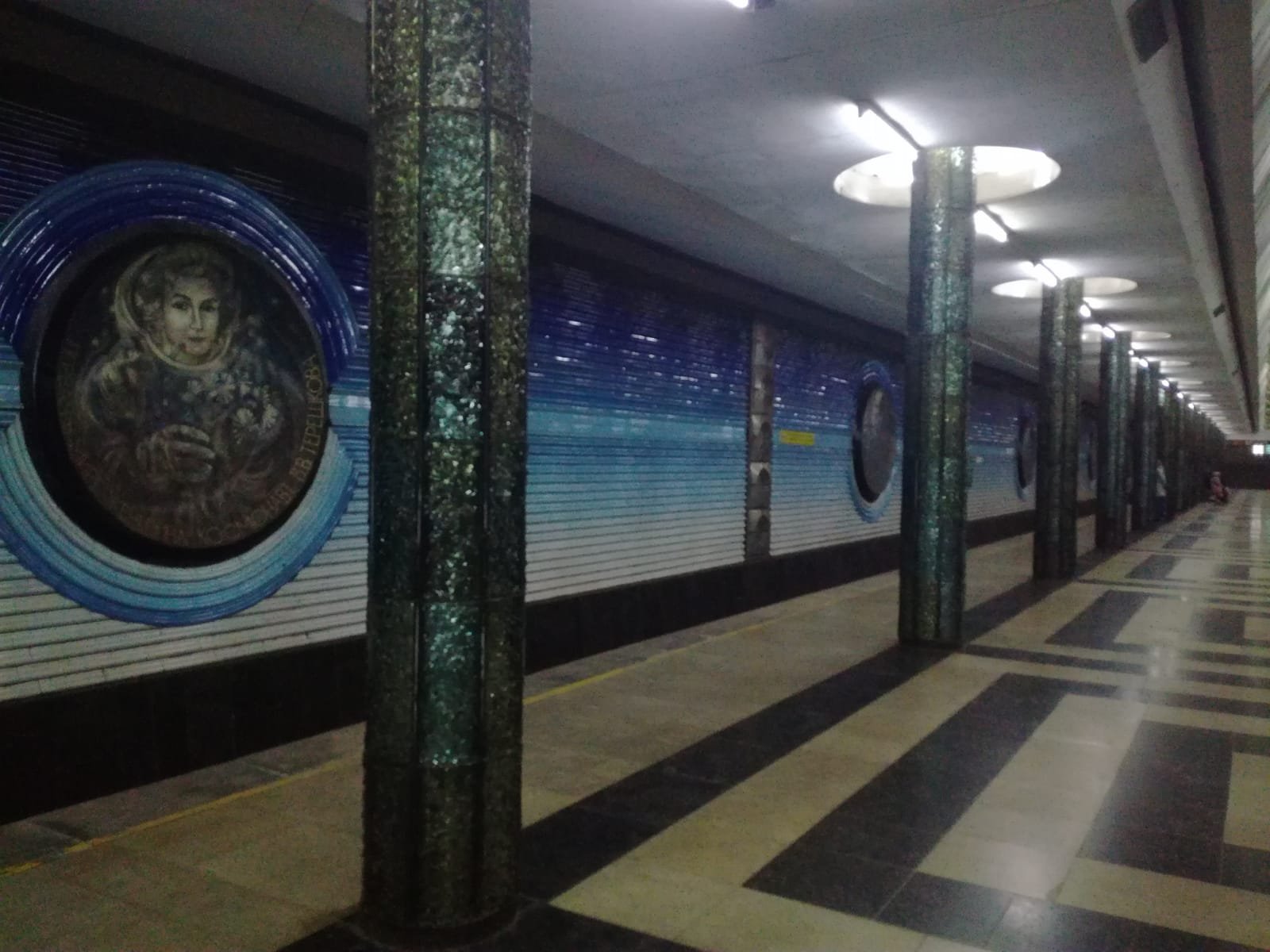
So, a lot of things reminded me of how it used to be in Bulgaria in the 1980s: the monuments, the old block of apartments, the local market (where people would still offer to record music for you!), the circus. Even the main department store in the town where I went to high school was called ‘Tashkent’. We took the metro a lot (by the way, there was no metro in Bulgaria back in the ’80s). Some of the metro stations had very interesting decorations, the way I remember the Moscow metro when I visited it in the late 1980s.

The one thing we struggled with in Tashkent was knowing which restaurant was worth going to. In fact, that is one of the things we missed the most on our travels – after eating ‘street food’ most of the time, we were craving some variety…some
vegetables. Luckily, our next stop, Almati, would offer plenty of it.

Uzbekistan: Golden Teeth and Neon Signs

We were unprepared. Here comes the apocalypse.

It was so cold, I had to wear a minimum of five layers of clothes each day.

In a way, the weather reminded me of London. It’s very strange, varying from rain and cold the first day and sunshine and warmth the next.

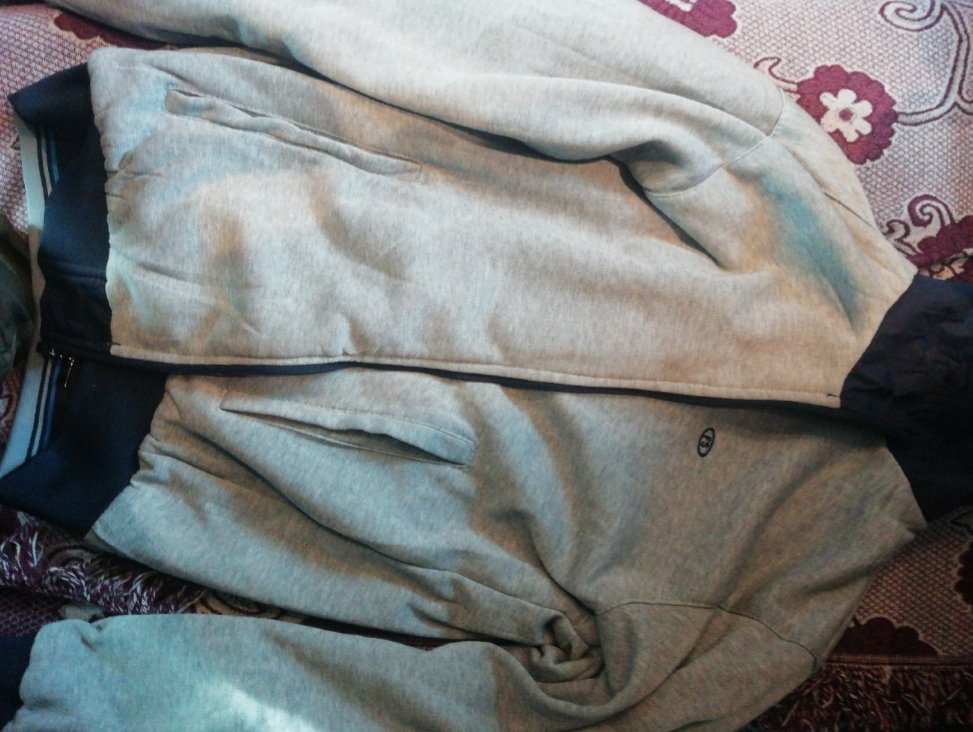
Unfortunately, I had lost the very comfortable and warm jacket ( https://beyondoverton.com/2018/09/28/armenia-home-of-the-crazy-drivers/), so I was left shivering in the chilly air. Eventually, we bought a warm jacket for me. Even though it isn’t fashionable it has the interesting feature of being double-sided.

And at least it keeps me warm! There were times when it was absolutely freezing outside and I was glad I was wearing something thick.

Anyway, from the Caspian Sea, we breezed through Kazakhstan into Uzbekistan in less than one day (we were going to re-enter Kazakhstan later on). We took what looked like a very antique train to cross the border. We waited at the train station of Beyneu until around 1am, when we finally boarded. Fortunately, the train had beds. As uncomfortable and stiff they were, I was glad there was at least something to lie on that wasn’t my mom’s lap.
It was an unusual train – it had no assigned seats, the beds were more like stiff benches, to climb up to the bunk bed, there was only a foothold (no ladder) and the seats/benches were in an open carriage thus everyone could see you sleeping.

Eventually, we were woken up at 5am to pass the border. We were asked the weirdest question to date : Are you bringing any history books into the country?
Another peculiarity was that, during the day, a huge number of sellers passed by the carriage every five minutes, selling clothes, electronics, toiletries and even kitchen utensils.

We visited four cities in Uzbekistan – Khiva, Bukhara, Samarkand and Tashkent(the capital).

Samarkand was my favourite.
It was very lively and the Registan (three madrases and a mosque) felt so grand and majestic.

One of the madrases was very unique, since it had paintings of animals on its frontal wall: a tiger in particular. For those who don’t know, Muslims are not allowed to use figurative art for religious purposes, so it was surprising to see this on the madras.

Registan was even more stunning when it was lit up at night. We only had one night to see it, so we stuck around the Registan for half an hour, waiting for the moment it lit up. It was worth it.

What really surprised me about Registan, though, was the sight of six weddings all at once. My mum said it was quite common in cities of historical beauty, but, living in London, I have rarely seen any.

But the Registan wasn’t the only highlight of Samarkand. We visited the tomb of Timur – who built Samarkand, Bibi mosque – a colossus which has never been finished, and the city necropolis. I particularly enjoyed the latter as it is composed of twisting corridors and colourful, tiled, rooms of tombs.

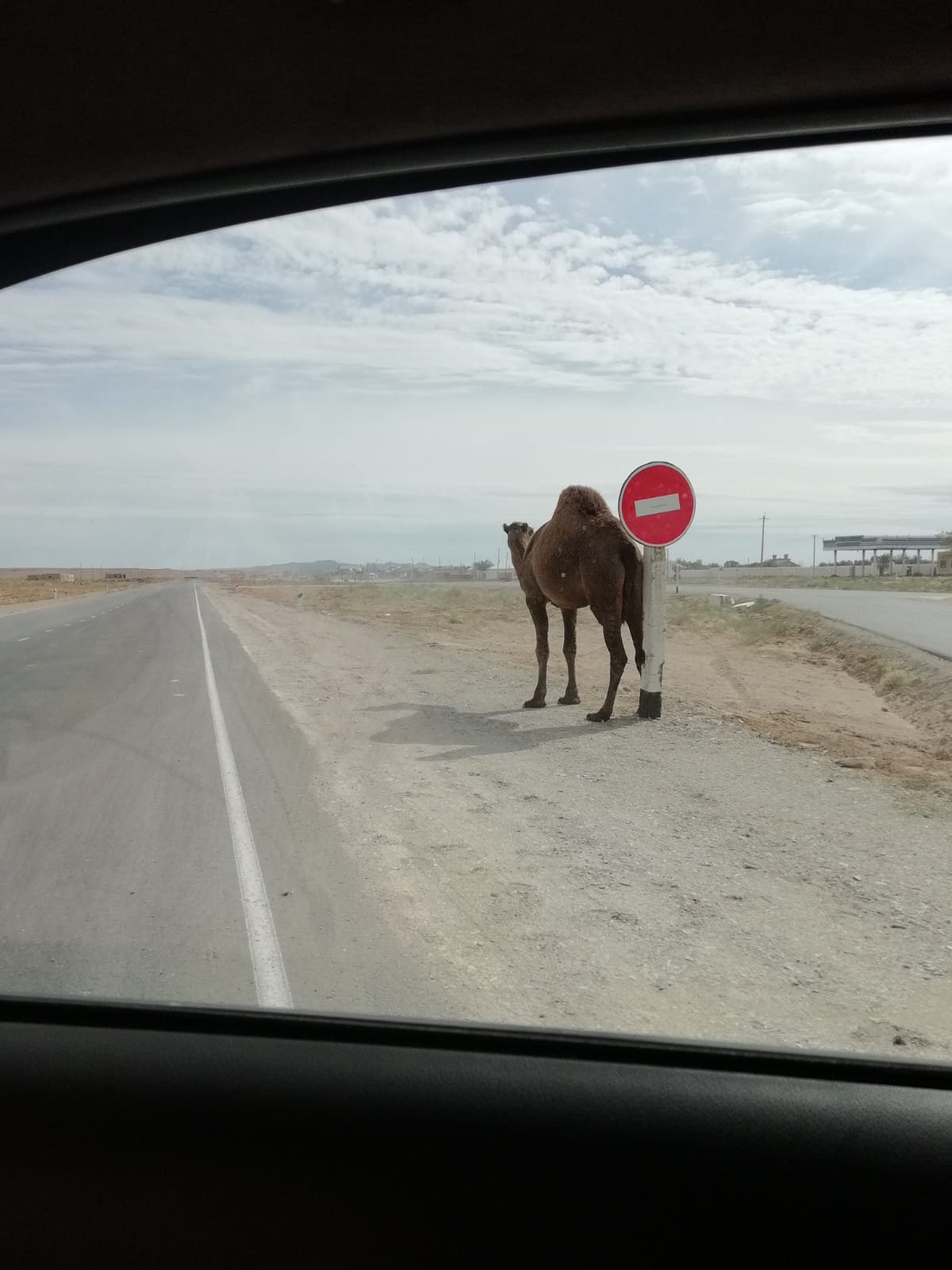
As usual, though, it is the presence of animals that grabbed most of my attention (to my parents’ frustration). I was thrilled with the encounter of two very cute kittens in Bukhara; while in Khiva, I witnessed a black cat having a rest on top of a thin wooden door. I also sighted a bunch of camels and a ram there. In fact, camels are very common all around Uzbekistan.

Indeed I also saw camels on the ride from Khiva to Bukhara.

More interestingly for my parents we also saw the land of Turkmenistan, as the road bordered it. At some point, we crossed the bridge where on the right side, the river was Turkmenistan, on the left side, it was Uzbekistan. The bridge had train tracks on as it is used by vehicles and train in alternate mode 😱.

Unfortunately, my mum had such a bad cold in Bukhara, that it was up to me, my sister and my dad to go sightseeing. I saw a
lot of madrases and mosques and I found it amusing that a part of the old city that was completely rundown had a wall built all around, so it wouldn’t leave a negative impact on the tourists’ view of the city.

Talking of walls, in Khiva, to my delight, there were extremely well preserved walls surrounding the old city. I quickly climbed one and, though I did get plenty of curious stares from the locals, I did not get questioned or arrested. Lucky me.
We also got to climb a minaret in Khiva. I found it fun climbing all the mismatched stairs with only my phone torch as a guide. Once we finally got to the top, we got a nice panoramic view of the city, including, no surprise, a wedding on the streets.

Another common denominator all around Uzbekistan, apart weddings and camels, was golden teeth. Pretty much everyone had at least one gold tooth (more often it was several, if not entire rows). It was very difficult for me to look at them while they spoke and it definitely made me more self-aware about my teeth, so I now brush them much more thoroughly and carefully every day.

Other curious things of the country were the number of neon signs on the streets, restaurants and shops and the constant presence of outdoor ovens. They are interestingly built like a cement igloo, the inside only exposed from the small hole at the top.

Now would be a good time to tell you of how and where I found Nemo stranded in Uzbekistan. Actually wait, let me talk about Tashkent, so you would be burning with curiosity. 😏

Tashkent was an interesting one.
We visited the observatory and I found out that, even though Timur himself wasn’t educated, he wanted others to be. I thought it was a kind and selfless act, especially since he did some savage slaughtering in his own time.
Tashkent was also the victim of a horrible and devastating earthquake in 1967. In honour of the tremendous efforts of the citizens to quickly reconstruct the city a memorial was built. It’s a powerful sculpture and I actually really enjoyed it. Moreover, when they restored the city, with the help of Russians, they didn’t just make it like it was before – they made it better. Specifically , each of the train stations was individually decorated with beautiful chandeliers and art all around. I’m sorry Britons, but compared to the Tashkent Tube, the London Underground is quite dull.

For some reason (I don’t see how) but my parents got nostalgic in Tashkent as they claimed it gave off an 80s feel. Ah, the youthful times! (for them)

While wandering around the streets we were particularly surprised to see row of women standing there with old style prams. We quickly realised that instead of babies, it was bread inside the prams, all wrapped up in blankets keeping the bread warm for the customers. Needless to say it was delicious.

I suppose I have held you on for too long. Yes, I did find Nemo, but unfortunately he was flattened on stone.

We stopped to ask for directions. I quickly got bored and started wandering around a statue – that is when I noticed the little orange clownfish, hidden in within the serious homage to the first, and only, Uzbek astronaut in space. Watch the video to see it in all its glory.

So, if you guys find Marlin, let him know. I found his son.

Silk Road (5): Border bothers

Tags

Every national border marks the place where two gangs of bandits got too exhausted to kill each other anymore and signed a treaty.

~Robert Anton Wilson


Borders are a complicated matter. In Europe, thanks to the EU, we don’t even notice them now, but I remember the days, pre-EU, when I had
to get visas every single time I wanted to travel abroad on my Bulgarian
passport. Still, it’s interesting to think that when it comes to passports,
they are a relatively recent phenomenon, having been introduced only in the early 20th century.

I had already noticed the Azerbaijan border upon entering Armenia from Georgia because it is a stone’s throw away from there. We could see the abandoned houses along the road and on the hills around us on the Armenian side: the Nagorno – Karabakh conflict continues to be a big issue for these two countries. On leaving Armenia, I was specifically asked if I would be coming from Iran back through Armenia or Azerbaijan. On entering Azerbaijan, we were summoned and questioned (in French, the official either did not speak or refused to speak Russian) why we had visited Armenia.

The bus trip Tehran – Baku took 22 hours, of which the majority were spent either at the border, waiting for customs inspection, or at arbitrary and frequent stops for lunch, breakfast, dinner, tea etc. The 70% or so devaluation of the Iranian currency had created a brisk trade across the border: Iranian consumer goods had become incredibly cheap compared to Azeri ones and some people naturally took advantage of this. However, Azeri customs officials were not willing to turn a blind eye. This caused massive arguments about what could pass the border (can you imagine arguing with British customs about what you are allowed to bring in the country!?) which meant it took ten hours for just our bus to go through.

The town of Astara bridges the border there. This, plus the fact that there is a beach on the Azerbaijan side, reminded me a bit of the Turkey-Georgia border at Sarp – only that instead of the Black Sea there is
the Caspian Sea, and Batumi’s equivalent, Baku, is some 300km away (instead of 10km away in the former). There was only one other thing that brought memories from this other previous border crossing – it was raining throughout; everything else about it was very different.

To start with, the border was deserted: not a single car passed through while we waited. A few trucks, though, did. There is no passenger waiting area at all. Just a warehouse where both passengers and buses are checked. Once through (with your bags) one has to wait outside for the bus to be inspected. I had never seen a close border control inspection of a vehicle before: they literally took the bus apart, then they had a dog sniff
out for drugs. The kids found this quite amusing.

Once we made it into Azerbaijan, I was happy I had already exchanged some money in a ramshackle shop on the Iranian side, even though the
rate was ridiculous: there are no exchange bureaus on the Azeri side.

There was a lot of drama in the bus after we passed the border on the way to Baku: some women were crying, some were shouting non-stop.
I think some of their goods were confiscated and on the others they probably had to pay a fine. Still, the bus kept stopping at random places along the road where local cars would wait and money and goods would change hands.

We had exchanged enough money at the border to be able to
take the metro in Baku to our hotel. We were pleasantly surprised to see that it was fairly easy to navigate (signs in Azeri, Russian and English).
Unfortunately, though, I had forgotten to download the offline map of our
hotel, so we had no clue where it was. Luckily, the hospitality and
helpfulness, which we had become so used to in Iran in the past two weeks, seemed to extend in Baku as well.

Literally everyone wanted to help us: the ticket salesman,
the police officer, random people would just stop and take out their phone to try to figure out the location of our hotel. Eventually, a young man, speaking fluent French (very unusual, we were told, yet this was the second time it happened in Azerbaijan in the course of a few hours!), decided to get off at our tube stop and walked us to the hotel.

It was ‘difficult’ to get back to reality otherwise: the cost of things were back to what one would get in Europe. Baku seemed the most expensive city so far on our travels. On the positive side, we were happy to be
back in a culture where we could enjoy a very nice glass of local red wine on our first dinner there.

On that note, even though Azerbaijan is a Muslim country, it is obvious they have adapted their religious beliefs to a Western model of modern society. People in Baku were extremely fashionable, well-groomed, and
good looking. Barely a single woman wore the hijab or conservative clothing. Once more, London comparisons come to mind, as those Muslim women clearly didn’t seem to think it is a religious requirement to cover! Men also seemed to care for their appearances to such an extent that I decided to get a haircut too.

The hotel where we stayed was serviced by a group of young people who, again, were eager to help. I don’t know if this is an Azeri custom, but they walked us to the restaurant for dinner, to the taxi stand, to the exchange bureau, and, yes, even to the barber shop. And these were not places around the corner, but a good 10-15 min. walk.

Baku is a weird mixture of modern Yerevan and old Tbilisi. It seems more compact than either though. We stayed in the old city which is still surrounded by a wall (cars need to pay extra to enter). This part of Baku
has been restored to such pristine conditions that it feels a bit of artificially old: you aren’t going to get the dusty, crumbling feeling of time having swept its hands through it.

This was in stark contrast with Iran. While even there, we eventually realized, many mosques and cultural artifacts had been restored, people
had somehow managed to preserve the feeling of history passing by. This was only enhanced by historical sights being everywhere. Iran is a bit like Italy in that sense: there is history on every corner. Baku also has beautiful
mosques, ancient palace, etc. but they pale in comparison with what we saw in Iran.

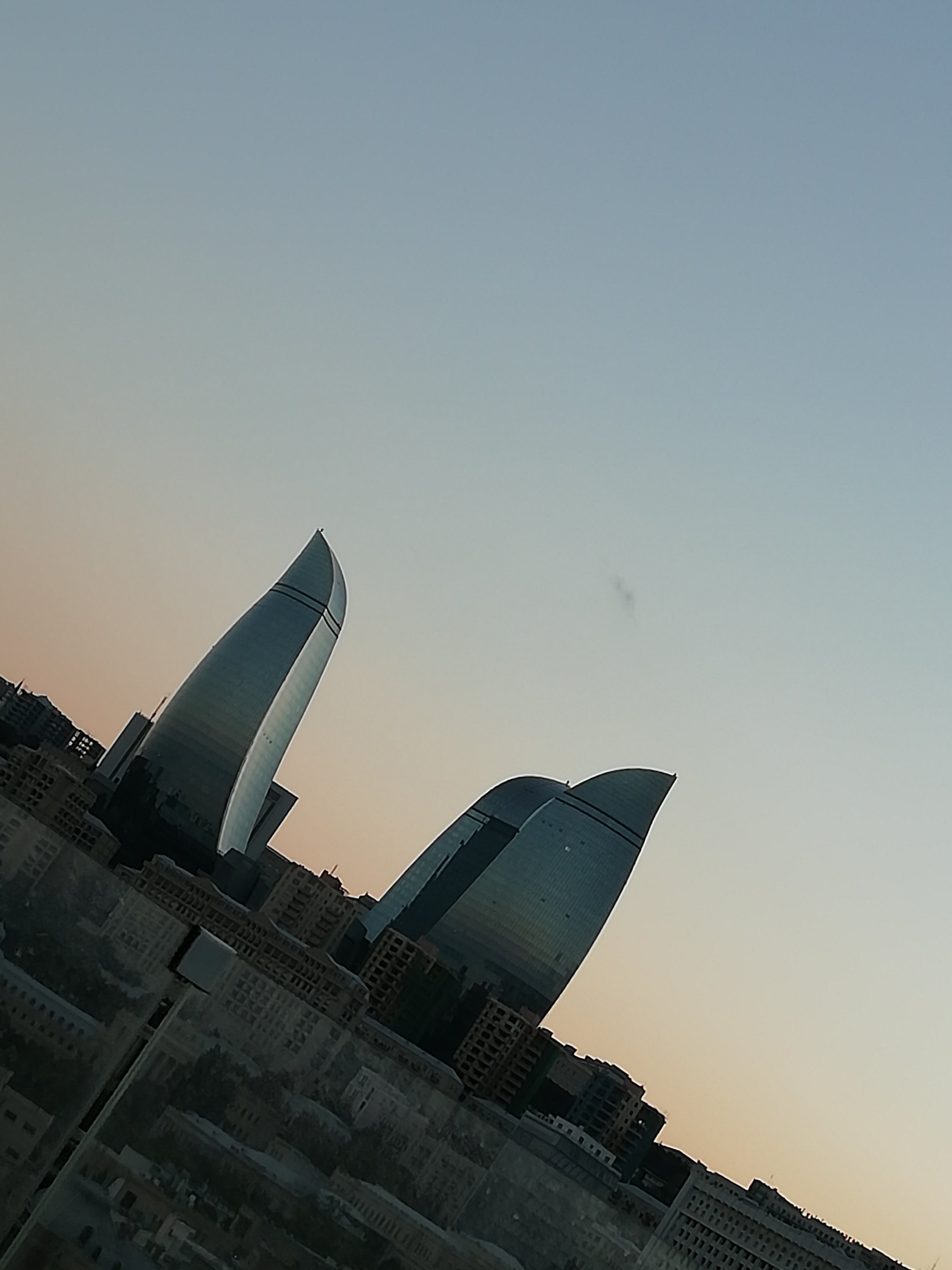
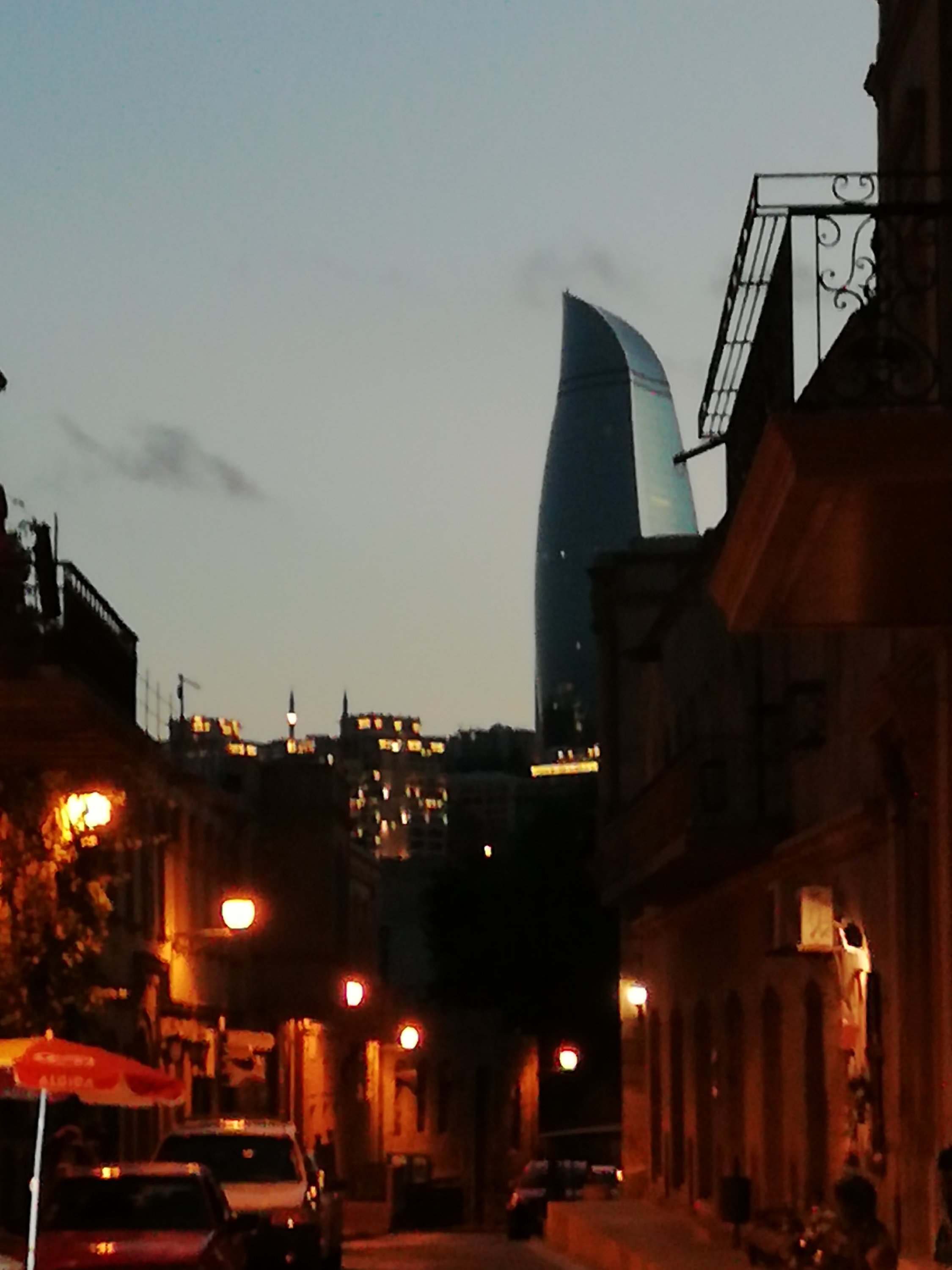
So, in Baku we just took it easy and simply enjoyed walking the streets. That’s how we stumbled upon the Flame Towers, symbolizing Azerbaijan’s rich deposits of natural gas and oil (later, on the way to the seaport, we also saw the constant blaze of fire coming from the mountains in
the distance where the deposits are).

We also saw an enormous KFC restaurant (my son told me that, apparently, it is the largest KFC in the world!). Actually, already in Iran a five-star hotel would proudly have one of its floors dedicated to a fast food restaurant. The imposing building, which hosted this KFC in Baku, then
clearly indicated that fast food is quite well regarded by the locals in Central Asia. Could it be that it is still a novelty and a connection to the
western world and culture which the young people in these countries strive to emulate?

On the way to the Flame Towers we saw a massive flag in the distance. We did not think much of it, having already seen the massive flags in
Turkey, but later on we found out that it was the second largest one in the
world. In fact, until 2010, when they raised the one in Dushanbe, Tajikistan, it was the largest. Azerbaijan, though claims other ‘firsts’. For example, it was, unofficially the first country to declare independence from the Soviet Union in March 1991. It is also considered the first democratic Islamic republic (saying that, they have had a father and son as presidents pretty much since independence, with the son now serving three terms, when officially two terms is the maximum – so, I don’t know how that works).

Of course, we also did the ‘obligatory” sightseeing: Maiden Tower, roamed the streets of the old city, visited the Palace. There was one thing on our minds though: how to cross the Caspian Sea.

We had initially planned to go north around the Caspian Sea because there are no passenger ferries across (and we were told it wasn’t worthy to get the expensive Turkmenistan visa). Talking to people and digging deeper into travel blogs, however, we found out that one could still cross the Caspian Sea as a passenger on a cargo ship. The only problem is that there are no schedules for those: they leave only when required by the specific type of cargo. Still, we decided to try that option.

This meant that we had to call every morning the Caspian Shipping Company to find out if there was a boat going to Kazakhstan that day.
We got lucky on our third day in Baku. We were told that the boat would leave at 10pm so, as the port is 70km south of Baku, and eager to be there in plenty of time to acquire tickets for the boat, we left the city at 2pm.

This was the start of, possibly, the longest 24h of my life! It made me wish I was a truck driver: at least they have a bed in the back of their cabin!

We arrived at around 3pm and bought the $70 (per person – it includes bed and meals) ticket with no problem. We found out, though, that the boat might “only dock at 10pm, which means you will embark around 2am, and the boat might eventually leave around 5am”. Ok, we can survive
that.

Wait a minute. This is not a passenger port, there is no passenger terminal! The facilities consisted of a bunch of containers which were transformed to be a “drivers’ waiting area”, a shop, a bank, the Caspian Shipping Company’s office, a police booth and the smelliest, most disgusting toilet I had ever seen in my life!

We can do this?! Yeah, right.

The sight of a family seemed to cause a lot of excitement among the police and the truck drivers – as one can imagine, this is predominantly a man’s world. The police kept double checking our passports and asked me several times if this was indeed my wife and these were really our kids!

We soon found out how the system works: you buy eggs, sausages and vegetables from the makeshift shop and get the guy who mans the waiting area to cook them for you (I made a mistake not to agree a price first for his services, and, of course, he tried to charge us restaurant prices!).

There was nothing to do there. No free Wi-Fi. The kids were reading and trying to do some schoolwork but overall it was a huge exercise of our patience and managing our expectations in the face of the uncertainty of when we would depart.

We ended ‘sleeping’ on rackety chairs all night. Around midnight there was some commotion but it turned out it was the boat to Turkmenistan that was leaving (after also several hours of delay). No one had any information about what was happening to our boat. Around 7am I went to the ‘office’ of the Caspian Shipping Company and knocked on the door. The same guy who sold us the tickets the day before appeared from behind and asked me angrily what was going on. I said, I simply wanted to know if our boat had even docked. He just snapped back something like, “I was sleeping, how would I know?!”

If only we had been given some information, instead of spending so much time waiting aimlessly at the port, we could have visited the mud volcanoes which were very close by. Because of the enormous reserves of oil and gas (before the discovery of oil in the Arabian Peninsula, Azerbaijan boasted the world’s largest deposits – the scenery outside Baku is dominated by oil wells), Azerbaijan apparently has almost half of the world’s mud volcanoes in existence!

Finally, one of the police guys took pity on us and showed us on his phone (using one of those apps) that our boat was just outside of the harbor waiting to dock as soon as a berth got freed up. Finally, some hope.

We eventually embarked at 3pm and the boat departed at 7pm
for the 22h crossing of the Caspian Sea.

Let me tell you a secret: there is nothing special about crossing the Caspian Sea. We got lucky true: the sea was flat as a pancake (and
there is nothing to see but… water there – no other boats either), the
weather was nice and sunny, the crew was friendly (they allowed Georgia and my daughter to use special quarters when they needed to), the food was decent, and, yes, the truck drivers were friendly. I am not sure whether we even saved time compared to if we went around through Russia. So, apart from just saying, “we did cross the Caspian Sea”, there is not much else to say about that.

An American in Azerbaijan

One the way to Baku, we took another overnight bus. While in the one we took to Iran we were greeted by a friendly family, we were introduced to a gang of traders on this one. We boarded the bus at 8 o’clock and were delayed for an hour because of an argument between the driver and some passengers. Finally we got on the bus and all was well until we got to the border. Aah, the border.
We got up at 5 am and had to wait another half hour before we could finally go to passport control. Once there, it took ten minutes before we finished but we had to wait for everyone else. Eventually, we were told to get on the bus where we waited for another ten minutes because a passenger ran into trouble in passport control.
Once that was sorted, the bus started moving but stopped literally after one metre. We got off again to go through security which was right next to passport control. This was where the fun began.
I and my family got through, no problem. Well, we were questioned a bit, but compared to what happened next, it was nothing.
A couple of other passengers got through too, but there still remained a big group of old ladies carrying massive amounts of luggage (a dozen bag each or so).
The thing was, because of the exchange rate, consumer goods especially were very cheap in Iran, so they all bought a lot of stuff and were planning to resell it for a higher price in Azerbaijan.
But there is a limit to how many items you can bring into the country, so each woman spent at least one hour arguing with the border patrol. As a result, we waited almost ten hours at the border.
When the issue seemed finally solved, and the bus passed security as well, we were told to get on. But, of course, we were held back, again, because some passengers had unresolved issues with their passports. At that point, I didn’t really care or mind too much, because I was comfortably sitting on the bus, reading my kindle, but eventually even I felt restless, because another hour had passed to no avail.
Eventually, the bus went and there was no issue… until half an hour later. The bus stopped on the side and a passenger went out only to come back ten minutes later. This went on several times all the way to Baku. The passengers were already selling their goods along the way!
What was meant to be a 16 hour bus ride, turned into a 24 hour ride, but at least we arrived that same day.
What a relief.

Forgetting the terrible bus ride, I really, really liked Baku. It was modern everywhere – even the underground tunnels were large and clean ( as opposed to the ones in London). The atmosphere was very warm and welcoming and the view was beautiful. Baku is home to three Flame Towers, which are lit up at night and are stunning at sunset.

The picture above was taken at the top of Maiden Tower. It was fun climbing all the stairs. There is no confirmed theory on why it was built, and plenty of legends on the reason behind the name, which I found particularly interesting, as they mostly consisted of a woman jumping off and committing suicide.

Anyway, the Flame Towers are now my favourite building.

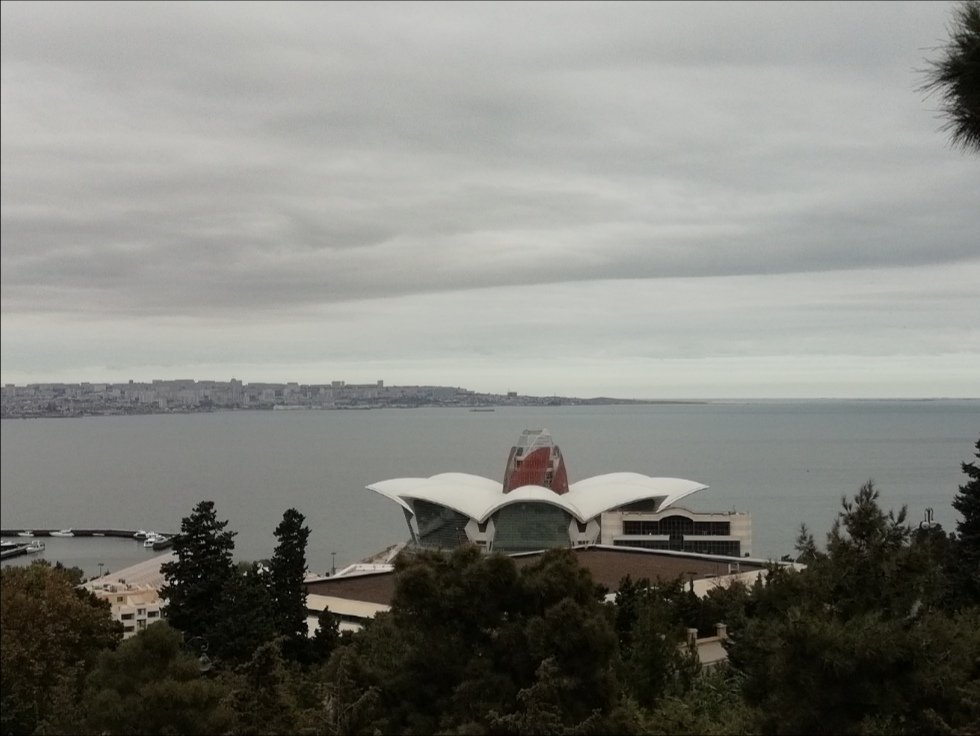
Near the Flame Towers is the Caspian Waterfront Mall, which, at first sight, looks very much like the Sydney Opera House in… well, Sydney.

It is difficult to decide which I prefer: Baku or Batumi. In terms of view, either would do, but in terms of atmosphere and people, I would pick Baku. As I mentioned before, the atmosphere is very welcoming – it was very relaxing and comforting to walk along the coast at night. The food is amazing and the people are so friendly. For instance, we were trying to find our way to the hotel and around 6 strangers on the train came over to help guide us to our location.
One Azeri guy who spoke fluent French even went out of his way to get off the train with us and guide us to the hotel before going back. He also went out of his way to mention to my mum that he was already engaged after she made a point on how kind it was for him to help us.
Azeri guy, if you’re reading this, thank you again for helping us. By the way, my mum is still too attracted to my dad, so there is no way she would fall for another man.
Anyway.

Ok, I now know why we were on a bus for 24 hours and at the border control for more than 10… it was all training for this: the boat from Baku to Aktau. Upon calling the port every morning, we were told there would be a ship at 22.00 on our third day in Baku. My dad was worried we might not find tickets (it is a cargo ship which takes passengers for a price; you can’t book or get tickets anywhere else but here at the sea port), so we checked out from the hotel at Baku at 14.00 and we waited at the seaport (it is 70 km from the hotel, in the middle of nowhere). The place was absolutely deserted if it weren’t for many, many trucks, a makeshift toilet, shower, store, tea place, custom offices. All of those were self contained in middle size ship containers (and of course we were asked to pay tourist price for anything we touched). Once there we were duly informed that the boat might arrive at 22.00, we might be able to board at 2.00 am and we might depart at 5.00 am; If no storm hits us we might be on the boat for as little as 20 hours. I couldn’t even fathom how long it would be before we will be able to disembark once at the Kazakhstan border!

Well, good news. The boat never docked at 22.00. We spent the night sleeping on the table, drunken style.

P. S. In the name of full disclosure: my mum had sent a WhatsApp to close friends and family with some details of our sea trip ahead which might sound familiar to what written above… I felt it was good enough to include it here (plagiarism??? 🤔🤐)

Turns out we actually spent a whole 24 hours at the empty seaport, waiting for the ship.
In addition, I noticed this:

…which left me not very reassured about the journey ahead. I was wary throughout the whole ride until we arrived in Aktau, Kazakhstan.

On the other hand, the container we stayed the night in, played Skyscraper at some point (in Russian!), so I was settled. 👍

Furthermore, we had interesting company. We met our first traveller on our trip : an American, who goes by the name Wongie. 👋Hello, Michael.


So, there you have it folks, an American in Azerbaijan. Stay tuned.

Silk Road (4): We took a bus ride to Iran

Tags

I cursed the sky to open
I begged the clouds for rain
I prayed all night for water
For this burning in my veins
It was like my soul’s on fire
And I had to watch the flames
All my dreams went up in ashes
And my future blew away

Now the oil’s gone
And the money’s gone
All the jobs are gone
Still we’re hangin’ on

Down in dry county

~Bon Jovi


Something is happening in Iran and you know it by the way the currency moves…

I had done a lot of research for this Silk Road trip, started in early January to think of an itinerary. But not everything could be planned in advance. When it comes to Iran, nothing could be booked in advance.

As it turned out, this was quite fortuitous. First and foremost, the exchange rate moved in our favour: a month before we entered Iran the Rial lost ⅔ of its value. This was on top of the already quite good value of accommodation, transport etc. which existed there before.

The official money in Iran is Rial, but because of the enormous number of zeros (I constantly carried tens of millions of Rial in my pocket; a dinner for four would cost around 2 million), the locals have a made-up unit called Toman, which simply has one fewer zero. It was very, very confusing at first to get around that because it was not obvious whether the quotes were in Rials or Toman – not for the locals, of course, who were used to the prices of specific items and goods.

It was not easy to know where to exchange though as there is the unofficial exchange rate and the official one, which is about half that. And while we were there, the Rial depreciated by another 30%! And it’s not like a foreigner can just look up the exchange rate online for guidance (no Bloomberg app!). The first time I needed to exchange (at the Armenia-Iran border) I relied on a kind fellow bus passenger to educate me on the intricacies of the Iranian street exchange rate market, and more importantly, to give me the approximately “correct” level from an app on his phone.

In Tehran, we simply stumbled on one of the main exchange points: Ferdowsi Square. It reminded me a bit of “The Magurata” in Sofia, Bulgaria in the late days of communism/early days of capitalism. In terms of the way the crowd worked, though, it might have operated a bit closer to any open-cry exchanges in US in the good old days! This kind of market was though quite unsophisticated: a few blocks away from the square, there opened the possibility of a clear arb.

Second, self-organized trips are cheaper than going through a travel agent anywhere in the world but in Iran they are incredibly so. This is because in Iran it’s extremely difficult to self-organize a tour from abroad. Because of decades-long sanctions, the Iranian payment system is not linked to the rest of the world’s directly: one cannot use foreign-issued credit or debit cards in the country. Therefore, there are agencies outside of Iran which facilitate the booking of all tourist-related activities (for small items, like tickets for buses and tourist attractions, the premium, though, could be more than 100%, especially after the devaluation). The option is either to use them or to carry lots of cash and do it on the go once in the country.

Not knowing the exact date/time etc. we would be in the country, forced us to organise internal traveling ourselves, once on the spot. Incidentally, this saved us a lot of money. The downside of doing this was, though, that the hassle and uncertainty, which normally accompany such activity, were amplified by our inability to speak, understand and read a totally different language and writing. After a couple of days in the country, we realized we should at least learn the written numbers in Farsi (by the way, Farsi is just ‘Persian’ in Arabic – apparently the Arabs had difficulty pronouncing the ‘P’ sound). This was partially spurred by the fear of being too easily cheated!

People trying to take advantage of us being foreigners in Iran were, however, fewer than what we normally experienced in the other countries so far on our trip. Everyone is of course aware how much more foreigners can afford now compared to not only a month ago but also in general. However, I did not see any bitterness on their side. They just accept it as a way of life. As one businessman observed, “We are a country of sanctions and we have learned how to cope with them; there is nothing new with these new ones; but, yes, it is disappointing because we thought we were finally getting along.”

But let me backtrack a bit here: to get to Tehran, in the spirit of this trip, we took a bus ride from Yerevan! That was a long journey – more than 24 hours – with crossing the border in the middle of the night. However, the bus was rather comfortable (it even had a carpet in the middle lane) and, as with all long-range buses on this trip, one gets complimentary food and drinks.

The distance to the border is only around 400 km but it takes at least 10 hours to get to, as the road passes through some very tricky mountainous terrain along where, in the crevices on the sharper turns, we saw the remnants of a few cars. (If you have ever been to the ski resort Les Deux Alpes, imagine the 20 km stretch at the end, to the top, but multiply that by 20, constantly going up and down – that’s Yerevan to the Iranian border). On the positive side, the landscape is absolutely stunning!

I knew that there were daily buses from Yerevan to Tehran but I had no idea where exactly they left from and how much they cost. As it turned out, because they are operated by different companies, they all leave from different places and their cost varies. No easy way to find out this information either online or even through the hotel. Best is to go to a travel agency (of which there are many in Yerevan). There are obviously alternative ways to travel but they are much more expensive (the locals could take us only to the border for the price of our whole trip to Tehran, for example).

Our first impression of the Iranian people, from meeting some Iranians on our bus, coincided with what we had read and what other people told us: they were very friendly and curious to meet and help foreigners. That impression indeed stayed till the end of our journey in Iran. In fact, when we asked people if they are equally friendly to themselves as well, not just to foreigners, they told us that they are friendly to everyone who needs help, but foreigners, obviously, seem to need more help in Iran.

We spent the time on the bus talking with our newly-made friends about everything: from what to see in Iran, to education, history, cultures and even politics. In fact, the one thing Iranians really love is talking politics. They openly discuss current affairs (as one Iranian later pointed out to us, “I can assure you there are more Iranians who like America than Americans who like Iran”).

We intentionally avoided bringing in religion in any of our conversation not to stir sensitivities, however, it was clear that most of the people we met, while religious, did not necessarily agree with the extreme religious requirements in place. For example, throughout our stay, we were super careful not to break any laws or customs having heard how strict the authorities are: we made sure that our 15-year old daughter, who looks more like 10, had the hijab on all the time. But locals kept telling us not to worry, that young girls do not even need to wear a veil. In fact, while having a dinner in one of those open courtyards of their traditional houses in Isfahan, we noticed that even some of the local women had their hijab off, resting on their shoulders (a sight quite common especially in norther Tehran).

A similar attitude of resignation rather than active promotion of was adopted towards the issue of separation between the sexes. While, men and women cannot ride in the same subway carriage, cannot go together to the swimming pool, cannot hold hands or show any kind of affection in public, etc., on several occasions we saw locals disregarding such rules whenever they could get away with it (i.e. kissing and hugging in the street).

As tourists, the daily reality of a society which enforces the separation of sexes barely touched us anyway. We only got a small taste of it when it came to wanting to use the swimming pool as a family (which we couldn’t) or attending a mosque during a religious ceremony. Once, I waited patiently outside the Shah Mosque on Naqsh-e Jahan Square in Isfahan for a long time with my son and a crowd of other men while Georgia and my daughter were visiting inside during prayer time. A few of them struck a conversation with me, probably seeing my worried face and my glazing eyes for a view of my wife and daughter, hopefully, exiting the mosque. They were really surprised that I was worried and assured me the mosque was “the safest place one could possibly find”.

We stopped a few times along the road before we reached Iran – once because the cooling system of the bus stopped working, another time for lunch. We had prepared our own snacks but I had left about $3 worth of ADM and went to buy some ‘ayryan’ (yogurt mixed with water and some spices – it is the best thirst quencher). I struck a conversation with the owner, an Iranian, who was very curious to see an ‘European-looking’ family in this part of the world – only locals and probably a few really adventurous backpackers otherwise take the bus to Iran – tourists take the plane!

I bought some plain rice just so that the AMD does not go to ‘waste’. When he realized this was our last Armenian money he brought us some meat to go with the rice, water and tea! That was even though I kept telling him that I do not have any more AMD to pay for it: he was genuinely very generous! This was going to be one of our many encounters with the amazing Iranian hospitality.

We passed through several small towns before we reached the border. Inevitably, they looked very 1960-70s Soviet style but they were impressive because I had never seen old Soviet block of apartments perched on the rocks in the mountain.

Finally, we reached the border. Its crossing was surreal: we walked through into no-man’s land for almost 1 km. In total darkness. Otherwise, both Armenian and Iranian passport controls were swift and courteous. Once in Iran, however, we had to further wait for the bus to pass customs control – and that took hours!

Past the border we fell asleep only to be woken up a few hours later and ordered to get off the bus! I feared something bad happening but it was only a rest stop – I think the bus driver must get a commission from the ‘restaurant’ for every person who buys something otherwise I do not get it why we had to leave the bus (the kids were very unhappy). Eventually, most people just bought some tea, only the bus drivers entered the restaurant.

I woke up with the first rays of sunlight eager to lay my eyes for the first time on this place I heard and read so much about! Iran is mostly a desert sprayed with some rocky mountains and an oasis here and there. The road system is, however, much better than either Georgia or Armenia: all the main highways even have toll booths! There are plenty of police speed checks, and in general, plenty of police presence. As a result, driving is very civilized, one could say, as good as any European highway (excluding the Mediterranean ones, of course!).

Arriving in Tehran in the early morning or, possibly, at any time of the day is a totally different matter. There are simply no traffic rules. At all! I have never seen anything like this anywhere. Perhaps Mumbai comes close but still not comparable. For cars constantly drive against traffic whenever, on the several-lanes avenues, there is a gap of oncoming traffic (or not!). Motorcycles commonly take to the pavements whenever traffic is slow or the road is one way and they need to go in the opposite direction (what is amazing is that they beep at the pedestrians to move away as if it is the pedestrians who have invaded their territory, not the other way around).

And traffic lights – what are those for? The weird thing is that there is police literally on every major crossing!

On our first day, we attempted to walk for half an hour to reach the Grand Bazaar from our hotel. This was the one and only time we did this given the state of the traffic, the inexorable heat and the awful pollution (on the positive side, this is when we stumbled across Ferdowsi Square and the local foreign exchange market). In the evening, the coolness of the air (Tehran is very close to the highest peak in the Middle East) and the lack of traffic make walking more manageable. We went then looking for a restaurant and as we stopped to ask one man for help, a small crowd gathered, all trying to help or just being curious. Foreign tourists do not randomly walk the streets of Tehran. In fact, we saw very, very few tourists in Tehran and that was in Golestan Palace.

That evening we met an Iranian who spoke fluent Italian who invited us to his brother’s apartment for dinner! The brother also spoke fluent Italian (and a few other languages). As we were not in the mood for spaghetti and in search of local flavours, they took us to this wonderful cafe where we had an amazing evening. This was yet another example of the famous Iranian hospitality.

Tehran was too much for me. Apart from the noise and havoc in the street, the Grand Bazaar was also a disappointment of sort. It is imposing and busy but not that different from the Grand Bazaar in Istanbul: in fact, anything not an artefact or authentic is made in Turkey or China. For a real experience of a different sort of Grand Bazaar, I recommend visiting Isfahan’s. Golestan Palace, though, is definitely worth a visit: our first encounter of traditional Iranian architecture and beautifully coloured tiles everywhere!

We were indeed told that to visit the real beauty of the country, one must really go in the mountains just north of the city for nature or head south towards the Persian Gulf for history, culture and nature combined! This is then what we did by heading to Kashan, about 3 hours bus ride from the South Terminal in Tehran. Kashan is this quiet and quirky little town full of traditional houses. A traditional house is one with an internal wide-open courtyard, a fountain in the middle, and with lots of little passages that lead to different size rooms. These houses are really stunning.

We made a point to stay in one despite our self-imposed backpackers’ budget. But Kashan is much cheaper than Tehran and, especially, our next stop, Isfahan, so it actually fitted us perfectly. I really liked Kashan. Among other things I especially enjoyed playing backgammon with the locals (though I lost). I do not understand why of all places recommended for tourists to must see in Iran, Kashan is the least favourite. Perhaps because it is a little village compared to all the others but is really charming. Plus, there is a lot to see in the surroundings.

It is for this reason that we decided to take a private car the following day, instead of the bus, to Isfahan. On the way, we visited the highest village in Iran, Abyaneh (2,222m above sea level). It is more than 2,500 years old and its houses, which are made of red mud and straw, have mostly survived the centuries. Abyaneh reminded me of many villages perched along the hills in the Italian countryside: it is that different from anything else in Iran. Even the locals wear very different clothes than anywhere else we visited.

While planning Iran, we did not factor in that our stay will coincide with the end of their most important religious holiday: you must have seen the men wearing black and green and beating themselves with branches on TV or online. For two days, everything closes in the country. That reality fully caught up with us while in Isfahan. That was unfortunate for us but it also gave us a chance to learn more about this tradition by visiting these ceremonies: the locals were very eager to explain things to us and they took lots of pictures! On the upside, during those two days there are stands all across the city which give away free food, tea, sweets and fruits (most restaurants are closed as well).

It was business as usual the morning we had scheduled to leave Isfahan, thus we managed to visit quickly the stunning central square, which is surrounded by two imposing mosques, a palace and the Grand Bazaar. A peculiar thing about Isfahan is the Armenian quarters, and particularly Venk Cathedral: one of the most exquisitely decorated churches I have ever seen. The surrounding area is also full of cute cafes where one could finally have a proper coffee (Iranians do not really drink coffee, and if they do, it is nescafĂŠ).

Once in Shiraz we visited many mosques, treated ourselves to some proper (European-style) restaurant food – after eating mostly ‘street food’ until then, this was a welcome diversion, though the bill looked astronomical (2 million, 800 thousand Rial), and organised our visit to Persepolis and Necropolis. Persepolis was great, but it is Necropolis that is magnificently different than any other ancient ruins I have ever seen, consisting of carved tombs in the middle of the mountain. In fact, Persepolis reminded me of the Baalbek Roman ruins in the Bekaa Valley in Lebanon.

I will actually remember Persepolis for almost choking on water. We had left Shiraz at 8:30 (rather than the suggested 8:00) in the morning. By 11am it was so hot and I was so thirsty, that eager to refresh, I gulped the water in a hurry and it went the wrong way…which is ironic, because one thing that will stay with me from Iran is how dry the country is. All the cities we stayed in had totally dry river beds. And there are so many fountains and water passages everywhere and they are all dry. I can only imagine how more beautiful Iran’s already well-preserved gardens and courtyards would look otherwise.

The changing of the climate globally is partially to blame: it is difficult to imagine that it would snow in the winter in Iran even 10 years ago (and the snow would actually keep) in the middle of the desert. The locals did not remember when it was that it properly rained last time. But this is also Iran’s own doing: the building of an intricate underground water system, eventually completely dried the on-the-ground natural water. This is not something necessarily recent. In fact, almost all cities we visited, but especially the ones in the south, had ancient underground water canals. They run deep and are still open – one could easily go down to the bottom.

In light of this water problem, I was surprised to find out that water is safe to drink almost everywhere we went – and there are public drinking fountains all over the cities we visited. Same holds for public toilets – they are free and they are everywhere (some of them are indeed “ancient”). In fact, the cities are kept in almost pristine condition: there is very little garbage on the street, plenty of bins and sanitary workers attending to the streets even late into the evening.

Another unexpected aspect of Iran for me was how digitalized commerce is. Credit/debit card payments are common everywhere, in the bazaars, on the street, and even in the most run-down taxis. In the major cities, there is a bank literally on every corner. I don’t know if they have the equivalent of Amazon but, they do have the equivalent of Uber called ‘Snap’. One could also easily book bus tickets online. Of course, we could not enter this digital world, but people were happy to book things online for us.

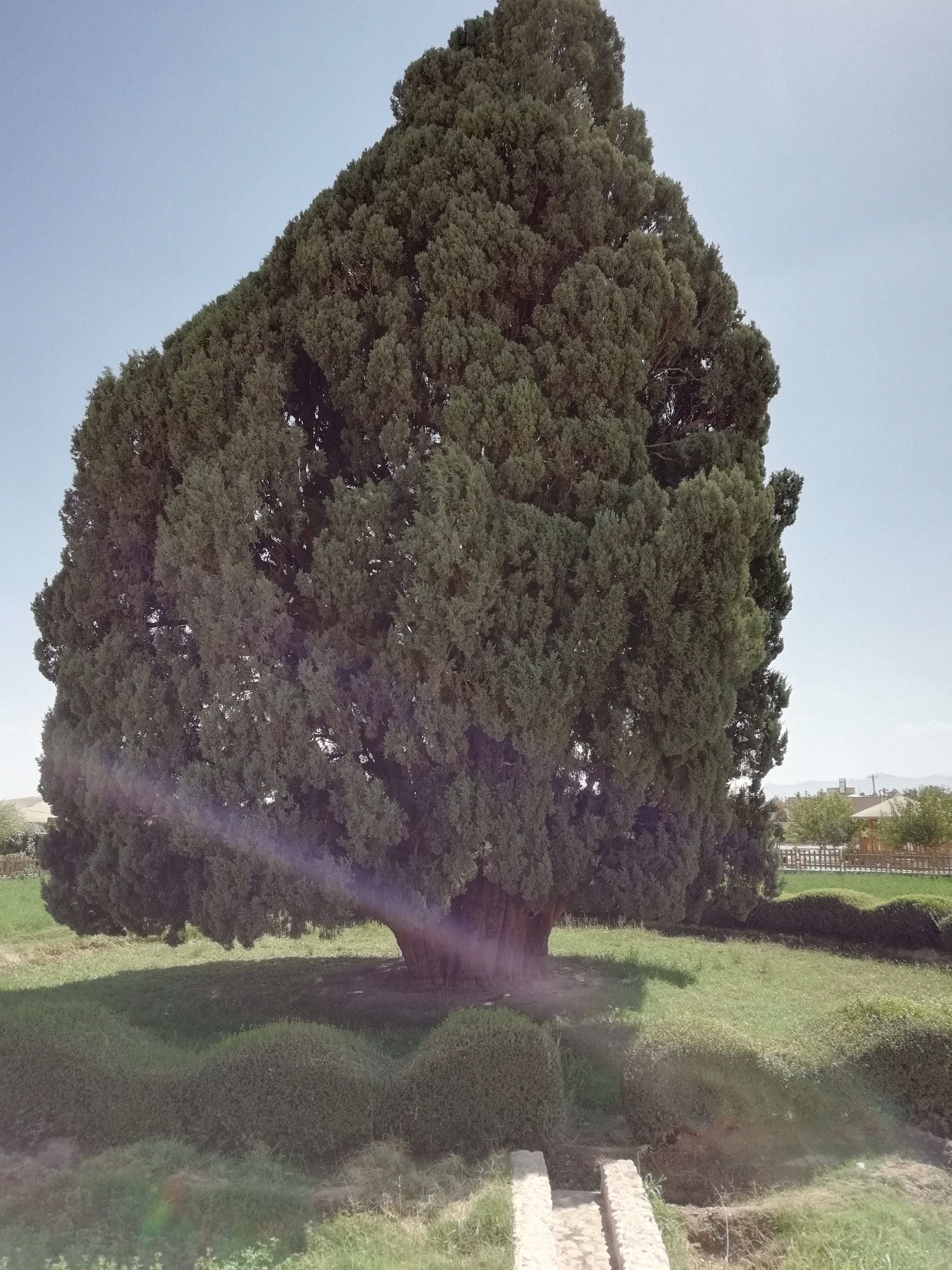
Our last stop before completing our Iran journey back to Tehran was Yazd, the centre of Zoroastrianism and the largest wind catcher in the world. On the way there, we saw a 4000 years old living organism, a cedar tree. In Yazd, I started to get restless about the exchange rate and its massive drop. Having worked in Emerging Markets for so many years, I feared this was not a good omen. My unease was also further exacerbated by the fact that since we had left Tehran it was a constant struggle to find a ‘proper’ place to exchange money (unless one was happy to pay the unrealistic rate at the hotels). The Grand Bazaars were the obvious places but even there, there was not one designated spot. In the Grand Bazaar in Tehran, for example, there is an area where all exchange matters are handled, similar to Ferdowsi Square. In Kashan we had to ask a few shops and finally we were led to a secluded place on the second floor of an otherwise mostly empty building. In Isfahan and Shiraz, it was randomly in the street, mostly around taxi stands. Funnily enough, it was in Yazd that there were several official exchange shops on designated streets, however by then the exchange rate had moved so much that locals were getting so concerned that we would be asked even by everyday workers to exchange.

When it comes to currencies, it is obvious Iranian people prefer EUR to USD now, probably as they see Europe as a viable emigration possibility. But whenever I struck conversation with business people about economic matters, it is interesting that they did not see any other alternative to the US Dollar. They think Europe has no choice but to eventually succumb to US pressure on sanctions: “one thing is for the government not to support these sanctions, but a private company would never take the risk and avoid them for fear of US business repercussions”.

They do not see Russia or China as alternatives either. In fact, they seem to look even more suspiciously at them as well: “Russia is simply a brute force and Russian tourists have a massive attitude of superiority”, while “China is a smart opportunist looking only after itself and Chinese tourists are simply clueless – you talk to them for 5 minutes while they just stare at you and eventually you realize they did not understand anything you said”. Moreover, “what are we going to do with all these RUB and CNY, we can’t buy anything we want from them, so we end up exchanging them back into USD and EUR to have access to global markets”.

This is a stark reminder to China which wants to make the CNY a global currency: they either have to offer something (goods and services) the rest of the world wants to buy with their currency in exchange or to offer safe store of capital, the way the US has done all these years. It seems China has played its goods for exports card already: global consumer markets are swamped with cheap Chinese goods. Which means they have to move up the value chain (which they are trying to, especially in technology) or free up the capital account and develop massively their financial services market. I will come to this after my visit to China.

Indeed, for a country under sanctions for so many years, there is a massive oversupply of goods in Iran (for now). The bazaars are full of consumer goods and there is plenty of food: fruits, vegetables, meat, bread, rice, teas…and rich sweet shops. The best thing was buying freshly baked bread straight from the oven – it is an amazing feeling which brought back memories from my childhood years in Bulgaria when we used to do the same.

And, again, the people are so generous – you can try anything in the shops and they are absolutely not offended if you decide not to buy. We walked one late evening back to the hotel in Yazd and passed by an oven with freshly baked bread. A man had just purchased half a dozen flat breads. Trying to balance them on his motorcycle, he saw us looking curiously inside wondering whether to go in and buy some bread. He just took one of his breads and insisted on giving it to us as a gift.

After Yazd we were once more back in Tehran, the only place where we could catch an international bus. This time we purposely stayed in the north to be able to see another aspect of the city. Indeed, if there is any social separation in Iran, it is most obvious in Tehran, which is clearly divided between the northern rich, residential and full of nature – a stroll in verdant, mountainous Durband is a must – and the southern poor part of the city. In fact, one could say that northern Tehran stands out among everything we saw inside the country.

I don’t know if this new round of sanctions would have a different effect on Iran’s economy than any of the previous ones. While there is still an abundance of some consumer goods, prices of water, rent and some other essentials and services have gone up. In fact, it is inevitable that the price of any good which has an imported component would be rising and with the Rial continuing to lose its value things could become really difficult.

Silk Road Footnote

Tags

Travelling across countries, where everything you know is different, from the language to the food, WC habits, social customs, etc., while knowing it is going to be never-ending, is overwhelming. Being always transient in each place is disorienting. Having to figure out every new encounter in terms of friends or foe, exhausting.

This trip proves to be very tiring on our emotional intelligence. I realized that in most of our daily life before, we rarely used emotional intelligence because everything is more or less a routine. Now, we have to constantly assess the situation: are people genuine, do they mean good, are we doing something inappropriate?

Saying that, I am not yet regretting our choice. Each day feels remarkable in a way that our previous daily routine, which was far from being stress-free anyhow, never was. We are also learning to adjust our expectations quicker, which, I think is improving our capacity to just relax and be… we have had especially a lot of waiting to do at borders, which was a full on training!

Most of my vivid impressions, in fact, on this trip are from crossing land (and now sea) borders because 1) they take a really long time; 2) they set your expectations for the rest of the country; 3) they are at the intersection of sometimes vastly different cultures, religions, customs; 4) they could open up new opportunities; 5) waiting at the borders gives me the time to reflect and also write.

For me, this trip is massively going out of my comfort zone and facing my fears on all possible levels with an ultimate goal. To quote Walter Mitty: “To see the world, things dangerous to come to, to see behind walls, draw closer, to find each other, and to feel. That is the purpose of life.”

We just arrived in Bukhara, Uzbekistan, after visiting, Khiva and Nukus, and following a 14h train ride from Beyneu, Kazakhstan. We gave ourselves, roughly a week to go through the country, which is slower than we have done till now (except Iran). Thus I am hoping this might give me a chance to do some writing.

Iran – The Curious Land

Iran is hot.
And when I say hot, I mean trapped in a sealed box with a piece of the sun, in the Sahara Desert during summer.
But I mustn’t complain, for my mum and my sister have had it worse as they were both fully covered and had to wear hijabs throughout the days.

The heat is exacerbated by the shortage of water all over Iran. We sat eating on a bridge in Esfahan where the river was completely dry. Most fountains had no water either, but were covered in dirt and leaves instead.

Locals are so curious about tourists in Iran. If I had a dollar every time someone looked at me as if I’m an alien, I would be as rich as Mark Zuckerberg. Many times during our stay in Iran, locals would come up to us and have a five minute conversation and pose for pictures. There was even this lady who filmed her son talking to us as if we were some sort of celebrities. Every time we crossed the road, people would even shout hello from their transport vehicle while asking where we were from.

Indeed it is so true what we had heard about Iranians – they are very friendly. Already on the bus from Yerevan to Tehran, a big Iranian family came over and striked up a conversation with us. They offered us food and invited us to visit them in their home. Later on during the journey, we witnessed a backgammon match between two men on the streets. They noticed my dad’s interest and offered him a chance to play. It was a tough match, but unfortunately the opponent won.
At some point I also got a chance to join two local boys who were kicking the ball on the streets. They were Iranian and I was Italian, but we had one common language – football.

Whilst in Iran, we visited 5 cities – Tehran, Kashan, Esfahan, Shiraz and Yazd, in that order.

In the big cities, what struck me, was the predominance of transport vehicles (i.e. traffic!). On entering Tehran, I saw a man pushing his car, attempting to start it, before jumping inside and steering it. In Esfahan, several boxes collapsed out of an overfilled truck, onto the road. In Shiraz, an out-of-control car was speeding on the highway, chased by a man on foot. We can only assume the driver was unconscious. What happened next? I’ll leave you to guess🤐😜 * cue suspense music *

Of course, apart the traffic there were other interesting things to see in Iran.

In Tehran, we visited Golestan Palace, which is impressively decorated with glistening diamonds and mirrors in most rooms. The city is also home to the 5th tallest communications tower in the world – Milad Tower. It was pretty high. Near the Milad Tower was a big air bag. To be able to do the big jump was, of course, the highlight of my day.

In Kashan, I particularly enjoyed running around the historical houses. Actually, all of us really liked Kashan as a whole. We also visited the ancient baths. It is pretty clever the way it had been designed – they built twisting corridors, so it would take longer for the heat of the hot tub to escape.

Kashan was also where, for the first time, we sat at Iranian tables – if you could call it that. It was a sort of a hard big bed, with no table and carpet instead of mattress – for respect and tradition, you take off your shoes (which could be embarrassing if you have smelly feet!). I enjoyed eating on those “beds.” I think it should be internationally welcomed.

On our way to Esfahan, we stopped by Abyaneh. On the way, we observed a castle perched high on a hill. Funny enough it looked like the sandcastles I would build on the beach at Villa Gea. Once on Abyaneh I understood why: constructions there are made of mud and straw.
It was impressive, the whole village of Abyaneh is red mud and straw. Built more than 2000 years ago, they have all managed to stay firm and still.

While in Esfahan, Iran went in a state of mourning for Hussein, the third Iman, who died gruesomly in a battle. Therefore, all the shops and mosques closed, which was unfortunate, because we couldn’t see much. On the other hand, this gave us plenty of time to relax and for me to do lots of studying. So not much happened in Esfahan. This didn’t mean we couldn’t participate in the ceremonies though. Locals invited us to events and (*cough* without our consent *cough*) took pictures of us wearing religious trinkets which were given to us. In addition, we were constantly offered free tea and dates on every corner of the streets, which was paradise for my mum.

The morning we were meant to leave the city though, we managed to quickly tour the beautiful square with its several mosques and Palace. We also managed to make a stop to the Armenian church. For us it was strange to learn that in Esfahan there were Christian Armenian quarters, considering how seriously Iran enforces Islam within its border. The Armenian Church was fully decorated with painting, including a massive depiction of Hell.

In Shiraz, of course, we visited Persepolis and Necropolis. I was surprised of Persepolis, because I expected it to be a bit bigger as it was the old capital of Persia, founded by Darius the Great. Two stone griffins stood guard at the entrance to Persepolis, the Gate of all Nations, still imposing after all those years (553 BC) and despite the great number of graffiti spoiling their base.
While walking around Persepolis, I also couldn’t help but notice how the carvings were so extremely detailed, the carved soldiers even had different clothes.

Talking of detail, I was mostly impressed with the delicately and beautifully carved trees by a professional carver in a park back in the city. No words can describe the beauty and detail of the elegantly shaped trees.

Shoutout to the amazing carver.

Necropolis consisted of just four tombs, which were really high up, right in the middle of the mountains.

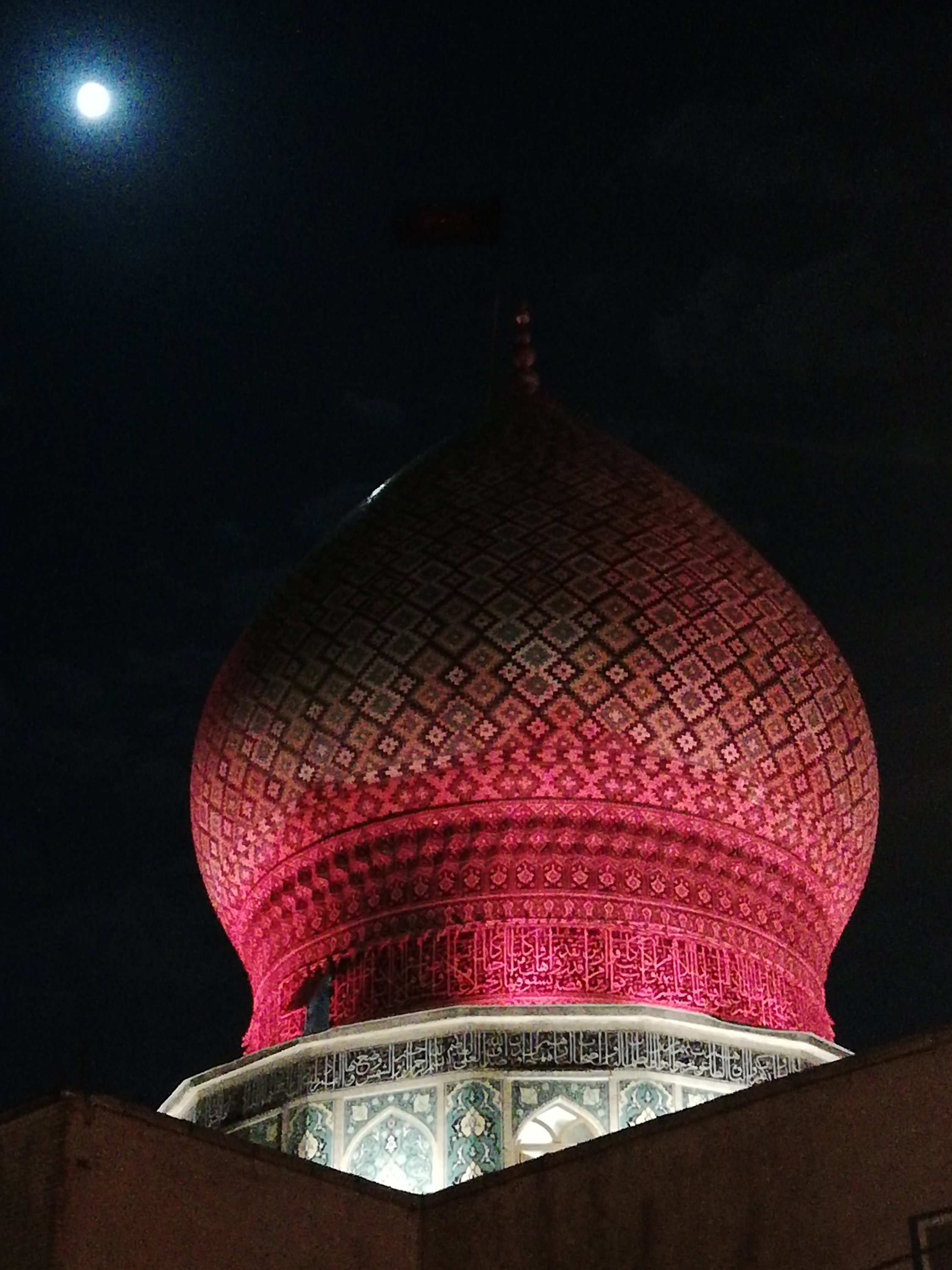
Shiraz is also home to many interesting mosques e.g. one had tiles all of mixed colours and another was lit up at night.

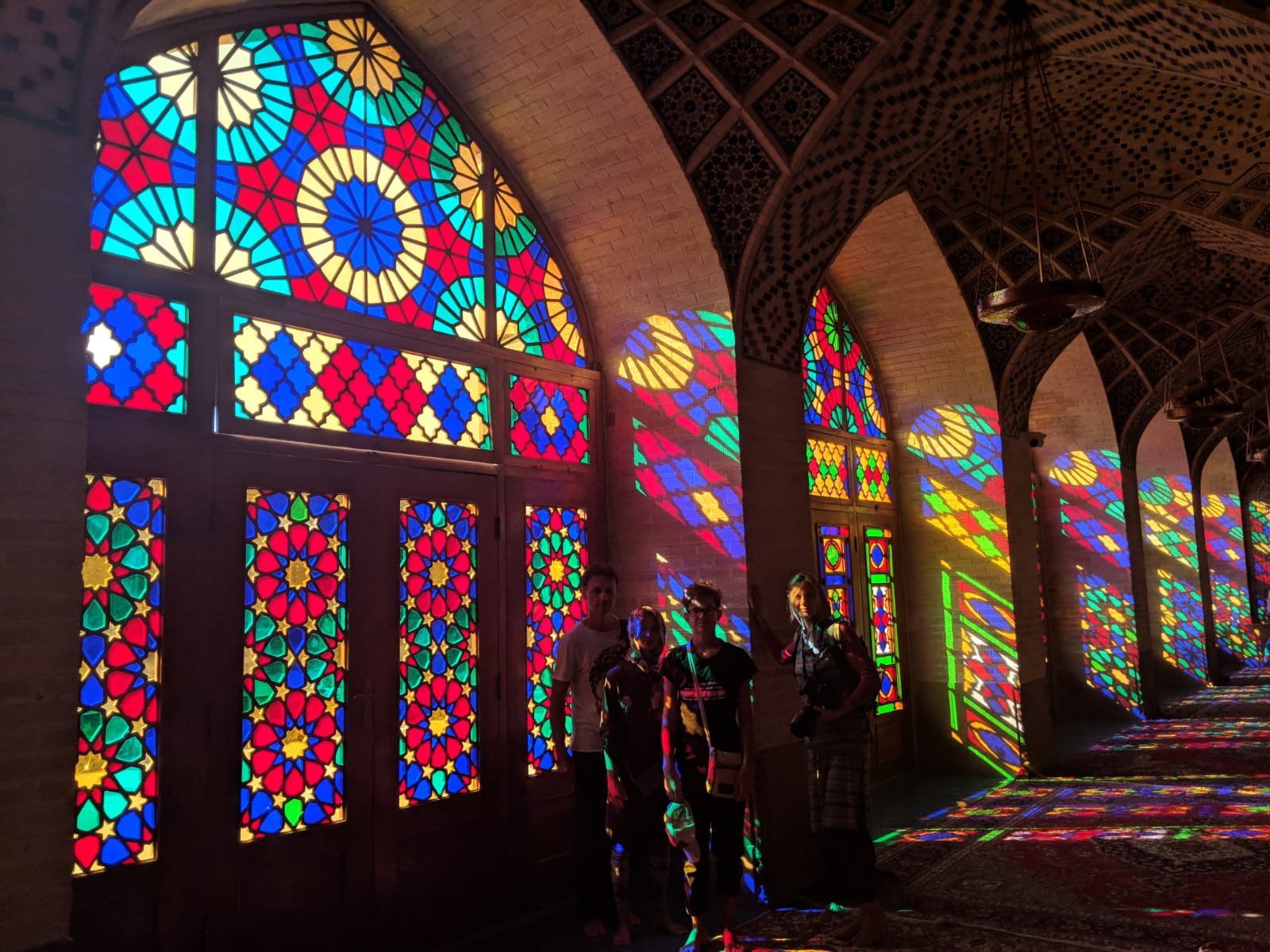
There is also the so called Pink Mosque, which at sunrise, fills up with the reflected colours from the stained windows, like a giant caledoiscope!

So Shiraz was very interesting. But one word of warning: watch out in its Bazaar – there are always motorcycles and people with boxes coming from the opposite direction.

Eventually our time in Shiraz was over, and we made our way to Yazd, also stopping by Pasargard on the way. Pasargard was quite a dissapointment – it was very antique but, compared to Persepolis, there wasn’t much left to feel impressed by.
After Pasargard, we visited the oldest living creature in the world (according to the Iranians, but upon some research it turns out it is only the second), Sarv-e Abarqu, a cedar tree, still living, even after 4000 years.

I liked Yazd as much as Kashan. I was particularly amused by a red fountain, near the marvelous Amir Chakhmagh (I’m sure is actually blood…😦I unveiled your secrets, government🕵️‍♂️🤯🤐oh well🤷‍♂️).

Yazd is the home of wind catchers – they are everywhere.
It even has the tallest wind catcher in the world (which, while not looking much in terms of height was producing really powerful wind).
Another impressing fact – Yazd is still an important center of zoroastrianism (ancient religion of Persia strongly linked to nature) and in their temple still burns an eternal fire.

Finally we returned to Tehran to take a bus to Baku. But first, we stopped by Maybod, which was in any case on our way. We visited a castle (posed for pictures) and the Ice House, a massive dome with a massive hollow hole underneath, which was used to store ice in the ancient times. Even the tiniest whisper would echo around the walls. Creepy. * shudders *
Oh yeah, we also rescued a pigeon stuck inside.

After Maybod, we went straight to Tehran. It was there that our two-week stay in Iran finished. While I must admit it was fun in general, it was difficult to roam around in the scorching heat that envelopes Iran from sunrise to sunset.

P. S. Melon juice is a must–have drink in Iran. The same goes for syrup juices with flowers. So, if you ever have the quenching desire to have a nice, fresh melon juice or a syrup, come to Iran. Thank you for coming to my TED Talk.

P. P. S The night we returned to Tehran, for dinner, I overate lamb and sure enough, the next morning, I wasn’t feeling so well.
In which case, I felt like:

Sorry Marvel fans.

I feel your pain.

🙃

Silk Road (3): Fast Car

Tags

“You got a fast car

I got a plan to get us out of here

I been working at the convenience store

Managed to save just a little bit of money

Won’t have to drive too far

Just’ cross the border and into the city

You and I can both get jobs

And finally see what it means to be living.”

~Tracy Chapman

I am not sure if Armenians are ‘worse’ drivers than their Georgian neighbors or, actually, ‘more skilled’, considering the incredibly poor state of their transportation infrastructure. The road leading to the Georgian-Armenian border indeed is only one lane and once past it, it becomes one of the worst major roads I have been on so far. Avoiding the humongous holes and the incoming traffic was an incredible feat (our driver even proceeded to overtake an ambulance whose lights and siren were on). We were duly stopped by the police a few kilometers after for speeding.

The driver’s skill was even more incredible considering that a lot of the cars in Armenia are beyond ancient: I have never seen so many old Soviet cars since I lived in Bulgaria in the 1980s. I think literally all the trucks we saw were ‘Zils’ or ‘Kamaz’. Funnily enough though, the Armenians seem to take a lot of pride in their cars. Indeed, our driver – who, despite the fact that we picked up the minivan at the Tbilisi bus station, his lack of spoken Russian and his abruptness, was Armenian – got really upset when we ate some chakapuri (bread with cheese) and a few crumbles fell on the floor of the car. He did not calm down even after we cleaned up everything. All this even though the minivan was an ancient Mercedes with worn-off interior and holes in the plastic dashboard.

The area along the border here is very mountainous but the landscape changes from plush, almost tropical in Georgia to arid, almost desert-like in Armenia (similar to the one around Kars in Turkey). The border crossing itself was very straightforward: modern and absolutely no queuing at all. The kids and Georgia were sitting in the back, while I was squeezed in between a lady with more bags than she could carry and a poker player with just a ‘man’s bag’ in his hand. Still, she asked me, and not him, to help carry one of her bags across the border (was she a ‘trader’ of some sort?).

We arrived in Yerevan under a scorcher. If the driver likes you he will stop anywhere you ask him too. I had developed a connection with the poker player, who was in Tbilisi overnight to play as he had been banned from all casinos in Yerevan, so he helped us get to our hotel. We found tennis in common with him: Andre Agassi, who, according to him, is an Armenian born in Iran and living in US (the lady thought that even Serena Williams is of Armenian origin!).

The old town of Yerevan is like Chernokonevo, the village upon which my home town, Dimitrovgrad, was built after WW2 – a few shanty houses. But unlike Dimitrovgrad, Yerevan is an ancient city with rich history and culture. All the wars and earthquakes must have put a heavy toll on this city. Maybe, this is why there is massive amount of construction going on, much more than I saw in either Istanbul or Tbilisi, or, in fact, in any European city. To see ancient Armenian churches and castles one has to go in the surroundings of Yerevan and across the border in Turkey.

In fact, Yerevan is very modern: there are a lot of art installations and monuments all over the city. But most of the architecture is still Soviet style. Yerevan is also very vibrant. While we were there it was full of street musicians, there was even a live concert of a Russian band, and the singing fountains in Republic Square were on every evening.

Armenian food is somewhat similar to Georgian – just slightly different versions of the same dish. I did not see the khinkali equivalent in Armenia though. And, of course, Georgian wine is out of this world. But I found Armenian fruits sweeter, especially the apricots (I am really gutted I did not try the Georgian watermelon, though). The Georgians have this ‘churchuri’ made out of dried fruits and nuts held together by grape molasses; the typical Armenian equivalent is to take the whole dried fruit and fill it up with nuts – both are absolutely outstanding!

As I mentioned before, we are doing this trip the backpackers’ way, meaning we use as much public transportation as possible. Turkey was perfect in that sense – very easy. Georgia was ok – we used the metro. But while there is more Cyrillic on the signs along the road in Armenia (than in Georgia) Yerevan’s metro is very small and the signs are only in Armenian. Therefore, we walked till, under 34C, at some point it became impossible. So, we took a taxi back and forth to the Armenian Genocide Memorial – it cost us less than $2 equivalent each way and both drivers were very pleasant and polite (I could communicate in Russian).

Having spent some time now also in Armenia, combined with our experience in Georgia, made me reflect on our expectations regarding the service industry and how it affects our views of a country and its people. In Tbilisi, the restaurant waiter may indeed have been less attentive according to our standards, but we felt very welcomed when we were invited to the house of our friend’s friend and treated to tea, coffee and fruits. In Yerevan, even though the hotel’s clerk was clueless when asked basic tourist information and she clearly didn’t seem to think it was part of her job description to help, the doorman kindly helped us.

It made me question whether the level of service we expect is linked to our culture. In particular, I guess, I was surprised at my own Western bias, considering I grew up behind the Iron Curtain. It made me wonder what possible hope we have to teach our kids tolerance and understanding of other cultures by any other means than travelling through them

Silk Road (2): Could beautiful nature and ancient history create a false sense of entitlement?

Tags

The first thing that struck me in Georgia was the Toyota Priuses. I think that literally every third car was a brand-new Prius. That was in stark contrast to almost all other cars which were very run-down Opels, Fords, BMWs, etc. You could still see the old Soviet Lada, Jiguli and Volga too.

We took the ‘marshrutka’ (minibus) from the border to the rented apartment in Batumi. Needless to say, the exchange rate at the border was much worse than anywhere else in town, so apart from exchanging our leftover TRY and having enough (50 EUR cents = 1.5 GEL per person) to pay for the ride into town, no more money was necessary. The marshrutka itself was a leap into my past – the early 1990s in Bulgaria – I think the vehicle was even older than that. Moreover, it boarded at least twice the allowed capacity and our Turkish driver on the other side of the border was an angel compared to this Georgian one.

The second thing that struck me was that pretty much everyone was reluctant to speak Russian, regardless of age. The military conflict with Russia had left a big impression of some resentment but mostly bewilderment (“What possibly could the Russians want from us?”). The caretaker of the apartment where we stayed however, brightened up when I told him I am originally Bulgarian and gave us a very nice bottle of local homemade red wine.

Batumi has an impressive beachside boulevard where we spent our day strolling about and riding on mini-scooters. The scooters had their own designated lane but at 20-25 km/h they could still pose danger to the pedestrians who walked nonchalantly in the area: I presume this was part of the Georgian driving experience anyway. Hiring the scooters ‘broke’ our daily entertainment budget but that was an offset from the transportation budget from the day before (the ‘marshrutka’) and the free ride to the train station later which our host was nice enough to offer.

Apart from the popularity which comes with its name from the old Soviet times and the casinos which I presume tourists flock to, I am not sure what else Batumi has to offer though (BTW, again, the bid-offer spread in some exchange bureaus is less than 1%). Yes, the skyline looks impressive and even the modern buildings have a very nice style, which actually blends well with some of the older architecture still visible across. But the beach itself is large rocks and no sand at all: Kobuleti, a half hour drive East, has a better beach.

The train to Tbilisi is very modern with free Wi-Fi and outlets for charging devices. It is not as fast as Istanbul-Ankara, though, as it takes one hour more to cover 100km less in total distance. But then the mountainous landscape does not allow it. The ride immediately after leaving Batumi train station runs for several kilometers literally along the beach where there are still the old Soviet style (very rundown) blocks of apartments alongside some impressive villas. If the mountains on the Turkish side of the border reminded me of Switzerland, this side of the border looked much more like Costa Rica – almost tropical. And while the Turkish side has much more order and the houses looked generally nicer, everything looked rundown in Georgia.

Tbilisi, however, also has a touch of Italy when it comes to its old city (and, of course, the wine): it is a quirk combination of art, imposing buildings, beautiful natural landscape and historical artifacts. It is a city for romance, full of balconies (on a visit to the city during the Cold War, M. Thatcher allegedly said, “Everywhere else they are building shelters, you are building balconies”) and night lights – the stroll to the Sulphur baths is a must. In hindsight, actually, we should have stayed longer in Tbilisi to enjoy its full splendor.

We were very lucky to meet up with a friend of a friend who spent the whole day showing us the city and its surroundings. She was amazing, such a nice and positive person. Most Georgian people in the service industry, however, looked rather miserable and even bitter somehow. I am not sure whether it was my Russian that made them so. That attitude, which sometimes merged into outright rudeness, obviously will not help business: most tourists are Russian. And knowledge of any foreign language is a plus, especially one which is spoken by hundreds of millions of people (Georgia’s population, on the other hand, is just around 4 million).

While in Turkey, I fully expected to be bargaining when engaging in an exchange as part of custom. In Georgia, the bargaining felt as if it was more about not being taken advantage of. Our host in Tbilisi, for example, offered to charge $280 (4 people) to take us to Yerevan (5 hours drive) and lied how much the ‘marshrutka’ would cost ($50 per person), when the actual price was not only $13 per person but there was plenty on offer as long as someone bothered to go to the taxi stand at the bus station.

In the local street flea market my daughter’s leaning to touch an object provoked an extreme reaction by the shopkeeper – she yelled so violently that passers-by stopped to see what happened. In one shop there was even a sign in English that said “Customer is not always right”!

I am only guessing here, but all this could be related to a sense of entitlement, also very common in my home country, Bulgaria. Small countries like these, which are lucky to have amazing nature, are full of ancient history and once had very sophisticated culture, but which were more recently easily conquered by other more populous, but less ‘ancient’ nations, do maybe tend to feel superior and to blame external forces for their issues. In that sense, Georgia is both an old and a very new country at the same time: having gained its independence from the Soviet Union only a few decades ago, it still lacks the proper institutional infrastructure and framework to really make decisions in its own interest. It is naĂŻve to think that having exited one ‘union’, joining another would automatically solve all problems.

Before passing a real judgement about the way a traveler is treated in Georgia, however, I feel we need to complete our journey and revisit, under the light of new experiences, this first opinion I formed.