It has been going on now for a year, at least: after stopping Chinese companies on several occasions from buying specific US assets, the US administration has been also looking into banning outward US investments in Chinese assets.
The fund in the spotlight is the Federal Government Thrift Savings Plan Fund (TSPF) – the largest defined contribution plan in the world with assets of about $558Bn. The assets are split in five core funds and one additional overlapping fund as following:
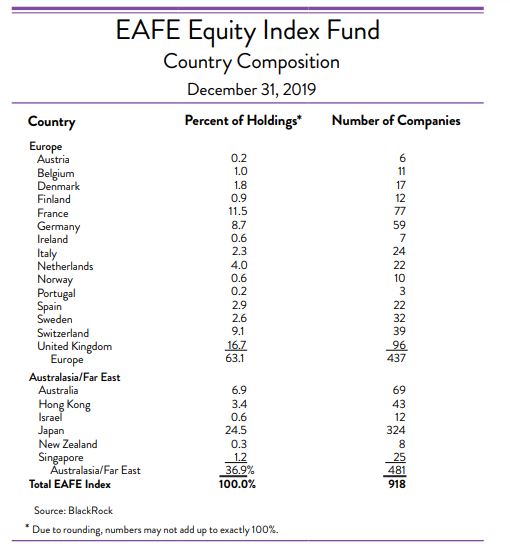
Of those above, it is the I Fund that is now in the spotlight. For the moment, it has no exposure to China as it is invested in MSCI ex US EAFE.
TSPF is an outlier amongst most large retirement plans that it still has no EM exposure. In June 2017, external consultants, Aon Hewitt, made a recommendation to the board to switch to MSCI ex US All Country which is a much broader index followed by all large retirement plans. One characteristic of this index is that it includes many EMs (and yes China). The board studied the proposal and made the decision to switch in November 2017 with a target for that sometime in 2019*.
As the US-China trade war was going in full swing, the threats of possible ramifications on US investments in China started coming in, and the I Fund never made that switch.
How big is this potential US investment?
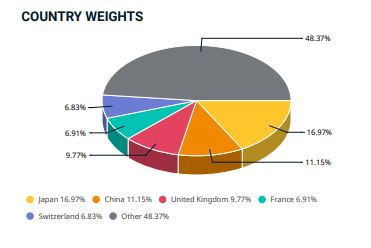
The MSCI ex US All Country is still about 75% developed markets (DM). But China is about 11% weight (second largest now), which is rather big given the recent index inclusion (the weightings have increased progressively in the last two years). That means the I Fund would have between $6Bn exposure to Chinese equities.
Adding the L Fund exposure. The L Fund will have 9% in the I Fund (from 8% currently). Therefore, given the AUMs in each above, it will have between $1-2Bn Chinese equities exposure. So, total TSPF exposure will be max $8Bn. Note, however, the L Fund’s expected exposure going forward: projections are for a substantial reduction in the G Fund weights at the expense of all others. So, potentially the future Chinese exposure can grow substantially as also China’s weight in the MSCI ex US All Country index also grows.
What is that in the context of the big flow picture?
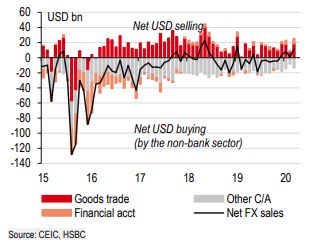
China is in the cross hairs of deglobalization which started before the Covid crisis, but now, that process is accelerating in direct proportion to the anger towards China amongst some of the major global players, especially the USA. In the USA, globalization coincided with financialization which promoted major capital inflows to offset the trade account outflows. Financialization is now on the wane in the USA (as per the regulations post 2008, and accelerated further post the Covid crisis), while on the rise in China (see flows below).
As the Chinese economy has been catching up to the US (and possibly the Covid crisis also accelerated this process as well), it is likely that we may see a reversal of some of these past flows, namely, a reduction in China’s current account surplus at the expense of net foreign inflows.
Equities
Last year passive index inflows in China A shares were $14Bn; total inflows were about $34Bn
Total foreign investment in Chinese A shares is about $284bn
Foreign equity inflows this year are still a positive $5Bn despite the Covid crisis: according to HSBC data, March recorded an outflow (largest ever) but all other months were inflows, with April inflow more or less cancelling the March outflow.
Fixed Income
Total foreign holdings are also around $283Bn, 70% of which are in GGBs.
Inflows into GGBs have been consistently positive since the index inclusion announcements last year and the year before.
According to Barclays, YTD net Inflows are at $17Bn (5x more than at same time last year) despite a net outflow in March (but that was only because of selling in NCDs).
Average monthly inflows in Chinese FI is about twice that in equities.
Domestic Flows
March registered the largest domestic outflow ($35Bn) of any month since the 2016 CNY crisis (largely due to southbound stock connect flow (mainland residents bought the largest amount of HK stocks on record).
According to HSBC, FX settlement data shows that, most likely, domestic corporates have actually been net sellers of foreign currency in Q1 this year.
Economics
While Chinese exports are expected to decline going forward, in the short term, so are imports, especially after the collapse in oil prices. However, it is inevitable that if globalization does indeed start reversing, China’s current account will shrink and possibly go into a deficit.
Conclusion
What happens to the overall flow dynamics then, really depends on whether foreigners continue to invest in Chinese assets (and expecting that domestic residents might look to diversify their portfolios abroad once the capital account is fully liberalized, if ever). A potential ban on US Federal Government investments in China might indeed be driven by short-term considerations and emotions following the Covid-19 pandemic developments, however, unless it is followed by also a ban encompassing all US private investment, it is unlikely to amount to anything positive for the US. Moreover, it could actually give the wrong signal to foreign investments in the US, that the administration is becoming not so ‘friendly’. That could spur an outflow of foreign money from US assets, something that I discussed at length here.
There have been two dominant trends in the last four decades. The breakdown of the Bretton Woods Agreement in the early 1970s, the teachings of Milton Friedman, and the policies of Ronald Reagan, eventually ushered in the process of US financialization in the early 1980s. The burst of the Japan bubble in 1990, the Asian and EM financial crises of the mid-1990s, the dotcom bubble, and, finally, China’s entry into WTO in the early 2000s, brought in the era of globalization. This whole period has greatly benefited US, US financial assets and the US Dollar.
An unwind of these two trends of financialization and globalization is likely to have the opposite effect: causing US assets and the US dollar to underperform. From a pure flow perspective, going forward, foreigners are likely to invest less in the US, or may even start selling US assets outright. They are such a large player that their actions are bound to have a big effect on prices.
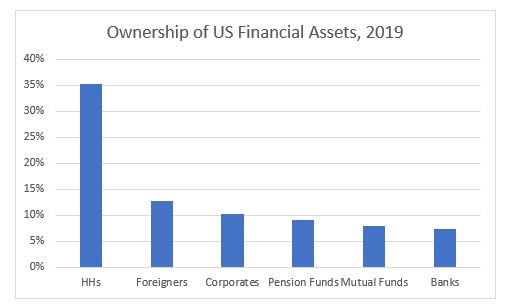
Foreigners have played an increasingly bigger role in US financial markets. In terms of ownership of US financial assets, if they were an ‘entity’ on its own, they would be the second largest holder of US financial assets in the US, after US households.
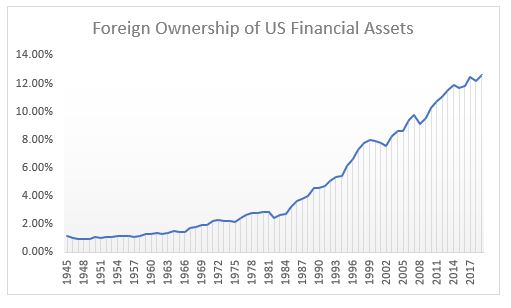
Foreigners owned about 2% of all US financial assets between 1945 and the 1980s. That number doubled between 1980 and 1990 and then tripled between 1990 and 2019!
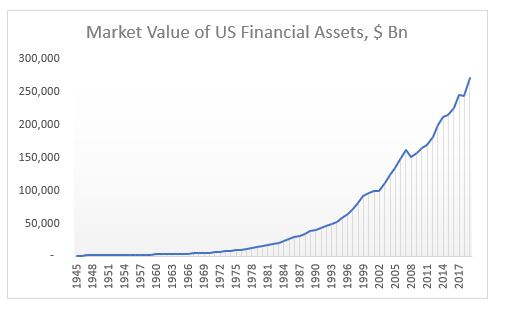
As of the end of 2019, there were a total of $271Tn US financial assets by market value. Non-financial entities owned the majority, $129Tn, followed by the financial sector, $108Tn, and foreigners $34Tn.
The financial crisis of 2008 ushered in a period of financial banking regulation (on the back of the US authorities’ bail-out), which has slowly started to dismantle some of the structures built in the previous period starting in the 1980s. The Covid-19 pandemic and the resulting government bailout of the whole US financial industry, this time, are likely to intensify this regulation and spread it more broadly across all financial entities. As a result of that, there have been already calls to rethink the concept of shareholders primacy which had been a bedrock of US capitalism since the 1980s.
In addition, the withdrawal of the UK from the EU in 2016, followed shortly by the start of a withdrawal of the US from global affairs with the election of Donald Trump, ushered in the beginning of the process of de-globalization. The US-China trade war gave a green light for many companies to start shifting global supply chains away from China. The Covid-19 pandemic intensified this process, but instead of seeking a new and more appropriate location, companies are now reconsidering whether it might make sense to onshore everything.
What we are seeing is the winding down of these two dominant trends of the last 40 years: financialization and globalization. The effects globally will be profound, but I believe US financial assets are the most at risk given that they benefited the most in the previous status quo.
De-financialization is likely to reduce shareholder pay-outs (both buybacks and dividends) which have been at the core of US equities returns over the years. The authorities are also likely to start looking into corporate tax havens as a source of government cash drain in light of ever-increasing deficits. As a result, and as I have written before, I expect US equities to have negative returns (as of end of 2019*) for the next 5 years at least.
De-globalization is likely to reduce the flow of US dollars globally. Foreigners will have fewer USD outright to invest in US assets. Those, which are in need to repay USD debt, may have to sell US assets to generate the USDs. Indeed, the USD may strengthen at first but as US assets start to under-perform, the selling by foreigners will gather speed causing both asset prices as well as the USD to weaken further.
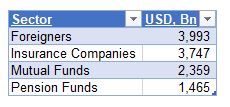
For example, foreigners are the third largest player in US equities, owning more than $8Tn as of the end of 2019. See below table for some of the largest holders.
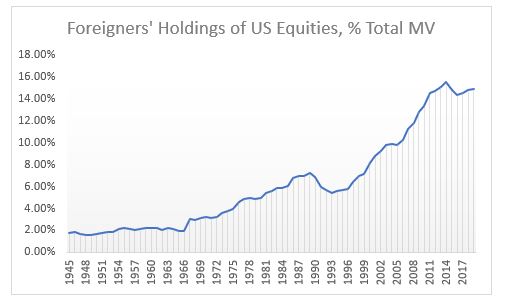
As a percentage of market value, foreigners’ holdings peaked in 2014, but they are still almost double the level of the early 1990s and more than triple the level of the early 1980s. Last year, foreigners sold the most equities ever. Incidentally, HHs which have been a consistent seller of equities in the past, but especially since 2008, bought the most ever. Pension Funds and Mutual Funds, though, continued selling.
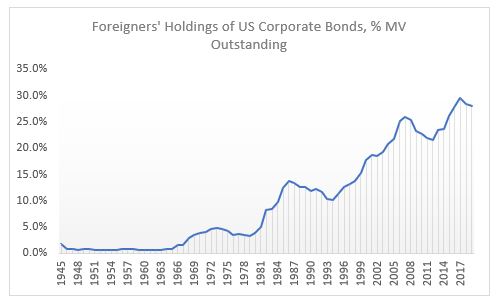
Foreigners are the largest holder of US corporate bonds, owning almost $4Tn as of end of 2019, more than ¼ of the market.
As a percentage of market value, foreigners’ holdings peaked in 2017, but they are still more than double the level of the early 1990s and 8x the level of the early 1980s.
Foreigners are also the largest holders of USTs, owning almost $6.7Tn as of end of 2019, more than 40% of the overall market.
As a percentage of market value, foreigners’ holdings peaked in 2008, at 57%! At today’s level, they are still about double the levels of the early 1990s and early 1980s.
There is a big risk in all these markets if the trends of the last four decades start reversing. US authorities are very much aware of the large influence foreigners have in US markets. The Fed’s swap and repo lines are not extended abroad just for ‘charity’, but primarily to ‘protect’ US markets from forced foreign selling in case they cannot roll their USD funding.
The UST Treasury market seems to be the most at risk here given the mountain of supply coming this and next year (multiple times larger than the previous record supply in 2008 – but foreigners back then were on a buying spree). The risk is not that there won’t be buyers, eventually, of USTs as US private sector is running a surplus plus the Fed is buying by the boatload, but that the primary auctions may not run as smoothly.
It was for this reason, I believe, that the authorities exempted USTs from the SLR for large US banks at the beginning of April. If that were not done, PDs might have been totally overwhelmed at primary auctions given the increased supply size, the fact that the Fed can’t bid and if foreigners start take up less. It is not clear, still, even with the relaxed regulation, how the primary auctions will go this year. We have to wait and see.
This is my reading of an excellent paper by S&P Global, “Examining Share Repurchasing and the S&P Buyback Indices in the U.S. Market” by Liyu Zeng and Priscilla Luk, March 2020.
Over the past 20 years (up to end of 2019), the S&P 500 Buyback Index had outperformed the S&P 500 in 16 out of 20 years, or about 5.5% per year. YTD, it has underperformed, though, by about 14%! With that it, has managed to erase the last 10 years of outperformance!
We had similar underperformance of the buyback index in the early stages of the last financial crisis, in 2007; while in 2009, the S&P 500 Buyback Index had a significant excess return. Make your own conclusions where we are in this cycle.
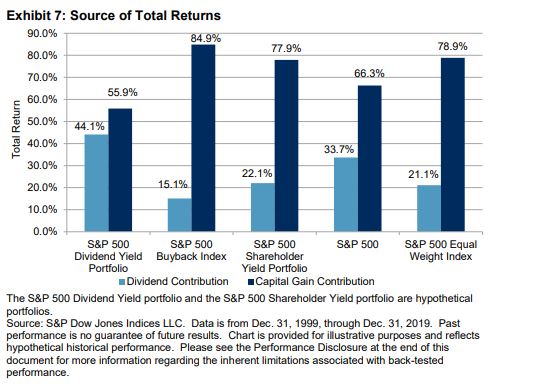
Reality is that “buybacks tend to follow the economic cycle with increased or decreased repurchase activities in up or down markets while dividend payouts are normally more stable over time, the S&P 500 Dividend Yield portfolio tends to outperform in down markets, while the S&P 500 Buyback Index may capture more upside momentum during bull markets.“
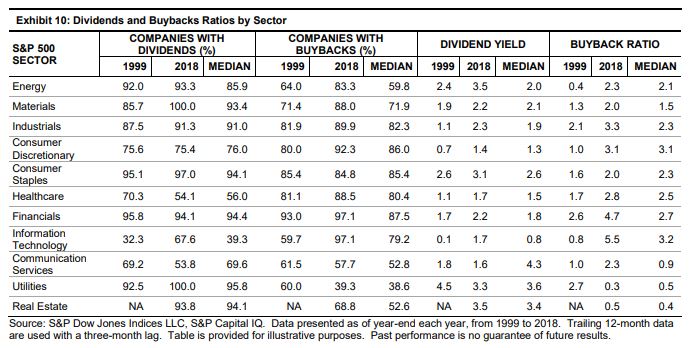
Almost all of tech, financial sector and consumer discretionary companies engage in share buybacks. Less than 50% of utilities do (but they all pay dividends). As share buybacks tend to congregate in cyclical rather than defensive sectors, the buyback index tends to underperform during recessions (this year).
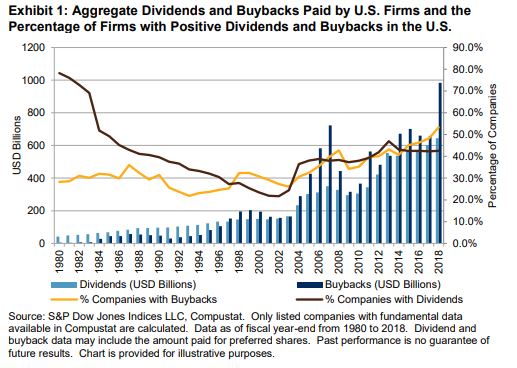
Since 1997, the total amount of buybacks has exceeded the cash dividends paid by U.S. firms. The proportion of dividend-paying companies decreased to 43% in 2018 from 78% in 1980, while the proportion of companies with share buybacks increased to 53% from 28%.
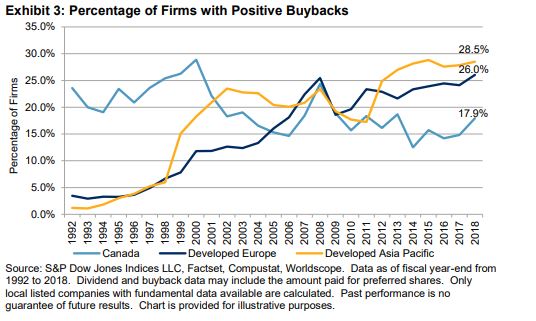
Compare to other developed markets. Despite an increase of share repurchases in Europe and Asia, as a % of all companies, buybacks still stand at about half that in the US. On the other hand, fewer Canadian companies engaged in share buybacks during that period.
For the S&P 500 Index, over the last 20 years, 2/3 of the total return has come from capital gains and only 1/3 from dividends. Before the mid-1980s, when buybacks became dominant, the opposite was true. Buybacks have been instrumental in driving equity returns since the mid-1980s.
After yesterday President Trump tweeted about it, there is today continuous noise about a possible OPEC++ (global coalition of all crude oil producers) meeting next week with the expectations of substantial cut in production, anywhere between 10 to 15mbd. On one hand, if this materializes, it will be an unprecedented (not counting the 1970s oil embargos). On another, it will barely go to match the lost demand from the (almost) whole world going on economic standby for at least a month, maybe much longer on the back of COVID-19.
Let’s put this into context. We got a 25% decline in oil prices (from low 40s on WTI to low 30s) when Saudi Arabia and Russia (OPEC+) could not agree on a 1.5mbd cut a month ago, and Saudi instead announced they ‘might’ increase production by 1.5-2mbd (but as of yet they really haven’t). Arguably, if they had agreed on a cut, oil prices may have rallied a bit, maybe to mid or high 40s.
But then we got another 30% decline (from low 30s to low 20s) when the negative effect of COVID-19 on demand became more evident. In an alternative reality if OPEC+ deal had happened a month ago, prices could have then collapsed to the low to mid 30s (30% off mid to high 40s). Don’t forget that oil had already sold off about 30% YTD at the time of pre-OPEC+ no-deal weekend. These are the milestones to keep in mind when considering the scenarios ahead of a possible crude production cut in the next few days.
So, this is the way I am looking at this:
The likelihood of ‘everyone’ (not just Saudi and Russia, but OPEC++) really agreeing on a 10-15mbd cut is very close to nil;
But the likelihood of a ‘fudge’ agreement is very high.
‘Everyone’ benefits from a ‘deal’, even the oil importers as crude has become the main sentiment indicator and that would help risk assets: OPEC++ could decide to announce a ‘deal’ simply to stabilize the market with the idea that no one is expected to really cut production (perhaps negative effects of COVID-19 eventually wear off and demands comes back0.
Reality is that, in a similar manner to Saudi Arabia not really ‘wanting’, or, arguably, even being unable to hike production by 2mbd (they have never really managed to sustain production above 12mbd), no one really intends to, or is willing to go the other way (cutting production may actually entail lost capacity for ever). So, in both cases, everybody is playing the waiting game and hopes to do nothing. But the trick is in delivering the right message.
But what could happen to crude prices if there is an announcement of a 10-15mbd cut?
One would expect that the low range point of a bounce would be the low-to-mid 30s on WTI (where prices would have been, had a cut happened between Russia and Saudi Arabia a month ago, and the demand lost we can project at the moment from COVID-19). We are just above 30 on WTI as of right now, on Friday close. But given the much larger cuts this time, the high point of the range could indeed be the low 40s where prices were before the Russia – Saudi deal fiasco.
What happens if there is not even a ‘fudge deal’ in the coming few days? We go back to the low 20s immediately and then we wait to see how much more demand is destroyed.
I think we should distinguish between dollar shortage and dollar funding stress. We have a lot of the latter and much less of the former compared to any previous crisis.
‘Dollar shortage’ is your classical EM currency crisis stemming from a balance sheet currency mismatch: borrow in dollars to fund a non-dollar asset. Cue Mexico’94, Asia’97, Russia’98, Brazil’99, Turkey’01, Argentina’01. There are fewer of them nowadays.
A ‘dollar funding stress’ stems from borrowing in dollars to fund a dollar asset – that’s the problem today (see for ex. Z. Pozsar’s latest). It feels like the old EM currency crises because a lot of dollar assets are owned by foreigners but it is very different at the same time as there are no balance sheet currency mismatches.
That distinction is important because the market is treating it as if it is a dollar shortage crisis while it is a classic ‘Mark-to-market (MTM)’ crisis. If the dollars were borrowed through the swap market, refinancing would widen the basis and move the currency. If the borrowing was in the loan/bond market, it would be a credit story, not a currency story.
There is also a break even price for dollar funding above which foreigners would choose to sell the dollar asset and repay the loan, rather than continue to finance it (probably they will have to top up if the MTM has moved too much from where they bought it). All this is a very different situation from a dollar shortage crisis whereby they would need to sell a local currency asset and actually convert proceeds into dollars.
The Fed is well aware of all this and has acted very swiftly to respond to the recent strengthening of the dollar by improving massively the terms of the five existing central bank swap lines and by adding today nine more to the frame. The extraordinary moves in some DM currencies, notably NOK and AUD, has also prompted the respective central banks to verbally intervene (Norges) or ‘not to rule out’ intervention (RBA).
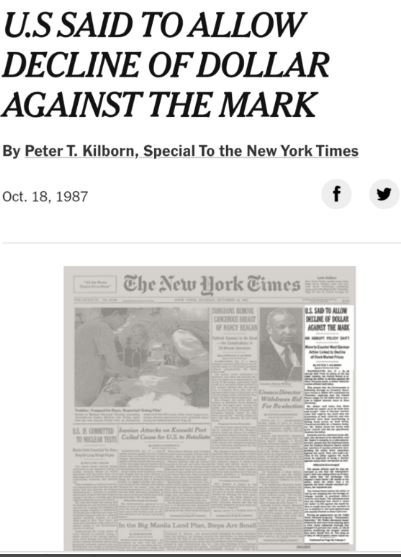
Some people have mentioned to me that a new Plaza Accord is needed. I am not so sure. In my opinion, it would be counterproductive. From a behavioral point of view, a weak dollar is not necessarily beneficial for US assets given that a big chunk of them is owned by foreigners. Just like a worsening of the dollar funding terms may push these people to sell, so could an attempt to substantially weaken the dollar. We shouldn’t forget a small but very much overlooked fact of the 1987 stock market crash: on the weekend before Black Monday, the US Treasury Secretary threatened to devalue the dollar.
Bottom line is that a dollar funding crisis should have a much smaller effect on weakening the local currency than a dollar shortage crisis.The market does not need a dollar devaluation, rather a stable dollar. Policy makers should make sure foreign dollar funding does not blow up.And finally, market pundits should be careful exaggerating the dollar shortage issue.
The response from the two most powerful central banks could not have been more different. ECB is innovative, using fine tuning and precision in tiered rates and targeted lending; Fed is still throwing the kitchen sink at the market by flooding the banking system with liquidity.
ECB is also going more direct partially because the banking system there is in shatters, but also because it makes sense regardless. Plus, the ECB is already taking credit risk by buying corporate bonds. Surely, the next step is literally direct credit lending and massively expanding the ECB counterparty list.
Fed is still stuck in the old model of credit transmission, entirely relying on the banking system. That model died in 2008, in fact, even before that, in the early 2000s, as the first Basel rules came into effect and the shadow banking system flourished.
Post 2008 it became much more common for financial institutions, like PE etc. to get in the credit loan business. Needless to say, this carries a big risk given that they don’t have access to Fed’s balance sheet like the banks.
The US banking system is now flooded with liquidity. If the new repo auctions are fully subscribed, this will double banks’ reserve balances and will bring them to the peak post the 2008 crisis. But do banks need that liquidity? It does not seem so: the first $500Bn repo auction yesterday had just $78Bn of demand. But that liquidity from the Fed is there on demand, plus the central banks swaps lines are open, and as of March 12, none has been drawn. And finally, the foreign reverse repos pool balance at the Fed has not shown any unusual activity (no drawdowns). All this is indicating that USD liquidity is at the moment sufficient, if not superfluous, so, it should have a negative effect on USD, given long USD has been a popular position post 2008.
All this liquidity, however, may still do nothing to stocks, as seen by their performance into the close yesterday, because balance sheet constraints prevent banks from channelling that liquidity further into the US economy where it is surely needed. From one hand, the Fed is really pushing on a string when it comes to domestic dollar liquidity, but, on the other, it is providing more than plenty abroad.
Risky assets are still a sell on any bounce, and the USD is probably a sell as well, as the Fed will be forced to keep cutting but it is now running a risk of foreign money exiting long established overweight positions in US assets.
China went through three main changes to stem the spread of the Coronavirus:
Quarantine
Lockdown
Rationing
In the ‘West’, we’ve added ‘Self-quarantine’ first, in some countries. Others are in the delusional phase of ‘Delay’, because, apparently, they are worried that ‘people will get bored and break out of self-isolation if it last too long’. In fairness, there is a logical reason to delay because as China and Italy will find out, the economic costs of going through those stages above are enormous. That reason is that scientists could be able to find vaccine in time. That is a very dangerous bet for the infections grow exponentially, and if a vaccine does not come soon enough, the health care system of the country will be overwhelmed (and no, the coming warm weather in the Northern Hemisphere is unlikely to slow down the infections, like in the normal flu, because this is not the normal flu, and infections have shown to grow also in hot weather like Singapore or Iran). Then, not only the economic costs but also the societal costs will be unspeakable.
Finally, one other country’s leader still thinks this virus could be ‘fake’…
WHO went on a fact-finding mission to China and released a report on February 28. The report is unequivocal:
“China’s bold approach to contain the rapid spread of this new respiratory pathogen has changed the course of a rapidly escalating and deadly epidemic.”
There are also stories about two different strains of the virus, apparently stemming from the desire to explain higher number of infections/deaths in some countries and lower in others. I don’t know. To me this is simply a function of testing more people and proper reporting. It also makes sense to run with that story in countries which have chosen to be in the ‘Delay’ stage. Occam’s razor: even if there were two strains, I don’t see how they can be country-specific.
“Everywhere you went, anyone you spoke to, there was a sense of responsibility and collective action, and there’s war footing to get things done”
~Bruce Aylward, the epidemiologist who led the WHO mission to China
There is no doubt that even in the best cases in the ‘West’, the ones which added ‘Self-quarantine’, it will take longer to get through this also because of culture, different societal structure and more liberal thinking. For example, the talk in Italy is that if things don’t start improving in a couple of weeks the country might have to go to the next stage, ‘Rationing’ (only one person per household can leave the house to replenish supplies).
After decades of general peace, no major natural disasters in the ‘West’, and used to thinking only in financial terms, we cannot comprehend what is happening to us and are unable to quickly make the right decision how to proceed forward. For almost everybody, understandably, limiting our movement is at minimum uncomfortable and for a lot of people, unacceptable. To go through rationing is unimaginable (even though for some of us, who grew up behind the Iron Curtain, this was a feature of daily life). But seriously, it’s not like we have been asked to go to war, like our grandparents; we are just told to sit on the couch at home and play video games!
I did not expect the ‘no deal’ from OPEC+ largely because of the urgency of the immediate demand destruction from the Coronavirus.
In hindsight, Russia’s reaction was quite rational. What about the Saudis?While they are still the lowest cost producer, the precariousness of the political situation there (see developments this weekend) makes me believe that they have a lot more to lose from the current status quo. Russia may be at a disadvantage when it comes to cost, but after years of sanctions, it is more prepared to withstand lower prices for longer.
As a result, I see Saudis’ attempt to lower prices on their products as a ‘bluff’, which, if called, they will have to fold. On the long run, lowering prices can only be counterproductive for them. First of all, it will affect their fiscal balance. Second, it will reinforce Russia’s (supposed) game plan (to push US shale out of the game) and hurt US, a Saudi ally. Therefore, this is at best an attempt to gain marginal market share; it would be extremely imprudent to begin a price war.
While indeed Trump has been very vocal on the benefit of low oil prices to US consumers, the sands started shifting in 2019 as the US became a net exporter of petroleum towards the end of the year: all of a sudden, Trump started extolling US energy independence. Would the US president be eager to keep a campaign promise to end US reliance on foreign energy? If so, he would now need to balance low oil prices with the risk of the US shale oil industry going bust. Therefore, I would not be surprised if the Saudis get a call from the White House should oil prices continue to plunge and that threatens the viability of US energy production.
I think the short-term market reaction this week will be brutal, but this is very different from 2014-2016 when we had similar producers’ dynamics and oil hit $30. First, inventory build-up back then was +230mbd, today it is -1.5mbd. Second, shale was in the upswing then, while now it is on the backfoot: oil-well declines are much bigger, costs are higher, and capital is scarcer.
I was bullish WTI at $45 last weekend partially because I expected the markets to bounce on sentiment, which they did, but more importantly, because the price reflected a demand-supply imbalance discounting a sharp drop in demand from the Coronavirus effect – there was, I thought, a decent cushion. Moreover, it is my view that either China will use the oil price drop to simply buy more oil, or that economic activity in China, being the marginal swing buyer of oil, will slowly come back – or rather much faster than in the West thanks to the actions the authorities there took to contain the outbreak.
Oil eventually hit $30 in 2016 but did not stay there long. It is much more difficult to model today the demand destruction from the Coronavirus but also there should be some marginal energy demand coming from the digital medium as all these people staying/working from home get online (ICT energy use is now more than half travel energy use, and it is growing very fast). Supply side is always easier to model, and it shows that compared to 2014, inventories are much lower, shale is largely out, and specs are short.
We should not underestimate that lack of liquidity/margin calls work both ways depending on positioning (as per gold sell-off a week ago) That means one needs to watch the newswires and trade rather than invest. That’s what I am doing.
As if rates going negative was not enough of a wake-up call that what we are dealing with is something else, something which no one alive has experienced: a build-up of private debt and inequality of extraordinary proportions which completely clogs the monetary transmission as well as the income generation mechanism. And no, classical fiscal policy is not going to be a solution either – as if years of Japan trying and failing was not obvious enough either.
But the most pathetic thing is that we are now going to fight a pandemic virus with the same tools which have so far totally failed to revive our economies. If the latter was indeed a failure, this virus episode is going to be a fiasco. If no growth could be ‘forgiven’, ‘dead bodies’ borders on criminal.
Here is why. The narrative that we are soon going to reach a peak in infections in the West following a similar pattern in China is based on the wrong interpretation of the data, and if we do not change our attitude, the virus will overwhelm us. China managed to contain the infectious spread precisely and exclusively because of the hyper-restrictive measures that were applied there. Not because of the (warm) weather, and not because of any intrinsic features of the virus itself, and not because it provided any extraordinary liquidity (it did not), and not because it cut rates (it actually did, but only by 10bps). In short, the R0 in China was dragged down by force. Only Italy in the West is actually taking such draconian measures to fight the virus.
Any comparisons to any other known viruses, present or past, is futile. We simply don’t know. What if we loosen the measures (watch out China here) and the R0 jumps back up? Until we have a vaccine or at least we get the number of infected people below some kind of threshold, anything is possible. So, don’t be fooled by the complacency of the 0.00whatever number of ‘deaths to infected’. It does not matter because the number you need to be worried about is the hospital beds per population: look at those numbers in US/UK (around 3 per 1,000 people), and compare to Japan/Korea (around 12 per 1,000 people). What happens if the infection rate speeds up and the hospitalization rate jumps up? Our health system will collapse.
UK released its Coronavirus action plan today. It’s a grim reading. Widespread transmission, which is highly likely, could take two or three months to peak. Up to one fifth of the workforce could be off work at the same time. These are not just numbers pulled out of a hat but based on actual math because scientist can monitor these things just as they can monitor the weather (and they have become quite good at the latter). And here, again, China is ahead of us because it already has at its disposal a vast reservoir of all kinds of public data, available for immediate analysis and to people in power who can make decisions and act fast, vert fast. Compare to the situation in the West where data is mostly scattered and in private companies’ hands. US seems to be the most vulnerable country in the West, not just because of its questionable leadership in general and Trump’s chaotic response to the virus so far, but also because of its public health system set-up, limiting testing and treating of patients.
Which really brings me to the issue at hand when it comes to the reaction in the markets.
The Coronavirus only reinforces what is primarily shaping to be a US equity crisis, at its worst, because of the forces (high valuation, passive, ETF, short vol., etc.) which were in place even before. This is unlikely to morph into a credit crisis because of policy support.
Therefore, if you have to place your bet on a short, it would be equities over credit. My point is not that credit will be immune but that if the crisis evolves further, it will be more like dotcom than GFC. Credit and equity crises follow each other: dotcom was preceded by S&L and followed by GFC.
And from an economics standpoint, the corona virus is, equally, only reinforcing the de-globalization trend which, one could say, started with the decision to brexit in 2016. The two decades of globalization, beginning with China’s WTO acceptance in 2001, were beneficial to the USD especially against EM, and US equities overall. Ironically, globalization has not been that kind to commodity prices partially because of the strong dollar post 2008, but also because of the strong disinflationary trend which has persisted throughout.
So, if all this is about to reverse and the Coronavirus was just the feather that finally broke globalization’s back, then it stands to reason to bet on the next cycle being the opposite of what we had so far: weaker USD, higher inflation, higher commodities, US equities underperformance.
“I am here for one reason and one reason alone. I’m here to guess what the music might do a week, a month, a year from now. That’s it. Nothing more. And standing here tonight, I’m afraid that I don’t hear a thing. Just…silence”
~Margin Call
At the moment, the popular narrative in the market is that the Fed has created the greatest liquidity boost ever. On the back of it, US stock prices, in particular, have risen in an almost vertical fashion since September 2019. The irony is that this boost of liquidity was not big enough to justify such a reaction. In fact, if we compare Fed’s recent balance sheet increase to QE 1,2,3, it becomes obvious that they have little in common, which is why central bank officials have continuously stated that this is not QE. Whether that is the case or not is not a question of trivial semantics. It actually carries important market implications: once this overestimation of Fed liquidity becomes common knowledge, the stock market would have to correct accordingly.
The large increase of autonomous factors on the liability side of the Fed’s balance sheet is at the core of this misunderstanding.
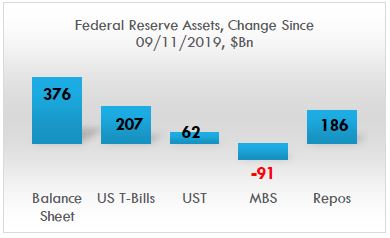
Although the Fed has indeed been doing around $100Bn worth of repo operations on a daily basis since September 2019 (less so recently), these operations are only temporary (overnight and 14-days), i.e. they cannot be taken cumulatively in ascertaining the effect on liquidity. In fact, during that period, the Fed’s balance sheet increased by only about $400bn, of which about half came from repos, the other from securities purchases, mostly T-Bills, with the increase in UST (coupons) more than offset by the decline in MBS.
Source: FRB H.4.1, BeyondOverton
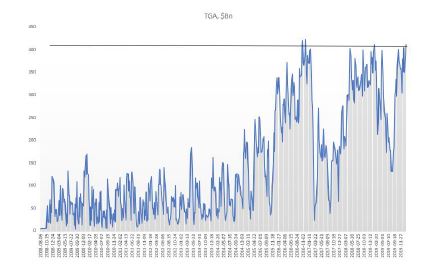
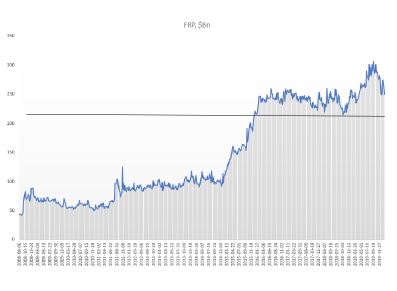
However, not all of the increase in Fed’s balance sheet went towards interbank liquidity: bank reserves rose by only about $150Bn (as of 22/01/2020), less than half of the total! Almost two-thirds went towards an increase in the Treasury General Account (TGA), which takes liquidity out. The growth of currency in circulation (which also decreases liquidity) was exactly offset by a net decline in reverse repos: a drop in the Foreign Reverse Repos (FRP), but a rise in domestic reverse repo.
Source: FRB H.4.1, BeyondOverton
Fed actually started increasing its T-Bills and coupons portfolio already in mid-August, three weeks before the repo spike. Part of that increase went towards MBS maturities. But by the end of August, Fed’s balance sheet had already started growing. By the third week of September, also the combined assets portfolio (T-Bills, coupons, MBS) bottomed out, even though MBS continued to decrease on a net basis.
Source: FRB H.4.1, BeyondOverton
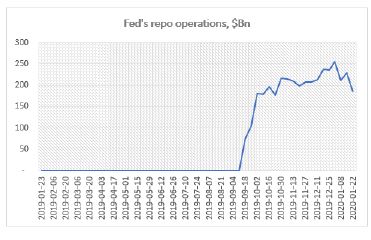
Fed’s repo operations began the second week of September. They reached a high of $256Bn during the last week of December. At $186Bn, down $70Bn from the highs, they are at the same level where they were in mid-October.
Source: FRB H.4.1, BeyondOverton
On the liability side, TGA actually bottomed out two weeks before the Fed started buying coupons and T-Bills, while the FRP topped the week the Fed started the repo operations. Could it be a coincidence? I don’t think so. My guess is that the Fed knew exactly what was going on and took precautions on time. Just as we found out that the Fed had lowered the rate paid on FRP to that of the domestic repo rate, we might also one day find out if it did indeed nudge foreigners to start moving funds away.
Source: FRB H.4.1, BeyondOverton
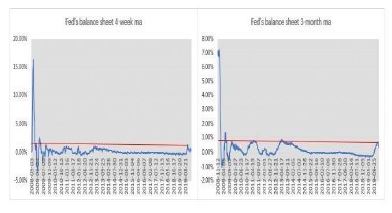
So, while the Fed’s liquidity injection since last September was substantial relative to the period when the Fed was tapering (2018) or when the balance sheet was not growing (2015-17), it is a stretch to make a claim that this is the greatest liquidity boost ever. The charts below show the 4-week and 3-month moving average percentage change in the Fed’s balance sheet. The 4-week change in September was indeed the largest boost in liquidity since the immediate aftermath of the 2008 financial crisis. The 3-month change, though, isn’t.
Source: FRB H.4.1, BeyondOverton
The Fed pumped more liquidity in the system during the European debt crisis. In the first four months of 2013, both the growth rate of the Fed’s balance sheet and the absolute increase of assets and bank reserves were higher than in the last four months of 2019. Moreover, there were no equivalent increases in either the TGA or the FRP.
Source FRB H.4.1, BeyondOverton
In fact, the reason Fed’s balance sheet changes this time around did not provide any substantial boost to liquidity, is precisely because they are very different from the three QE episodes immediately after the 2008 financial crisis.
For example, during QE1, the increase in securities held was more than three times the increase in Fed’s total assets. That was mostly because loans and central banks (CBs) swaps declined, to make up the difference. The Fed bought both coupons and MBS. However, 75% of the increase in assets came from a rise in MBS (from $0 to almost $1.2Tn), while T-Bills remained unchanged and agencies declined.
The Fed had begun to extend loans to primary dealers (PDs) even before September 2008, but immediately after Lehman Brothers failed, it included asset-backed/commercial paper/money market/mutual fund entities to this list of loan recipients as well. At around $400Bn, these were short-term loans, designed to pretty much make sure that no other PD or any significantly important player failed.
By the time QE1 finished most of these loans were repaid. In a similar fashion, the Fed had already put in place CBs swap lines even before September 2008, but they got really filled up, to the tune of more than $500Bn, after the Lehman Brothers event. Finally, repos actually decreased during QE1. Bottom line is, as far as Fed’s assets are concerned, September 2019 had no resemblances at all to September 2008.
On the liability side, the differences were also stark. Unlike 2019, during QE1 bank reserves contributed to 95% of the overall increase of balance sheet. The FRP remained pretty much flat for the full duration of QE1, while the TGA was unchanged but it did exhibit the usual volatility during seasonal funding periods.
Source: FRB H.4.1, BeyondOverton
QE2 was much more straightforward than QE1. Fed’s assets increased only on the back of coupon purchases (around $600Bn), while the Fed continued to decrease its MBS and loans portfolio. On the liability side, bank reserves continued to contribute about 95% of the increase. The rest was currency in circulation. Bottom line here again is that there is really no resemblance to 2019.
QE3 was similar to QE2 in the sense that Fed’s reserves increased 100% on the back of securities purchases (around $1.6Tn), but this time split equally between coupons and MBS. On the liability side, however, at 80% of total, bank reserves contributed slightly less towards the overall increase than during QE1 or QE2. The rest was split between currency in circulation and reverse repos. So, during QE3 less of the Fed’s balance sheet increase, than during the previous QEs, contributed to liquidity overall, but still much more than in 2019.
Reverse repos were especially prominent after QE3, when the Fed stopped growing its balance sheet but before it actually started tapering it. Probably, that was the sign that the banking system was actually running enough surplus reserves that it was willing to give some of the liquidity back to the Fed.
To recap, whatever the Fed has been doing so far, starting in September 2019, has simply no comparisons with any of the previous QEs. The largest increases on the Fed’s balance sheet in 2019 were T-Bills and repos; the Fed never bought T-Bills or engaged in repos in any of the previous QEs – the asset mix was totally different. On the liability side, while in the QEs almost all of the increase went directly into bank liquidity, in 2019 less than 50% did. FRP was more or less unchanged, at around $100Bn, between the beginning of QE1 and the end of QE3, but by September 2019 it had tripled. TGA averaged around $60Bn before the end of QE3; thereafter the average increased four times!
As a matter of fact, when we put the whole picture together, the case could be made that the Fed did not really create any additional liquidity at all since equities bottomed in March 2009.
Fed’s assets have increased by about $2Tn since then. But only 37% of that increase went to bank reserves. 40% went towards the natural increase of currency in circulation, 14% went to the TGA and 9% went to the FRP (last three drawing liquidity out).
Source: FRB H.4.1, BeyondOverton
Yes, bank reserves have increased by about $800Bn since then but also have bank reserves needs on the back of Basel III liquidity requirements. According to the Fed itself, the aggregate lowest comfortable level of reserve balances in the banking system ranges from $600Bn to just under $900Bn. Thus, at $1.6Tn currently, there is not much excess liquidity left in the system: on a net basis, whatever extra liquidity was created, it happened between September 2008 and March 2009.
More precisely, actually, the Fed did create surplus liquidity up to about the end of 2014. Between 2015 and the end of 2017, the liquidity in the system stayed flat. After that, the Fed started taking liquidity out, and by the middle of 2019 it left just about enough surplus liquidity (over and above the March 2009 level) to satisfy Basel III liquidity requirements.
Going forward, it is very likely that the bulk of the increase of the central bank’s balance sheet is behind us for the moment, ceteris paribus. The Fed will continue shifting from repos to T-Bills and probably coupons (especially if it hikes the IOER/repo rate, as expected). The effect on liquidity will depend on the mixture of liabilities, though. I expect the TGA to start drifting lower with seasonality as well as because it is at level associated with reversals in the past.
Source: FRB H.4.1, BeyondOverton
FRP has a bit more to go on the downside but I think it will struggle to break $200Bn, and it might settle around $215Bn. TGA and FRP declining should help liquidity even if Fed’s balance sheet does not increase. If the decline in the demand for repos is less than Fed’s securities purchases, bank reserves are likely to go up: this should help liquidity overall. Otherwise, it depends on the net effect of the change in all autonomous factors.
Source: FRB H.4.1, BeyondOverton
So, while the Fed has just about created enough liquidity to take bank reserves to the level of March 2009 (plus the reserves required to meet Basel III liquidity requirements), S&P 500 is up 10% since the Fed started this latest liquidity injections, and almost 400% since the bottom in 2009: an outstanding performance given all of the above. While the rise in the market pre 2019 can be fully attributed to massive corporate share buybacks, with active managers and real money (households, pension funds, mutual funds and insurance companies) net sellers of equities, thereafter, it is more of a mixed bag.
In 2019 retail money picked up the baton from corporates and bought the most equities since the 2008 financial crisis[1]. In addition, there has been relentless selling of volatility in the form of exotic structured retail products (mostly out of Asia[2]), betting on a continued stability and a rising trend on the back of the ongoing US corporate share buyback program, combined with the Fed’s about face on rates last year. Together with an all-time record speculative selling of VIX futures, this has left the street, generally speaking, quite long gamma, thus further helping the market’s bullish stance (to monetize their gamma exposure, dealers sell on rallies and buy on dips, thus cushioning the market on the way down, while the buying from other sources ensures the market keeps grinding higher).
Having mostly missed the extraordinary rally in US stocks during 2009-2018 (i.e. during the Fed’s previous balance sheet expansions and before the tapering), real money did not want to be left out on this one as well. However, not only the premises for this bullishness are unfounded, as discussed above, but also the internals of the previous stock market rally might be changing.
Corporate share buybacks, while still strong, are fading. This is happening for two main reasons. First, the Boeing scandal (prior to last year, Boeing was one of the largest share buyback companies in the US), I believe, is really accelerating bipartisan support to allow regulators more leeway into scrutinizing how companies choose to spend their cash. Second, with corporate earnings growth slowing down, US companies have been substantially scaling down their plans for share buybacks in 2020, anyway.
Neither the fact that the central bank liquidity is much smaller than envisioned, nor that the breadth of the rally is narrowing, seems to be on people’s radar at the moment. On the contrary, investors might be even embracing a completely new paradigm, this-time-is-different attitude, which sometimes comes at moments preceding a market correction. For example, at Davos 2020, Bob Prince, the Co-CIO of the largest hedge fund in the world, Bridgewater, said in an interview with Bloomberg TV, that he believed the boom-bust cycle was over. In fact, he went further in elaborating on this view:
“Stability could be an opportunity…You’ll hear the tremors before the earthquake. It won’t just come upon you all of a sudden. Volatility is out there, but it is not imminent.” This reminded me of the build-up to the 2008 financial crisis[3]. It’s not that people did not see the risks in subprime mortgage CDOs back then. They did, and that was why it took them some time to get in on the
[1] See Brace Your Horses, This Carriage is Broken”, BeyondOverton, January 14, 2020
[2] “How an exotic investment product sold in Korea could create havoc in the US options market”, Bloomberg, January 20, 2020
[3] “When the music stops, in terms of liquidity, things will be complicated. But as long as the music is playing, you’ve got to get up and dance.”, Chuck Prince, CEO of Citibank, the largest US bank in 2007.














 BeyondOverton