• About
  • BeyondOverton Travel
    • Silk Road (1): If Turkey is in crisis, it’s not obvious visiting it
    • Silk Road (2): Could beautiful nature and ancient history create a false sense of entitlement?
    • Silk Road (3): Fast Car
    • Silk Road (4):We took a bus ride to Iran
    • Silk Road (5): Border bothers
    • Silk Road (6): Chevrolet Land
    • Silk Road (7): Free-roaming camels and wild horses
    • Silk Road (8): China West to East
    • Silk Road (9): I have not told half of what I saw
  • BLOG
  • g88kboy Travel
    • On the Silk Road
    • Bulgaria : The Chicken crossed the Road
    • Turkey : The Country, not the Bird
    • Georgia on my Mind
    • Armenian Ayran
    • Iran – The Curious Land
    • An American in Azerbaijan
    • Uzbekistan: Golden Teeth and Neon Signs
    • Kazakhstan: Thirty Sweating Seniors
    • China Part One – Pandas Are Extinct
    • China Part Two: My TED Talk (Deep Analysis)
    • Phillipines – They Relax, I (pretend to😉) Study
    • Singapore: flashing trees and a torrent of tears
    • Malaysia: That ain’t no croc, it’s a log
    • Brunei: The Instinctive Fight for Superior Domination
    • Phillipines: Hello Friend Again
  • Outside the window
    • Bulgaria
    • Turkey
    • Georgia
    • Armenia
    • Iran
    • Azerbaijan
    • Uzbekistan
    • Kazakhstan

BeyondOverton

~ let's move this window

BeyondOverton

Category Archives: Monetary Policy

Are these the ‘wise owls’ of the North?

03 Sunday Nov 2019

Posted by beyondoverton in Debt, Monetary Policy

≈ Leave a comment

Really interesting the divergence of monetary policy in Norway and Canada, and now possibly, Sweden with the rest of the DM/EM world in the last 12 months*. While pretty much every other central bank in the world has turned dovish, Norges hiked four times since September last year, while Bank of Canada has hiked 5 times since mid 2017. And last week, against all odds and expectations, Riskbank also surprised by pretty much guaranteeing a hike at its December meeting. It’s questionable whether hikes in either country was/is warranted looking strictly at economic activity.

Despite a spike in core inflation in early 2019, something which Norges had actually expected to be temporary, inflation is back below 2%. Both Canada’s and Sweden’s inflation spiked up in mid 2018 and have recently retreated back below 2%. Growth in all three counties has actually been more elevated than in neighboring Europe or US but growth was never the reason their respective central banks cut rates before, so it does not seem to be the reason they are now hiking. In fact, looking at weakening domestic demand and rising unemployment rates in Sweden, there are probably more reasons to cut than hike now.

So why are they hawkish? One theory is that the central banks are worried about rising household leverage with private debt to GDP in each close to the highest in the world. The thing is, other countries in a similar situation have chosen to go the opposite way. Australia, New Zealand, Korea, which also have high household debt ratios, tried to be ‘hawkish’ but have been aggressively cutting over the last 12 months on the back of slowing global demand.

The problem with hiking rates when over-indebtedness is high is that you are ‘inviting’ financial instability and when that is one of your mandates, it is probably not such a wise choice. Is that why the Riskbank has said it would hike only once and stop at 0%?

Another theory is that the Riskbank is preparing to introduce the e-krona and does not want to be dealing with the arb of negative rates. I find that a poor excuse to hike as well.

And finally, some people are looking for a symbolic meaning of Sweden going back to 0% after being the first modern central bank to go below, 10 years ago. I don’t know. My guess is that it is more likely to be part of the experimentation process, but that ultimately it would turn out to be too early not to be a policy mistake.

*In Israel, the UK and the Czech Republic the last interest rate moves were a hike. However, Israel hiked only once, in November last year (from 0%) and with inflation at 0.5% and below the target range of 1-3%, the central banks has removed any prospect for a further rate increase and confirmed inflation is in a downward trend. UK is a special case of Brexit and deserves a post on its own. The Czech Republic, I have to admit, is a proper outlier here with both growth and inflation bucking all trends in Europe and, therefore, also deserves its own blog post.

Negative interest rates may not be a temporary measure

29 Tuesday Oct 2019

Posted by beyondoverton in Debt, Monetary Policy, Politics

≈ 2 Comments

Tags

demurrage, negative interest rates

In the current debt-backed system, the majority of money is still loaned into circulation at a positive interest rate. Even in Europe and Japan, where base interest rates and sovereign bond yields are negative, the majority of private debt still carries a positive interest rate. This structure inherently requires a constantly growing portion of the existing stock of money to be devoted to paying solely interest. Thus, the rate of growth of the money supply has to be equal to or greater than the rate of interest, otherwise more and more money would be devoted to paying interest than to economic activity.

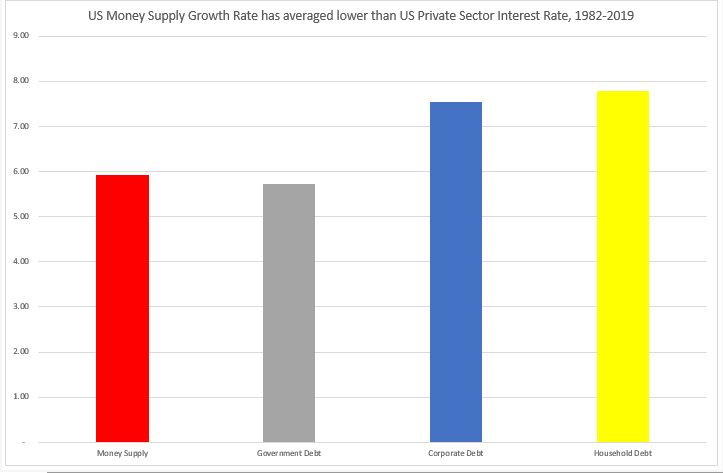
The long-term average growth rate of US money supply is around 6%, which is only slightly higher than the average interest rate on US government debt but it is below both the average US corporate interest rate and US household debt. While I have used the UST 10yr yield as the average yield on US government debt (the average maturity of US debt is slightly less than that), the estimates for both US corporate debt and US household debt are very generous. For the former, I used the average yield on Aaa and Baa corporate bonds, and for the latter I used a weighted average interest rate between mortgage debt and auto loans (I have used 2/3 and 1/3 weights). I have not included the much higher yield on US corporate junk bonds which comprise a growing proportion of overall corporate debt. I have also not used credit card/consumer debt, which has a much higher interest rate than auto loans, and also student loan debt which carries approximately similar interest rate to auto loans. Just like for BBB and lower rated US corporates, credit card and student loan debt are a much higher proportion of total US household indebtedness compared to before the 2008 crisis.

I estimate the long-term average economy-wide interest rate as a weighted average of government, corporate and household debt – with the weights being their portions of the total stock of debt. That rate currently is about 7%, still higher than the average money supply growth rate since the early 1980s. Over the last four decades, US money supply has not only not grown enough, on average, to stimulate US economic growth, but has been, in fact even, below the overall interest rate in the economy. Needless to say, this is not an environment that could have persisted for a long time.

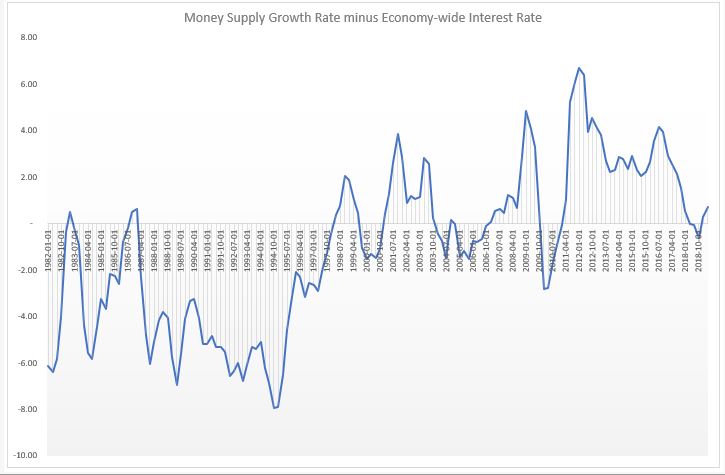
Indeed, if one calculates the above equivalent rates for the period 1980-2007, the situation would be even more extreme (see Chart below). In fact, until the late 1990s, money supply growth had been pretty much consistently below the economy-wide interest rate. Only after the dotcom crisis, but really after the 2008 crisis, money supply growth rate picked up and stayed on average above the economy-wide interest rate.

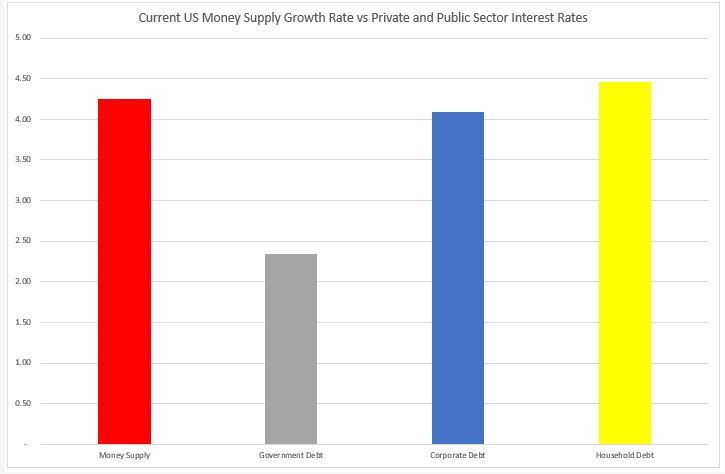
What is the situation now? The current money supply growth rate is just above the average economy-wide interest rate; respectively above the government and corporate interest rates but below the household interest rate (data is as of Q1’2019).

It is also still below the combined average private sector interest rate.

So, even at these low interest rate, US money supply is just about enough to cover interest payments on previously created money. And that is assuming equal distribution of money. Reality is that it is only enough to cover interest payment on public debt. And even in the private sector, money distribution is very skewed: corporates have record amount of cash but it is only in the treasuries of few corporates. The private sector, overall, can barely cover its interest payment, let alone invest in CAPEX, etc.

The deeper question is whether money creation should indeed be linked to debt at positive interest rate. In fact, we have already answered that question, and gone beyond, with some portion of money creation in Europe and Japan actually happening at negative interest rate. In effect, the market is trying to correct for all those decades when money creation substantially lagged interest payments: money there is starting to decay.

Demurrage money is not unusual in history. Early forms of commodity money, like grain and cattle, was indeed subject to decay. Even metallic money, later, on was subject to inherent ‘negative interest rates’. In the Middle Ages, in Europe, coins were periodically recoiled and then re-minted at a discount rate (in England, for example, this was done every 6 years, and for every four coins, only three were issued back). Money supply though, did not shrink, as the authorities (the king) would replenish the difference to find his own expenses. In 1906, Silvio Gesell proposed a system of demurrage money which he called Freigeld (free money), effectively placing a stamp on each paper note costing a fraction of the note’s value over a specific time period. During the Great Depression, Gesell’s idea was used in some parts of Europe (the wara and the Worgl) with the demurrage rate of 1% per month.

The idea behind demurrage money is to decouple two of the three attributes of money: store of value vs medium of exchange. These two cannot possibly co-exist and are in constant ‘conflict’ with each other: a medium of exchange needs to circulate to have any value, but a store of value, by default, ‘requires’ money to be kept out of circulation. Negative interest rates in effect split these two functions.

Seen from this point of view, negative interest rates may not be a temporary phenomenon just to spur lending. On the opposite, negative interest rates may be here to help reduce the overall debt stock in the economy and to escape the deflationary liquidity trap caused by the declining marginal efficiency of capital.

Repo squeeze and the Fed: two additional solutions

04 Friday Oct 2019

Posted by beyondoverton in Monetary Policy, Politics

≈ Leave a comment

Tags

Fed

Things the Fed can do to alleviate the potential repo squeeze (apart from the usual suspects already discussed in great detail by both saleside/buyside research and in Twittersphere):

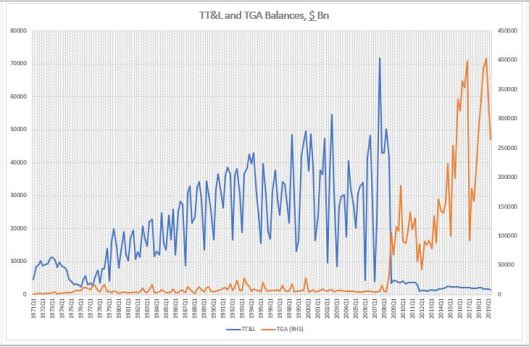
1) hike the interest banks pay on TT&L ‘notes’ accounts from EFF-25bps to EFF, or to make it even simpler, equal to IOER. That could encourage funds to move from the TGA account back to TT&L accounts and ‘release’ reserves.

When the Fed started paying IOER, the opportunity cost for the Treasury to keep money on deposit in the banking system (TT&L accounts) rose. The Treasury thus started using the TGA at the Fed.

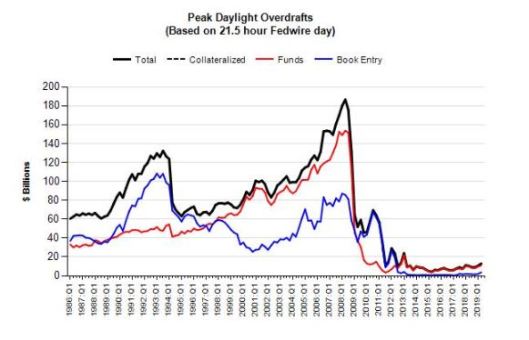
2) cut the fee on daily uncollateralized overdrafts from the current 50bps, adjust the net debt caps, decrease the penalty daily overdraft fee of 150bps. That could encourage better use of the existing Fed intraday liquidity option.

The Fed made major changes to its daily overdraft operations in 2011 spurred by some inexplicable desire to limit its credit exposure. This was probably on the back of political pressure from the legacy of the 2008 crisis during which the Fed indeed took massive credit risk.

Before 2011, the majority of the Fed’s daily overdrafts were uncollateralized. The new rules discouraged uncollateralized ‘repos’ by raising their fees and introducing collateralized overdrafts for free. After those changes, majority of the overdrafts became collateralized. The problem arose when during the most recent repo squeeze, the mechanics of obtaining collateral became complicated.

In any case, Fed’s action was strange given the fact that only a few months before that, in 2011, it had changed the accounting rules which pretty much ensured that the central bank can not go bankrupt (no negative equity) even in theory.

Should the Fed, actually, be providing free intraday liquidity with no collateral to eligible institutions? I think so. Because:

-that liquidity is needed for transaction (retail 24/7), not consumption or production purposes (Pfister 2018)

-the central bank can create money at zero cost, while the opportunity cost of holding money should be equal to the social cost of creating it (Friedman 1969)

-the central bank would be simply accommodating Basell III regulations

These two solutions are not groundbreaking: the Fed would be either going back to the way things were before 2007 (uncollateralized Fed daily overdrafts), or taking into account new developments (the emergence of IOER).

What do Myanmar driving and our monetary system have in common?

21 Thursday Mar 2019

Posted by beyondoverton in Monetary Policy, Questions, Travel

≈ Leave a comment

Both make people’s lives unintentionally difficult and complicated by having changed the system in the 1970s but continuing to insist on following the same old rules.

In 1970, Myanmar General Me Win changed the direction of traffic in the country (literally overnight) from left to right. Such a sudden decision would have been a precarious change even in the best of circumstances, but in the case of Myanmar which, having been a British colony, traffic had been on the left with a right-hand drive steering wheel, it was truly extraordinary given that all the cars continued to be with a right-hand steering wheel!

In 1971, US President Richard Nixon ended the gold standard which had been at the core of most of the world’s monetary systems for centuries. The world truly went on fiat money. That would have been a difficult task in the best of circumstances given the previous history of fiat money. In the case of US, and most other countries, it became an impossible one given that no attempt was made to upgrade the monetary system to the new reality of fiat money.

Every country we have visited so far on our journey is unique on its own, but no country in the world is so truly unique as Myanmar when it comes to driving on the road. We spent almost a month in Myanmar and honestly it took me some time to realize that we were driving on the right side of the road but also the driver is sitting on the right side of the car! Can you imagine how hard and crazy this is? I actually can, having lived in London for two decades and frequently driven to Europe. But even that is not a good comparison as I would generally drive on well-kept highways in Europe, while in Myanmar there are no real highways, all roads are single lane and quite bad by European standards. Try overtaking under these conditions in Myanmar: when the steering wheels of cars didn’t change, people were left with relying on honks and passenger guidance when merging into a lane.

Something similar happened with our monetary system: in 1971 we finally, and for good, threw off the gold shackles but we did not change the gold standard accounting (CB reserves vs. government bonds) and continued to impose imaginary limits on government finances and money supply in general. This is as backward, inconvenient and dangerous as a right-hand drive on the right side of the road.

I started paying attention to this monetary inconsistency only after GFC’08 when it became obvious that there is something ‘not right’ with our money supply: the way the Fed was conducting QE, the way inflation did not budge, and the way no one batted an eyelid when the $700bn financial rescue plan was announced. Then I discovered Mosler, Wray and the rest of the original MMT crew. Finally, I brushed up on financial history going well beyond the Great Depression, when ‘MMT’ was last popular, to Knapp and even beyond (“Debt: the first 5,000 years”). But what convinced me most that our monetary transmission mechanism is far from optimal (just like in Myanmar, I had to spend some time on its roads to even notice the peculiarity) was that I was intimately involved in the plumbing of the financial system by trading and having exposure in the short end of the money markets, especially in the years following GFC’08.

What is extraordinary for me in both cases is that people don’t seem to be bothered and despite the obvious difficulties prefer to just get on with the existing status quo. Speaking to locals in Myanmar, there is neither appetite to change back to the previous driving system, nor to start importing left-hand driving wheel cars (even though some people have mentioned a draft law that would have a cut-off point after which only left-hand drive wheel cars would be allowed to be imported). In the case of gold-standard-monetary-system-not-fitted-to-a-fiat-world, the people in power (central bankers, prominent economists) have ridiculed any attempts to think of possible improvements.

Fiscal policy is next but it’s also unlikely to work

03 Sunday Feb 2019

Posted by beyondoverton in Monetary Policy, Politics, Uncategorized

≈ 1 Comment

Simon Wren-Lewis wrote an interesting article yesterday The Interest Rate Lower Bound Trap and the ideas that keep us there

Unfortunately, the ideas that keep us plugging pointlessly at monetary policy are not that dissimilar to the ideas which will push us into trying fiscal policy: both of them are based on using the old industrial model of labor and capital income distribution which is much less suitable in the digital age where technology takes center stage.

What particularly caught my attention was the 3rd paragraph and this very relevant question: “If these countries really did have a zero output gap, then why is inflation below target?” Which gets to the core of the issue about how technology has possibly substantially increased potential output.

Yet, our models do not fully capture that. Perhaps that is because we continue to put too much weight on capital and labor in the production function when clearly technology has marginalized them both, the evidence being in zero rates and flat wages.

Let’s take capital.

1) there is a large corporate capital surplus;

2) digital technology does not require so much capital;

3) consumer debt is maxed out.

All three of the above lead to low demand for credit meaning low interest rates regardless/independent of monetary policy.

So, after years of zero/negative/low rates (decades in Japan) it is finally obvious that the monetary transmission mechanism is now clogged (see above). Naturally, despite all the opposition, we are probably just a recession away to switching to fiscal policy.

But as labor’s turn comes, there is no guarantee and zero evidence (see, again, Japan) that fiscal policy would work as its transmission mechanism is probably also clogged. And the reason can be found in the fact that it is easier for corporates to switch from labor to technology in automating production.

A diversion.

That’s where the debate about technological unemployment comes in. And here I am in the camp believing that this time things are different because technology is more advanced and is taking away ‘IQ’ jobs in addition to just ‘brawn’. ‘EQ” jobs are humans’ last call of resistance but maybe not for too long.

Sure, no evidence of this for now but that’s because in the initial stages, with aggregate demand low, companies will choose to focus on cost reduction by using cheaper labor (taking advantage of the threat of automation keeping a lid on wages), than higher output/higher productivity using technology.

We’ve had jobless recoveries before but post GFC’08, we’ve had a ‘wageless’ recovery – plenty of jobs but anaemic wages. Neither is particularly good for aggregate demand as individual purchasing power barely increases.

The situation is even worse now as consumer debt to disposable income keeps rising (people now need two jobs to survive).

In the short run, we could potentially see a rise in wages as the labor pool gets gradually depleted, but the switch to automation would also be faster which would push unemployment up/wages back down. In the long run, technology substitution becomes inevitable as both its cost continues to decline and its capabilities to rise.

And, by the way, we are not helping, as apparently we are also getting dumber (see “Were the Victorians cleverer than us?” by M. Woodley et all).

Diversion ends.

So, the most obvious fiscal policy stimulus is infrastructure spending. That’s much easier to get voted in given the state of our roads and bridges, etc., and the fact that there are probably already too many people shuffling papers on desk jobs working for the government.

Infrastructure spending could be the most economically beneficial option but could also contribute the least to aggregate demand if it bypasses labor due to automation: awarding a billion $ contract to a company to renovate a bridge using mostly automated machinery is hardly going to increase labor’s purchasing power.

My feeling is fiscal policy will indeed soon become the default option. Sadly, not necessarily because it would work better overall for increasing aggregate demand but simply because it has become plain obvious that monetary policy is powerless.

Instead, we need to think ‘beyond the Overton Window’. The income transmission mechanism which we have adopted since the first industrial revolution, Work->Job->Income is broken. Monetary and fiscal policy thus become redundant. We need a new model more suitable for the digital age.

From golden fetters to debt shackles

18 Friday May 2018

Posted by beyondoverton in Monetary Policy

≈ Leave a comment

It is the prerogative of the state to issue money. In the past, some states did it better than others: Roman Republic, Song China issued money in line with economic expansions and under the checks and balances of a solid institutional framework. During the Dark Ages, however, European states issued money to fund disastrous wars waged on the back of economic stagnations. The gold standard, introduced in part to limit the state powers in monetary affairs, did exactly that: it severely restricted the flow of money to the availability of gold, thus cutting the wings of any economic expansion.

When the Bretton Woods agreement in 1971 eventually put an end to the gold standard, and fiat money finally became the norm, governments, however, chose to delegate that function of money creation to their banking system: banks could issue new mediums of exchange only in the process of also issuing debt. This was a massive improvement over any monetary transmission mechanism of the past because it linked money creation directly to economic activity (assuming that the debt is used to fund projects leading to economic growth).

So, it worked well at the beginning: debt levels were very low to start with, the financialization of the economy in the 1980s made it much easier to obtain new debts and the 1st Digital Revolution made sure there were plenty of good project to fund. However, even that was not bullet proof: the system was set-up by default to encourage the creation of debt so that money is created. However, with good projects to fund becoming scarce, funding moved to less productive endeavors: junk bonds in the 1990s, mortgage debt in 2000s, and the pinnacle to top it off, corporate debt for share buybacks in 2010s!

With debt levels high and continuing to rise, how high can interest rates go before they nip the whole process of money creation in the bud? We had a glimpse of that post the S&L crisis in the early 1990s which eventually gave rise to shadow money; we had something similar post the 2008 financial crisis when debt deleveraging gave rise to crypto money. Both shadow and crypto money were designed as substitutes of the medium of exchange which had gone scarce as debt origination slowed down. The problem with that is, because they are not regulated, they do not carry the safety/convertibility features of inside money and thus at some point the whole process badly backfires.

In a sense, we ended the gold standard, only to put the monetary fetters back using debt as the anchor. Even though this process was an improvement, it is questionable, however, whether the banking system has done a better job than the state would have done, if it had taken full advantage of the fiat monetary system post 1971.

‘State’ money creation – this ghost from the past is badly needed for the future

17 Thursday May 2018

Posted by beyondoverton in blockchain, Monetary Policy

≈ 3 Comments

At present, majority of money (medium of exchange=inside money) creation in the developed world gets done by private banks. The state (government and/or the central bank =outside money) does create money but it is either as a medium of exchange within the banking system only, or on the back of demand for physical cash in exchange for inside money.

I have written about this before here (‘A simplified hierarchy of money’). The problem with the current monetary transmission mechanism (‘A simplified version of the monetary transmission mechanism’) is that it is set up almost by default to produce a scarcity of money. One alternative could be that the central bank distributes money directly using all the available data management techniques and recent advances of technology (central bank digital cash).

Given the state of our economy, and in order to properly address the level of technological advances we are experiencing, i.e. to minimize the risk of disruptions which could lead to social upheavals and loss of our prosperity, it could be a good idea to look at history to see how money was created and distributed in similar periods of development.

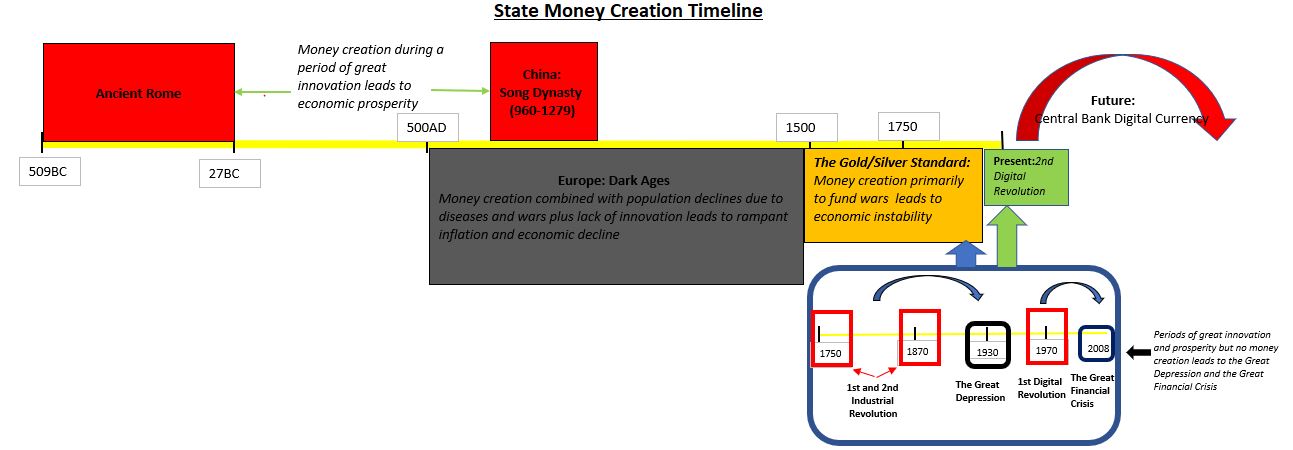
(Click to enlarge)

Indeed, inside vs. outside money creation is only a recent phenomenon (late 20th century) while state money creation had been the norm for the majority of human existence. And that’s the thing. Unfortunately, our current views of state money creation are really shaped by the most recent examples which had been disasters. For example, the Gold Standard came into existence to curb the rampant money creation to fund wars during the European Dark Age. In addition, that was a period without any major commercial innovations and characterized by population stagnation across Europe.

The late 18th and the 19th century, on the other hand, saw the 1st and 2nd Industrial Revolution which introduced new modes of production. The second half of the 19th century up to early 20th century was also characterized by a period of general peace (Pax Britannica). By then the great innovations of the previous two centuries were also commercialized. As a result of all this, Europe, in particular, became very prosperous.

Unfortunately, the existence of the Gold Standard, prohibited the state to issue enough money to correspond to the increased potential of economic activity. The Great Depression in the 1930s was thus characterized by a positive supply shock, on the back of these innovations, and a negative demand shock on the back of insufficient supply of the medium of exchange.

Early 20th century was probably the first time humanity was experiencing the fruits of progress on a basis similar in scale to the period of the Song Dynasty (960-1279) in China and the Roman Republic (509BC-27BC). Yet, policy makers failed to take full advantage of this by unnecessarily restricting the flow of money. It took a global war which destroyed/redirected a large part of Europe’s industrial capacity to re-address the imbalance between supply and demand.

Even then, policy makers, still did not take note that there was a paradigm shift in the late 1800s after the 1st Industrial Revolution, when a period of innovations massively shifted our economic potential much higher. While the developed world was slowly moving away from ‘scarcity’ and closer to ‘abundance’, they continued to operate from the basis that supply of resources is the bigger issue. The period from the end of the WW2 to the early 1970s continued to be characterized by a restrictive flow of money, the quasi gold standard. Luckily, it did take some time for capacity to come back on line after the war, so there were no major financial disasters.

In fact, it was quite ironical, that as soon as President Nixon decided to finally fully abandon the gold standard and introduce the age of fiat money, the world experienced a supply side crisis: due to problems in the Middle East, the supply of oil became restricted leading to a rise in inflation. This actually emboldened policy makers even further to focus on issues emanating from insufficient supply of resources and thus manage the demand side of the economy more closely to reflect that. The problem on the supply side, however, was short-lived, and as soon as the Middle East crisis subsided, oil started flowing back and ‘equilibrium’ ensued.

Nevertheless, even to the present day, our economic policy is still dictated by the mantra of supply side economics and inflation targeting.

Alongside these developments, the second half of the 20th century was also characterized by the start of the 1st Digital Revolution with the invention of the computer in the 1950s and its commercialization in the 1980s. Starting in the 1990s, globalization also took off. These developments boosted even further potential supply, while at the same time, money flow, despite no restrictions on actual money supply due to its fiat nature (but actual restrictions due to the separation of outside and inside money) continued to be restrictive.

These were the developments which led to the Great Financial Crisis in 2008, which, just like the Great Depression before, was characterized by a positive supply shock due to a burst of the commercialization of previous innovations and a negative demand shock due to insufficient money supply. The present time seems also to be the beginning of what could be called the 2nd Digital Revolution of AI and VR, which has the potential to even further increase our economic potential. Yet, when it comes to money creation, we are still operating with the mentality the Gold Standard: money is kept excessively restricted for fear of rising inflation.

In light of this, it could be worthwhile to point out that there were actually periods of successful state money creation in the past: Rome in the last five centuries BC and China between 10th and 13th century. Why did state money creation work back then? Three main reasons:

  • massive prosperity on the back of the commercialization of previous innovations,
  • a period of relative peace, and
  • a properly working institutional framework

It is important also to note that both in the beginning of the 20th century and now, all these three reasons above are present. If history is any guide, failure to supply the necessary amount of medium of exchange to ‘record’ this existing prosperity could lead to war, followed by disappearance of the economic prosperity, and in the worst possible scenario (did not happen during the Great Depression) the dismantling of the institutional framework. Or, if more recent political developments are any guide, could this time be different and the decline starts with the dismantling of the institutional framework, followed by war and the natural disappearance of prosperity?

To sum up:

  • state money creation is good when it is done within a solid institutional framework, and it follows (or is accompanied) by a positive supply shock brought about by previous innovations leading to economic prosperity (past examples: the Roman Republic, China during the Song Dynasty; no current examples);
  • state money creation leads to negative outcomes when it follows a negative supply shock brought about by war, natural population declines, or inadequate institutional framework (Europe during the Dark Age, the Gold Standard; more recent examples: Zimbabwe, Turkey, Argentina, etc.)

We can’t ignore SOFR (continued)

23 Friday Mar 2018

Posted by beyondoverton in Monetary Policy

≈ Leave a comment

Tags

Rates

  • People have been proposing a variety of reasons for the LIBOR-OIS spread continued widening. And majority of them make sense. My view is that we cannot discard the fact that the gradual replacement of Libor with the Secured Overnight Financing Rate (SOFR) is also playing a major role.
  • Unless you are actually directly involved in the Libor market, and there are only a ‘handful’ people left in it now, the larger investment community is not paying enough attention to these changes.
  • At the moment there are four eligible benchmark interest rates which can be used for hedge accounting purposes, as per FASB: UST, LIBOR, OIS (based on FFER), SIFMA Municipal Swap Rate. The Fed has requested that the OIS based on SFOR to be added to the list.
  • This is a big deal. There are $350Tn of worth of loan/bonds, etc. tied to Libor. And by 2021 Libor will be gone. From April 3, 2018, the Fed will start publishing Libor’s replacement, SOFR. Anyone involved in the Fixed Income markets better start to get ready.

Of course, LIBOR may remain viable well past 2021, but we do not think that market participants can safely assume that it will.  Users of LIBOR must now take in to account the risk that it may not always be published.

Jerome H. Powell, Roundtable of the Alternative Reference Rates Committee, November 2, 2017

  • The meaning of Libor may still be the same, but the significance of the way it is derived, has massively changed since the scandals of 2012, and now its relevance is about to fade: Libor is no longer reliable.

In our view, it would not be feasible to produce a robust, transaction-based rate constructed from the activity in wholesale unsecured funding markets.  A transactions-based rate from this market would be fairly easy to manipulate given such a thin level of activity, and the rate itself would likely be quite volatile.  Thus, LIBOR seems consigned to rely primarily on some form of expert judgment rather than direct transactions.  

Jerome H. Powell, Roundtable of the Alternative Reference Rates Committee, November 2, 2017

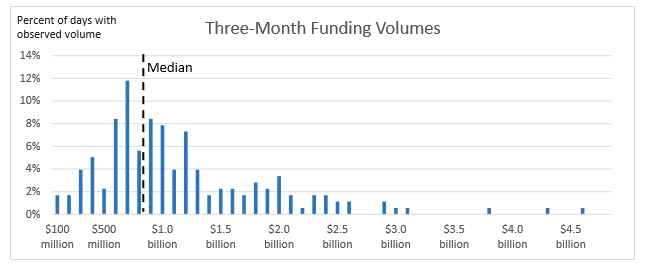
  • Today, there are 17 banks that submit quotes in support of Libor. Look at the distribution of daily aggregate wholesale dollar funding volumes for the 30 global systemically important banks: the median is less than $1 billion per day. On some days, there are less than $100 million.

  • SOFR is very different. To begin with, it is secured (UST collateral), it is only O/N and it is only transactional but volumes are massive (see below). Libor is unsecured, term and it is both transactional and ‘estimated’ (increasingly more the latter). SOFR is kind of a ‘pure’ GC rate.

  • SOFR is a good proxy for a risk-free rate. It could offer the broadest measure of dealers’ cost of financing Treasury securities O/N and, therefore, it could provide useful information regarding O/N demand and supply for funding in the UST repo market.
  • So, the market has three years or so to start converting $trillions worth of contracts which point now to Libor, to SOFR (some of them will just expire before that date). The problem is, because Libor is much higher than SFOR, the receiver of Libor on a legacy contract will require compensation in order to agree to the conversion.

  • There are just too many issues with this conversion. For example, how do you deal with current Libor contract which requires payments based on 3m Libor after the introduction of SFOR which is only O/N (CME will start trading future on SOFR in May)?


Now, however, market participants have realized that they may need to more seriously consider transitioning other products away from LIBOR, and the ARRC has expanded its work to help ensure that this can be done in a coordinated way that avoids unnecessary disruptions.

Jerome H. Powell, Roundtable of the Alternative Reference Rates Committee, November 2, 2017

  • When you need to settle floating rate coupons then you need to use OIS (based on SOFR), but there may not be that much (term) liquidity there at the beginning. You don’t want to be relying on this then if you are going to be converting trillion of $ of Libor.
  • Darrell Dufe proposes instead an auction and protocol based approach. Bottom line is that the LIBOR->SFOR conversion is a big thing in the markets and unless you dig in regulatory/compliance documents, very few people are discussing it.

The story of the year is not soaring Libor but emerging SOFR

22 Thursday Mar 2018

Posted by beyondoverton in Monetary Policy

≈ 1 Comment

Tags

Rates

  • So, apparently Morgan Stanley thinks “soaring Libor is the story of the year…”  I believe the story of the year is Secured Overnight Financing Rate (SOFR) which the Fed will start publishing April 3; LIBOR is going into the history books. I am not saying the widening of the Libor-OIS spread is related to this, however, I suspect so.
  • The widening of the Libor-OIS curiously coincided with the Fed’s initial announcement on SOFR in June’18, then again in towards the end of 2017 when it said it plans to start publishing SOFR in Q1’2018. It blew up finally, when it became clear that that date will be April 3.

  • Libor setting was always partially subjective even in the good old days pre-2008, especially longer-dated tenors; after 2008, with many banks withdrawing, it has become increasing less transaction-based.
  • According to the Fed, SOFR will be entirely transaction-based and it will be purely spot (O/N). This is a big divergence with the Libor-based structure. Has the market started to transition already?
  • For example, custodians need to move to new systems for calculating compound term coupons from spot because even though market makers will start to build systems to trade futures and forwards, that will take time as it also needs regulatory approval.
  • New debt products will reference SOFR, but existing ones must also have some reference to SOFR, especially longer-dated ones when Libor really becomes extinct in 2021. All this takes time as well, and, I suspect, it is not going to be that straightforward given the large legacy of Libor products out there.

A simplified version of the monetary transmission mechanism

23 Thursday Nov 2017

Posted by beyondoverton in Monetary Policy

≈ 2 Comments


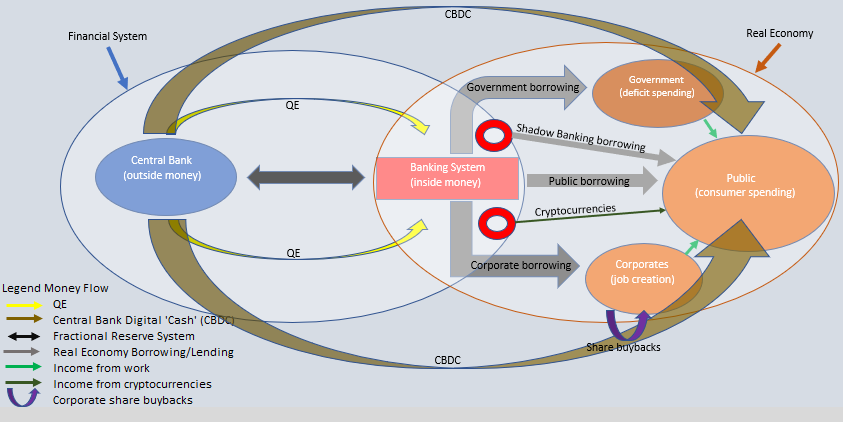
(Click to enlarge)

This is a follow-up on yesterday’s post which showed a simplified version of the hierarchy of money. This one dwells on why exactly the money supply is not reaching the end consumer and how this can be fixed.

The two main parts of the diagram are the financial system and the real economy. The financial system comprises all the main actors depicted in the “Hierarchy of Money”: the central bank, the banking system, shadow banks and cryptocurrencies. The link between the financial system and the real economy is the banking system (with the help, recently, of shadow banks and cryptocurrencies).

At the moment there is no direct way to ‘deliver’ safe assets from the central bank to the public. Everything has to go through the banking system which generates state-backed private money (the banks and the shadow banks) which then get lent to the public. Cryptocurrencies are a new addition to the financial system. Unlike the other actors, they generate private assets not backed by state money and, moreover, they can enter the real economy directly, not in the form of borrowing but in exchange for ‘work’ (the verification process) – which is what really makes them attractive to the other forms of money.

The process of QE is really a closed-loop within the financial system. All it does is swaps financial assets (mostly sovereign paper in the US and UK, some private assets in EU, and now a lot of private assets in Japan) for central bank reserves. The public does not get any benefit from QE directly. However, they do benefit from the lower rates of interest, thanks to QE, which the banks offer on borrowing (the downside being that demand for loans has decreased in the developed world after 2008 in general, and, moreover, banks are not that eager to extend new loans pressed by the recent regulations).

Within the real economy, there are generally two traditional ways to receive income: from corporates and from the government, in both cases in exchange for work. Working for the government had been on the rise before 2008 but with the push for austerity thereafter, this has slowed down. Corporate employment has remained stable but because of outsourcing abroad and especially because of technological automation of work, real wages have been stagnant for decades. Higher paid manufacturing jobs have been replaced by lower paid service jobs; full employment with benefits has been replaced by part-time employment without benefits.

In addition, corporates had been investing less and less in R&D and Capex, which in theory could have led to more employment. In fact, since 1982 when Rule SEC 10B-18 was introduced, corporate have preferred to engage in share buybacks.

So, one way for the public to replace the lost income from traditional employment has been direct borrowing from the banks. This is a phenomenon which started already in the 1980s with the financialization of the real economy. It really took off after the dotcom crisis when shadow banking offered cheap residential mortgages loans. After 2008, which marked the peak of the private debt super-cycle, this has also slowed down massively.

This opened the way for cryptocurrencies to fill in the void offering an alternative source of income – access to a seemingly safe private asset. Cryptocurrencies are a much riskier development than the shadow banking lending and if they are allowed to spread more widely within the real economy, they could lead to a much bigger financial crisis than 2008.

The economy cannot operate if all avenues which increase consumer purchasing power are either closed (Work≠Job≠Income) or they are becoming risky (direct borrowing from banks, shadow bank borrowing, cryptocurrencies). The public needs to be able to receive safe assets directly from the central bank (central bank digital ‘cash’) either in the form of discounted loans or even in the form of UBI.

← Older posts
Newer posts →

Subscribe

  • Entries (RSS)
  • Comments (RSS)

Archives

  • January 2023
  • December 2022
  • November 2022
  • August 2022
  • February 2022
  • April 2021
  • November 2020
  • October 2020
  • September 2020
  • August 2020
  • July 2020
  • June 2020
  • May 2020
  • April 2020
  • March 2020
  • February 2020
  • January 2020
  • December 2019
  • November 2019
  • October 2019
  • May 2019
  • March 2019
  • February 2019
  • January 2019
  • December 2018
  • November 2018
  • October 2018
  • September 2018
  • August 2018
  • June 2018
  • May 2018
  • March 2018
  • February 2018
  • January 2018
  • November 2017
  • October 2017
  • September 2017
  • August 2017
  • July 2017
  • June 2017

Categories

  • AI
  • Asset Allocation
  • blockchain
  • China
  • De-urbanization
  • Debt
  • Decentralization
  • EM
  • Energy
  • Equity
  • FX
  • g88kboy
  • Monetary Policy
  • Politics
  • Questions
  • Quotes
  • The last man standing will laugh
  • Travel
  • UBI
  • Uncategorized
  • VR

Meta

  • Create account
  • Log in

Blog at WordPress.com.

  • Subscribe Subscribed
    • BeyondOverton
    • Join 74 other subscribers
    • Already have a WordPress.com account? Log in now.
    • BeyondOverton
    • Subscribe Subscribed
    • Sign up
    • Log in
    • Report this content
    • View site in Reader
    • Manage subscriptions
    • Collapse this bar
 

Loading Comments...