• About
  • BeyondOverton Travel
    • Silk Road (1): If Turkey is in crisis, it’s not obvious visiting it
    • Silk Road (2): Could beautiful nature and ancient history create a false sense of entitlement?
    • Silk Road (3): Fast Car
    • Silk Road (4):We took a bus ride to Iran
    • Silk Road (5): Border bothers
    • Silk Road (6): Chevrolet Land
    • Silk Road (7): Free-roaming camels and wild horses
    • Silk Road (8): China West to East
    • Silk Road (9): I have not told half of what I saw
  • BLOG
  • g88kboy Travel
    • On the Silk Road
    • Bulgaria : The Chicken crossed the Road
    • Turkey : The Country, not the Bird
    • Georgia on my Mind
    • Armenian Ayran
    • Iran – The Curious Land
    • An American in Azerbaijan
    • Uzbekistan: Golden Teeth and Neon Signs
    • Kazakhstan: Thirty Sweating Seniors
    • China Part One – Pandas Are Extinct
    • China Part Two: My TED Talk (Deep Analysis)
    • Phillipines – They Relax, I (pretend to😉) Study
    • Singapore: flashing trees and a torrent of tears
    • Malaysia: That ain’t no croc, it’s a log
    • Brunei: The Instinctive Fight for Superior Domination
    • Phillipines: Hello Friend Again
  • Outside the window
    • Bulgaria
    • Turkey
    • Georgia
    • Armenia
    • Iran
    • Azerbaijan
    • Uzbekistan
    • Kazakhstan

BeyondOverton

~ let's move this window

BeyondOverton

Tag Archives: shadow banking

A look at shadow banking globally

19 Saturday Nov 2022

Posted by beyondoverton in Uncategorized

≈ Leave a comment

Tags

shadow banking

The spill-over from the crypto debacle recently was pretty much non-existent in public markets, largely because risk-on positions were relatively low (see my previous note), but also because crypto itself, even at its peak ‘capitalization’, is rather small relative to the other monetary aggregates, and is rather low in the overall hierarchy of money. I have written extensively on crypto before, how it (doesn’t) fit in the monetary transmission mechanism because it resembles shadow money, and why it is therefore not the future of money.

Rather timely in that sense, the Financial Stability Board (FSB) released last week a new report on the state of the non-bank, aka shadow bank, financial intermediation. The report itself is not particularly interesting but I took it as an opportunity to have an update on how financial assets are distributed intra as well as inter-country.

Bottom line is that despite being at the epicentre of the 2008 financial crisis and all the subsequent regulations introduced after that to ‘curtail’ it, shadow banking is still growing, especially in Europe, and in general outside of the US. If one were looking for a systematic risk to the system, it is not crypto per se, and it is still shadow banking.

How is this going to play out? Very general, shadow banking comprises all financial institutions without access to the central bank, i.e., without the cover of a lender of last resort. So, yes, crypto falls under that umbrella. And yes, it is crypto, or rather the tech behind crypto, which would eventually usher the solution – central bank digital currency (CBDC) which would allow direct access to a central bank balance sheet for pretty much everyone.

But that is unlikely to happen immediately now (too much wokeness about ‘privacy and liberty’ which completely misses the point about CBDC): we might have to go through another crisis to force our hands.    

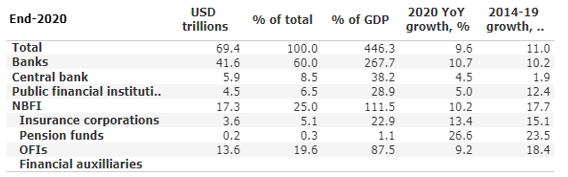
As of the end of 2020, there were $462.6Tn of financial assets globally. And this is how they were distributed:
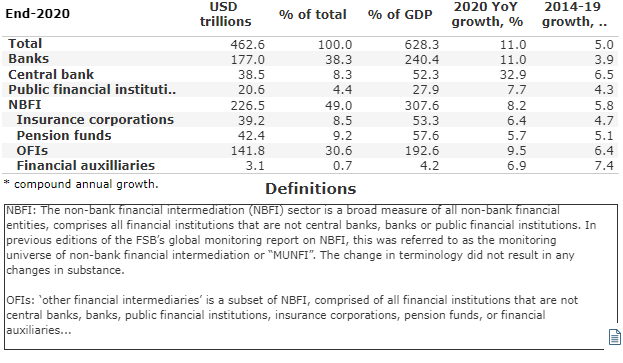
Roughly speaking, we can break column one into two subsections: traditional banking (Banks, Central bank, Public Financial Institutions) and shadow banking (Non-bank financial institutions=NBFI: Insurance corporations, Pension funds, OFIs=other financial institutions, Financial auxiliaries). As of 2020, the two comprised roughly a 50/50 split of the total with shadow banking catching up to traditional banking in the last few years (see the chart below, panel on the left).
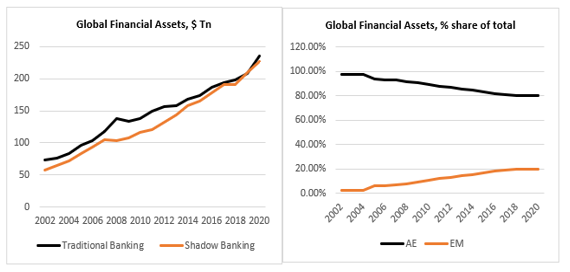
Within traditional banking the share of bank financial assets is little changed over time (down marginally since 2002), but the share of central bank assets has grown substantially at the expense of public financial institutions. Within shadow banking, the share of OFI has grown substantially at the expense of pension funds and insurance companies.

How are total financial assets distributed inter-country? The chart above (panel on the right) shows the breakdown between Advanced Economies (AE) and Emerging Markets (EM): while in 2002 EM comprised just 2% of the total, in 2020, they were up to 20%!

Within AE, shadow banking now dominates, rising from 45% of the total in 2002 to 54% in 2020 (see the chart below, the panel on the left): it seems that QE has favoured a built-up of assets there. On the other hand, traditional banking is still very much dominant in EM even though its share has fallen over the years: shadow banking’s share has risen from 17% of the total to 27% (right-hand panel).

While central bank activity in financial markets has risen in AE, from 3% in 2002 to 8% in 2020, it has declined substantially in EM, from 43% in 2002 to 10% in 2020 (see the chart below, panel on the left). And while the social safety net (pension funds, insurance corporations) share of total financial assets has been fairly stable in AE around 20%, it has declined in EM from 12% in 2002 to 7% in 2020 (panel on the right).

USA comprises a little more than a quarter of all global financial assets but one-third of the total shadow banking assets. The shares of traditional and shadow banking assets to total US financial assets are little changed over the years at 37% and 63% respectively. The share of the central bank financial assets has increased over the years from 2% to 6%.
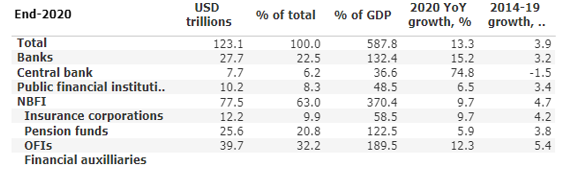
The Euro-area share of total financial assets is a bit less than a quarter of all global financial assets, but it has seen an explosion of shadow banking – its share of the total assets has risen from 20% to 51% since 2002. The share of the central bank financial assets has increased over the years from 4% to 12%.

Financial assets in Japan are about 10% of total global financial assets. Shadow banking in Japan is about 30% of the total financial assets in the country – and it has been fairly stable over the years. The share of the central bank financial assets has risen from 4% in 2002 to 16% in 2020.
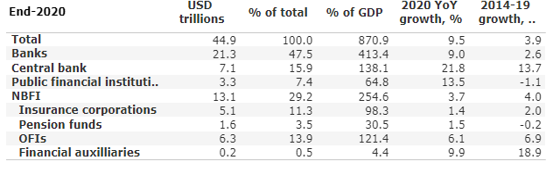
China overtook Japan as the third largest global centre for financial assets in 2013 and currently it comprises about 15% of all global financial assets. Shadow banking in China has risen from 4% in 2005 (that’s when proper data becomes available for China) to 25% in 2020 but it is still below the ones in the other major financial centres. China bucks the trend whereby its central bank assets as a share of total have fallen from 22% in 2005 to 9% in 2020. The social safety net in China is pretty much non-existent – there is no pension funds industry, for all intends and purposes, while the insurance corporations’ share of financial assets has barely moved, risen from 4% to 5% since 2007!
Cryptocurrencies and the monetary transmission mechanism

28 Friday Jul 2017

Posted by beyondoverton in Monetary Policy

≈ 1 Comment

Tags

blockchain, cryptocurrency, shadow banking

There is a bit of paradox between the advance of technology and the subsequent emergence of the “cashless” society, on one hand, and the rise in demand for physical cash in the developed world, on the other hand. This dichotomy can be explained, however, with the fact that the former has to do with “cash” as a unit of account/medium of exchange and the latter with “cash” as a store of value: while we use less and less physical cash for transactions because technology allows for alternative methods of payment, we demand more physical cash because interest rates are 0% (or even negative).

The emergence of the shadow banking system in the early 2000s and the rise of the cryptocurrencies post the 2008 financial crisis may have the same roots – the lack of or the unequal distribution of safe assets (USTs, physical cash, etc.). The response in the early 2000s was the creation of ‘fake safe’ assets within the shadow banking  system (subprime CDOs and the like), and now it is the creation of alternative ‘safe/blockchain’ cryptocurrencies. In both cases the free market is responding to the need for a genuinely safe asset available to everyone, but unfortunately delivering something different. Inequality does have a big role to play here (the ‘work->income’ channel being broken). But the authorities, probably inadvertently, also affected these processes: in late 1990s, the Clinton administration decided that it wanted to generate a budget surplus and reduced the issuance of USTs; post 2008, as part of QEs, the Fed took out of circulation a good chunk of USTs.

In other words the shadow banking system emerged and developed because the monetary transmission mechanism was not working properly – money was ‘siphoned’ out of the economic system as savings and financial investments and never found its way back. In the mid-1990s the shadow banking liquidity surpassed the traditional  monetary liquidity and by 2007 it was totally dominant. In an environment like this, the central bank was powerless to conduct monetary policy using the traditional mechanisms such as interest rates. Lehman Brothers was one of the main cogs in the shadow banking mechanism. Were the authorities blindsided by the fact that the bank was not a depository institution and thus it was safe to let it go as there will be no bank runs like in the 1930s? Nevertheless, Lehman Brothers’ failure produced a massive run on all shadow banking centers and thus total monetary liquidity collapsed. Even to this date, despite years of zero interest rates, and despite an increase in traditional liquidity, total liquidity is still barely above the level reached pre 2008 crisis because the shadow monetary liquidity is still decreasing.

So, we have these cryptocurrencies emerging and taking the place of the traditional monetary mechanism as a result. The idea of a cryptocurrency is similar to shadow money because it uses a private legal tender (‘fake safe’ money). It is digital cash but the electronic money that had existed before (for ex. credit and debit cards) were always denominated in the units of the sovereign currency (GBP, USD, USTs). However, it is revolutionary because it uses highly sophisticated blockchain technology (eliminating the need for intermediary and addressing the issue of trust) and because its digital format allows instantaneous dissemination.

Cryptocurrencies should be a massive headache for central banks because they are a direct competitor to their legal tender. Why some central banks are so eager to endorse them is a mystery to me. Authorities already have so little control over monetary policy that if they indeed allow cryptocurrencies to proliferate without the central bank’s control, the monetary transmission mechanism would be further jeopardized. In addition, cryptocurrencies are a direct competitor to the commercial banking model which uses the central bank’s legal tender in the process of creating its own ‘private’ money. At the moment the existing cryptocurrencies are used mostly as a store of value, but if more and more retail outlets start to accept them, they would begin to be used as a medium of exchange and unit of account.

However, a lot of central banks are also in the process of testing their own digital currencies (most of them are also blockchain-based). For example, in 2015 Ecuador was the first country to introduce its own digital cash after it had banned Bitcoin. If the central banks allow the public, and not just a select group of financial institutions as it is the system now with central bank reserves, to have direct access to this form of legal tender (the so-called Chicago Plan), then that would be truly a revolutionary monetary policy turn.

Subscribe

  • Entries (RSS)
  • Comments (RSS)

Archives

  • January 2023
  • December 2022
  • November 2022
  • August 2022
  • February 2022
  • April 2021
  • November 2020
  • October 2020
  • September 2020
  • August 2020
  • July 2020
  • June 2020
  • May 2020
  • April 2020
  • March 2020
  • February 2020
  • January 2020
  • December 2019
  • November 2019
  • October 2019
  • May 2019
  • March 2019
  • February 2019
  • January 2019
  • December 2018
  • November 2018
  • October 2018
  • September 2018
  • August 2018
  • June 2018
  • May 2018
  • March 2018
  • February 2018
  • January 2018
  • November 2017
  • October 2017
  • September 2017
  • August 2017
  • July 2017
  • June 2017

Categories

  • AI
  • Asset Allocation
  • blockchain
  • China
  • De-urbanization
  • Debt
  • Decentralization
  • EM
  • Energy
  • Equity
  • FX
  • g88kboy
  • Monetary Policy
  • Politics
  • Questions
  • Quotes
  • The last man standing will laugh
  • Travel
  • UBI
  • Uncategorized
  • VR

Meta

  • Create account
  • Log in

Blog at WordPress.com.

  • Subscribe Subscribed
    • BeyondOverton
    • Join 74 other subscribers
    • Already have a WordPress.com account? Log in now.
    • BeyondOverton
    • Subscribe Subscribed
    • Sign up
    • Log in
    • Report this content
    • View site in Reader
    • Manage subscriptions
    • Collapse this bar
 

Loading Comments...