Not all debt is created equal

Following up from a previous post which looked at a breakdown of US debt, here are my thoughts on a more general framework of assessing a country’s debt vulnerability.

I suggest we look at debt along the lines of debt sustainability (private vs public) and sovereignty (foreign vs domestic). Everything else being the same, in terms of the ability of repayments, public debt is better than private debt, and domestic debt is better than foreign currency denominated debt. This is because it is possible to monetize the debt in the former (public and domestic), while not (directly) possible in the latter (private, foreign).

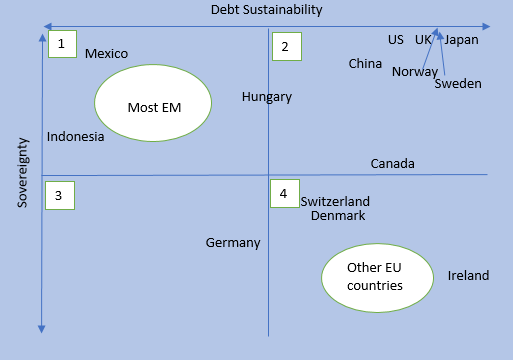
In the diagram below as one moves from left to right on the horizontal axis the country’s debt sustainability becomes worse; on the other hand, as one moves from top to bottom on the vertical axis, the country is deemed less sovereign (less able to monetize its debt).

(Data source to construct the diagram: BIS on private and public domestic debt, BIS/IMF/OECD/WB on foreign/external debt)

Therefore, one can discern the worst possible combination as being private and foreign debt (Quadrant 4 in the diagram above). An example of that would be Asian corporates/countries in the 1990s: because the countries had a pegged exchange system, i.e. they were not fully sovereign, even the domestic public debt would have been considered ‘foreign’, i.e. no monetization was possible. This, of course, led to the Asian crisis in 1997/98. On the other hand, the best possible combination is a sovereign country with mostly public and domestic debt. Actually, a lot of those same Asian and other emerging market (EM) countries now fall in this category (Quadrant 1). Even though, some of these countries still maintain a ‘dirty’ float, for example Indonesia (therefore not completely sovereign), their debt level is not only much smaller than before but it is also much smaller than a lot of the developed market (DM) countries. In addition, most of the EM countries have very little foreign debt.

Most of EU countries not only have a lot of private debt but they are also not sovereign because they are dependent on the ECB for monetization. In a sense, they all have only ‘foreign’ debt as their central bank is not allowed to create money and monetize. I have put Germany a bit higher than the rest of the EU countries simply because of its deemed influence on the ECB. However, Germany does have much less debt than most of the other EU countries, therefore, it is to the left of them. Actually, because the ECB ‘monetization’ came way too late, we had the EU sovereign crisis of 2011/12. And it was a sovereign (public debt) crisis for some countries directly because they had too much public debt (Greece, Italy) and for some it was indirectly because they also bailed out the private sector first (Ireland).

Japan has a lot of both private and sovereign debt but it is only domestic and the country is fully sovereign. Both US and UK have a lot of private debt but not as much public debt like Japan. However, just like Japan, their overall debt is mostly in their domestic legal tender, so they are fully sovereign.

China is a special case and it requires its own separate blog post. Suffice to say that it has a lot of ‘private’ debt in a foreign currency. However, it also has very little public debt and massive foreign currency reserves. Therefore, in theory, China can deleverage much easier the private debt (which is, actually, ‘quasi-public’ in many cases) by leveraging the sovereign – much easier than the way US, UK or EU had done during their own crises recently, or, in fact, Japan’s in the 1990s. China’s government balance sheet is cleaner in a way.

When it comes to debt vulnerability EM fairs much better than DM in general.

China’s belated move to ban ICOs could actually push token prices higher…

…in the short term as the supply of new tokens becomes restricted, and if demand stays the same. However, further regulations are more likely to take prices lower. Down the line, I would not be surprised if some tokens disappear completely.

To a certain extent, the crypto-mania now reminds me of the dotcom mania in the late 1990s. Both of them have an underlying cause that justifies their rise. In the case of dotcom it was the beginning of the digitalization of society (new ways to connect, work and entertain) and the promise of the commercial internet (new way to shop!). In the current crypto-currencies craze, the underlying cause is the scarcity of money, stemming from the rise of inequality on the back of the breakdown of the Work=Job=Income model, and the following promise of creating the new medium of exchange using a totally different framework (i.e. if we cannot get  the medium of  exchange by having a job, and it the central banks would not print the medium of exchange and  distribute it to the population at large, the population at large will create its own medium of exchange).

I know bitcoin, for example, is down 12% from the announcement of the ban on ICOs. That’s still less than the last time, in March this year, when PBOC also announced it was looking into tightening regulations on bitcoin trading. But that’s beside the point. One could say the most recent news is, actually, more important.

And it is indeed more likely that as the authorities start introducing even more regulations on crypto-currencies, their prices will become … less volatile but also settle down in a lower range. After all, without regulations, and without an underlying businesses per se, crypto-currencies currently do have an advantage over other regulated asset classes. But, strictly speaking, from a flow perspective, restricting the supply of an asset, should make its price go up, if demand is unchanged. The fact that new ICOs are not allowed should make the existing tokens more valuable.

Of course, that is only a short-term view, which does not take into account the possibility of further regulatory actions. It is surprising to me that it has taken such a long time for authorities to start looking into these ICOs and also, in general, into the spread of crypto-currencies, given that the latter are a direct threat to their own legal tender. In fact, there is confusion globally as to what indeed those crypto-currencies are. Are they an asset, a currency, or legal tender? Not only different countries have different definitions but in some countries the definitions vary depending on the regulatory authority even!

For the current crypto-mania to subside we do need to see central banks introducing their own digital legal tender accessible to everyone in society (and not just to banks and other select financial institutions as is the case now with central bank reserves). In other words, authorities need to address the underlying cause of the spread of the crypto-currencies. All other measures would most likely only temporarily slow-down their rise.


It should be abundantly clear by now, but let me state it here, that this blog does not constitute an investment advice. And I have no positions in any crypto-currencies/tokens.

US student loan debt increase: dramatic but not a systematic financial concern

Summary

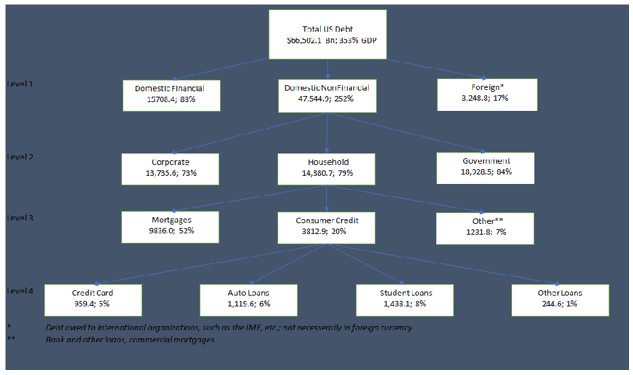
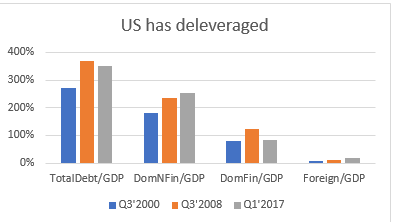
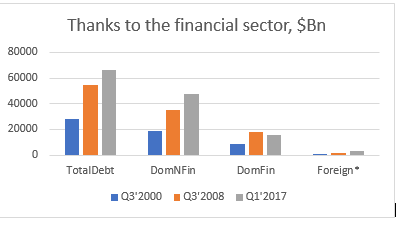
  • Even though total US debt is up in nominal terms since the 2008 financial crisis ($54.7Tn vs $66.5Tn), total debt as a % of US GDP is down (368% vs 353%)
  • It is the financial sector that has deleveraged both in nominal terms and as a % of US GDP ($18.2Tn vs $15.7Tn and 122% vs 83%, respectively)
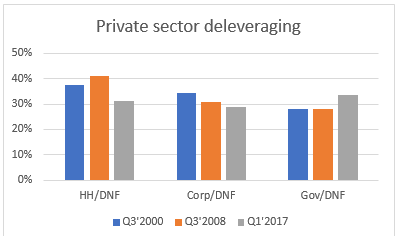
  • Of the nonfinancial sector private debt holders, households have deleveraged relative to GDP (97% vs 79%), while business have leveraged but only from 72% to 73%, even though both of their nominal debt levels have gone up ($14.3Tn vs $14.9Tn and $10.7Tn vs $13.7Tn).
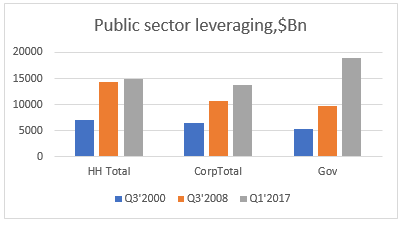
  • The public sector (federal and state government) has leveraged both in nominal terms (the overall debt levels have doubled from $9.8Tn to $18.9Tn) and relative to GDP (66% vs 84%)
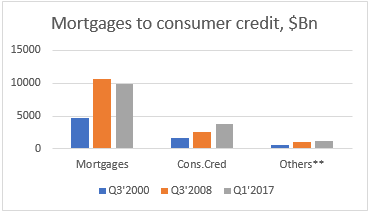
  • Households have reduced their mortgage debt from $10.7Tn to $9.8Tn, while increased their consumer credit debt from $2.6Tn to $3.8Tn
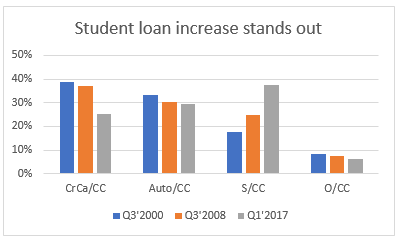
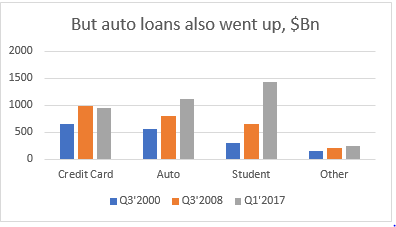
  • Out of consumer credit, households reduced marginally their credit card debt ($983Bn vs $959Bn), increased their auto loans ($802Bn vs $1.1Tn) and more than doubled their student loans ($659Bn vs $1.4Tn)
  • The media and some financial analysts are focusing on these latter increases in auto and student loans as a sign that households are increasingly leveraging again, however, the reality is that a large part of the increase in consumer credit debt is offset by the decrease in mortgage debt
  • In addition, neither student (8% GDP) nor auto (6% GDP) – nor the two combined – have the systematical and strategic significance of mortgage debt which was the cause of the 2008 financial crisis (72% of GDP at the time)

Charts and details

There is a lot of confusion sometimes when it comes to analyzing debt. From a macro point of view there are two main distinctions: private (household and businesses) vs public (sovereign) and domestic (denominated in the sovereign currency) vs foreign (foreign currency). The distinction above is important because for a fully sovereign country it is the private and foreign debt that one should be really concerned about.

The public sovereign debt can always be repaid because the sovereign can print the currency at will, even though in extreme cases that may mean currency devaluation and possibly hyperinflation. The private domestic borrowers have no choice but to find means of acquiring the legal tender to repay the debt. However, in some extreme cases, as in during the 2008 financial crisis, the sovereign can choose to bail the private sector out (the financial sector in this case) by resorting to creating currency ‘ex nihilo’.

Neither public nor private foreign borrowers (i.e. entities which have borrowed foreign currency) can resort to such privilege and, just like the private domestic sector, have to find means to obtain the foreign currency to repay their debt. Again, sometimes in extreme cases, as in during the Greek crisis, international institutions can choose to bail out the sovereign foreign borrower. This normally happens after the sovereign foreign borrower has first bailed out a private foreign borrower in their own country (as it happened for the financial sector in Portugal, Ireland and Greece during the European sovereign crisis).

Here I focus on US domestic nonfinancial debt, i.e. both public as well as private but denominated in the sovereign legal tender. Here is a big picture view of that debt:

(Click to enlarge for a better view)

The numbers above are the latest available (Q1, 2017) from the US Fed Z1 Flow of Funds Report. All the data in this note are sourced from the above report. In the analysis below, which uses the above diagram as a basis, I have chosen to look at the relevant debt levels now as well as just before the 2008 and 2000 US crises.

Level 1 Analysis:

Relative to GDP, the US has deleveraged, even though the domestic non-financial sector has continued to leverage.

However, the US financial sector has deleveraged in nominal terms as well, which is quite extraordinary indeed.

Level 2 Analysis:

Here we drill down the US domestic non-financial sector debt. Relative to the overall domestic non-financial sector total debt, both households and the corporate sector have deleveraged.

It is the government (mostly the federal government) which has continued to leverage. Public sector debt has more than doubled since 2008 and almost quadrupled since 2000. But as per the above, even though the increase of public sector debt is an issue (see Japan), it is not a systematic issue (again, see Japan). Our concern is drilling further into the private debt story, more specifically the household sector.

Level 3 Analysis:

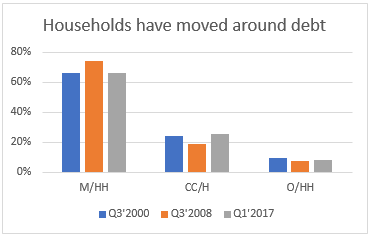
Mortgage debt as a % of overall household debt has decreased at the expense of consumer credit. The polar opposite of what happened between the 2000 and 2008 crises.

But in nominal terms, between 2000 and 2008, both mortgage debt and consumer credit debt increased (and mortgage debt more than doubled from $4.7Tn to $10.7Tn). That is why the 2008 financial crisis was so massive. Still, what is causing the increase of consumer credit debt?

Level 4 Analysis:

It seems out that the media, etc. does have a reason to focus on the ‘extraordinary’ rise in student loans, especially when they hit, and surpassed, the trillion dollar mark. Relative to overall household consumer credit, student loan is the only item which has increased.

In nominal terms, auto loans also surpassed the trillion dollar mark, but it is nevertheless the sheer increase in student loans which has captured the attention. Perhaps, there is much more to the student loan story than the financial implications. There is also the moral/emotional side of the fact that the cost of education has increased disproportionally to what it can offer in terms of advantages in the job market in the age of the sophisticated machine. While it is still true that a person with a higher education would generally fair better professionally, there must be a heavy discount to the fact that this person would have to also pay down the student debt which he/she acquired in the process. Once we draw the line, who is better off?

There is no doubt though that there is little in the above numbers to be concerned from a systematic point of view. At least relative to previous financial crises. A collapse of the student loan market would certainly affect consumer confidence and economic growth but it is unlikely to have the same catastrophic effect as the mortgage crisis of 2008.

Corporate vs. state UBI

It has been amusing to observe how people keep have been getting Japan wrong throughout the years, both fundamentally, when it comes to society’s structure and wealth, as well as asset price-wise.

For example, the widow-maker’s trade: betting on higher JGB yields ‘for ever’ not realizing the power of technology to create superfluous extra (surplus) capital and labor in peace time. In fact, if one thinks of the famous hockey stick chart of human progress (also the chart used by Kurzweil to show Singularity), the chart of global developed markets sovereign yields going back centuries has a similar shape but in the opposite direction: steep and high 2000 years ago to flat and zero now. You could say, the higher the “culture” the lower the yield.

Similar for stock prices: people have been betting on higher stock prices not realizing the Japanese corporates’ eroding profitability due to the hidden cost of BS jobs and corporate Universal Basic Income (both represented in the low unemployment figures, see below).

Demographics plays a very small role in GDP because as society progresses labor’s utility in the production function has greatly diminished at the expense of technology.  It is not that dissimilar on the consumption side either. In the post-consumerism (increasingly digital) society that we live in, the young are consuming even less material things (the ones that matter for GDP) than the old. In Japan specifically, demographics has long ago stopped to matter.

Productivity, on the other hand, is a function of both labor and technology. We can very easily increase productivity when we substitute labor with technology. We have chosen to do the opposite, despite plenty of advances in technology, however, because we do not have an alternative method of distributing wealth rather than Work=Job=Income. In fact, if we choose to increase productivity right now while using the same old method of wealth distribution, inequality will rise even more.

Demographics and productivity are basically remnants of the old industrial model of classical economics – the same model which only looks at how to increase GDP without regard to human wealth being (again, it is very easy to increase GDP if that is our goal but that does not mean society would be better off).

Japan’s GDP per worker (i.e. a much narrower definition than GDP per capita) is and has been actually higher than the equivalent in the US during Japan’s supposedly lost decades (and that is despite a very slow adoption of technology – slower than what it could have been given an alternative wealth distribution method).

I can see a lot of similarities between how Japan has decided to structure its society and how some rich oil countries in the Middle East have done the same. Japan uses technology and the corporates to distribute wealth, while in the Middle East, is the state distributing and the source of wealth is abundant oil (note, there is a similar UBI mechanism also in Alaska and Norway).

There are numerous other UBI experiments going on in many different countries and cities. I wonder if the fact that society is very homogeneous in Japan and the Middle East help with UBI being more accepted: here I mean the right to citizenship being very strict and narrow. For example, in the Middle East, where technology is not so well advanced yet, it is foreigners who do most of the everyday jobs; Japan could easily use more robots to do the work. In both cases, only citizens would receive, unconditionally, the benefits of (someone else’s) labor and the spoils of technology or the luck of natural resources.

I am struggling to reconcile this new reality with the idea that in the past immigration and an open society have greatly contributed to human advancement by allowing for diversity and the free dissemination of knowledge. Now open borders seem to be a hurdle for any county which wants to introduce this new model of wealth distribution. In addition, ideas disseminate much easier due to the Internet and open source also allows anyone to benefit from new inventions.

Oil (and all natural resources) are finite, while demographics means Japan is slowly running out of people to employ. None of this is a problem if the Middle East invests its substantial wealth in labor saving technologies (and constantly innovates) or if Japan changes it wealth distribution model. Is a country a free rider if it chooses to close its borders and take care only of its own citizens? What is the right model to structure society so that it works for everyone not just for only a small number of countries?

Blockchain as a trust bearer: from evolution in the developed world to revolution in emerging markets

Trust is at the core of human relationships. If we do not trust each other, it makes it difficult for us to cooperate and ‘build’ something together. Thus, progress does not happen (or it takes much longer for it to materialize). In the context of economic transactions, maintaining trust takes time and is costly as it requires the build-up a complex system of ‘middlemen’. By creating a secure, digital, distributed and decentralized database, blockchain is simply the latest, and most efficient, bearer of trust in an evolutionary cycle.

In the past when humans lived in small communities, trust was ‘easier’ to maintain as people knew each other well. For example, if I was luckier hunting than you one day, I could ‘afford’ to give some of my kill to your family trusting that you would do the same when a similar opportunity arises another time.

(Moreover, there was no upside to keep it all for oneself as, most likely, it would have rotten. In a sense, amidst the scarcity prevalent in these primitive societies, there was a momentary ‘lapse’ of abundance which possibly was at the base of people being so generous and cooperative in the first place. This simple observation raises profound questions about our human nature but this is not the time for such a philosophical diversion).

In this transaction, there was an exchange of real goods against the ‘unwritten’ promise of the opposite transaction at some point in the future. In essence, the lucky hunter was ‘gifting’ his unused part of the kill to the other party. Trust in this case worked because 1) we, cumulatively, remembered about the past transaction; 2) there was a huge cost of no-cooperation and thus loss of trust.

As the tribe expanded, these two conditions could easily be broken as our memory is fragile by nature. If in the past, the transaction simply took place between two people, now that was not possible without a third party, a middleman, ‘guaranteeing’ its credibility. The chief of tribe, for example, by the mere existence of his (it was mostly a male!) status was such a trust holder/verifier in those early days. But he could also forget and he could also intentionally misrepresent the past (scarcity of resources opened up the possibility of corruption).

One way around that was to start keeping track of the past transactions, the original ledger: that could be done either in physical format (sticks in a corner) or ‘written’ format (tallies in the dirt). This process did not last long as people, of course, figured ways to tamper with these early ledgers. The next natural step, therefore, was to find a more solid ‘ledger’, one which was more difficult to alter: what if we use very heavy, unmovable/undeletable objects instead? The Yap stones are a good example of this early form of trust.

As ‘society’ evolved, people branched out of their tribes and encountered others from foreign places with whom they wanted to interact. It was increasingly more difficult, however, to establish and maintain trust between two strangers: the transaction ‘ledgers’ they kept could have been different; the heavy, unmovable objects they could have used to record/‘verify’ their transaction, hugely impractical for people on the move. That is probably how the concept of ‘money’ as an exchange first appeared: when strangers meet and the risk of lost trust is great, we needed a revamp of the traditional exchange system. Debt and gifts require reciprocity which is not easy with strangers.

To paraphrase, it is much more pertinent to think of ‘evil’ as the source of all money, rather than the other way around.

Thus, the need for standardization arose as the concept of value became much more subjective. It was at this point that precious metals picked up the baton of trust holders/ledger keepers. “Precious” as in the sense of scarce, difficult or impossible to forge and easy to carry around. This gold system lasted for centuries supported by a framework of trust bearers, the kings and queens, breaking only temporarily a few times in history (i.e. under the Roman Republic and the Ming dynasty in China). Noteworthy is the set-up experimented in a few Italian city states during the Renaissance, which put in place the beginnings of the modern accounting system and the possibility of trust resting entirely on an institutional framework devoid of gold. This became a permanent feature, eventually, in the 1970s after the break-up of the Bretton Woods system.

Thereafter, economic trust has been maintained entirely by institutions like central banks. This trust was put in question after the 2008 financial crisis. This is when blockchain came into existence and has since slowly been establishing itself as the next bearer of trust in the cycle. Therefore, we could say, it is less revolutionary than evolutionary. By converting dispersed analogue information in a ‘all-in’ digital format, blockchain allows for the creation of a massive encrypted and secure database. Blockchain increases the efficiency of the trust system disproportionally to any other previous set-up.

At the moment, we may not trust the data we have been presented with in a transaction and would need middlemen to verify it by double-checking existing information. By storing all previous transactions, and the data that goes with them, in a distributed and decentralized database (without a central authority, tampering with it becomes more complicated), the blockchain mechanism, in effect, gets rid of these middlemen. For example, once all the information on a house is on the blockchain (has been verified once), it does not need to be verified every single time the house is sold/bought in the future. In addition, only new, incremental information needs to be verified.

Blockchain standardizes trust. It is interesting how recent commentators have compared Bitcoin with gold. Indeed, they both carry ‘information’ we can trust without question (especially when we transact with ‘strangers’ – which is now everybody in this time and age). Yes, blockchain is the same as the gold of the past – easy to ‘carry on’ and secure to exchange between two strangers from different ‘tribes’. Unlike gold, though, this trust is based not on physical properties (scarce, unmalleable, etc.) but on the evolution of our institutions which have allowed the technological progress we have experienced.

The digital world has no boundaries (for now). While we are questioning the merits of globalization at the moment, and whether this process is in reversal, such digital standardization in one country can easily spread across the world. Blockchain could thus actually speed up globalization and, therefore, substantially improve the prospects of some developing countries. Emerging markets assets have generally traded at a discount to their equivalents in the developed world, partially because of the huge institutional gap between the two.

Intrinsic value is indeed subjective but given certain assumptions can be modelled. The issue is that in emerging markets the assumptions can change literally overnight. In addition, there is the question of legal ownership, etc. For example, engaging in an exchange in a country with inadequate legal or executive system, where information is not readily available or cannot be trusted, is prone to be much more difficult and thus would require a substantial margin of safety. If indeed blockchain transforms the institutional framework of the emerging market world, it would not only raise asset prices there but, in the process, it could also accomplish what numerous NGOs and millions of financial aid money have failed to do in the past: make people accountable and subsequently raise everyone’s living standards.

Moreover, the lack of such trust legacy systems (fewer vested interests) in those countries may actually prove to be a positive development, as it could make it easier for some emerging markets to adopt the blockchain faster than developed markets. After all, there are plenty of examples where some developing countries leapfrog the developed world in adopting new technologies (i.e. skipping the evolutionary cycle completely – for example, mobile phones without first going through fixed phone lines; mobile banking without a bank account, etc.). In this sense, while in the developed world the trust system is slowly being updated through blockchain, this same process could be truly revolutionary in the developing world.

How the optimists blew up the universe

All technology revolutions need a breakthrough in three factors to succeed: energy, transport and communications (see Jeremy Rifkin’s work on this). The most plausible argument against AI reaching overall human-like capabilities could be energy availability. I don’t think we have the energy system required to accommodate such a massive explosion of AI. Organic systems, like the human brain, are still the most energy efficient systems present.

However, we, humans are flawed by nature. And this is good. I think limited intellectual capability exists for a reason. The fact that there is some kind of natural upper limit to human IQ/intelligence is an essential requirement for our survival as species: any system needs an OFF switch (natural or artificial) as part of its in-built safety design. Therefore, we may never reach Singularity, or we may reach an adverse form of Singularity, which in the process of optimization to reach its perfection state, self-destroys.

For all we know, this might have happened already in the past. The energy requirements to carry on the task of optimization are so large that this intensity creates a black hole which sucks in not only the Earth but also the whole Solar System. The only way humans are able to survive such a scenario event is to exit the Solar System just before the process of self-destruction. It must be humans, in organic form, exiting, for they must make sure that they preserve their imperfections as the only hope for future survival (a perfect trans-human or an AI-equipped machine would simply carry on with the process of optimization and eventually reach a similar event).

With the knowledge on hand, these humans do not search for a habitable planet but simply create a biosphere on the first available planet they encounter. Then they proceed to recreate our world – the proverbial Garden of Eden – under one main condition: “never bite from the tree of knowledge” for fear of a repeat of the above scenario again. And again, and again, the process keeps repeating itself…

The universe, therefore, has to be expanding all the time because, if not, these black hole explosions will eventually destroy it all. In other words, humans are just planet-hopping imperfect organic forms who, in search of perfection, leave nothing but black holes behind them. Long live the pessimists!

Stanisław Jerzy Lec

  • Before we conquer deep space let’s try to bridge inter-human space.
  • You have broken the wall of your cell with your head. What are you going to do in your neighbor’s cell?
  • Maybe your God wants you to boast about him in front of all other gods.
  • Cannibals using fork and knife – is this progress?
  • Everyone is an actor but is there a script for everyone?
  • The peak of human morals: moving-prisons for nomads.
  • Once again, I will start from the beginning, but before that, how do I end?
  • How does the wind know which way to blow?
  • The ultimate nightmare: bureaucracy takes over the country after it has eliminated ignorance.
  • I welcome all thoughts that prevent me from thinking.
  • I was forced to use wings as I was thrown out of the airplane without a parachute.
  • I prefer “Entry forbidden” to “No entry”.
  • I do not agree with math: the sum of zero is a humongous number!
  • Some leaders would cut the hands of their citizens if they did not need them to clap.
  • I was dreaming of reality. I woke up relieved.
  • Do not turn your back on reality? How is this possible if reality surrounds us everywhere.
  • Can the devil tempt me in believing in God?
  • If you want to climb high, you have to fold your wings.
  • Humans: live before it becomes fashionable to do something else.
  • Be careful dramatizing your life – what if there is a better actor for your part?
  • Be careful when fame shines on you. Your enemies are the ones hiding in the shadow.
  • Don’t waste the energy accumulated from going down the slope.
  • If there is no precedent that’s also a precedent.
  • The first condition of immortality is death.
  • Can you make up lack of talent with character?
  • Many things were not created because of the impossibility of them being named.
  • The fact that he died is not proof that he lived.
  • When you think about it, the same fire which Prometheus stole from the gods was used to burn Giordano Bruno.
  • As we get closer to the truth, we move away from reality.
  • If you want to get to the source, you must swim against the current.
  • Some people want to believe in the things they understand; others want to understand the things they believe in.
  • His conscience is clear as it has never been used.
  • Usually, the exit is where the entrance was.

Cryptocurrencies and the monetary transmission mechanism

Tags

, ,

There is a bit of paradox between the advance of technology and the subsequent emergence of the “cashless” society, on one hand, and the rise in demand for physical cash in the developed world, on the other hand. This dichotomy can be explained, however, with the fact that the former has to do with “cash” as a unit of account/medium of exchange and the latter with “cash” as a store of value: while we use less and less physical cash for transactions because technology allows for alternative methods of payment, we demand more physical cash because interest rates are 0% (or even negative).

The emergence of the shadow banking system in the early 2000s and the rise of the cryptocurrencies post the 2008 financial crisis may have the same roots – the lack of or the unequal distribution of safe assets (USTs, physical cash, etc.). The response in the early 2000s was the creation of ‘fake safe’ assets within the shadow banking  system (subprime CDOs and the like), and now it is the creation of alternative ‘safe/blockchain’ cryptocurrencies. In both cases the free market is responding to the need for a genuinely safe asset available to everyone, but unfortunately delivering something different. Inequality does have a big role to play here (the ‘work->income’ channel being broken). But the authorities, probably inadvertently, also affected these processes: in late 1990s, the Clinton administration decided that it wanted to generate a budget surplus and reduced the issuance of USTs; post 2008, as part of QEs, the Fed took out of circulation a good chunk of USTs.

In other words the shadow banking system emerged and developed because the monetary transmission mechanism was not working properly – money was ‘siphoned’ out of the economic system as savings and financial investments and never found its way back. In the mid-1990s the shadow banking liquidity surpassed the traditional  monetary liquidity and by 2007 it was totally dominant. In an environment like this, the central bank was powerless to conduct monetary policy using the traditional mechanisms such as interest rates. Lehman Brothers was one of the main cogs in the shadow banking mechanism. Were the authorities blindsided by the fact that the bank was not a depository institution and thus it was safe to let it go as there will be no bank runs like in the 1930s? Nevertheless, Lehman Brothers’ failure produced a massive run on all shadow banking centers and thus total monetary liquidity collapsed. Even to this date, despite years of zero interest rates, and despite an increase in traditional liquidity, total liquidity is still barely above the level reached pre 2008 crisis because the shadow monetary liquidity is still decreasing.

So, we have these cryptocurrencies emerging and taking the place of the traditional monetary mechanism as a result. The idea of a cryptocurrency is similar to shadow money because it uses a private legal tender (‘fake safe’ money). It is digital cash but the electronic money that had existed before (for ex. credit and debit cards) were always denominated in the units of the sovereign currency (GBP, USD, USTs). However, it is revolutionary because it uses highly sophisticated blockchain technology (eliminating the need for intermediary and addressing the issue of trust) and because its digital format allows instantaneous dissemination.

Cryptocurrencies should be a massive headache for central banks because they are a direct competitor to their legal tender. Why some central banks are so eager to endorse them is a mystery to me. Authorities already have so little control over monetary policy that if they indeed allow cryptocurrencies to proliferate without the central bank’s control, the monetary transmission mechanism would be further jeopardized. In addition, cryptocurrencies are a direct competitor to the commercial banking model which uses the central bank’s legal tender in the process of creating its own ‘private’ money. At the moment the existing cryptocurrencies are used mostly as a store of value, but if more and more retail outlets start to accept them, they would begin to be used as a medium of exchange and unit of account.

However, a lot of central banks are also in the process of testing their own digital currencies (most of them are also blockchain-based). For example, in 2015 Ecuador was the first country to introduce its own digital cash after it had banned Bitcoin. If the central banks allow the public, and not just a select group of financial institutions as it is the system now with central bank reserves, to have direct access to this form of legal tender (the so-called Chicago Plan), then that would be truly a revolutionary monetary policy turn.

Will decentralization lead to de-urbanization?

Tags

,

Army (3500 BC): walled city -> Navy (1210 BC): walled city -> Air Force (early 20th century): walls provide no security; in fact, institutional and physical infrastructure concentration reduces security rather than increases it -> Cybersecurity (early 21st century): decentralized security essential as centralization runs the risk of total destruction. Will the trend of decentralization spurred by the advances of technologies like the blockchain, for example, speed up the process of de-urbanization in the developed world? Can technology also start to reverse the developing world urbanization?