• About
  • BeyondOverton Travel
    • Silk Road (1): If Turkey is in crisis, it’s not obvious visiting it
    • Silk Road (2): Could beautiful nature and ancient history create a false sense of entitlement?
    • Silk Road (3): Fast Car
    • Silk Road (4):We took a bus ride to Iran
    • Silk Road (5): Border bothers
    • Silk Road (6): Chevrolet Land
    • Silk Road (7): Free-roaming camels and wild horses
    • Silk Road (8): China West to East
    • Silk Road (9): I have not told half of what I saw
  • BLOG
  • g88kboy Travel
    • On the Silk Road
    • Bulgaria : The Chicken crossed the Road
    • Turkey : The Country, not the Bird
    • Georgia on my Mind
    • Armenian Ayran
    • Iran – The Curious Land
    • An American in Azerbaijan
    • Uzbekistan: Golden Teeth and Neon Signs
    • Kazakhstan: Thirty Sweating Seniors
    • China Part One – Pandas Are Extinct
    • China Part Two: My TED Talk (Deep Analysis)
    • Phillipines – They Relax, I (pretend to😉) Study
    • Singapore: flashing trees and a torrent of tears
    • Malaysia: That ain’t no croc, it’s a log
    • Brunei: The Instinctive Fight for Superior Domination
    • Phillipines: Hello Friend Again
  • Outside the window
    • Bulgaria
    • Turkey
    • Georgia
    • Armenia
    • Iran
    • Azerbaijan
    • Uzbekistan
    • Kazakhstan

BeyondOverton

~ let's move this window

BeyondOverton

Category Archives: Questions

What is the optimal central bank balance sheet size?

16 Thursday Nov 2017

Posted by beyondoverton in Debt, Monetary Policy, Questions

≈ Leave a comment

Answer: Depends on the size of the overall financial system balance sheet and whether it is deleveraging/leveraging.

This is a follow up on a previous post addressing the rationale for a continued increase of the major central banks’ balance sheet barring a sudden rise in the ‘private’ banks’ balance sheets.

Summary: We have been used to a small and relatively stable central bank balance sheet because before the 2008 financial crisis, the banking system balance sheet had been steadily growing. However, post the crisis, the banking system started deleveraging across the developed world. To avoid a continuation of the financial crisis, the central banks there had no choice but to leverage, i.e. increase their balance sheet.

Going forward, the size of the central bank balance sheet will be very much determined by what happens with the banking system balance sheet as a whole: if banks continue with the deleveraging, something which is more than likely given the plethora of financial regulations (Dodd-Frank, Basel III, MIFID2, FATCA, AMLD, AIFMD, CRS, etc.), the central bank may have to continue to expand its balance sheet or face another financial crisis.

Background

Since the 2008 financial crisis, to most economic observers, central banks have been increasing their balance sheets in order to facilitate easier economic conditions having exhausted their conventional means to do so. There is a strong debate among economists, investors and market practitioners, in general, about the effectiveness of such policies. I argue that the direct economic issues (growth, inflation) may have been of secondary importance to the reasoning behind the increased central bank balance sheets.

Central bankers’ primary objective may have been financial stability, including maintaining a stable rate of growth of the country’s total financial balance sheet. In that sense, some central banks’ balance sheet may need to grow even larger if the ‘private’ banking sector continues to deleverage.

On one hand, central banks’ balance sheets are unique in the sense that they act as the lender of last resort: they control, and, to a certain extent, regulate the money supply. That’s the conventional view of central banks. On the other hand, they are an integral part of the country’s financial sector, and, therefore, cannot be viewed in isolation.

The ‘private’ and central banks’ balance sheets are indeed linked together. We have been used to the former generally rising, especially so after the great financialization of the economy beginning in the 1980s. Therefore, we have taken it for granted that the central bank needs to just ‘sit back and relax’: there was no need for it to do any heavy lifting, i.e. the central bank’s balance sheet did not need to rise relative to GDP or to the whole financial sector’s balance sheet.

Since 2008, however, we have seen the private banking system heavily deleveraging in the US and EU. In Japan, the deleveraging actually started in the mid-1990s when the ‘private’ banking system’s balance sheet started shrinking relative to GDP. In order to maintain financial stability, the central banks in these respective countries needed to start to increase their balance sheet at a much faster pace than GDP and, more importantly, than the rate of deleveraging of the ‘private’ banking sector.

Japan

Even though it started properly leveraging (QE) only in the early 2000s, the Bank of Japan (BOJ)’s balance sheet started growing relative to GDP at the same time the domestic commercial banks’ balance sheet started deleveraging in the mid-1990s (see the chart on the right hand-side of the panel below). Nevertheless, the total financial system balance sheet (BOJ + the commercial banks) continued to decline between 1995 and 2007 (see the chart on the left-hand side of the panel below). The BOJ should have expanded its balance sheet much more back then.
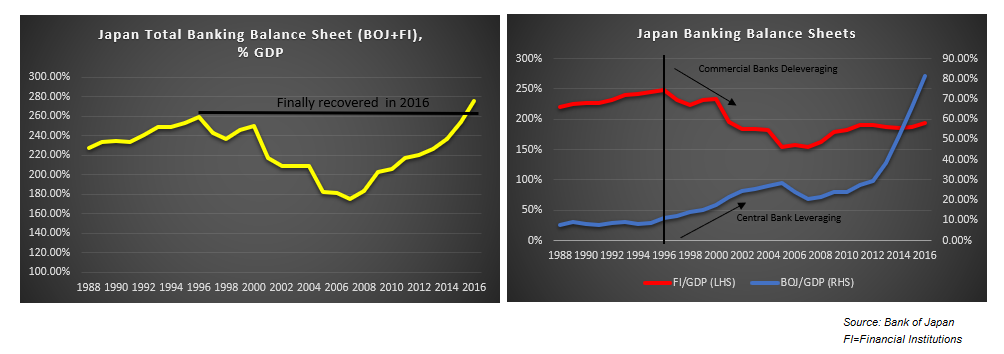
Ironically, it was after the 2008 GFC that the domestic commercial banks’ balance sheet in Japan started growing again in line with also the BOJ’s balance sheet. As a result, the total financial system balance sheet also started growing. However, it took until 2016 for it to reach its previous peak from the mid-1990s. That was mostly thanks to the BOJ heavily increasing its balance sheet by starting to buy also private assets – corporate bonds, REITs, equities.

EU

Financial institutions in the Euro-area started deleveraging after the sovereign crisis in 2012 and since then have shed about 4Tn EUR in assets (Left-panel chart below). The European Central Bank’s (ECB) balance sheet, on the other hand, has increased by about 3Tn since the 2008 financial crisis with the majority of the increase happening after 2014 (Right-panel chart below).
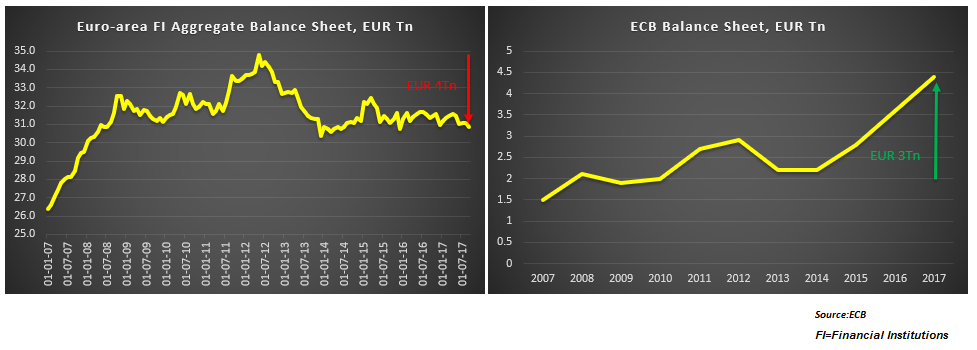
Indeed, between 2011 and 2014, both the banking system’s and ECB’s balance sheets had been decreasing relative to EU-area GDP – a fact which substantially contributed to the prolonged negative effect of the sovereign crisis and kept European assets underperforming (Right-panel chart below). Since 2014, however, while the banking system balance sheets continued to decrease, the ECB balance sheet started to rise relative to GDP.
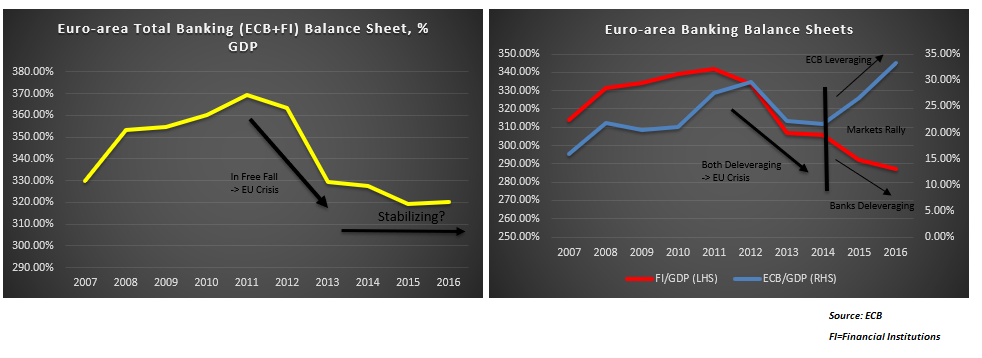
As a result of that, the total balance sheet (ECB + financial institutions) has started to stabilize at these levels (Left-panel chart above). Nevertheless, it seems that the ECB is indeed repeating the BOJ error of taking its time to raise its balance sheet to support the deleveraging happening in the banking system. If that deleveraging continues, as is more likely than not on the back of continued regulation (Dodd-Frank, Basel III) and the pressure form fintech and now cryptocurrencies, the ECB will most likely also have to massively increase its purchases by adding private assets to the list, just like BOJ.

US

US total banking system assets (Fed + financial institutions) are unchanged since the 2008 financial crisis (Left-panel chart below). Even though, the financial system has indeed deleveraged by the order of $3Tn (Right-panel chart below), the Fed has made up by leveraging its balance sheet by about the same amount. In fact, this is the first time since WW2 when banks in the US have deleveraged.
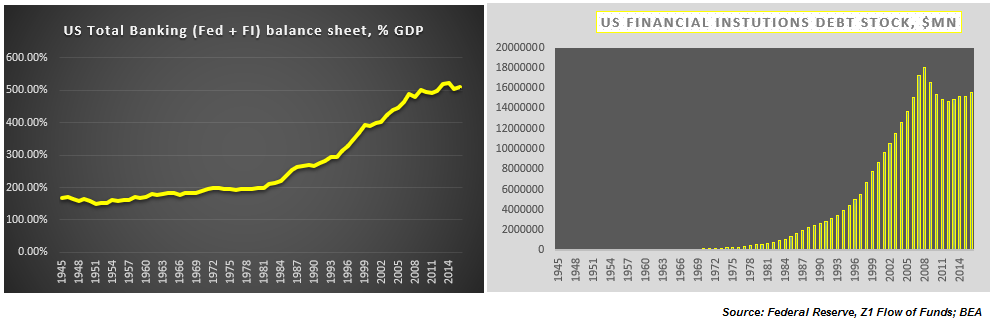
However, most of the liquidity in the system since the mid-1990s has been generated in the shadow banking system (see here, for example). Therefore, for the US, I have compared the central bank’s balance sheet to total domestic liquidity (Charts below).
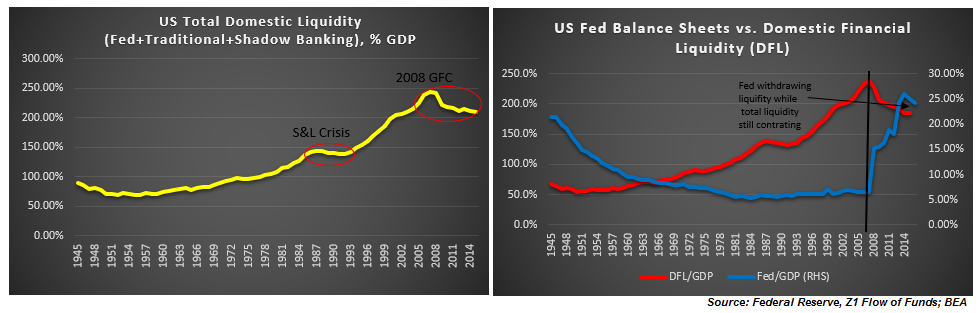
Total liquidity relative to GDP is still decreasing despite the efforts of the Fed to the contrary (Left-panel chart above). Except for the period between WW2 and 1957, there was only one other period when total domestic liquidity was decreasing – during the Savings and Loan crisis in the late 1980s.

Fed’s liquidity is now starting to slow down as well. This is a big risk if the banking system also continues to deleverage (Right-panel chart above).

Conclusion
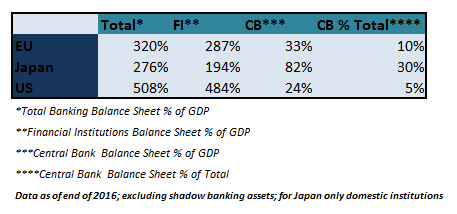
BOJ, ECB, Fed balance sheets are much bigger relative to GDP and relative to where they were before the crisis on absolute levels, but relative to the total balance sheet of the financial system they are still quite small. If the ‘private’ banks continue to deleverage, the central banks’ share of the total balance sheet will continue to naturally rise even if they do not increase their balance sheet. The overall financial system will shrink as a result. However, the risk to the financial system is much bigger if the central banks also deleverage at the same time.
Why US equities keep outperforming?

07 Saturday Oct 2017

Posted by beyondoverton in Equity, Questions

≈ 1 Comment

A lot has been written lately about the outperformance of US stocks over European stocks. Here is a good summary.

I would add two other things to the list of possible reasons for this outperformance.

Corporate share buybacks

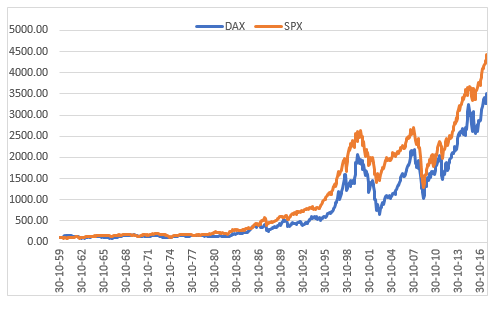
US corporate stock buybacks are a feature in US equities to a much larger extent than European corporate stock buybacks. For example, US corporates were given a “green light” to buy their own shares when Rule 10b-18 was introduced in 1982. The S&P Index started outperforming the DAX in the mid-1980s (Chart below, both of them indexed to 100 in 1959).

Source: Bloomberg, author’s calculations

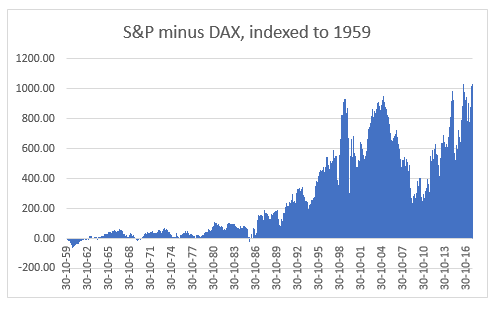
As US buybacks increased, the outperformance became more obvious (Chart below).

Source: Bloomberg, author’s calculations

Intangible assets

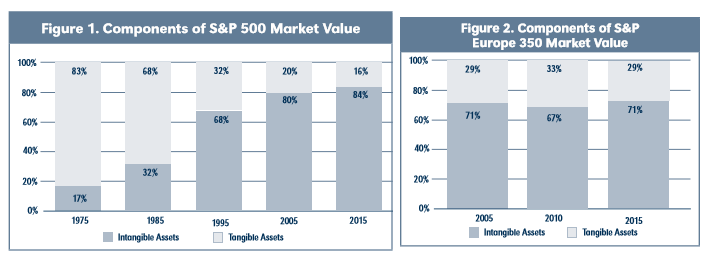
A second reason for the outperformance of US stocks could be the higher % of intangible assets in US indices (Charts below).

Source: “Intangible Asset Market Value Study” by Cate M. Elsen and Nick Hill

Historically, the combined value of a company’s physical assets should equal its market value. But we know that this Tobin’s Q ratio has become a bad predictor of the stock market. Why? Because intangibles have replaced physical assets as the main factor of production. We cannot see the intangibles on companies’ balance sheets but there are ways to guess their worth (look at investments/expenditures on the income statement). According to Simcha Barkai from the University of Chicago, intangibles are worth $48Tn just in the US (that’s more than the physical value of all companies’ assets)!

What if central banks gave the QE money to the people?

03 Tuesday Oct 2017

Posted by beyondoverton in blockchain, Debt, Monetary Policy, Questions, UBI

≈ Leave a comment

I would not be blindfolded by the fact that the US is trying to go back to ‘normal’ with the Fed on a rate-raising spree. ‘Normal’ changed a long time before 2008. You cannot go back to ‘normal’ with a broken monetary transmission mechanism. We can create all the money in the world but if it goes in the hands of the few, if it is subsequently ‘hoarded’ and if it cannot  reach the end consumer because Work≠Job≠Income (whether that is because of technology, globalization or whatever) or because the credit channel is closed (the end of the private debt super-cycle in 2008), the economy is not going to go anywhere. And if there is little demand because there are not enough mediums of exchange, aka money, circulating in the economy, optimizing production is a waste of time and resources.

Instead of focusing on going back to a ‘normal’ interest rate policy, a forward-looking central bank would be looking into the opportunity presented by the rise of the blockchain technology and the subsequent spread of digital cryptocurrencies. The latter are a direct response to the broken down monetary transmission mechanism: if the traditional mediums of exchange do not circulate in the economy, people are devising their own ways of exchanging goods and services.

The interest-rate cycle is something of the past now. If the financial crisis of 2008 did not make it obvious, perhaps, we have to wait for the next one, which would be here like clockwork as policy makers embark on the policy of ‘normalization’. But there is some hope that some central banks are looking into ways to introduce a digital currency of their own and opening their balance sheet to the public at large.

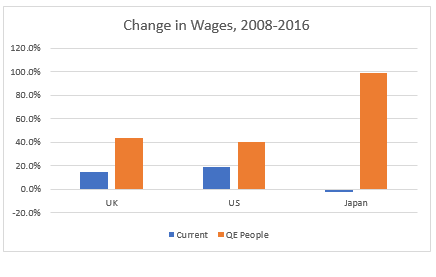
Back of the envelope calculation shows that if the money spent on buying financial  assets by the central banks of UK, US and Japan, was instead disbursed directly to the people, working wages would have risen substantially.

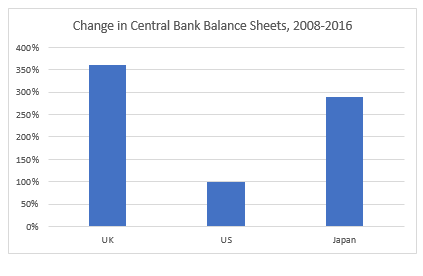
Between 2008 and 2016, central banks’ balance sheets have risen by 360% in the UK, 99% in the US and 280% in Japan.

Source: Bank of England, US Federal Reserve, Bank of Japan

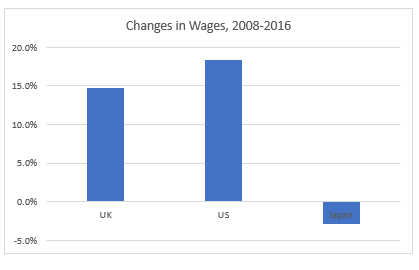
At the same time, over this period, nominal wages have risen by only 14.8% in the UK, 18.4% in the US and actually fallen by 2.9% in Japan! In 2016, the average annual wage in the UK was GBP 34,142, in the US – USD 60,154 and in Japan – Yen 4,425,380.

Source: OECD

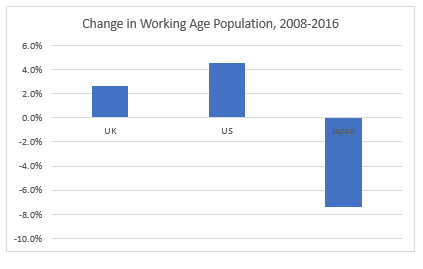
Japan is peculiar also because its working age population declined by 7.4%, while US’ and UK’s rose by 4.5% and 2.7%, respectively, during this period.

Source: OECD

I took the actual change in central bank balance sheets and divided it over the average working age population between 2008 and 2016. If this money could have been disbursed directly to the people, workers would have received a lump sum of GBP8,574, USD10,997, Yen4,430,424 over the period.

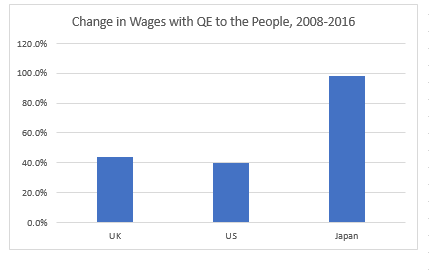
Let’s imagine that this lump sum was disbursed to the working age population at the end of 2016. Compared to 2008, their wages in 2016 would then have been higher by 44% (UK), 40% (US), 98% (Japan)!

If wages could indeed ‘miraculously’ rise by almost half in the UK and US and almost double in Japan over this 8 year period, what are the chances that we would still be stuck around 2% inflation in the US and UK and around 0% in Japan? Where would GDP be?

This is a very simple exercise. Undoubtedly real life is much more complicated that this and it is rarely black and white. Moreover, this would have been a lump sum disbursement, a one-off boost to income, and not a permanent rise in wages. Consumer behavior in this case, Ricardian equivalence, etc., would have been very different from a situation with a permanent rise in wages.

However, instead of patting ourselves on the back that things could have been much worse had the central banks not backstopped the financial system by buying financial  assets, can we not also think how they could  have also been much better if we found a better use for the money miraculously created out of thin air? If we could create money out of thin air to boost financial asset prices, is it really not possible to devise a way whereby the consumer also gets a permanent rise in income? Can we have an adult conversation about the effects of such an experiment without resorting to the taboos of the past? Can we include people other than economists in this conversation?

The free market may be the best and most efficient optimization model available so far to us, but what if we are optimizing the wrong variable?

What is the role of surplus capital?

28 Thursday Sep 2017

Posted by beyondoverton in Questions

≈ Leave a comment

Source: Z1 Flow of Funds, US Federal Reserve/Click to enlarge

“For an individual agent, additional income is necessarily accumulated in financial or real assets. The income not spent (the individual’s “saving”), which is initially received in the form of additional settlement medium, is allocated across asset classes. But for the economy as a whole this is obviously not true. The allocation of savings simply represents a gross transfer of assets across individuals: the increase in deposits of income receivers is matched by the decline in deposits of those that pay that income out. It is only when the additional income is supported by issuance of financial claims (eg credit or shares) that financial assets and liabilities are created. By the same token, the popular and powerful image that additional saving bids up financial asset prices (and hence depresses yields and interest rates) because it “has to be allocated somewhere” is misleading. There is no such thing as a “wall of saving” in the aggregate. Saving is not a wall, but a “hole” in aggregate spending.” BIS Working Paper 346

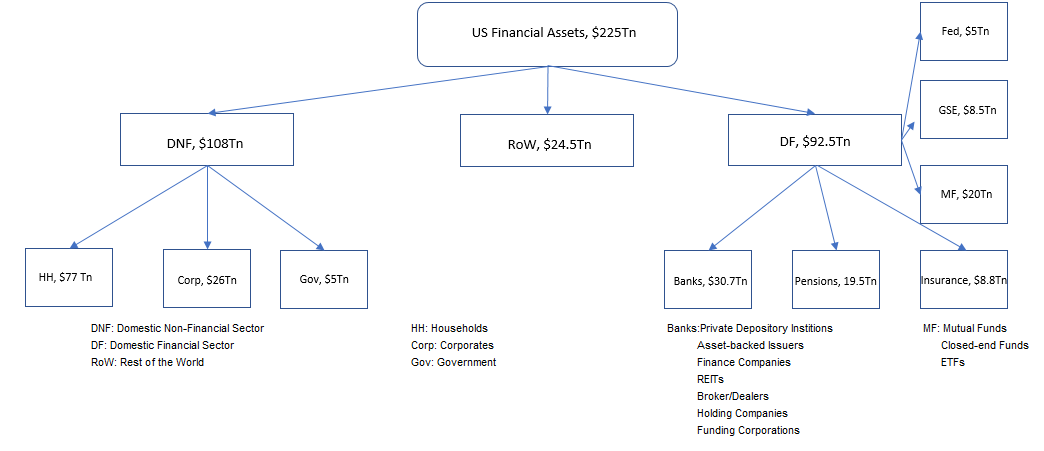
  • There are $225Tn of US financial assets in terms of market value (Chart above).
  • Financial assets growth started to surpass GDP growth in the early 1980s as the financialization of the US economy began. For example, for 40 years between 1945 and 1985, the ratio of financial assets to GDP varied between 5x and 6x. After 1985, the ratio started moving higher and higher and currently stands at record 12x!

Source: Z1 Flow of Funds, US Federal Reserve

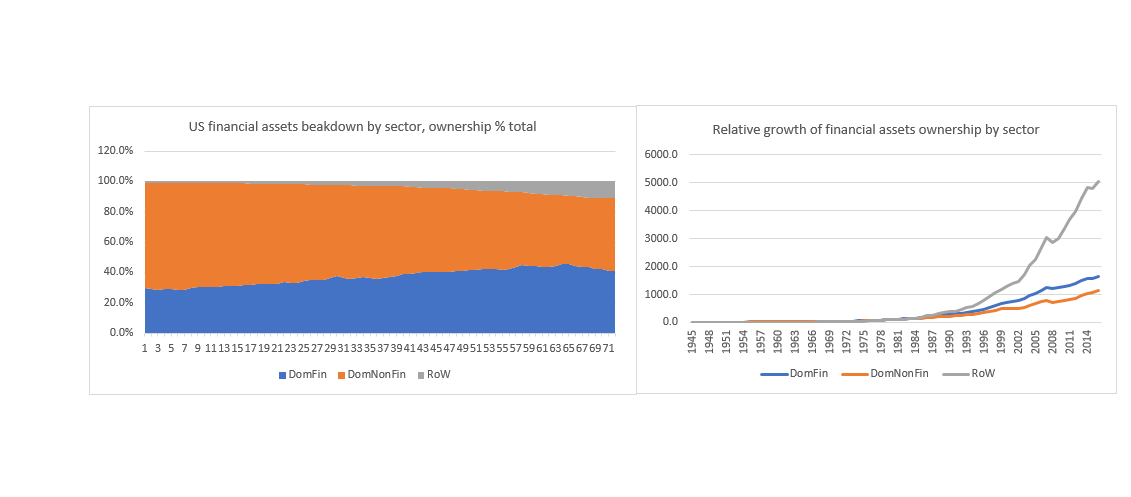
  • In terms of ownership, financial assets are split among three major sectors: Domestic Non-Financial, Domestic Financial and Rest of the World.
  • The Domestic Financial Sector started gathering more and more financial assets relative to the Domestic Non-Financial Sector in the early 1990s. But it is really foreigners who began heavily investing in the US as trade flows picked up in the late 1990s and strong globalization trends emerged.

Source: Z1 Flow of Funds, US Federal Reserve/Click to enlarge

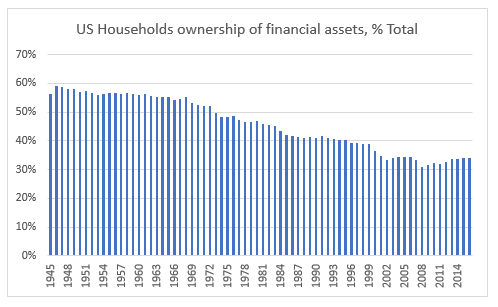
  • US households’ direct ownership of financial assets has gradually decreased since 1945 in line with the financialization of the US economy. As absolute savings increased, the financial industry expanded to meet households demand for new products in which to invest them. After the 1980s, the financial industry not only was creating new products but also started investing on behalf of households.

Source: Z1 Flow of Funds, US Federal Reserve

  • Savings are a dead weight on the real economy as they drain funds away from it. If instead they were invested in real projects, arguably, employment and economic growth could have been higher. At the moment, it is the financial sector, primarily, which benefits from this surplus capital.
  • As this surplus capital gets diverted into savings, new money must be created to serve the real economy. This new money gets created as debt. This has generally been a more efficient method of  money creation than most other ones in the past as it matches closely economic activity.
  • However, as the debt stock increases mathematically due to positive interest rates, this efficiency decreases. In addition, not only new money must be created to serve the real economy but also to pay back the old debt.
  • The financial sector gets a cut on both the asset side of the balance sheet (managing the surplus capital) and on the liability side (creating the debt).
  • Looking at the US economy from this sectoral balance point of view, we should be also asking ourselves questions about the role of this surplus capital.
  • For example, what is the need for government bonds in a fiat monetary regime? Are they ‘created’ to fund US government budget deficits, for example, or to meet the demand for positively yielding (protection from inflation) and safe (protection from default) assets as the surplus capital increases?
  • Given that companies generally prefer to fund themselves using internal capital, what is the role of the stock market especially when there is also surplus corporate capital?
  • How far can we go monetizing the real world to create enough financial assets to meet the demand of the increasing capital surplus globally?
  • In the increasingly digital world where the marginal cost of production is zero and in the old industrial world where the marginal cost of production is dropping fast because of the advances of technology, how much surplus capital in aggregate do we need?
  • Do we have so much surplus capital because our income distribution model is broken?

…

Who owns US Treasuries?

21 Thursday Sep 2017

Posted by beyondoverton in Debt, Questions

≈ 1 Comment

Source: Z1 Flow of Funds, US Federal Reserve

2016

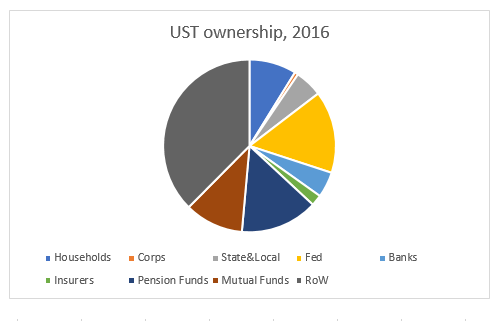
  • The biggest owner of US Treasuries (UST) are foreigners at 37.6% of total. Relative to other holders, their ownership actually peaked in 2008 at 44.2% and they have been net seller in the last two years.
  • The second biggest owner of UST is the Fed at 15.4%. If we add state and local governments to it, the government, as a whole owns, 20.6% of UST.
  • In the domestic sector, pension funds own the most at 14.5%, followed by mutual funds at 11% and households at 8.8%.

Over the years

Source: Z1 Flow of Funds, US Federal Reserve

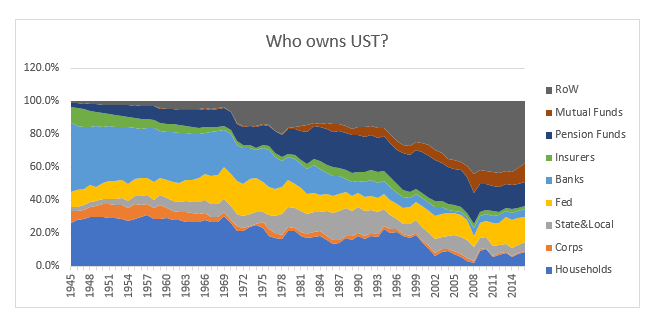
  • The ownership of UST has changed significantly over the years. For example, at the start of the data in 1945, the financial sector (banks, broker-dealers, etc.) owned 41.9% of the total; in 2016 that had fallen down to 4.8%.
  • Households, the corporate sector and insurance companies have also substantially reduced their UST holdings over the years.
  • Mutual funds and pension funds, on the other hand, have increased them.
  • The elephant in the room, however, is the foreign sector, which in 1945 was the second smallest owner of UST (after mutual funds) at 1%. There was a big jump in foreign ownership in the 1970s and then starting in the mid-1990s.

T-Bills vs long dated US government securities

Source: Z1 Flow of Funds, US Federal Reserve

  • Majority of US government debt has historically been in long-dated instruments.
  • However, in the mid-1970s, there were about as many T-Bills as long-dated government paper. Nevertheless, over the last couple of years, the issuance of T-bills has declined to all-time low.

Who owns US debt?

19 Tuesday Sep 2017

Posted by beyondoverton in Debt, Questions

≈ 1 Comment

…and how it is distributed

Source: Z1 Flow of Funds, US Federal Reserve

There was $41.3Tn of US debt in 2016 compared to $26.8Tn in 2006 and $12.4Tn in 1996.

Instruments

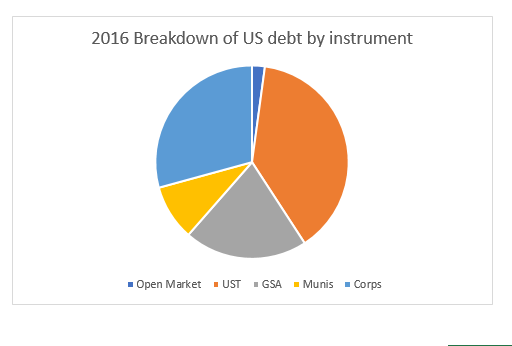
In terms of instruments, in 2016 total US debt was split as follows: 38.7% was in US Treasuries (UST), 29.3% was in US Corporates (USC), 20.6% was in Government Sponsored Agencies (GSA), 9.3% was in Municipal Bonds (Munis) and 2.6% was in Open Market Paper (OMP)

Source: Z1 Flow of Funds, US Federal Reserve

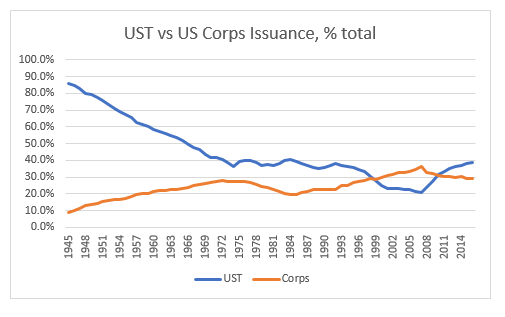
US Treasuries issuance as a % of total reached its all-time low in 2008 at 20%; the high was 1945 at 86%. There was a drastic reduction is US Treasuries issuance in the 1990s as Clinton’s administration decided to eliminate the US budget deficit. US Treasuries issuance picked up significantly after the 2008 financial crisis and almost doubled as a % of total by 2016.

Source: Z1 Flow of Funds, US Federal Reserve

US corporate issuance, on the hand reached an all-time high in 2007 at 36%; the all-time low was 1945 at 9%. Between 1999 and 2010 there were more US corporates bonds issued than US Treasuries.

Source: Z1 Flow of Funds, US Federal Reserve

Sectors

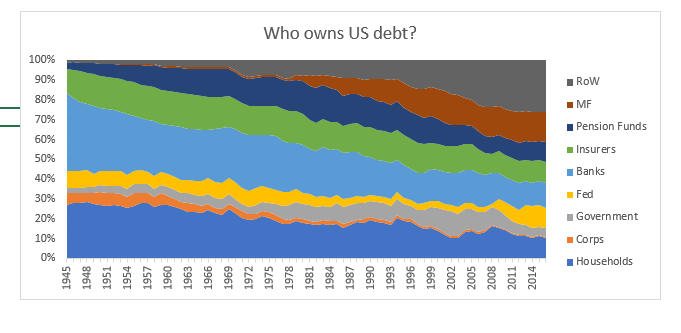
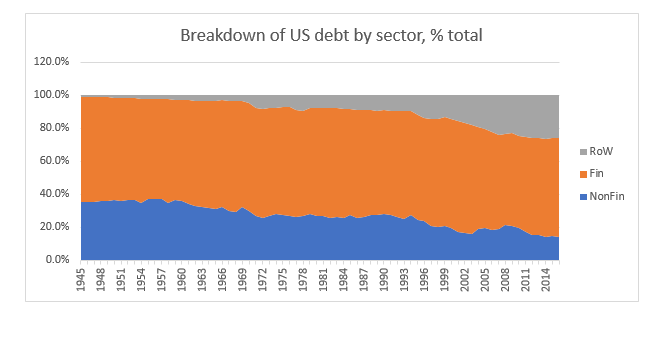
In terms of sectors, the largest owner of US debt is the US financial domestic sector at almost 60% of total, followed by the Rest of the World (RoW) at 26%, and the US nonfinancial domestic sector at 14%. Both domestic sectors have declined at the expense of the foreign sector as globalization spread after the mid-1990s.

Source: Z1 Flow of Funds, US Federal Reserve

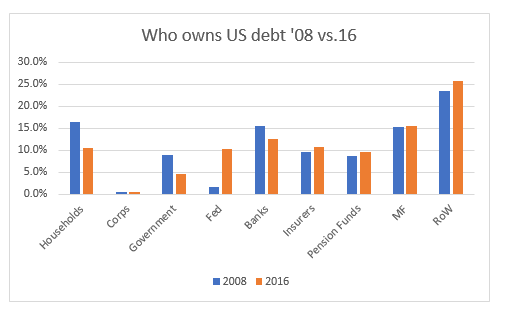
The biggest holder of US debt in 2016 were indeed foreigners, followed by mutual funds, banks and households. While foreigners’ holdings are close to an all-time high, both banks’ and households’ holdings of US debt are at an all-time low.

Between 2008 and 2016, Fed’s holdings increased by almost x10 (1.6% to 10.2%). The rest of the government’s holdings however halved from 9% to 4.5%. Households and banks both reduced their holdings while foreigners increased them.

Source: Z1 Flow of Funds, US Federal Reserve

Who owns US equities?

18 Monday Sep 2017

Posted by beyondoverton in Equity, Questions

≈ 1 Comment

Source: US Z1 Flow of Funds, Federal Reserve

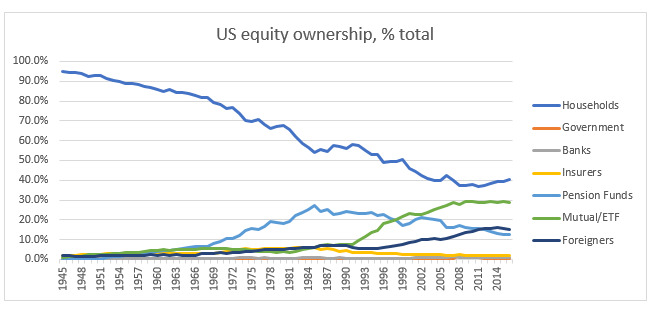
  • The ownership of US equities has changed significantly since WW2. In 1945, US households owned 95% of all US equities directly. By 2016 that figure had gone down to just 40%. However, households are still the largest owners of US equities direct.
  • Between 1945 and 1985, households switched from directly owning some of their equities to owning equities through pension funds. While in 1945, pension funds had pretty much 0% holding of equities, by 1985 that number had gone up to 27%. Thereafter, pension fund holdings of equities has declined to 15%. In 2016, pension funds are only the 4th largest owner of US equities.
  • After the mid 1980s, with the financialization of the US economy in full bloom, households started investing in mutual funds and closed end funds, and later on ETFs. Mutual funds/ETF holdings of equities rose from just 6% in 1985 to 29% now, and they form the second largest holder of US equities. The share of ETFs rose especially rapidly after 2000.
  • Foreigners’ holdings of US equities also substantially increased after the early 2000s with the process of globalization taking speed and especially so after China entered WTO. As a % of total, foreign ownership of US equities doubled from 7.5% in 1999 to 15% now. Even though foreigners have been net sellers of US equities in the last couple of years, they still represent the 3rd largest holder.
  • The US government has been a holder of US equities since 1996 mostly through state and local governments. In 2008 the federal government acquired some equities as part of the bailout program after the 2008 financial crisis. The Fed also bought equities in 2009 and 2010. Both the federal government and the Fed have been selling equities since then.
  • Banks and insurance companies are the other holders of US equities but their holdings are either small and steady (banks at around 1%) or small and declining (insurance companies’ holdings have declined from 6% in the early 1980s to 2% now).
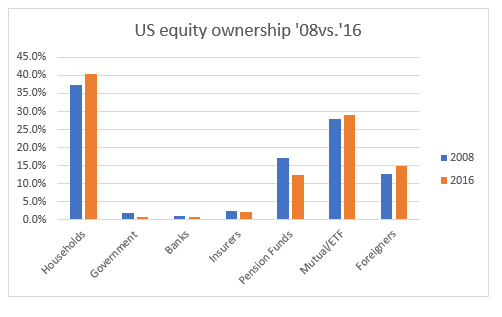
  • The chart below shows how US equity ownership as a % of total has changed between 2008 and 2016.

Source: US Z1 Flow of Funds, Federal Reserve


Will decentralization lead to de-urbanization?

27 Thursday Jul 2017

Posted by beyondoverton in Decentralization, Questions

≈ 1 Comment

Tags

De-urbanization, Decentralization

Army (3500 BC): walled city -> Navy (1210 BC): walled city -> Air Force (early 20th century): walls provide no security; in fact, institutional and physical infrastructure concentration reduces security rather than increases it -> Cybersecurity (early 21st century): decentralized security essential as centralization runs the risk of total destruction. Will the trend of decentralization spurred by the advances of technologies like the blockchain, for example, speed up the process of de-urbanization in the developed world? Can technology also start to reverse the developing world urbanization?

Newer posts →

Subscribe

  • Entries (RSS)
  • Comments (RSS)

Archives

  • January 2023
  • December 2022
  • November 2022
  • August 2022
  • February 2022
  • April 2021
  • November 2020
  • October 2020
  • September 2020
  • August 2020
  • July 2020
  • June 2020
  • May 2020
  • April 2020
  • March 2020
  • February 2020
  • January 2020
  • December 2019
  • November 2019
  • October 2019
  • May 2019
  • March 2019
  • February 2019
  • January 2019
  • December 2018
  • November 2018
  • October 2018
  • September 2018
  • August 2018
  • June 2018
  • May 2018
  • March 2018
  • February 2018
  • January 2018
  • November 2017
  • October 2017
  • September 2017
  • August 2017
  • July 2017
  • June 2017

Categories

  • AI
  • Asset Allocation
  • blockchain
  • China
  • De-urbanization
  • Debt
  • Decentralization
  • EM
  • Energy
  • Equity
  • FX
  • g88kboy
  • Monetary Policy
  • Politics
  • Questions
  • Quotes
  • The last man standing will laugh
  • Travel
  • UBI
  • Uncategorized
  • VR

Meta

  • Create account
  • Log in

Blog at WordPress.com.

  • Subscribe Subscribed
    • BeyondOverton
    • Join 74 other subscribers
    • Already have a WordPress.com account? Log in now.
    • BeyondOverton
    • Subscribe Subscribed
    • Sign up
    • Log in
    • Report this content
    • View site in Reader
    • Manage subscriptions
    • Collapse this bar
 

Loading Comments...