• About
  • BeyondOverton Travel
    • Silk Road (1): If Turkey is in crisis, it’s not obvious visiting it
    • Silk Road (2): Could beautiful nature and ancient history create a false sense of entitlement?
    • Silk Road (3): Fast Car
    • Silk Road (4):We took a bus ride to Iran
    • Silk Road (5): Border bothers
    • Silk Road (6): Chevrolet Land
    • Silk Road (7): Free-roaming camels and wild horses
    • Silk Road (8): China West to East
    • Silk Road (9): I have not told half of what I saw
  • BLOG
  • g88kboy Travel
    • On the Silk Road
    • Bulgaria : The Chicken crossed the Road
    • Turkey : The Country, not the Bird
    • Georgia on my Mind
    • Armenian Ayran
    • Iran – The Curious Land
    • An American in Azerbaijan
    • Uzbekistan: Golden Teeth and Neon Signs
    • Kazakhstan: Thirty Sweating Seniors
    • China Part One – Pandas Are Extinct
    • China Part Two: My TED Talk (Deep Analysis)
    • Phillipines – They Relax, I (pretend to😉) Study
    • Singapore: flashing trees and a torrent of tears
    • Malaysia: That ain’t no croc, it’s a log
    • Brunei: The Instinctive Fight for Superior Domination
    • Phillipines: Hello Friend Again
  • Outside the window
    • Bulgaria
    • Turkey
    • Georgia
    • Armenia
    • Iran
    • Azerbaijan
    • Uzbekistan
    • Kazakhstan

BeyondOverton

~ let's move this window

BeyondOverton

Category Archives: Monetary Policy

A simplified hierarchy of money

22 Wednesday Nov 2017

Posted by beyondoverton in blockchain, Monetary Policy

≈ 3 Comments

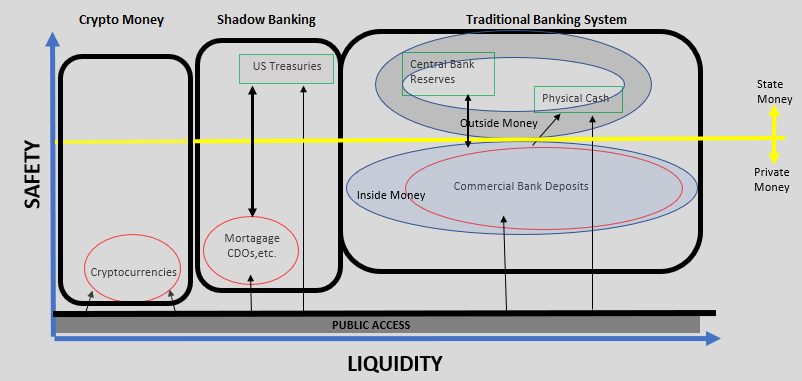
This is a simplified diagram of the modern monetary system from the point of view of liquidity (horizontal axis – liquidity increases as we move to the right) and safety (vertical axis – safety increases as we move upwards). It distinguishes among three types of monetary systems: traditional banking, shadow banking and crypto money. In addition, it defines money as ‘private’, i.e. money created in the private financial system (majority of money) and public or state, i.e. money created by the central bank or the government. Finally, the diagram shows which type of money the general public has access to at the moment.

This is work in progress, any feedback is welcome!

Traditional Banking System

The traditional banking system is centralized with the central bank sitting at the top issuing central bank reserves. To connect to the major payment systems, such as BACS or CHAPs in the UK or Fedwire in the US, financial intermediaries must have a reserve account at the central bank. Generally speaking, because central bank reserves are used only for settlement purposes between the central bank and commercial banks, they are sometimes called ‘outside’ money, i.e. money which sits outside of the real economy: the general public does not have access to them.

‘Outside’ money has gone to also comprise all state-issued money: in the US this is the physical coins issued by the government (the US Mint) and the paper dollars issued by the Federal Reserve (US Bureau of Engraving and Printing). It is only to this state money that the general public has access to. ‘Outside’ money is the safest money instrument out there: a fully sovereign government can never willingly default. The risk, as always, is only inflation.

Below state money lie commercial bank deposits which is private money created out of thin air on the back of public borrowing. This privately issued money comprises the majority of money in the system. Because of that, it is also called ‘inside’ money, i.e. this is the money that circulates within the real economy.

Commercial bank deposits are not as safe as state money because banks can go under (the money created is on the back of loans which are inherently risky). However, through the fractional reserve system which we have in place, part of that money is ‘backed’ by state money, i.e. every single time the commercial bank issues a loan by creating bank deposits it has to make sure it also has (or acquires/borrows) a portion of central bank reserves at the same time. In addition, some portion of the public deposits is insured by the state, so that even if a commercial bank goes bankrupt, some of the deposits will be made whole. Finally, all commercial banks are regulated by the central bank and subject to capital, liquidity and leverage requirements.

The public generally does not dwell much on the riskiness of commercial bank deposits. Except for Northern Rock in the UK in 2008, we have not had many major bank-runs in the developed world since the Great Depression. In fact, to most people who have deposits well below the insurance limit, commercial bank deposits are safe. It is this inherent link to the state which gives this impression of safe commercial bank deposits. In the words of former Bank of England governor, Mervyn King, “[M]any treat loans to banks as if they were riskless.  In isolation, this would be akin to a belief in alchemy – risk-free deposits can never be supported by long-term risky investments in isolation.  To work, financial alchemy requires the implicit support of the tax payer.”

The money created within this traditional banking system is the safest and most liquid form of modern money.

Shadow Banking

Shadow banking has been around for a while. In fact, in the mid-1990s, shadow banking liquidity in the US surpassed traditional banking liquidity. This, plus the fact that it is not part of the traditional monetary transmission mechanism (a lot of the liquidity created until 2008 was off banks’ balance sheets – not easy for regulators, or for that matter even bank analysts to spot it), contributed to the 2008 financial crisis. Since 2008, however, shadow banking liquidity has massively declined and now is again less than traditional banking liquidity.

In a similar fashion to the traditional banking system, the core of the shadow banking system is a state money-like asset: US Treasuries. The actual ‘money’ in the shadow system is also, similarly, a private asset in the form of a repackaged loan: the mortgage CDO/CBOs. US Treasuries are used as collateral for the mortgage packages, or one could say as settlement instruments not unlike the central bank reserves. Unlike in the traditional banking system though, the public has direct access to the US Treasury market.

The safety of the US Treasuries is on par with the safety of the state money in the traditional banking system. In terms of liquidity, it depends on the usage. The mortgage packages, however, are private ‘money’ which are substantially less safe than the private commercial bank deposits of the traditional banking system (even though, in most cases, the former had actually higher ratings, a fact which was at the core of the mortgage crisis of 2008).

The shadow banking system grew out of the inadequacy of the traditional banking system to distribute money efficiently. It was a perfect timing as well, coming on the heels of the dotcom crash when the authorities were more than eager to see the residential real estate market driving the bounce.

Crypto Money

This is the latest development in the transformation of the modern monetary transmission mechanism. In a similar fashion to the rise of the shadow banking system in the early 2000s, crypto currencies have come in to fill in the void of lost income post the 2008 crisis and the inability of modern money supply to reach the end consumer.

Crypto money is even worse (less safe) than shadow money because it lacks state money collateral. In addition, the private asset is created outside of the private financial system in a decentralized/distributed fashion. However, its claims of ‘equality’ when it comes to money creation (a permission-less system) may have been valid in the beginning, but with the complexity of the verification process increasing and the need for extra computer power, it is not the case any longer: a few ‘miners’ are now ‘in control. The hard forks which have happened in Bitcoin are an example of these vested interests.

Finally, on the positive side as this is the whole point, the public does have access to cryptocurrencies, but with their price having risen several times over just this year, reality is that now only the ‘privileged’ can afford to buy the major cryptocurrencies. And because they are considered a store of value, with a lot of buyers claiming they are going to hold them ‘forever’, cryptocurrencies are much less likely to be exchanged and thus their liquidity will continue to suffer.

Access to central bank balance sheet

The sovereign state through the central bank is the only issuer of safe assets. Ironically, in the process of QE with the aim to prop up the deleveraging banking system, the amount of safe assets has been greatly reduced (the central bank buys sovereign bonds, to which the public has access to, and issues reserve balances to which the public does not have access to). The demand for physical cash has actually risen in the developed world, partially on the back of this.

In fact, the central bank or the government does not have direct control over any of the safe assets the public has access to: coins are issued by the government and paper dollar are issued by the Federal Reserve but only on the back of demand for physical cash by the public (the public swaps electronic commercial bank deposits with physical cash – in other words, there is no mechanism by which the central bank/government can give physical cash to the public unless it passes through commercial bank deposits). US Treasuries are issued by the government but again they can generally be purchased only by swapping them with commercial bank deposits.

Because access to its balance sheet is so restricted, the central bank’s efforts to increase monetary liquidity post the 2008 financial crisis have been highly inadequate. In fact, in light of this, the central bank should have focused more on how to directly help the financial system with its deleveraging process, than on affecting the money supply. To that effect, it would have been much more beneficial for the central bank to focus on buying mostly private assets. Both the BOJ and ECB have eventually started doing this but more on the back of declining supply of sovereign paper rather than by design.

In addition, the ability of commercial banks to increase the money supply is severely limited not only because there is less borrowing demand from the public but also because capital and leverage regulations (Basel III) make it prohibitively to do so. So, as the money transmission mechanism stalls, similar to the period post the dotcom crisis in the early 2000s, the market has gone and created alternative private safe assets to supplement the public’s need for money: this time, cryptocurrencies. Because they are even more toxic than the sub-prime mortgage packages, the more widespread they become with the pubic, the higher the risk of an even bigger-than-2008 financial accident.

The answer could be widening out access to the central bank balance sheet for the whole population. This can be done in various ways using the same blockchain technology now prevalent amongst the various cryptocurrencies. Indeed, a previous post listed some of the major central banks and their efforts in this direction.

What is the optimal central bank balance sheet size?

16 Thursday Nov 2017

Posted by beyondoverton in Debt, Monetary Policy, Questions

≈ Leave a comment

Answer: Depends on the size of the overall financial system balance sheet and whether it is deleveraging/leveraging.

This is a follow up on a previous post addressing the rationale for a continued increase of the major central banks’ balance sheet barring a sudden rise in the ‘private’ banks’ balance sheets.

Summary: We have been used to a small and relatively stable central bank balance sheet because before the 2008 financial crisis, the banking system balance sheet had been steadily growing. However, post the crisis, the banking system started deleveraging across the developed world. To avoid a continuation of the financial crisis, the central banks there had no choice but to leverage, i.e. increase their balance sheet.

Going forward, the size of the central bank balance sheet will be very much determined by what happens with the banking system balance sheet as a whole: if banks continue with the deleveraging, something which is more than likely given the plethora of financial regulations (Dodd-Frank, Basel III, MIFID2, FATCA, AMLD, AIFMD, CRS, etc.), the central bank may have to continue to expand its balance sheet or face another financial crisis.

Background

Since the 2008 financial crisis, to most economic observers, central banks have been increasing their balance sheets in order to facilitate easier economic conditions having exhausted their conventional means to do so. There is a strong debate among economists, investors and market practitioners, in general, about the effectiveness of such policies. I argue that the direct economic issues (growth, inflation) may have been of secondary importance to the reasoning behind the increased central bank balance sheets.

Central bankers’ primary objective may have been financial stability, including maintaining a stable rate of growth of the country’s total financial balance sheet. In that sense, some central banks’ balance sheet may need to grow even larger if the ‘private’ banking sector continues to deleverage.

On one hand, central banks’ balance sheets are unique in the sense that they act as the lender of last resort: they control, and, to a certain extent, regulate the money supply. That’s the conventional view of central banks. On the other hand, they are an integral part of the country’s financial sector, and, therefore, cannot be viewed in isolation.

The ‘private’ and central banks’ balance sheets are indeed linked together. We have been used to the former generally rising, especially so after the great financialization of the economy beginning in the 1980s. Therefore, we have taken it for granted that the central bank needs to just ‘sit back and relax’: there was no need for it to do any heavy lifting, i.e. the central bank’s balance sheet did not need to rise relative to GDP or to the whole financial sector’s balance sheet.

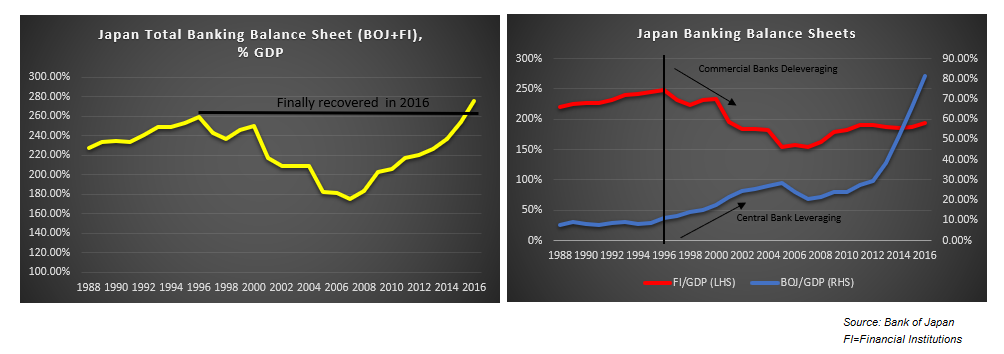
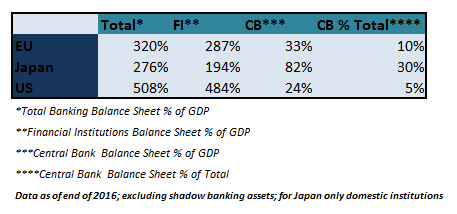
Since 2008, however, we have seen the private banking system heavily deleveraging in the US and EU. In Japan, the deleveraging actually started in the mid-1990s when the ‘private’ banking system’s balance sheet started shrinking relative to GDP. In order to maintain financial stability, the central banks in these respective countries needed to start to increase their balance sheet at a much faster pace than GDP and, more importantly, than the rate of deleveraging of the ‘private’ banking sector.

Japan

Even though it started properly leveraging (QE) only in the early 2000s, the Bank of Japan (BOJ)’s balance sheet started growing relative to GDP at the same time the domestic commercial banks’ balance sheet started deleveraging in the mid-1990s (see the chart on the right hand-side of the panel below). Nevertheless, the total financial system balance sheet (BOJ + the commercial banks) continued to decline between 1995 and 2007 (see the chart on the left-hand side of the panel below). The BOJ should have expanded its balance sheet much more back then.

Ironically, it was after the 2008 GFC that the domestic commercial banks’ balance sheet in Japan started growing again in line with also the BOJ’s balance sheet. As a result, the total financial system balance sheet also started growing. However, it took until 2016 for it to reach its previous peak from the mid-1990s. That was mostly thanks to the BOJ heavily increasing its balance sheet by starting to buy also private assets – corporate bonds, REITs, equities.

EU

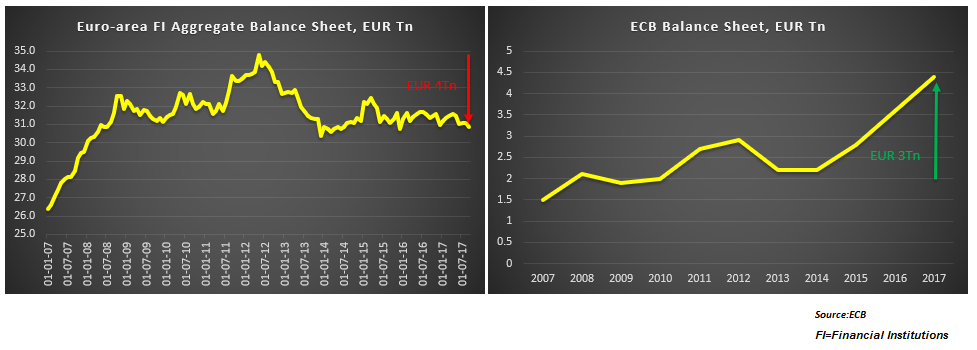
Financial institutions in the Euro-area started deleveraging after the sovereign crisis in 2012 and since then have shed about 4Tn EUR in assets (Left-panel chart below). The European Central Bank’s (ECB) balance sheet, on the other hand, has increased by about 3Tn since the 2008 financial crisis with the majority of the increase happening after 2014 (Right-panel chart below).

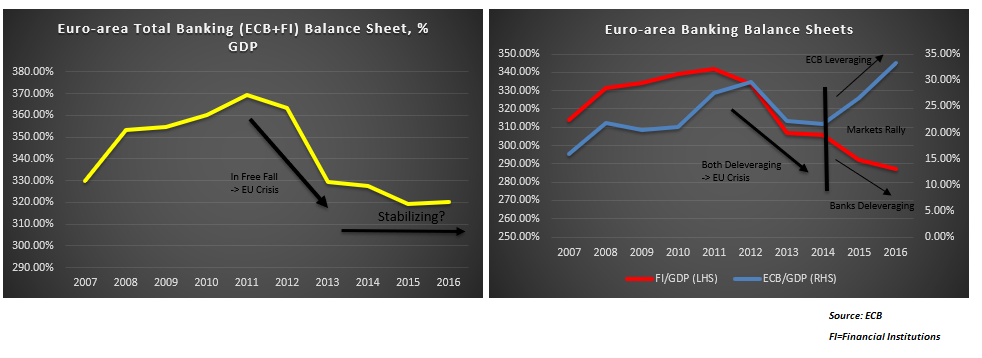
Indeed, between 2011 and 2014, both the banking system’s and ECB’s balance sheets had been decreasing relative to EU-area GDP – a fact which substantially contributed to the prolonged negative effect of the sovereign crisis and kept European assets underperforming (Right-panel chart below). Since 2014, however, while the banking system balance sheets continued to decrease, the ECB balance sheet started to rise relative to GDP.

As a result of that, the total balance sheet (ECB + financial institutions) has started to stabilize at these levels (Left-panel chart above). Nevertheless, it seems that the ECB is indeed repeating the BOJ error of taking its time to raise its balance sheet to support the deleveraging happening in the banking system. If that deleveraging continues, as is more likely than not on the back of continued regulation (Dodd-Frank, Basel III) and the pressure form fintech and now cryptocurrencies, the ECB will most likely also have to massively increase its purchases by adding private assets to the list, just like BOJ.

US

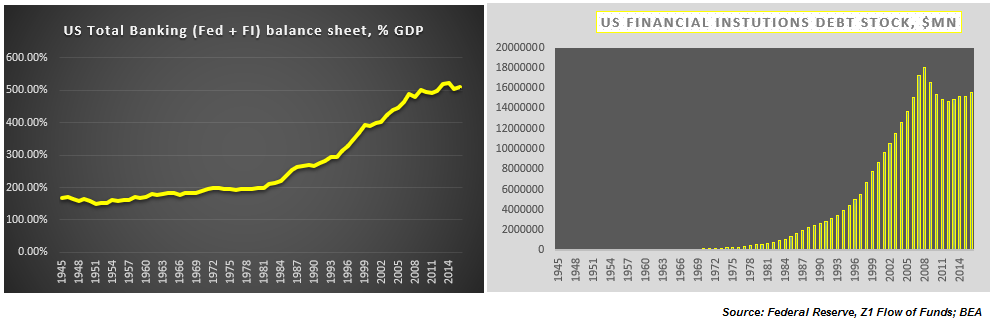
US total banking system assets (Fed + financial institutions) are unchanged since the 2008 financial crisis (Left-panel chart below). Even though, the financial system has indeed deleveraged by the order of $3Tn (Right-panel chart below), the Fed has made up by leveraging its balance sheet by about the same amount. In fact, this is the first time since WW2 when banks in the US have deleveraged.

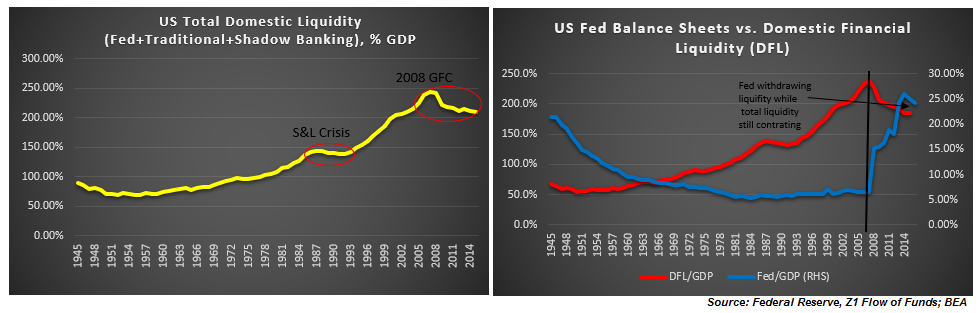
However, most of the liquidity in the system since the mid-1990s has been generated in the shadow banking system (see here, for example). Therefore, for the US, I have compared the central bank’s balance sheet to total domestic liquidity (Charts below).

Total liquidity relative to GDP is still decreasing despite the efforts of the Fed to the contrary (Left-panel chart above). Except for the period between WW2 and 1957, there was only one other period when total domestic liquidity was decreasing – during the Savings and Loan crisis in the late 1980s.

Fed’s liquidity is now starting to slow down as well. This is a big risk if the banking system also continues to deleverage (Right-panel chart above).

Conclusion

BOJ, ECB, Fed balance sheets are much bigger relative to GDP and relative to where they were before the crisis on absolute levels, but relative to the total balance sheet of the financial system they are still quite small. If the ‘private’ banks continue to deleverage, the central banks’ share of the total balance sheet will continue to naturally rise even if they do not increase their balance sheet. The overall financial system will shrink as a result. However, the risk to the financial system is much bigger if the central banks also deleverage at the same time.

Bitcoin is not the future of money

06 Monday Nov 2017

Posted by beyondoverton in blockchain, Decentralization, Monetary Policy

≈ 4 Comments

This is a follow-up on “’Mining’ for money is a ridiculous idea”


Source: https://coinmarketcap.com/ , Author’s calculations

Summary: By creating private alternative money supply and payment systems, cryptocurrencies are threatening the raison d’etre of both the central bank, which governs the current monetary transmission process, and the private money institutions, which create the majority of the money. This is a dangerous precedent which history shows does not end well for the incumbents. Bitcoin, specifically, while it has developed an ingenious way of money creation through the blockchain, has unfortunately, other flaws, namely fixed end supply, high energy costs, limitations of the number of transactions it can process, security and privacy risks.

A ‘bubble’ is a dangerous thing to play with

Below, I am questioning in theory the rise in Bitcoin’s price, specifically, but also the viability of all cryptocurrencies. However, I am absolutely not doing anything about it in practice. Even though the sudden increase in cryptocurrencies’ market capitalization looks absolutely ridiculous to me, I have been around the markets long enough to have been burnt by the Siren call of shorting a bubble before it is ready to pop. I do not have positions in any cryptocurrencies, nor am I advocating positions in any at this point.

Even in real life, I hate the bubbles equivalents: the balloons. They make me nervous because of the uncertainty and suddenness of that popping sound whenever the balloon touches something sharp eventually. When my kids were little and they were invited to a birthday party, I always tried to find an excuse not to go: it was inevitable that balloons would be popping up. The funny thing is that when they brought a balloon home, left it somewhere in a corner and forgot about it, I had no problem: I knew, sooner or later, that the balloon would naturally deflate.

Being right vs. making money

So, I was never a bubble chaser when I was a trader. I preferred to make the money on the way down, after the sudden pop or even when the bubble slowly filtered away. 2008 was my best year, but not because I predicted the crisis. Not at all. I mean, in the years preceding the crisis EVERYBODY knew that credit spreads were ridiculously tight, that the US consumer had too much debt, etc. But nobody, that I know, had the bearish trade on when the bubble eventually burst in 2008. I remember though trying (to put it on) – buying protection in a number of US and UK banks and especially in Eastern European sovereigns – but it was always too early and the negative carry eventually made the trade not worthy.

Going into 2008 I was at least not long the market. By the end of that summer, my P&L was chopping around 0 (but more often on the negative side): the shorts did not work out, and I did not have the stomach to be long. It was basically a waste of time. In fact, I was convinced that they would not let Lehman go. I mean, they had ‘saved’ Bear Stearns…But, moreover, I had done my homework and was aware that Lehman was probably the main character in the shadow banking game. You take Lehman out and the whole show is over: a run on the banks. But not from the retail depositors side – the broker/dealers (Morgan Stanley, Goldman Sachs) did not have retail depositors – rather from the institutional side. I knew that the shadow banking system had produced the majority of the monetary liquidity and that once it was blown apart, the central bank would have to step in big time.

I think if you were in the markets back then, you would always remember exactly what you were doing when you first found out that Lehman Brothers declared bankruptcy. The importance of the event was enormous even by itself: a venerable institution, more than 150-years old, which survived even the Great Depression. (I think the equivalent of that would have been the collapse of Barring Brothers, the second oldest merchant bank in the world, in 1995. Sadly, I started my career on Wall Street in 1996 and have no recollection of that event). However, that Sunday, September 7, 2008, I was waiting to board a flight from Venice to London – we had been there to attend a relative’s wedding. Checking my Blackberry, I was stunned when I read the news! What followed in the weeks after was a relentless buying of Eurodollar futures contracts (short-term rates, not the currency for those that may be confused here by the terminology). And that is why 2008 was my best year managing money…

2008 was year zero in modern banking

While I seemed to be on top of the (trading) world back then, for all intends and purposes, 2008 could be considered the end of traditional banking. The big deal in that sense, however, and in hindsight (always in hindsight – hindsight is the best friend we have ever known) was not Lehman’s bankruptcy, but a white paper by a person or an organization by the name of Satoshi Nakamoto. The paper came in late October of that year. I said in hindsight because I did not know about the paper until much later (and anyway, I was too busy trading Eurodollar futures contracts in 2008). It was the creation of Bitcoin and, more importantly the process associated with it, the Blockchain, which would mark the year 2008 for me: the time before that would be considered BB (Before Blockchain), and the time after – AB (After Blockchain)!

In fact, I do not remember when I first found out what Bitcoin is: 2011, 2012? Yes, I think it was in the midst of the Greek debt crisis when Bitcoin appeared on my trading horizon. You see, I love the idea of technology but I am absolutely rubbish when it comes to its practicality. Bitcoin first became a hot topic of conversation simply because we were in the midst of the European crisis, gold had more than doubled up since the 2008 crisis, interest rates were at 0%, and some smart people started to look for an alternative safe haven for personal use. (Not me…)

However, I never really got involved until late 2015 when I wrote a paper on the Blockchain. I remember when I first mentioned ‘blockchain’ in one of our regular office meetings. Literally no one had a clue what I was talking about. People had kind of heard of bitcoin, but not of blockchain. In banking circles, at least, the idea of the bitcoin was a complete anathema back then. No one of any reputation wanted his or her name associated with ‘Bitcoin’. And rightly so, because it was thought the ‘currency’ was used for nefarious deals on the dark net (and it probably was). Plus, a number of exchanges dealing with it had gone bust in mysterious circumstances.

Anyway, that paper was not on the bitcoin but on the blockchain. We explored how central banks can take the idea of the blockchain from the private sector and use it in a novel way to collect and analyze economic data which would help them conduct monetary policy in a much more efficient way. We advocated a sort of 100% reserve banking experiment.

Since the breakdown of the Bretton Woods System in 1971 and probably by the early 2000s, the private banks had done a fairly good job (with the use of the credit intermediation process) of creating just enough money supply to, more or less, match economic activity (MxV=PxT). However, as our economies gradually moved in the digital era, it became increasingly more difficult to capture that economic activity and match it up with enough mediums of exchange: in a sense, my position was, and still is, that because of its inherent lack of knowledge of economic activity our current monetary system does not produce enough money in order for the economy to work at its full potential.

GDP accounting, created in the ashes of the Great Depression, was more suited to an industrial economy, not so much to a service or, let alone, a digital version. The money created by the private banks, therefore, became increasingly more detached from the real economy. After the burst of the consumer debt bubble in 2008, there was very little demand for loans, so the banks could not create money even when it was most necessary. In addition, the increase in banking capital requirements thereafter, made it more difficult to extend loans and create money even if there was demand for that from the public or corporates.

Basically, it was a mess. Money supply had stopped working properly. So, we thought, what if the primary creation of the money went back to the state. The elegance of the blockchain process allowed for a decentralized, distributed ledger of (economic) data (the new GDP) which the central bank could use to govern the creation of money. This new technology provided for a big diversion from the old days when the state would misuse the creation of money (and which gave ‘helicopter money’ their bad rap).

In a sense, the blockchain offered a sensible alternative to the private-banks-run credit creation of money. In our example, however, the private banks would continue to create money but they would be constrained by a version of ‘100% reserve banking’. The blockchain, therefore, would allow the issuance of central bank digital currency (CBDC) accessible to the public at large (as opposed to a small number of depositor-taking institutions).

Central Bank Digital Currency

That was 2015. At that time, only Ecuador had begun experimenting with CBDC. Eventually, Ecuador became the first country to introduce its own digital cash after it had banned Bitcoin. “Electronic money will work as a payment method beyond the legal tender in circulation, and used with absolute trust by the entire citizenry…”(Source: Electronic Money, Banco Central del Ecuador).

Since then, pretty much all major central banks have embarked on the road of evaluating the feasibility of CBDC. None has, so far, done it.

In its One Bank Research Agenda (OBRA) from February 2015, the Bank of England posed the question of whether central banks should issue digital currencies. “Digital currencies, potentially combined with mobile technology, may reshape the mechanisms for making secure payments, allowing transactions to be made directly between participants. This has potentially profound implications for a financial system whose payments mechanism depends on bank deposits that need to be created through credit.” Since then the BoE has issued several papers on the viability of central bank digital currency. It is also partnering with UCL to practically explore the possibility of creating the so-called RSCoin.

The Riskbank (Sweden) is the oldest central bank in the world, the first to issue paper money in the 17th century, and the first one to move to negative interest rates. It could also be the first to issue CBDC. “The Riksbank is investigating whether it would be possible to issue a digital complement to cash, so-called e-kronas, and whether such a complement could support the Riksbank in the task of promoting a safe and efficient payment system.”

Already in 2014, Danmarks National Bank (Denmark’s Central Bank) said that bitcoin is not money and [Bitcoins] ‘have no actual utility value, bearing closer resemblance to glass beads’. However, blockchain technology, or a variety of that, for example, would be an obvious model to use of virtual currency.

Canada’s Central Bank is running ‘Project Jasper’ which examines the feasibility of using distributed ledger technology (DLT), aka blockchain, to construct a wholesale payment system. This could eventually lead to the central bank issuing a digital currency of its own, called Cad-coin.

The Monetary Authority of Singapore (MAS) is running Project Ubin which uses DLT for inter-bank payments. In a speech (“Economic Possibilities of the Blockchain Technology”) at the Global Blockchain Business Conference this October, Mr. Ravi Menon, Managing Director of MAS asked: “…can we create a more efficient inter-bank payment and settlement system without MAS acting as the trusted party?”

The Central Bank of China could be considering the issuance of CBDC as a way to stabilize its own fiat currency while expressing concern of the inherent dangers of crypto currencies. According to this report, Yao Qian, the Director of the Digital Currency Institute under PBOC said, “it would be a disaster to recognize it [Bitcoin] as a real currency. And the lack of value anchoring inherently determines that bitcoin can never be a real one.”

Heavily burnt by the 2008 financial crisis, Iceland may be taking the most direct drastic measures. In a report commissioned by the Prime Minister, the suggestion is: “[I]n a Sovereign Money system, private banks do not create money. Instead this power is in the hands of the Central Bank, which is tasked with working in the interest of the economy and society as a whole. In the Sovereign Money system, all money, whether physical or electronic, is created by the Central Bank.”

In January 2017, the Reserve Bank of India (RBI) issued a white paper recommending the adoption of the blockchain. In September 2017, IDBRT, a research institute established by the RBI, announced plans for the launch of a blockchain platform.

The Central Bank of Russia (CBR) is moving fast towards the development of a national digital currency. In October 2016, CBR announced it had successfully developed a prototype blockchain called “Masterchain”.

In November 2016, Hong Kong Monetary Authority (HKMA) issued a white paper on the advantages and disadvantages of DLT. In October this year it issued a second white paper in which it stated clearly, “[A]part from the PoC projects, the HKMA has also commenced research on Central Bank Digital Currency (CBDC) with the aim of assessing the potential benefits, challenges and future implications of issuing CBDC. This is another example of the growing potential for the application of DLT.”

The European Central Bank (ECB) has issued several papers on DLT and its potential (the latest) without being explicit about the use of blockchain-based CBDC. Indeed, both the ECB and the Bank of Japan have said recently that they think “DLT like blockchain is not mature enough to power the world’s biggest payment systems, though it has the potential to improve system resilience”. However, Japan’s Financial Service Agency is developing a blockchain-powered platform that will enable Japanese consumers to instantly share their personal information at multiple banks and financial institutions.

Finally, the US Federal Reserve issued a white paper on the possible use of DLT in payments, clearing and settlement. However, recently elected new Fed Chairman Powel said in a speech in March this year, referring to the potential use of DLT or other technologies by central banks to issue a digital currency to the general public, that “[W]hile this is a fascinating idea, there are significant policy issues that need to be analyzed.”

The proliferation of cryptocurrencies

In a sense the developments described above stemmed from the period of central bank uncertainty post 2008. The uncertainty arose not because the central banks were not transparent enough (in fact, one could argue, they were too transparent), but because the policies they were adopting were unprecedented in modern times (post 1971). In addition, it was also a result of the advances in technology which allowed for a potential revamp of the money creation and transmission process. This naturally raised the issue of trust which, coupled with the lack of sufficient money circulation in the real economy, provided for a fertile ground for the development of a decentralized, distributed ledger-based cryptocurrencies that also offered a level of digital security never seen before.

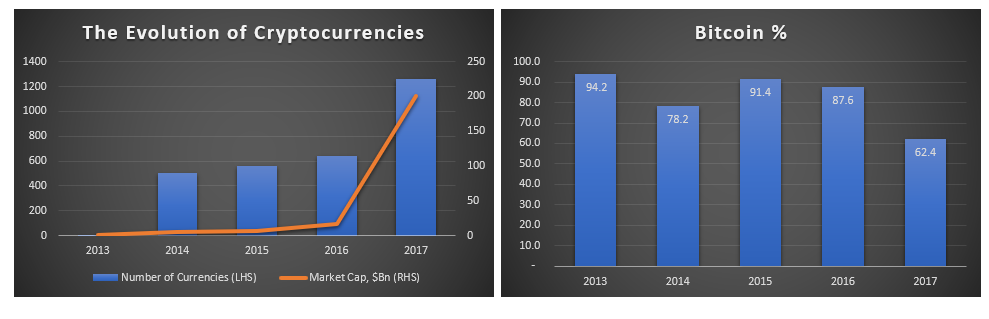
In 2013 there were just 7 alternative digital currencies with a market cap of about $1.5Bn. Bitcoin was the largest amongst them (see Charts at the top).  By October 2017, the number of crypto currencies had risen to 1260 and their market cap to $201Bn. Bitcoin is still the largest but its share has fallen from 94% to 62%. However, the top three cryptocurrencies (Bitcoin, Ethereum and Ripple) still comprise 85% of the total market cap.

The proliferation of these private cryptocurrencies fills a void in the money supply which the central banks have not been able to fill despite the massive increase in their own digital reserves (i.e. the central bank balance sheets). The economy is lacking a medium of exchange (and the subsequent unit of account) in order to operate at its optimum level. The traditional income distribution model, Work=Job=Income, which has characterized the industrial economy so far, stopped working sometimes in the early 1980s with manufacturing finally giving way to services.

In the late 1990s, as the digital economy started gaining speed, consumers started making up for their lost income with debt ‘secured’ by real estate and engineered in the so-called shadow banking system: private ‘AAA-rated’ subprime mortgage pools acted as ‘mediums of exchange’ in a not-so-dissimilar manner to today’s cryptocurrencies. The end of the debt super cycle in 2008 put a stop to that, and with the central banks unable to do anything about it, cryptocurrencies came to the fore.

Despite the massive rise in cryptocurrencies’ market capitalization, they are still less than 1/6 of the subprime total market capitalization at the peak of the crisis in 2007. One could say that they are not, yet, in any way, shape, or form of a systematic significance to the financial system. The problem is that at the growth rate the cryptocurrencies’ market cap is rising, it will reach that critical level ($1.3Tn for subprime) in a couple of years or so. So, perhaps, we may be in 2005 or 2006 equivalent to the 2008 financial crisis?

In addition, however, there is the further danger that crypto currencies are a much more direct competitor to central bank legal tender than shadow banking money because of the ease at which they can be accepted as medium of exchange and unit of accounts in retail outlets. As more economic transactions go through private digital currencies, central bank monetary policy could become less relevant. If there is less need for final settlement in central bank reserves, this threatens the whole existence of the central bank. In addition, if the crypto currencies do not use the private banking system for payments, what is the role of the private banks?

Bitcoin’s major flaws

There is a lot of stake to the current monetary transmission mechanism and it is for this reason why the central banks are starting to react (see above). If history is any guide, they will not hesitate to outlaw any attempt which is aimed at taking over their privilege to govern the money creation process. But Bitcoin also has numerous flaws on its own (the below written from a non-technical, but rather functional, point of view as it pertains specifically to money creation and transmission).

Store of value vs medium of exchange and unit of account. Bitcoin is trying to be both as seen by the various jurisdictions coming with different classifications for it (asset vs currency). But NOTHING can be all these things together at the same time and to the same extent. Bitcoin is a store of value first and a medium of exchange/unit of account second. That is a is problem if it is trying to be a currency. For, if a currency is expected to increase in value it is much more likely to be hoarded than exchanged and thus it is very unlikely to ever become a unit of account. A normal currency’s value is a derivative of its medium of exchange/unit of account function, not the other way around as in the case of Bitcoin.

If Bitcoin, on the other hand, is an asset, then it cannot expect to be a medium of account and unit of exchange in the real economy. However, that puts into question the source of its value in the first place. Compare to gold which, similarly to Bitcoin, has been used as a store of value for centuries due to its pureness (difficult to forge), malleability (ease to transport) and scarcity (limited additional supply). But at least, when all else fails we use gold for decorations. In addition, and more importantly, the authorities gave a big stamp of approval to gold by using it as the core of their money creation process. And when they did not, they did not like us to do it either (confiscation of gold during the Great Depression).

Fixed-end supply. A total of 21m bitcoin can be created. Unless the protocol is changed, the last bitcoin will be “mined” in 2040. Moreover, the rate of bitcoin supply gradually decreases each year (current inflation rate of bitcoin supply is around 4%). By some estimates already 3 out of every 4 bitcoins ever to be created are already ‘mined’. Needless to say, that is why Bitcoin is considered valuable.

But as seen in the preceding paragraphs, if this also destroys the purpose of bitcoin’s use (and assuming there are no other reasons why anybody would want to hold bitcoins), then it also degrades its value. The actual supply of bitcoin can be both much smaller than 21m (miner underplay and other technical peculiarities, loss/destruction of bitcoins) and larger (protocol is changed or the idea of ‘fractional reserve bit-coining’ is practiced).

High energy costs. I already touched on this issue here. More knowledgeable people have written extensively on the technicalities of energy usage in bitcoin ‘mining’ (see, for example, this, “One bitcoin transaction uses as much energy as your house in a week”) so I am not going to spend more time on this.

Transaction processing speed. Bitcoin’s blockchain can process low single digits to low double digits transactions per second. This is much lower compared to traditional payment system providers (Visa, MasterCard, PayPal, etc.) which can process thousands of transactions per second. There is thus a big question to the scalability of the bitcoin as a medium of exchange in the payment mechanism.

Of course, as the technology advances, more progress is expected in this regard (for example, see “Bitcoin Lightening Network: Scalable Off-Chain Instant Payments”, J. Poon, T. Dryja, January 2016). However, the speed of processing, the energy usage and the security (see below) can be increased several-fold if the blockchain process is designed to be ‘permissioned’ (Bitcoin is ‘permission-less’) as in when governed by a central bank, for example, in the case of CBDC.

Security and privacy risk. Without a ‘central authority of last resort’, there is a bigger risk of losing bitcoins than cash deposits, for example. If you lose your private key, or the hard drive gets corrupted, there is no one you can turn to help you retrieve your bitcoins (this is the equivalent of losing your physical cash). The same holds true for the possibility of reversing a bitcoin transaction, if, for example, it is done by mistake – it is not possible (there is a technical solution called ‘multiverse transactions’ but it cannot be done in a decentralized system like the blockchain as it involves a third party).

In addition, it is possible in theory for a major ‘miner’ with enough computational power to ‘fork’ the bitcoin blockchain for his/her own gain. This also opens up the system for potential fraud by altering past records. If the blockchain is permission-less, as in the case of Bitcoin, nothing stops a ‘miner’ to eventually gain this computational power (including collusions amongst miners – how many people trading currently bitcoin, for example, can understand exactly the permutations behind the most recent fork in the Bitcoin blockchain and why really this was done).

Finally, there is also the issue of hacking, whether the bitcoin is stored in an e-wallet on the internet, or with a centralized exchange, it does not matter (understanding the security of a physical bank is one thing; getting your head around cybersecurity is totally another).

Conclusion: Bitcoin and all other cryptocurrencies are a natural development of the money creation process. They are a result of the free market’s response to the breakdown of the traditional income generation model, which had been in existence since the Industrial Revolution, and the authorities’ inability, or rather, refusal, to address it by creating additional mediums of exchange and distributing them among the population.

The cryptocurrencies, however, are an imperfect solution, at best, to our money problem. Taken to the extreme, they could threaten the existence of the central bank and the banking model, in general. However, the technology inherent in them, the blockchain, used in accordance to the regulatory framework of a central bank and without much change to the current banking system, could shape the new money system which fits better our modern digital economy.

‘Mining’ for money is a ridiculous idea

03 Friday Nov 2017

Posted by beyondoverton in blockchain, Debt, Monetary Policy

≈ 2 Comments

Martin Walker (FT Alphaville) touches upon an important aspect of the modern crypto money creation process: the ridiculous costs and unnecessary side effects of digital ‘mining’.

Bitcoin exemplifies our bizarre relationship with money through the ages stemming from our lack of understanding of what it is. It’s as if we are cursed to never come to terms with money’s functions and how they help us progress. Our problems started with us prioritizing the ‘store of value’ of value function of money over ‘medium of exchange’ and ‘unit of account’. For if money is expected to increase in value, it is much more likely to be hoarded than exchanged and thus it will eventually cease to be a reliable unit of account.  

From the very beginning of humankind, it has indeed been a constant one step forward, two steps back kind of dance with our faithful companion. Money originated as a ‘gift’= a debt of gratitude to our fellow tribal members who shared their luck of finding more food than they needed. When our memory (of ‘how much’ we owe whom) failed and disagreements became common, we created the first money ledger run by the first central authority (the tribe leader): lines in the sand of who ‘owes’ who.

From there on, it all went downhill for different reasons: huge, cumbersome stones; other stupid object; precious metals… There were some interruptions to this craziness: the time of the Roman republic, the first fiat money in China, the Italian city states creating the first modern ledger during the Renaissance. But generally speaking the crazy money mist always came back and deluded us in going to extremes (mining foreign lands, killing indigenous people, etc.) to obtain shiny objects and call them money.

Until it all ended in 1971 when Nixon pulled the US out of the Bretton Woods Agreement and fiat money became the norm globally. And now, in 2017, having reached an extraordinary level of human progress, once again the mist is descending in front of our eyes and we are thinking about going back to ‘mining’ for money?  

Plenty of liquidity but scarce money

05 Thursday Oct 2017

Posted by beyondoverton in blockchain, Debt, Monetary Policy, UBI

≈ 3 Comments

“All the perplexities, confusion, and distress in America arise…from downright ignorance of the nature of coin, credit and circulation” John Adams in a letter to  Thomas Jefferson

1)We should have never ‘put together’ “store of value” and “medium of exchange”.    

2) If something has intrinsic value which is expected to go up in time, it will be hoarded and exchanged less often.

3)’Money’ is a “unit of account” which we ‘exchange’, in order to efficiently get the things we really need and want in life.

4)Inflation/Deflation are simply measures of whether ‘money’ is abundant or scarce relative to the economic activity we desire.

5)In the economic system we have created, purchasing power is gained either through paid work or through credit.

7)As long as companies earn a profit, they retain more ‘money’ than they distribute in wages and other payments, thus there is insufficient medium of exchange to meet the supply of goods.

7)Even if companies invest the profit in new projects, this only adds to the previous supply-demand imbalance unless new medium of exchange is added endogenously in the form of credit.

8)Advances in technology make the old paradigm of Work=Job=Income obsolete; purchasing power is lost.

9)Credit only makes the scarcity of ‘money’ more acute because new medium of exchange needs to be added just to pay the interest on the debt; a vicious cycle develops.

10)This credit/debt cycle also eventually comes to a natural end (2008); no more purchasing power can be added even endogenously.

11)If we want to keep the current economic system going, we need to find a new way of generating ‘purchasing power’.

12)But if the paradigm has shifted, normalization is meaningless; instead of going back to something that does not work, let’s look forward.

12)’Helicopter money’ has an, unjustifiably, bad reputation historically.

13)UBI is politically unfeasible to implement in a large country with open borders.

14)The problem with them in the past has been our lack of knowledge of existing economic activity, and thus our inability to disburse the right amount of purchasing power needed.

15)M≠PxT, so we invent V, in order to MxV=PxT

16) Both of them, however, are great ideas which need to be put in the context of our existing institutional framework.

17)The central bank opening its balance sheet (CBDC) to the public at large is the next step in monetary/fiscal policy.

18)Blockchain, as in a large, open, decentralized, distributed, real-time database of all economic transactions, is the digital equivalent of ‘GDP’ of the industrial era.

19)The Fisher’s equation above then takes the form of CBDC=Blockchain, ‘money’ matches economic activity.

What if central banks gave the QE money to the people?

03 Tuesday Oct 2017

Posted by beyondoverton in blockchain, Debt, Monetary Policy, Questions, UBI

≈ Leave a comment

I would not be blindfolded by the fact that the US is trying to go back to ‘normal’ with the Fed on a rate-raising spree. ‘Normal’ changed a long time before 2008. You cannot go back to ‘normal’ with a broken monetary transmission mechanism. We can create all the money in the world but if it goes in the hands of the few, if it is subsequently ‘hoarded’ and if it cannot  reach the end consumer because Work≠Job≠Income (whether that is because of technology, globalization or whatever) or because the credit channel is closed (the end of the private debt super-cycle in 2008), the economy is not going to go anywhere. And if there is little demand because there are not enough mediums of exchange, aka money, circulating in the economy, optimizing production is a waste of time and resources.

Instead of focusing on going back to a ‘normal’ interest rate policy, a forward-looking central bank would be looking into the opportunity presented by the rise of the blockchain technology and the subsequent spread of digital cryptocurrencies. The latter are a direct response to the broken down monetary transmission mechanism: if the traditional mediums of exchange do not circulate in the economy, people are devising their own ways of exchanging goods and services.

The interest-rate cycle is something of the past now. If the financial crisis of 2008 did not make it obvious, perhaps, we have to wait for the next one, which would be here like clockwork as policy makers embark on the policy of ‘normalization’. But there is some hope that some central banks are looking into ways to introduce a digital currency of their own and opening their balance sheet to the public at large.

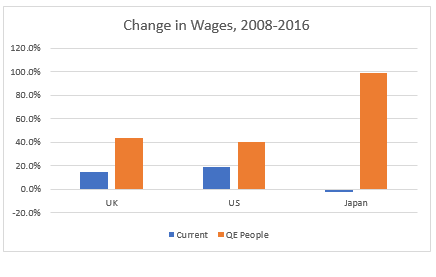
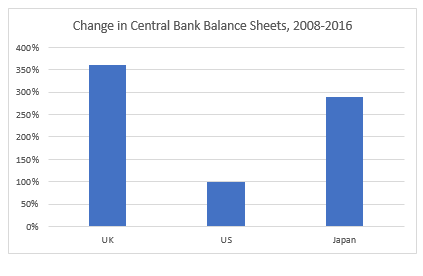
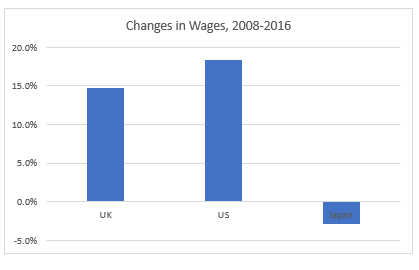
Back of the envelope calculation shows that if the money spent on buying financial  assets by the central banks of UK, US and Japan, was instead disbursed directly to the people, working wages would have risen substantially.

Between 2008 and 2016, central banks’ balance sheets have risen by 360% in the UK, 99% in the US and 280% in Japan.

Source: Bank of England, US Federal Reserve, Bank of Japan

At the same time, over this period, nominal wages have risen by only 14.8% in the UK, 18.4% in the US and actually fallen by 2.9% in Japan! In 2016, the average annual wage in the UK was GBP 34,142, in the US – USD 60,154 and in Japan – Yen 4,425,380.

Source: OECD

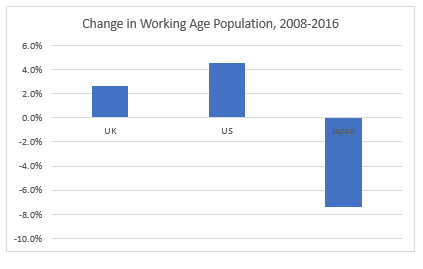
Japan is peculiar also because its working age population declined by 7.4%, while US’ and UK’s rose by 4.5% and 2.7%, respectively, during this period.

Source: OECD

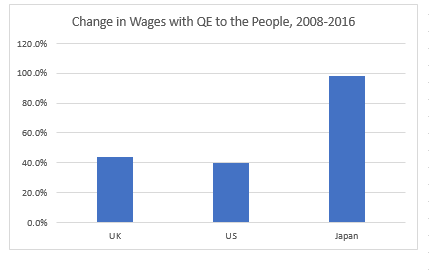
I took the actual change in central bank balance sheets and divided it over the average working age population between 2008 and 2016. If this money could have been disbursed directly to the people, workers would have received a lump sum of GBP8,574, USD10,997, Yen4,430,424 over the period.

Let’s imagine that this lump sum was disbursed to the working age population at the end of 2016. Compared to 2008, their wages in 2016 would then have been higher by 44% (UK), 40% (US), 98% (Japan)!

If wages could indeed ‘miraculously’ rise by almost half in the UK and US and almost double in Japan over this 8 year period, what are the chances that we would still be stuck around 2% inflation in the US and UK and around 0% in Japan? Where would GDP be?

This is a very simple exercise. Undoubtedly real life is much more complicated that this and it is rarely black and white. Moreover, this would have been a lump sum disbursement, a one-off boost to income, and not a permanent rise in wages. Consumer behavior in this case, Ricardian equivalence, etc., would have been very different from a situation with a permanent rise in wages.

However, instead of patting ourselves on the back that things could have been much worse had the central banks not backstopped the financial system by buying financial  assets, can we not also think how they could  have also been much better if we found a better use for the money miraculously created out of thin air? If we could create money out of thin air to boost financial asset prices, is it really not possible to devise a way whereby the consumer also gets a permanent rise in income? Can we have an adult conversation about the effects of such an experiment without resorting to the taboos of the past? Can we include people other than economists in this conversation?

The free market may be the best and most efficient optimization model available so far to us, but what if we are optimizing the wrong variable?

There is nothing extraordinary about the rise of central banks balance sheets

29 Friday Sep 2017

Posted by beyondoverton in Monetary Policy

≈ 1 Comment

There is nothing more deceptive than an obvious fact.

–Arthur Conan Doyle, “The Boscombe Valley Mystery”


  • Major central banks’ balance sheets (Fed, ECB, BoJ) have increased by about $10Tn since the collapse of Lehman Brothers in 2008.
  • There is nothing extraordinary about this fact.
  • This is also how much the IMF estimates the global shadow banking system has lost in about that period.
  • Is this a coincidence?
  • I do not have the data for the shadow banking monetary liquidity globally, but looking at data for the US, shadow banking liquidity has fallen by about $5tn while the Fed’s balance sheet has increased by about $4tn since the 2008 crisis.
  • Still think it is a coincidence?
  • The core of our monetary system is money as credit. If the commercial banks/broker dealers cannot perform the collateral intermediation process as necessary for the monetary liquidity to reach its designated purpose, the central bank has to step in and lend its own balance sheet.
  • The collapse of Lehman Brothers struck directly at the core of the shadow banking system and caused monetary liquidity to collapse as a result. However, in the years that followed, developments on the regulations side (Basel, Dodd-Frank) have further prevented the banks to provide enough monetary liquidity.
  • As long as shadow banking liquidity continues to deteriorate, the central banks will have to plug in the difference just to keep the monetary liquidity from going down.
  • For example, the Fed’s balance sheet stopped growing in 2014 and that’s about when the ECB’s started growing again.
  • Global liquidity is still predominantly in USDs and a lot of that is generated in the offshore dollar market. The ECB, BoE, BoJ have become the de facto dealers of last resort in there. They are providing an extraordinarily formal backstop of this global dollar funding market.
  • This is a good thing. The increase in central banks’ balance sheets is a source of stability, not a reason for concern.
  • We are formalizing the shadow monetary liquidity. As long as this is ongoing, it would be difficult for a sustained rally in the USD.
  • The financial crisis of 2008 has put a lot of economics taboos out for discussion. How money is created in a fiat sovereign monetary system is one of them.
  • Going forward, central banks’ balance sheets may not only not shrink, but they may continue to increase if the central banks allow public (retail) access to them. As the process of digitalization advances and as cryptocurrencies continue to spread, they may not have a choice.

Frederick Soddy: The Role of Money

15 Friday Sep 2017

Posted by beyondoverton in Monetary Policy, Quotes

≈ Leave a comment

“Money now is the NOTHING you get for SOMETHING before you can get ANYTHING.”

  • This book attempts to clear up the mystery of money in its social aspect. With the monetary system in the whole world in chaos, this mystery has never been so carefully fostered as it is today. And this is all the more curious in as much as there is not the slightest reason for this mystery. This book will show what money now is, what it does, and what it should do. From this will emerge the recognition of what has always been the role of money. The standpoint from which most books on money are written has been reversed. In this book the subject is not treated from the point of view of the bankers as those are called who create by far the greater proportion of money but from that of the PUBLIC, who at present have to give up valuable goods and services to the bankers in return for the money that they have so cleverly created and create. This, surely, is what the public really wants to know about money.
  • In this book the mode of approach and the philosophy of money is expounded in the light of a group of new doctrines, to which the name ergosophy is collectively given, which regard economics, sociology, and history with the eye of the engineer rather than with that of the humanist.
  • To this day we are in the grip of a mercantile system which fritters away in distribution most of the advantage gained in lightening the labour of producing wealth.
  • Money now is the NOTHING you get for SOMETHING before you can get ANYTHING. As a matter of fact, this definition not only answers comprehensively what money now is but answers perfectly satisfactory all that money has always been, whether it has been coin or paper or any other form. From the point of view of the owner or possessor of it, money is the credit he has established in his favour with the community in which it passes current or is “legal tender”, by having given up in the past valuable goods and services for nothing, so as to obtain at his own convenience, in the future, equivalent value in turn for nothing. It is merely an ingenious device to secure payment in advance, and in a monetary civilization the owners of money are those who have paid in advance for definite market values if buyable goods and services, without as yet having received them.
  • Money, of course, is an entirely peculiar form of credit-debt relation from which no one can escape. Its exchange value depends, in fact, simply on the amount of wealth people voluntarily prefer to go without rather than possess.
  • The essential feature of money is that it is given in exchange of a wealth that currently does not exist, otherwise it would have been bartered. So, money is a legal claim to wealth over and above the wealth in existence. The owners of money possess claims to what they have given up, but what they have given up does not actually exist. Thus, the constant need to produce more and more goods. That is why money is virtual wealth.
  • If we examine the history of progress, the direction it has taken appears so often a matter of intuition and conviction, rather than to depend on anything that at the time would have been accepted as convincing or logical proof. One, certainly, of these signs is how what appears nothing so much as a jig-saw puzzle of disconnected events and conundrums suddenly seems to fit together into a picture, to be lost again in a haze of uncertainty, but always returning, each time a little more orderly and definite.
  • [N]ot one of the maladies afflicting the relations of men to-day are due to any real physical insufficiency, such as characterized the earlier epochs of history. They are due to the exact opposite,” over-production,”” glut,” competition for markets, and the like, which renders the continued existence of poverty and destitution a physical absurdity. Where Mr. Baldwin asked “What is the use of being able to make goods if you cannot sell them? ” the new economist would say at once ” Why don’t we sell them? What is money for? ” and so cut at once the Gordian knot of the whole tangle.
  • In brief, we live in a scientific age, the purpose of which is frustrated by the survival of beliefs in money, as the practical mechanism of distribution, which are the exact opposite of those which have made that age possible. The symptoms and repercussions are of infinite obscurity and complexity, but the remedy is neither obscure nor complex. It is as devastatingly simple and effective as correcting an error of arithmetic.

Source: “The Role of Money: What It Should Be Contrasted With What It Has Become”, 1934

Missing liquidity, good intentions and unintended consequences

14 Thursday Sep 2017

Posted by beyondoverton in Monetary Policy

≈ 5 Comments

Source: Z1 Flow of Funds*

The queen asked the wrong question

In November 2008, the Queen of England asked why no one saw the credit crunch coming. That was kind of unfair. The thing is quite a lot of people saw it coming. Some of them even publicly warned about it (even though that went on for many years in advance, so people ignored them). However, very few people did something about it (those that did are now ‘legendary’ and there are books written and movies made about them, to say nothing that they are also very rich as a result).

The right question to have asked is why nobody in authority did anything about it. I suspect that is the case because very few people actually understood what was going on and why it was happening. The data was not there. It goes back to the fact that it is pointless to guess what people think because that would not help you ascertain what they will do. Our mind freezes when we are facing options and we do not have the data or the ability to analyze the data in order to help us make a decision. In most situations that matter, therefore, people act only when they do not have a choice.

Smart ideas implemented too early could be a job killer

Most people in my circle of risk takers in 2006 and 2007 knew very well that something was afoot with all this subprime mortgage origination going around. Even if you were not a mortgage specialist, there was plenty of anecdotical evidence of how extreme the situation had gotten. The thing is most of us had been through the emerging market crises of the previous decade and, having survived that, had the temerity of selling risk way too early ahead of the Dotcom crash. There was no way we would have made make that same mistake so soon again in 2006, or 2007.

However, even in early 2008, when the pressure was mounting with funds and banks going out of business, there was still a general feeling of calm and belief in the status quo. The markets had been easy for the last 5 years before that and very few people were crunching the numbers and doing their homework. Everyone was just riding the trend. In fairness, it was not obvious how and where the macro problem was. Traditional liquidity was plentiful despite the Fed raising rates, traditional bank leverage was also not that high. You either had to go micro and do the really had work (aka Michael Burry) or be lucky (some people were, as always).

The case of missing money 2008 edition (flying blind in an ocean of data)

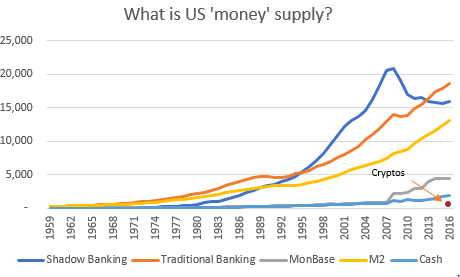
How should we measure monetary liquidity in our modern economy? We know that the physical notes and coins which the Fed and the Office of the Mint in the US, for example, produce is only a small % of the actual money supply (‘Cash’ in the chart at the top of the post). Moreover, we know that this cash is circulated only when the public demands to exchange its digital money for physical ones. The 2008 financial crisis has also finally taught us that majority of the money created is done by the ‘private’ banks in the process of loan origination (‘Traditional Banking’). Some people, however, are still confused with the base money creation by the central banks (‘MonBase’), calling it ‘printing money’. These excess reserves at the Fed, for example, are nothing but a monetary ‘cemetery’. They are stuck there, unable to enter the real economy unless new debt is created.

However, there is also the shadow bank money. The Fed defines shadow banks as “financial intermediaries that conduct maturity, credit, and liquidity transformation without explicit access to central bank liquidity or public sector credit guarantees.” Shadow banking had existed for many years but in the mid-1990s it took over the dominant position in liquidity transformation ahead of traditional money supply (chart at the top of the post).

The first problem of shadow banking, apart from the two obvious ones in the definition above, namely no access to central bank balance sheet and no public guarantees, is that it is done off the brokers’ balance sheets.

The second one was that the brokers, which were the dominant shadow banks, relied completely on the interbank market. Lacking deposits and access to the central bank, their funding was at risk every single time interest rates in the wholesale market went haywire or the value of the collateral (see below) declined.

And the third problem was that in the period between the Dotcom crash and 2008 the ‘safe’ collateral that forms the base of shadow banking liquidity transformation was mostly repackaged private debt in the form of (sub-prime) mortgage back securities.

It was a combination of all of the above which made the 2008 financial crisis so unique: 1) it was difficult to measure either the total liquidity in the system for macro-economic reasons, or the banks/brokers’ financial health; 2) the monetary system was much more dependent on the level of interest rates: one, it affected them directly in the interbank market, and, two, indirectly, as high interest rates eroded the ability to stay current on the mortgages which were at the core of the system -> mortgage assets plunged and -> the shadow banking funding was cut further.

Because most of the money before the crisis was created outside of the remit of the central bank, cutting rates, as was the traditional way of getting liquidity back in the system, did not work without also supplying enough safe assets at Par.

Be careful what you wish for because it can have unintended consequence

The rise of the shadow banking system coincided with the process of the financialisation of the economy in the 1980s and 1990s. As corporate profits increased at the expense of labor, capital was created but never circulated in the real economy. Instead it was hoarded at the top. The economy needed an alternative source of liquidity and the market provided it in the form of shadow banking. However, the Clinton administration’s plan to eliminate the government budget deficit towards the end of the 1990s also meant a substantial decline in US government bonds issuance.

That was a problem for the shadow banking liquidity as safe assets were essential in the liquidity transformation process. But again, the market responded by creating a plethora of seemingly ‘safe’ private assets by combining risky subprime mortgages with prime (GSE-backed) mortgages. In the beginning this suited everybody: the people who, while their real income had been declining, could now get credit to buy houses (and other durable goods), the government, glad to see the economy booming again, shortly after the shock of the Dotcom crash, the central bankers, quick to raise rates to give themselves  some room for cutting them later on, the rating agencies not turning away the extra commissions and eager not to spoil the party by giving ‘everyone a high grade’, and, finally, the banks, opening another avenue of revenue generation.

But the more the Fed raised rates the more difficult it was for those homeowners to stay current on their mortgage payments. We had three forces working together in that regard. First, as seen above, the whole system incentivized the creation of as many mortgages as possible. So, it was a question of volume. Second, there was little regard in terms of how that volume was generated. So, it was a question of very questionable mortgage origination practices (NINJAs, a lot of ARMs, etc.) And third, the price of real estate was rising rapidly. So, it was a question of even more debt in order to be able to buy that more expensive house (many loan-to-value mortgages above 100%). While at the same time real wages were still declining.

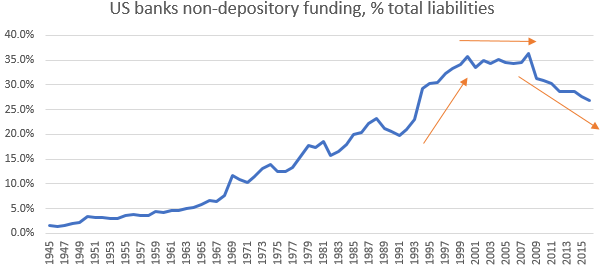
This was not rocket science. But it was the perfect storm that no one wanted to see coming because everyone was enjoying the party. And even though it was not straightforward to see it in the data, there were signs. For example, the chart below shows the non-depository funding (i.e. any other funding but checking and time-deposits which are the most secure ones) of US banks as a % of total assets. In the 1990s there was a spike in banks’ wholesale funding: repos, debt, open market paper, etc. The line flattened thereafter before hitting an all-time high in 2008. After 2008, the banks have continued to move away from wholesale funding in line with the decline of the shadow banking as well as with the new banking regulations.

Source: Z1 Flow of Funds

Bottom line is that despite the rise of math and science PhDs taking over the mortgage structured departments at the banks and broker dealers creating more and more complicated mortgage products, it was simple math that at some point eventually, as long as the Fed kept raising interest rates, the music will stop. No one knew when that would happen though and no one wanted to be the first to leave.

However, when it eventually happened, it was not clear why it happened. Lehman Brothers (one of the main cogs in the shadow banking system) was let go even though just a few months before Bear Stearns was ‘saved’. Letting a broker-dealer go under maybe was to teach a lesson at no such great cost to the system as it was not a depository institution, I do not know, but whatever the reasoning behind it was, it spectacularly backfired as the whole shadow banking system collapsed. The Fed had no choice but to take Morgan Stanley and Goldman Sachs under its wing shortly after Lehman’s bankruptcy (they officially became depository taking institutions).

The case of missing money, current edition

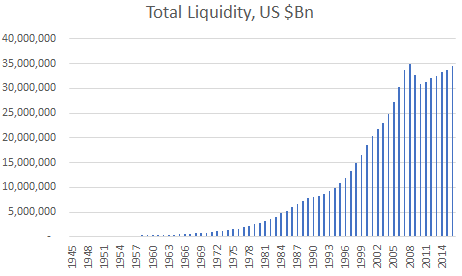
We still have no idea what our money supply is. Shadow banking liquidity continues to decrease and even though traditional money supply has continued to rise, total liquidity now is still just about at the same level as the peak of the 2008 financial crisis (chart below).

Source: Z1 Flow of Funds**

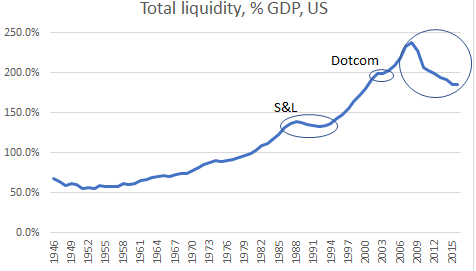
Relative to GDP, the situation looks even worse (chart below). Total liquidity as a % of GDP continues to decrease 8 years after the financial crisis. During the Dotcom crash, it only flattened out, but during the previous debt crisis, the 1990s Savings and Loans Crisis, total liquidity as a % of GDP decreased for about 5 years.

Source: Z1 Flow of Funds

It is no surprise then that we see the emergence of cryptocurrencies. They are the new fake safe private assets in a system starved of money and with real incomes still barely rising. With a total market capitalization of all cryptocurrencies of around $150bn, they are just about 10% of the US physical notes and coins in circulation, and only above 1% of US M2, so not an immediate and systematic danger to the monetary system. But unlike subprime mortgages, their digital and decentralized nature would allow them to spread very fast if the circumstances allow. And just like shadow banking liquidity, they are difficult to follow, let alone measure. Therefore, it is imperative for central banks and regulators not to get too complacent yet again.

*Shadow Banking Liquidity is defined as the sum of all sectors open market paper, holding companies’ debt and loans, GSE total liabilities, Agencies total liabilities, Issuers of asset-backed total liabilities, money market mutual funds total liabilities, broker-dealers repos; Traditional Banking Liquidity is defined as private depository institutions total liabilities; Cryptos is cryptocurrencies which is not to scale; All numbers in $Bn

** Total Liquidity is the sum of Shadow and Traditional banking liquidity

China’s belated move to ban ICOs could actually push token prices higher…

05 Tuesday Sep 2017

Posted by beyondoverton in blockchain, Monetary Policy

≈ Leave a comment

…in the short term as the supply of new tokens becomes restricted, and if demand stays the same. However, further regulations are more likely to take prices lower. Down the line, I would not be surprised if some tokens disappear completely.

To a certain extent, the crypto-mania now reminds me of the dotcom mania in the late 1990s. Both of them have an underlying cause that justifies their rise. In the case of dotcom it was the beginning of the digitalization of society (new ways to connect, work and entertain) and the promise of the commercial internet (new way to shop!). In the current crypto-currencies craze, the underlying cause is the scarcity of money, stemming from the rise of inequality on the back of the breakdown of the Work=Job=Income model, and the following promise of creating the new medium of exchange using a totally different framework (i.e. if we cannot get  the medium of  exchange by having a job, and it the central banks would not print the medium of exchange and  distribute it to the population at large, the population at large will create its own medium of exchange).

I know bitcoin, for example, is down 12% from the announcement of the ban on ICOs. That’s still less than the last time, in March this year, when PBOC also announced it was looking into tightening regulations on bitcoin trading. But that’s beside the point. One could say the most recent news is, actually, more important.

And it is indeed more likely that as the authorities start introducing even more regulations on crypto-currencies, their prices will become … less volatile but also settle down in a lower range. After all, without regulations, and without an underlying businesses per se, crypto-currencies currently do have an advantage over other regulated asset classes. But, strictly speaking, from a flow perspective, restricting the supply of an asset, should make its price go up, if demand is unchanged. The fact that new ICOs are not allowed should make the existing tokens more valuable.

Of course, that is only a short-term view, which does not take into account the possibility of further regulatory actions. It is surprising to me that it has taken such a long time for authorities to start looking into these ICOs and also, in general, into the spread of crypto-currencies, given that the latter are a direct threat to their own legal tender. In fact, there is confusion globally as to what indeed those crypto-currencies are. Are they an asset, a currency, or legal tender? Not only different countries have different definitions but in some countries the definitions vary depending on the regulatory authority even!

For the current crypto-mania to subside we do need to see central banks introducing their own digital legal tender accessible to everyone in society (and not just to banks and other select financial institutions as is the case now with central bank reserves). In other words, authorities need to address the underlying cause of the spread of the crypto-currencies. All other measures would most likely only temporarily slow-down their rise.


It should be abundantly clear by now, but let me state it here, that this blog does not constitute an investment advice. And I have no positions in any crypto-currencies/tokens.

← Older posts
Newer posts →

Subscribe

  • Entries (RSS)
  • Comments (RSS)

Archives

  • January 2023
  • December 2022
  • November 2022
  • August 2022
  • February 2022
  • April 2021
  • November 2020
  • October 2020
  • September 2020
  • August 2020
  • July 2020
  • June 2020
  • May 2020
  • April 2020
  • March 2020
  • February 2020
  • January 2020
  • December 2019
  • November 2019
  • October 2019
  • May 2019
  • March 2019
  • February 2019
  • January 2019
  • December 2018
  • November 2018
  • October 2018
  • September 2018
  • August 2018
  • June 2018
  • May 2018
  • March 2018
  • February 2018
  • January 2018
  • November 2017
  • October 2017
  • September 2017
  • August 2017
  • July 2017
  • June 2017

Categories

  • AI
  • Asset Allocation
  • blockchain
  • China
  • De-urbanization
  • Debt
  • Decentralization
  • EM
  • Energy
  • Equity
  • FX
  • g88kboy
  • Monetary Policy
  • Politics
  • Questions
  • Quotes
  • The last man standing will laugh
  • Travel
  • UBI
  • Uncategorized
  • VR

Meta

  • Create account
  • Log in

Blog at WordPress.com.

  • Subscribe Subscribed
    • BeyondOverton
    • Join 74 other subscribers
    • Already have a WordPress.com account? Log in now.
    • BeyondOverton
    • Subscribe Subscribed
    • Sign up
    • Log in
    • Report this content
    • View site in Reader
    • Manage subscriptions
    • Collapse this bar
 

Loading Comments...