• About
  • BeyondOverton Travel
    • Silk Road (1): If Turkey is in crisis, it’s not obvious visiting it
    • Silk Road (2): Could beautiful nature and ancient history create a false sense of entitlement?
    • Silk Road (3): Fast Car
    • Silk Road (4):We took a bus ride to Iran
    • Silk Road (5): Border bothers
    • Silk Road (6): Chevrolet Land
    • Silk Road (7): Free-roaming camels and wild horses
    • Silk Road (8): China West to East
    • Silk Road (9): I have not told half of what I saw
  • BLOG
  • g88kboy Travel
    • On the Silk Road
    • Bulgaria : The Chicken crossed the Road
    • Turkey : The Country, not the Bird
    • Georgia on my Mind
    • Armenian Ayran
    • Iran – The Curious Land
    • An American in Azerbaijan
    • Uzbekistan: Golden Teeth and Neon Signs
    • Kazakhstan: Thirty Sweating Seniors
    • China Part One – Pandas Are Extinct
    • China Part Two: My TED Talk (Deep Analysis)
    • Phillipines – They Relax, I (pretend to😉) Study
    • Singapore: flashing trees and a torrent of tears
    • Malaysia: That ain’t no croc, it’s a log
    • Brunei: The Instinctive Fight for Superior Domination
    • Phillipines: Hello Friend Again
  • Outside the window
    • Bulgaria
    • Turkey
    • Georgia
    • Armenia
    • Iran
    • Azerbaijan
    • Uzbekistan
    • Kazakhstan

BeyondOverton

~ let's move this window

BeyondOverton

Category Archives: Uncategorized

Low productivity is the least of our problems

17 Tuesday Oct 2017

Posted by beyondoverton in Uncategorized

≈ Leave a comment

Low productivity is the least of our problems. Why would we want to produce more output, when there is no one able to consume it, is beyond me. If we take care of our stagnating aggregate incomes and put more real purchasing power in the consumers’ wallets, productivity will take care of itself. However, it is a fact that the 200-year old Industrial Revolution-time model of income generation and distribution has broken down due to the spread of globalization and the rise of sophisticated technology which displaces even cognitive and non-routine human jobs. The problem is that we keep wanting to fix it instead of coming up with a new model which fits better our economic realities.

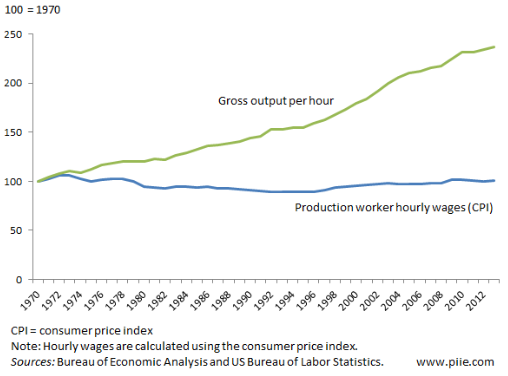
  • Low wages are not a result of low productivity. It is the other way around.
  • If full employment comes at the cost of lower wages, purchasing power may not rise and aggregate demand may not rise->output stagnates.
  • Stagnating numerator (output) and a rising denominator (employment)-> decreasing productivity.
  • Work dynamics have changed dramatically. The 200-yr old distribution model of Work=Job=Income is broken.
  • Machines are cheaper, more efficient and smarter than humans in increasingly more industry sectors.
  • The rate of growth of human cognitive skills (education and training) is unlikely to keep pace with the rate of growth of machine learning.
  • IBM Watson reads 1m books per second (now probably even more): 100k of human evolution is now ‘equal’ to 7 minutes of machine learning.
  • New ‘job’ creation in the digital era will happen but is unlikely to keep pace with the destruction of old jobs.
  • We will always want to work but do we need a job? If we create AGI but insist on people having a job for survival, we would have totally failed.

Random thoughts

22 Friday Sep 2017

Posted by beyondoverton in Uncategorized

≈ Leave a comment

  • In a free-floating fiat currency regime, sovereign bonds are the same as sovereign cash. They do not represent a promise to pay. Rather they are an accounting concept used to measure economic activity over time.
  • There is no bubble in sovereign bonds and the concept of valuation here is meaningless. Bonds are different from any other asset class because they have a terminal value and a maturity structure. They are simple math. No need to put bells and whistles there.
  • If the risk of default of a sovereign bond is 0%, then the only other risk is inflation. If also inflation is 0%? We happily hold risk-free currency in our pockets. Sovereign bonds are just like a savings account with the government instead of a private bank. How much do you get for a 1-year CD with your local bank at the moment? Why should 1-year T-bills yield 100bps more given that it is also better credit?
  • There is no natural rate of interest. Economics is a social science and there are many different equilibria.
  • However, over the very long run, interest rates have fallen from 25% in Babylonian times to almost 0% now in a consistent fashion through the ages. This is a result of the inevitable advances of innovation and the subsequent creation of extra surplus capital accumulation. There is no mean reversion in interest rates.
  • The only time interest rates have deviated from this long-term decline is when there has been a disruption on the supply side which had resulted in the subsequent destruction of capital. Wars and natural disasters or trade barriers and embargoes could be the cause of this. 
  • Negative interest rates are just one state of equilibrium. It may seem that they are central-bank imposed, however, the central bank only follows the market forces in their attempt to manage the debt burden.
  • Every single attempt by the central banks in the developed world to raise interest rates post the 1980s has been unnecessary as the economy has had plenty of surplus capital and labor on the back of years of peaceful technological advancement and no negative supply shocks. It has also backfired and led to recessions because of the increasing debt burdens.
  • Recessions are a balancing act. However, if economic balances are not resolved each following recession becomes more severe than the preceding one.
  • As the economy moves away from manufacturing, which requires heavy upfront investment, to services which require much less investment, and now to digital technologies which require even less investment, interest rates substantially lose their power to affect economic activity.
  • If it were not for externally-driven rising healthcare and education costs, US would have fallen in a deflation already in the mid-1990s.
  • If it was not for the decline in the labor participation rate after the 2008 financial crisis, the US unemployment rate would have been much higher. In addition, the jobs created in the last 8 years are predominantly in the service sector, low-wage, and in many cases, without benefits.
  • Yet interest rates affect the balance sheet of the financial sector. However, the effect is asymmetric. Lower rates push asset prices higher and make debts easier to service, but they do not cause an economic boom. Higher rates, on the other hand, cause asset prices to fall, but do nothing to liabilities which stay unchanged. This creates financial imbalances which eventually also cause economic imbalances.
  • Therefore, central bank interest rate policy may be effective in managing the financial economy but it can become a lose-lose game in servicing the real economy.
  • As a result, on one hand, there is an increasing demand for the medium of exchange from income-poor and debt-laden private citizens and for the unit of safety from savings-rich creditors. And, on the other hand, there is inadequate supply of both from the public sector.
  • This is not a recent phenomenon. We had a similar environment in the early 2000s. The market responded by creating fake-safe private assets (repackaged mortgage CDOs and the likes) which allowed the income-poor to buy real estate while it also provided a seemingly safe-haven for the savings-rich.
  • That did not work out well eventually.
  • The rise of cryptocurrencies in the last few years is just the more modern equivalent of these fake-safe assets. They are a result of the advances in technology but they also are a response to this broken monetary transmission mechanism which eventually led to the current inefficient income generation model.   
  • Cryptocurrencies simply fill in the void left by the central bank in its refusal to extend its balance sheet to the public at large. There is no other way for the public to receive the medium of exchange other than direct from the central bank at no cost: the private debt super-cycle in the developed world reached its peak in 2008, while the Work=Job=Income model broke down already in the 1990s.  
  • In the past, we used to call this kind of money creation by the central bank/government direct, “helicopter money”. It has a lot of negative connotations because of recent historical examples of autocratic rulers printing more money than the economy needed (and often for their own personal use). However, there are plenty of examples in earlier history when “helicopter money” actually worked in restoring and stabilizing economic growth.
  • Examples of that are the Roman Republic and the Song Dynasty in China when there was a solid institutional infrastructure guaranteeing social accountability.
  • The modern equivalent of “helicopter money” is central bank digital cash (CBDC – or some version of that). Given the rapid spread of cryptocurrencies, CBDC is inevitable. I wonder, though, whether CBDC would only be introduced after the next financial crisis forces the authorities’ hand.
  • In the present environment of large capital and labor surpluses, CBDC is unlikely to cause a runaway inflation unless it really is misused. The existence of solid institutional infrastructure in the developed world, however, makes that less likely.
  • However, there are still technical hurdles to the wider use of CBDC. Even with good intentions and with impeccable system of checks and balances, the world is too complex for human central planning.
  • What is the right amount of CBDC to inject in the economy? For how long? Does everyone get the same amount? Etc.  
  • Luckily, harnessing the enormous amount of data we have created using advanced machine learning and with the help of the blockchain to organize and store it, policy makers can draw conclusions about economic activity in real-time and thus supply the medium of exchange on demand.
  • Technological advances causing bigger and bigger capital and labor surpluses, the move from services to the digital economy causing lower and lower demand for investments, the introduction of CBDC making interest rate policy obsolete, what happens to our savings? What use is it to us? Can we live without financial assets?
  • This is not a trick question. Developed world governments have been buying up their own debt back and corporates have been buying back their own shares. Maybe that is a trend reflecting the new economic reality as described above…  

The turn in the bond market could come only after a negative supply shock

11 Monday Sep 2017

Posted by beyondoverton in Uncategorized

≈ Leave a comment

The bear market in bonds will not arise because of a pick-up in aggregate demand (AD) but because of a possible decline in aggregate supply (AS).

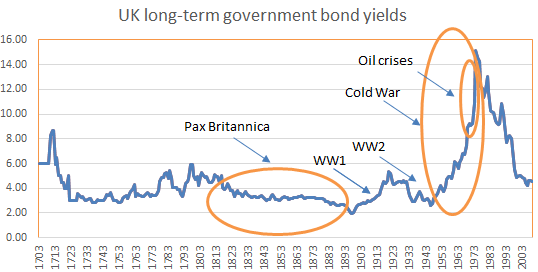
Source: BoE Three Centuries of Data

In times of peace (Pax Britannica see chart above), which allow for capital to accumulate, interest rates trend lower. Wars, conflicts, or even big natural disaster, deplete the capital stock and force interest rates to rise. Sometimes, when these negative supply shocks are one-off occurrences (the 1970s oil crises), we could get just a spike in interest rates; sometimes, if the conflict persists, the increase in interest rates can last much longer (the Cold War).

We are in a period when global capital surpluses have been accumulating at an increasing pace at least since the early 2000s when China entered WTO and most capital barriers were gone. Interest rates have been trending lower since the mid-1980s after the effects of the negative supply shock caused by the oil crises subsided and when eventually, shortly after, the Cold War ended. Some call this the biggest and longest bond bull market in history. It is, probably the biggest because interest rates have gone down from double digits in the 1980s to almost 0% now. But it is certainly not the longest. Interest rates in Britain trended down from 6% to 2% for almost 100 years in the 19th century.

We know that nothing lasts forever in life. Investment trends also end at some point. We spend a disproportionate amount of time and actual and mental capital on predicting these turning points. However, we should probably, instead, heed the words of famous British football coach, Kevin Keagan who is supposed to have said, “I know what is around the corner – I just don’t know where the corner is”. He almost sounds like a portfolio manager when he adds, “But the onus is on us to perform and we must control the bandwagon”.

If we are looking, nevertheless, for the turn in this global bond bull market, we are not going to find it in lower unemployment or even higher wages. In fact, it is unlikely to show up in any economic variables which determine AD. Instead, we should look for signs of any pressure on AS. In an environment of slowing population growth in the developed world and rapid technological expansion, AS can generally accommodate any expansion of AD. However, we should start to get worried if the sustained rise in inequality endangers our institutional infrastructure which leads to a social conflict.

Progress is deflationary. The moment humanity moved from hunter-gathering to agriculture we started creating capital and labor surpluses. Thanks to them we progressed as we could devote extra resources and time to other activities other than survival. At present, when work is equated with a job and income, few people connect that it was because of our leisurely activities that we had a chance to develop the arts and sciences of the past, which defined our culture and laid the foundation of our evolution through history.

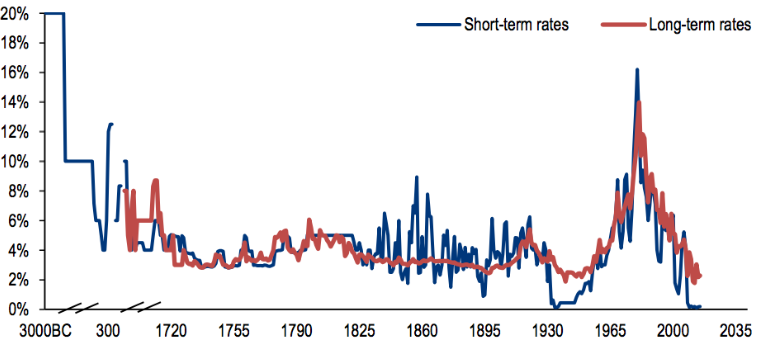
Source: Business Insider; original data from ‘History of Interest Rates’ by Homer and Sylla

Interest rates measure the cost of capital. So, naturally, when capital is abundant, ceteris paribus, interest rates should be low. And even though interest rates have generally moved from the upper left corner of the graph, in Babylonian times, to the lower right corner, now (chart above), history is full of examples when they also go up, and in some cases in a sustained fashion. There could be many reasons for that, but suffice it to say, that any event, natural (earthquakes, floods, etc.) or artificial (wars, epidemic diseases, etc.) which depletes either of the two surpluses would push interest rates higher.

Unfortunately, there have been many more artificial than natural disasters which have delayed our human progress. Nature is unpredictable, but human nature, not so much so. Therefore, some patterns keep repeating in history. Sometimes, it takes years for them to play out but eventually they do. For example, as mentioned above, ever since the Agriculture Revolution, and thanks to the prevalence of capital surpluses, the general norm has been one of AS > AD. The way we have dealt with this s to create an institutional infrastructure to help us distribute the capital surpluses in the most optimal way. Feudalism, capitalism, socialism are some examples of what we have gone through history depending on the level of our economic/technological development.    

The problem arises, when a paradigm shift comes around and changes the mode of both production as well as consumption. The Agriculture and Industrial Revolutions are examples of such positive supply shocks which changed the course of our evolution profoundly. In times like these, because of the inertia of the past and numerous vested interests, the institutional infrastructure takes much longer to adjust to these developments. Therefore, as the capital surpluses keep adding up but their distribution mode remains the same, and thus, outdated, the economy becomes more and more imbalanced (AS>>>AD). The point eventually comes when we ‘force’ a change also in the institutional framework to one more suited to deal with these new surpluses.

In the past these changes in societal structure have generally happened through wars and revolutions, a side effect of which has also been a sometimes substantial reduction of the capital (and labor) surpluses. For example, the period between the end of WW2 and now is considered one of general world peace. And indeed, relative to the horrors of the war which preceded it, it was. But despite the fact that indeed there were no major traditional global wars after 1945, the Cold War was a major global war of ideologies, in which few shots were fired, but one which caused a large capital outlay (military build-up, but also huge government investments in space exploration, and in general, technology).  In addition, there were a lot of proxy wars (Afghanistan, Korea, Vietnam) and conflicts (for example, the 1970s oil crises were a result of such a proxy conflict). As a result of that, interest rates tended to stay high.

By the end of the Cold War, when it was clear that capitalism had gained the upper hand as the main institutional framework of the time, interest rates started to subside. After the 1980s it was clear that USA was to become the global dominant power. In addition, all these government investments started to pay off and eventually ushered the Digital Revolution which is ongoing right now. To a certain extent, one could think of this period since then as Pax Americana, in reference to the global dominance of Britain during most of the 19th century.

Despite the war on terror, which has required also substantial amounts of capital, the fact that most of  the modern world has been in peace, has allowed the proliferation of globalization with trade and commerce booming. Not only the majority of the global surplus capital has found its way back to the US as the default safe haven given its dominance status (and given that the Washington Consensus had made sure most global capital barriers were off), but also it has been US corporates which have hugely benefited from the process of globalization. And finally, US households surplus savings have increased massively. In addition, the Digital revolution could also be ushering a similar paradigm shift to what happened after the Agriculture and Industrial Revolutions in the past.

Source: IMF

Around 60% of these FX reserves are in invested in USD. But is this excess foreign capital trend up now reversing?


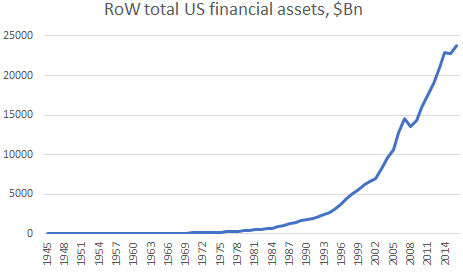
Source: US Federal Reserve Z1 Flow of Funds

The rest of the world (RoW) total US financial assets (market value) have continued to increase. There was an ‘exponential’ pick-up in the late 1970-early 1980s. As of the end of 2016 there was almost $24Tn of foreign money (private as well as public) invested in US financial assets.

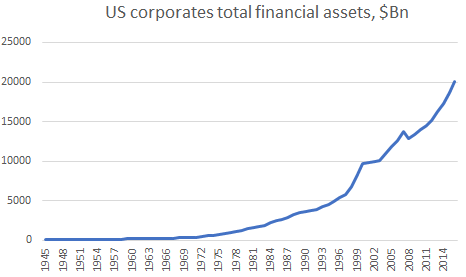
Source: US Federal Reserve Z1 Flow of Funds

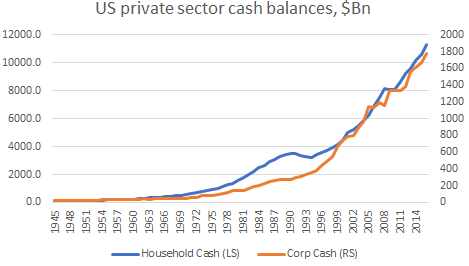
As of the end of 2016, US corporates held about $20Tn of US financial assets (of which about $2tn cash).

Source: US Federal Reserve Z1 Flow of Funds

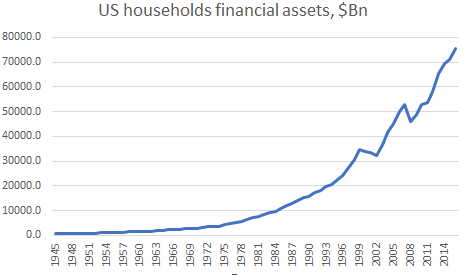
Finally, US households hold about $75tn of US financial assets.

The above numbers are in market value, and market value tends to rise in the long-run as GDP also tends to rise. But even if we strip out the rest and look at nominal cash balances, the US private domestic sector is in huge surplus (chat below).

Source: US Federal Reserve Z1 Flow of Funds

So, it is almost counter-intuitive from what we learn in economics where we are accustomed to believing that a rising GDP is associated with higher interest rates because of the need to suppress potentially inflationary pressures. Reality is that a rising GDP also produces more excess capital which tends to naturally put pressure on interest rates lower. In fact, I wonder whether, if the central banks do not artificially put up base interest rates to supposedly slow down the economy, in an environment of a declining population (slowing AD) growth and an accelerating growth of technological improvements (a large positive supply shock), interest rates would naturally drift lower as GDP rises.

Flying blind in an ocean of data

08 Friday Sep 2017

Posted by beyondoverton in Uncategorized

≈ 4 Comments

When it comes to the economy we have been flying blind for decades. Economic activity has evolved from manufacturing to services and now to something else completely: we are slowly leaving the physical medium and entering the digital medium where VR/AR, IoT, etc. are the new norms. Yet, we have continued to use the same data, the same measurement techniques, the same assumptions, and the same economic models. No wonder we are not getting anything meaningful form them, while economic growth sputters and inequality continues to increase. The risk here is to our long-established institutional framework. If recent events in the UK and US are examples of the effect of these technological and economic developments, then, barring a change of course, the political system in the developed world could come under even much more pressure.

There is so much to learn from history. Surely this is not the first time we have faced such disruptions. Indeed, after the crash of 1929 and during the following Great Depression, we similarly had no clue what to do. And it was largely because we did not know what had happened to us: thanks to the inventions of the Second Industrial Revolution, the economy had started transforming from being mostly agriculture to manufacturing. Technology had made possible both the production of increasingly larger quantity of goods (anything to do with farming at the time) and the displacement  (from employment) of increasingly more farmers: an uncanny increase of aggregate supply (AS) and a simultaneous decrease of aggregate demand (AD)!

“One reads with dismay of Presidents Hoover and then Roosevelt designing policies to combat the Great Depression of the 1930’s on the basis of such sketchy data as stock price indices, freight car loadings, and incomplete indices of industrial production. The fact was that comprehensive measures of national income and output did not exist at the time.” Richard T. Froyen, History of the NIPA

Part of the problem of not knowing what was going on was not being able to measure economic activity properly. Back then (the 1930s), in the 1980s, when the manufacturing to services transition was largely taking place, now, we seem to prefer to go on autopilot instead of updating our economic knowledge with the developments that have happened in other disciplines, such as technology.

For example, when manufacturing is only 12% of GDP, do we need to continue to put so much importance on manufacturing PMIs, for example? I remember sitting on my desk and looking at the Bloomberg terminal with trepidation every single time the NFP number was about to be released…No wonder it has become almost impossible to make money nowadays if our only gauge of economic activity is these publicized numbers. Correlations are broken, cause and effect has vanished. At best the numbers only give us a snapshot of a small and decreasing part of the ‘economy’, at worst they are totally misleading. Take, indeed, NFP: unemployment is close to its all-time lows and the Fed has hiked rates in anticipation of an inflation pick-up, but there is not even the prospect of inflation.

When the economic status quo changes and we ignore it, the ensuing vacuum creates imbalances which, taken to the extreme, can cause asset price crashes and extreme economic hardships. We got lucky in the 1930s in some countries which had strong leaders not afraid to take drastic actions – DLR’s ‘New Deal’; Takahashi Korekiyo’s ‘helicopter money’. It was fortuitous that some countries also decided to make a clean break from past economic models – the gold standard was abandoned. These measures might have been enough to stop the economic plunge, but not enough to return the economy to its pre-crisis prosperity.

We know in hindsight, sadly, that we had to endure a great war, to finally pull through the economic crisis.From an economic standpoint, WW2 did reduce aggregate supply as capital was depleted and destroyed. The government stepping in with increased spending on the war effort stabilized aggregate demand. It took more than two decades, but eventually both the economy and the stock market managed to recover the lost ground during the Great Depression.

Let’s hope that we do not have to go through the same experience this time around. With all this Big Data sloshing around, with the help of AI and machine learning and the prospect of quantum computing, someone out there surely is designing the next economic model to fit this new reality. Would the next Simon Kuznets, please, step up! According to the BEA, GDP was one of the great inventions of the 20th century and even though it took 8 years after the crisis for the data to be organized and officially put to use, it was worth it.

“Much like a satellite in space can survey the weather across an entire continent so can the GDP give an overall picture of the state of the economy. It enables the President, Congress, and the Federal Reserve to judge whether the economy is contracting or expanding, whether the economy needs a boost or should be reined in a bit, and whether a severe recession or inflation threatens.

Without measures of economic aggregates like GDP, policymakers would be adrift in a sea of unorganized data. The GDP and related data are like beacons that help policymakers steer the economy toward the key economic objectives.” Economics, 15th edition, Paul Samuelson and William Nordhaus

We need our own 2008 Great Recession GDP breakthrough. Yes, the NIPA accounts have been continuously updated since the 1940s, but for all intends and purposes it does feel indeed that we are adrift in a sea of unorganized data. Nowadays, there are billion of devices connected to the Internet with trillion of sensors but less than 1% of that data is utilized! For example, there are human sensors (miniature devices attached to our bodies which monitor our health) which could also be configured to monitor productivity; home device sensors which could give us real-time consumption; factory sensors which could give us real-time production, etc. Most of this data never reaches the operational decision makers.  Yes, there are still some technical challenges as connectivity and storage etc., but as the blockchain becomes even more sophisticated and the data is organized in a proper way, there should be no reason why it cannot be more widely used for macro decision making.

Just as GDP came as a response to the transition from agriculture to manufacturing in the 1920s, we should have looked into completely revamping our NIPA methodology probably already in the 1980s when the shift from manufacturing to services was completed. For example, accounting for services is more difficult as they are not uniform like manufactured goods and are often tailored to the customer.

At least in 1971 we scrapped another vestige of that old world – the Bretton Woods agreement. However, the two consecutive oil crises that followed, had the effect of one of those ‘black swan’ events that probably genuinely took us off course as they substantially curtailed aggregate supply and contributed to the rise of inflation. People do not get it but that supply shock in peaceful times was the anomaly. And because it was a one-off event and did not destroy capital (or labor) as during wars or even natural disasters, the inflationary spike which followed was literally temporary. But, instead, we hiked rates to double digits, and as the economy submerged even more, we got Reagonomics (supply-side economics) and adopted inflationary targeting (which we still practice even now).

When that did not work (in times of technological progress and peace – the period after WW2 – supply is never an issue, but demand is), we decided to financialize the economy and submerge it in debt. With the focus on the supply side and not on the fact that aggregate demand was faltering as manufacturing jobs moved into services but at a lower wage, the only way to replace the lost purchasing power was with debt.

Sadly, the result proved out to be not that much different than the 1929 crash (despite the numerous warnings: the 1980s EM debt crisis, the S&L crisis, the 1990s EM crisis…). In 2008 the great super debt cycle finally stopped for good. True, the aftermath of this most recent crisis was not the disaster the Great Depression had been. Thanks to those lessons from the past, we quickly resorted to a version of the ‘New Deal’ but for banks, and we expanded the monetary base (and again, we created money which were only available to the banks; for everyone else, money came at a price – a still positive interest rate despite base rates being negative in some countries).

In the aftermath of 2008 we managed to stabilize the situation, and even though, unlike the 1930s, the stock market and GDP are well above their pre-crisis highs, inequality continues to worsen. We still have not figured out the real reasons we ended up here. We keep asking questions like, Why is productivity so low? Why aren’t there any wage pressures? Why has labor participation declined? Etc. We need to answer these questions but we need to stop guessing and start thinking how to incorporate the advances of technology into our economic measurement techniques.  We need the data to convince our central bankers the plainly obvious for anyone with ‘real-life’ experience that structurally AD<AS.

And once we do that, we need to develop a plan how to boost AD. As long as there is peace, and because in the developed world we are lucky to have the proper institutional infrastructure which promotes entrepreneurship and protects its achievements, AS will take care of itself. But at the same time, that exact institutional framework which allows AS to grow unhindered, also prevents AD from growing: the same advances in technology which foster growth have also broken the Work=Job=Income model.

Therefore, it is a tricky and delicate situation: how do we change the institutional infrastructure to accommodate these technological changes but also preserve it to foster even more advances? For example, can we institutionalize a rise in wages, like ‘limited wage’? We could, but most likely that would only incentivize companies to speed up automation.

Or we could go the other way, like imposing a ‘Luddite-like’ ban on automation which forces companies to hire more humans. We could also limit the supply of labor by building a real wall on the border with Mexico or an imaginary wall with the EU, or by de-globalization, or, at the extreme, war…Obviously, none of these acts would be welcomed and most likely they would backfire and cause enormous human suffering. Actually, it is not completely out of the question that an overly ambitious and eager ‘benevolent’ government would use an AI algorithm one day to optimize the AD<AS issue with the end result being exactly one of those above.

How about just giving ‘money’ directly to people? And, let’s not use this loaded word, ‘money’. Because, all we would be doing is updating numbers on a spreadsheet. We can’t run out of numbers, can we?

It is difficult to offer a solution to these issues without the proper data. Even in the latter case, how do we know when AD eventually equals AS? How do we know when to stop before inflation does indeed rear its ugly head? Experimenting is what we have done for the last century or so, and thanks to the forces of capitalism we have done this well, certainly much better than any other possible alternative. But even if we want to, it is becoming increasingly clear that we cannot continue with this trial and error method: the ‘errors’ are piling up and are about to crumble our faith in the institutions which govern our modern society. Let’s just hope it is not already too late for a change.

Money for nothing

26 Monday Jun 2017

Posted by beyondoverton in Uncategorized

≈ Leave a comment

Newer posts →

Subscribe

  • Entries (RSS)
  • Comments (RSS)

Archives

  • January 2023
  • December 2022
  • November 2022
  • August 2022
  • February 2022
  • April 2021
  • November 2020
  • October 2020
  • September 2020
  • August 2020
  • July 2020
  • June 2020
  • May 2020
  • April 2020
  • March 2020
  • February 2020
  • January 2020
  • December 2019
  • November 2019
  • October 2019
  • May 2019
  • March 2019
  • February 2019
  • January 2019
  • December 2018
  • November 2018
  • October 2018
  • September 2018
  • August 2018
  • June 2018
  • May 2018
  • March 2018
  • February 2018
  • January 2018
  • November 2017
  • October 2017
  • September 2017
  • August 2017
  • July 2017
  • June 2017

Categories

  • AI
  • Asset Allocation
  • blockchain
  • China
  • De-urbanization
  • Debt
  • Decentralization
  • EM
  • Energy
  • Equity
  • FX
  • g88kboy
  • Monetary Policy
  • Politics
  • Questions
  • Quotes
  • The last man standing will laugh
  • Travel
  • UBI
  • Uncategorized
  • VR

Meta

  • Create account
  • Log in

Blog at WordPress.com.

  • Subscribe Subscribed
    • BeyondOverton
    • Join 74 other subscribers
    • Already have a WordPress.com account? Log in now.
    • BeyondOverton
    • Subscribe Subscribed
    • Sign up
    • Log in
    • Report this content
    • View site in Reader
    • Manage subscriptions
    • Collapse this bar
 

Loading Comments...