• About
  • BeyondOverton Travel
    • Silk Road (1): If Turkey is in crisis, it’s not obvious visiting it
    • Silk Road (2): Could beautiful nature and ancient history create a false sense of entitlement?
    • Silk Road (3): Fast Car
    • Silk Road (4):We took a bus ride to Iran
    • Silk Road (5): Border bothers
    • Silk Road (6): Chevrolet Land
    • Silk Road (7): Free-roaming camels and wild horses
    • Silk Road (8): China West to East
    • Silk Road (9): I have not told half of what I saw
  • BLOG
  • g88kboy Travel
    • On the Silk Road
    • Bulgaria : The Chicken crossed the Road
    • Turkey : The Country, not the Bird
    • Georgia on my Mind
    • Armenian Ayran
    • Iran – The Curious Land
    • An American in Azerbaijan
    • Uzbekistan: Golden Teeth and Neon Signs
    • Kazakhstan: Thirty Sweating Seniors
    • China Part One – Pandas Are Extinct
    • China Part Two: My TED Talk (Deep Analysis)
    • Phillipines – They Relax, I (pretend to😉) Study
    • Singapore: flashing trees and a torrent of tears
    • Malaysia: That ain’t no croc, it’s a log
    • Brunei: The Instinctive Fight for Superior Domination
    • Phillipines: Hello Friend Again
  • Outside the window
    • Bulgaria
    • Turkey
    • Georgia
    • Armenia
    • Iran
    • Azerbaijan
    • Uzbekistan
    • Kazakhstan

BeyondOverton

~ let's move this window

BeyondOverton

Tag Archives: corona virus

Will the US pull the plug on investing in China?

14 Thursday May 2020

Posted by beyondoverton in Asset Allocation, China

≈ Leave a comment

Tags

corona virus

It has been going on now for a year, at least: after stopping Chinese companies on several occasions from buying specific US assets, the US administration has been also looking into banning outward US investments in Chinese assets.

The fund in the spotlight is the Federal Government Thrift Savings Plan Fund (TSPF) – the largest defined contribution plan in the world with assets of about $558Bn. The assets are split in five core funds and one additional overlapping fund as following:

Of those above, it is the I Fund that is now in the spotlight. For the moment, it has no exposure to China as it is invested in MSCI ex US EAFE.
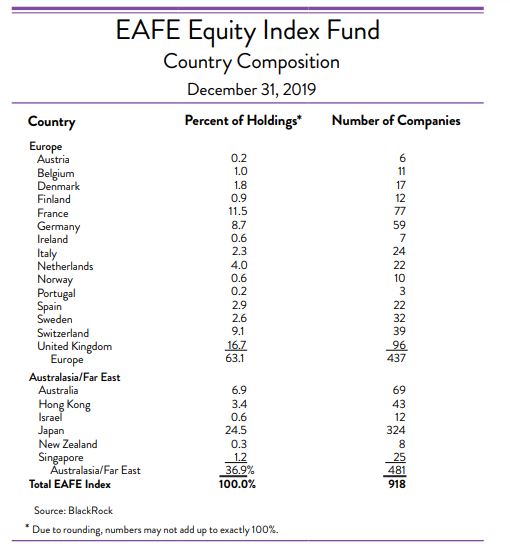
TSPF is an outlier amongst most large retirement plans that it still has no EM exposure. In June 2017, external consultants, Aon Hewitt, made a recommendation to the board to switch to MSCI ex US All Country which is a much broader index followed by all large retirement plans. One characteristic of this index is that it includes many EMs (and yes China). The board studied the proposal and made the decision to switch in November 2017 with a target for that sometime in 2019*.

As the US-China trade war was going in full swing, the threats of possible ramifications on US investments in China started coming in, and the I Fund never made that switch.

How big is this potential US investment?

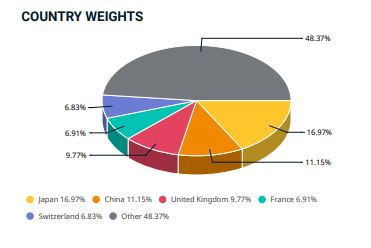
The MSCI ex US All Country is still about 75% developed markets (DM). But China is about 11% weight (second largest now), which is rather big given the recent index inclusion (the weightings have increased progressively in the last two years). That means the I Fund would have between $6Bn exposure to Chinese equities.
Adding the L Fund exposure. The L Fund will have 9% in the I Fund (from 8% currently). Therefore, given the AUMs in each above, it will have between $1-2Bn Chinese equities exposure. So, total TSPF exposure will be max $8Bn. Note, however, the L Fund’s expected exposure going forward: projections are for a substantial reduction in the G Fund weights at the expense of all others. So, potentially the future Chinese exposure can grow substantially as also China’s weight in the MSCI ex US All Country index also grows.

What is that in the context of the big flow picture?

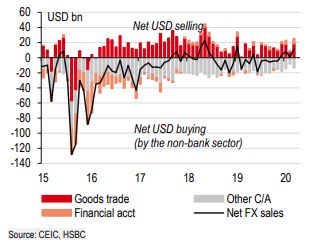
China is in the cross hairs of deglobalization which started before the Covid crisis, but now, that process is accelerating in direct proportion to the anger towards China amongst some of the major global players, especially the USA. In the USA, globalization coincided with financialization which promoted major capital inflows to offset the trade account outflows. Financialization is now on the wane in the USA (as per the regulations post 2008, and accelerated further post the Covid crisis), while on the rise in China (see flows below).

As the Chinese economy has been catching up to the US (and possibly the Covid crisis also accelerated this process as well), it is likely that we may see a reversal of some of these past flows, namely, a reduction in China’s current account surplus at the expense of net foreign inflows.

Equities

  • Last year passive index inflows in China A shares were $14Bn; total inflows were about $34Bn
  • Total foreign investment in Chinese A shares is about $284bn
  • Foreign equity inflows this year are still a positive $5Bn despite the Covid crisis: according to HSBC data, March recorded an outflow (largest ever) but all other months were inflows, with April inflow more or less cancelling the March outflow.

Fixed Income

  • Total foreign holdings are also around $283Bn, 70% of which are in GGBs.
  • Inflows into GGBs have been consistently positive since the index inclusion announcements last year and the year before.
  • According to Barclays, YTD net Inflows are at $17Bn (5x more than at same time last year) despite a net outflow in March (but that was only because of selling in NCDs).
  • Average monthly inflows in Chinese FI is about twice that in equities.

Domestic Flows

  • March registered the largest domestic outflow ($35Bn) of any month since the 2016 CNY crisis (largely due to southbound stock connect flow (mainland residents bought the largest amount of HK stocks on record).
  • According to HSBC, FX settlement data shows that, most likely, domestic corporates have actually been net sellers of foreign currency in Q1 this year. 
Economics

While Chinese exports are expected to decline going forward, in the short term, so are imports, especially after the collapse in oil prices. However, it is inevitable that if globalization does indeed start reversing, China’s current account will shrink and possibly go into a deficit. 

Conclusion

What happens to the overall flow dynamics then, really depends on whether foreigners continue to invest in Chinese assets (and expecting that domestic residents might look to diversify their portfolios abroad once the capital account is fully liberalized, if ever). A potential ban on US Federal Government investments in China might indeed be driven by short-term considerations and emotions following the Covid-19 pandemic developments, however, unless it is followed by also a ban encompassing all US private investment, it is unlikely to amount to anything positive for the US. Moreover, it could actually give the wrong signal to foreign investments in the US, that the administration is becoming not so ‘friendly’. That could spur an outflow of foreign money from US assets, something that I discussed at length here.

*See the memo from that meeting here: https://www.frtib.gov/MeetingMinutes/2017/2017Nov.pdf

Keep Calm and Stay at Home

11 Wednesday Mar 2020

Posted by beyondoverton in China

≈ Leave a comment

Tags

corona virus

China went through three main changes to stem the spread of the Coronavirus:

  • Quarantine
  • Lockdown
  • Rationing

In the ‘West’, we’ve added ‘Self-quarantine’ first, in some countries. Others are in the delusional phase of ‘Delay’, because, apparently, they are worried that ‘people will get bored and break out of self-isolation if it last too long’. In fairness, there is a logical reason to delay because as China and Italy will find out, the economic costs of going through those stages above are enormous. That reason is that scientists could be able to find vaccine in time. That is a very dangerous bet for the infections grow exponentially, and if a vaccine does not come soon enough, the health care system of the country will be overwhelmed (and no, the coming warm weather in the Northern Hemisphere is unlikely to slow down the infections, like in the normal flu, because this is not the normal flu, and infections have shown to grow also in hot weather like Singapore or Iran). Then, not only the economic costs but also the societal costs will be unspeakable.

Finally, one other country’s leader still thinks this virus could be ‘fake’…

WHO went on a fact-finding mission to China and released a report on February 28. The report is unequivocal:

“China’s bold approach to contain the rapid spread of this new respiratory pathogen has changed the course of a rapidly escalating and deadly epidemic.”

There are also stories about two different strains of the virus, apparently stemming from the desire to explain higher number of infections/deaths in some countries and lower in others. I don’t know. To me this is simply a function of testing more people and proper reporting. It also makes sense to run with that story in countries which have chosen to be in the ‘Delay’ stage. Occam’s razor: even if there were two strains, I don’t see how they can be country-specific.

“Everywhere you went, anyone you spoke to, there was a sense of responsibility and collective action, and there’s war footing to get things done”

~Bruce Aylward, the epidemiologist who led the WHO mission to China 

There is no doubt that even in the best cases in the ‘West’, the ones which added ‘Self-quarantine’, it will take longer to get through this also because of culture, different societal structure and more liberal thinking. For example, the talk in Italy is that if things don’t start improving in a couple of weeks the country might have to go to the next stage, ‘Rationing’ (only one person per household can leave the house to replenish supplies).

After decades of general peace, no major natural disasters in the ‘West’, and used to thinking only in financial terms, we cannot comprehend what is happening to us and are unable to quickly make the right decision how to proceed forward. For almost everybody, understandably, limiting our movement is at minimum uncomfortable and for a lot of people, unacceptable. To go through rationing is unimaginable (even though for some of us, who grew up behind the Iron Curtain, this was a feature of daily life). But seriously, it’s not like we have been asked to go to war, like our grandparents; we are just told to sit on the couch at home and play video games!

It can’t be that bad, can it?

Corona Virus market implications

29 Saturday Feb 2020

Posted by beyondoverton in Asset Allocation, China, EM, Equity, Monetary Policy, Politics, UBI

≈ 1 Comment

Tags

corona virus

Following up on the ‘easy’ question of what to expect the effect of the Corona Virus will be in the long term, here is trying to answer the more difficult question what will happen to the markets in the short-to-medium term.

Coming up from the fact that this was the steepest 6-day stock market decline of this magnitude ever (and notwithstanding that this was preceded by a quite unprecedented market rise), there are two options for what is likely to happen next week:

  1. During the weekend, the number of Corona Virus (CV) cases in the West shoots up (situation starts to deteriorate rapidly) which causes central banks (CB) to react (as per ECB, Fed comments on Friday) -> markets bounce.
  2. CV news over the weekend is calm, which further reinforces the narrative of ‘this too shall pass’: It took China a month or so, but now it is recovering -> markets rally. 

While it is probably obvious that one should sell into the bounce under Option 1, I would argue that one should sell also under Option 2 because the policy response, we have seen so far from authorities in the West, and especially in the US, is largely inferior to that in China in terms of testing, quarantining and treating CV patients. So, either the situation in the US will take much longer than China to improve with obviously bigger economic and, probably more importantly, political consequences, or to get out of hand with devastating consequences. 

It will take longer for investors to see how hollow the narrative under Option 2 is than how desperately inadequate the CB action under Option 1 is. Therefore, markets will stay bid for longer under Option 2.

The first caveat is that if under Option 1 CBs do nothing, markets may continue to sell off next week but I don’t think the price action will be anything that bad as this week as the narrative under Option 2 is developing independently. 

The second caveat is that I will start to believe the Option 2 narrative as well but only if the US starts testing, quarantining, treating people in earnest. However, the window of opportunity for that is narrowing rapidly.

What’s the medium-term game plan?

I am coming from the point of view that economically we are about to experience primarily a ‘permanent-ish’ supply shock, and, only secondary, a temporary demand shock. From a market point of view, I believe this is largely an equity worry first, and, perhaps, a credit worry second.

Even if we Option 2 above plays out and the whole world recovers from CV within the next month, this virus scare would only reinforce the ongoing trend of deglobalization which started probably with Brexit and then Trump. The US-China trade war already got the ball rolling on companies starting to rethink their China operations. The shifting of global supply chains now will accelerate. But that takes time, there isn’t simply an ON/OFF switch which can be simply flicked. What this means is that global supply chains will stay clogged for a lot longer while that shift is being executed. 

It’s been quite some since the global economy experienced a supply shock of such magnitude. Perhaps the 1970s oil crises, but they were temporary: the 1973 oil embargo also lasted about 6 months but the world was much less global back then. If it wasn’t for the reckless Fed response to the second oil crisis in 1979 on the back of the Iranian revolution (Volcker’s disastrous monetary experiment), there would have been perhaps less damage to economic growth.  Indeed, while CBs can claim to know how to unclog monetary transmission lines, they do not have the tools to deal with supply shocks: all the Fed did in the early 1980s, when it allowed rates to rise to almost 20%, was kill demand.

CBs have learnt those lessons and are unlikely to repeat them. In fact, as discussed above, their reaction function is now the polar opposite. This is good news as it assures that demand does not crater, however, it sadly does not mean that it allows it to grow. That is why I think we could get the temporary demand pullback. But that holds mostly for the US, and perhaps UK, where more orthodox economic thinking and rigid political structures still prevail. 

In Asia, and to a certain extent in Europe, I suspect the CV crisis to finally usher in some unorthodox fiscal policy in supporting directly households’ purchasing power in the form of government monetary handouts. We have already seen that in Hong Kong and Singapore. Though temporary at the moment, not really qualifying as helicopter money, I would not be surprised if they become more permanent if the situation requires (and to eventually morph into UBI). I fully expect China to follow that same path.

In Europe, such direct fiscal policy action is less likely but I would not be surprised if the ECB comes up with an equivalent plan under its own monetary policy rules using tiered negative rates and the banking system as the transmission mechanism – a kind of stealth fiscal transfer to EU households similar in spirit to Target2 which is the equivalent for EU governments (Eric Lonergan has done some excellent work on this idea).

That is where my belief that, at worst, we experience only a temporary demand drop globally, comes from, although a much more ‘permanent’ in US than anywhere else. If that indeed plays out like that, one is supposed to stay underweight US equities against RoW equities – but especially against China – basically a reversal of the decades long trend we have had until now.  Also, a general equity underweight vs commodities. Within the commodities sector, I would focus on longs in WTI (shale and Middle East disruptions) and softs (food essentials, looming crop failures across Central Asia, Middle East and Africa on the back of the looming locust invasion). 

Finally, on the FX side, stay underweight the USD against the EUR on narrowing rate differentials and against commodity currencies as per above.

The more medium outlook really has to do with whether the specialness of US equities will persist and whether the passive investing trend will continue. Despite, in fact, perhaps because of the selloff last week, market commentators have continued to reinforce the idea of the futility of trying to time market gyrations and the superiority of staying always invested (there are too many examples, but see here, here, and here). This all makes sense and we have the data historically, on a long enough time frame, to prove it. However, this holds mostly for US stocks which have outperformed all other major stocks markets around the world. And that is despite lower (and negative) rates in Europe and Japan where, in addition, CBs have also been buying corporate assets direct (bonds by ECB, bonds and equities by BOJ).

Which begs the question what makes US stocks so special? Is it the preeminent position the US holds in the world as a whole? The largest economy in the world? The most innovative companies? The shareholders’ primacy doctrine and the share buybacks which it enshrines? One of the lowest corporate tax rates for the largest market cap companies, net of tax havens?… 

I don’t know what is the exact reason for this occurrence but in the spirit of ‘past performance is not guarantee for future success’s it is prudent when we invest to keep in mind that there are a lot of shifting sands at the moment which may invalidate any of the reasons cited above: from China’s advance in both economic size, geopolitical (and military) importance, and technological prowess (5G, digitalization) to potential regulatory changes (started with banking – Basel, possibly moving to technology – monopoly, data ownership, privacy, market access – share buybacks, and taxation – larger US government budgets bring corporate tax havens into the focus).

The same holds true for the passive investing trend. History (again, in the US mostly) is on its side in terms of superiority of returns. Low volatility and low rates, have been an essential part of reinforcing this trend. Will the CV and US probably inadequate response to it change that? For the moment, the market still believes in V-shaped recoveries because even the dotcom bust and the 2008 financial crisis, to a certain extent, have been such. But markets don’t always go up. In the past it had taken decades for even the US stock market to better its previous peaks. In other countries, like Japan, for example, the stock market is still below its previous set in 1990.

While the Fed has indeed said it stands ready to lower rates if the situation with the CV deteriorates, it is not certain how central bankers will respond if an unexpected burst of inflation comes about on the back of the supply shock (and if the 1980s is any sign, not too well indeed). Even without a spike in US interest rates, a 20-30 VIX investing environment, instead of the prevailing 10-20 for most of the post 2009 period, brought about by pulling some of the foundational reasons for the specialness of US equities out, may cause a rethink of the passive trend.  

Subscribe

  • Entries (RSS)
  • Comments (RSS)

Archives

  • January 2023
  • December 2022
  • November 2022
  • August 2022
  • February 2022
  • April 2021
  • November 2020
  • October 2020
  • September 2020
  • August 2020
  • July 2020
  • June 2020
  • May 2020
  • April 2020
  • March 2020
  • February 2020
  • January 2020
  • December 2019
  • November 2019
  • October 2019
  • May 2019
  • March 2019
  • February 2019
  • January 2019
  • December 2018
  • November 2018
  • October 2018
  • September 2018
  • August 2018
  • June 2018
  • May 2018
  • March 2018
  • February 2018
  • January 2018
  • November 2017
  • October 2017
  • September 2017
  • August 2017
  • July 2017
  • June 2017

Categories

  • AI
  • Asset Allocation
  • blockchain
  • China
  • De-urbanization
  • Debt
  • Decentralization
  • EM
  • Energy
  • Equity
  • FX
  • g88kboy
  • Monetary Policy
  • Politics
  • Questions
  • Quotes
  • The last man standing will laugh
  • Travel
  • UBI
  • Uncategorized
  • VR

Meta

  • Create account
  • Log in

Blog at WordPress.com.

  • Subscribe Subscribed
    • BeyondOverton
    • Join 74 other subscribers
    • Already have a WordPress.com account? Log in now.
    • BeyondOverton
    • Subscribe Subscribed
    • Sign up
    • Log in
    • Report this content
    • View site in Reader
    • Manage subscriptions
    • Collapse this bar
 

Loading Comments...